|
Except
"The RealSky" which consists on databases on CD-ROM's linked
to various Planetarium software, all these programs are able to display
objects of your choice down to inaccessible magnitudes to amateur scopes (21), except after long expoures.
Like Nova for Windows
to name one famous application, all these software also display
trajectories of artificial satellites, comets,
asteroids and Kuiper objects, in fact they are only limited by your
computer memory and the update or not of your data files.
Your
suspicious object can also be something unusual but already referenced
here and there for some days. Asteroids in particular are probably the
first objects that you can confuse with stars. Fixed in front of the
starry field for dozen of minutes you need an accurate and a high
resolution sky chart to identify them.
Then
make the preliminary astrometric measurement to confirm the position of
the object. Two programs can be used :
-
Astrometrica developped by
Herbert Raab
-
CCD Astrometry by
John Rogers (seems no more available)
Both
require reference data from the Hubble Guide
Star Catalog. In addition, these programs automatically format data for
an electronic submission to the Minor Planet Center.
At
last, since 2005 there is also the MPO
Canopus software (see below) that many advanced amateurs use. When you pull up
a plate-solved image of a star field, it is able to identify all of the catalogued
asteroids, and show their path over a 1-hour period. In addition, it can
also be connected to a telescope, and perform photometry.
If
you think have located an asteroid, check first the coordinates of the suspect object on the
Minor
Planet Checker or Minor
Planet & Comet Ephemeris Service website at Harvard CfA.
Before
going further, check also the recent news on the major associations
websites devoted to these activities. Asteroids, comets and some other moving bodies are
reported to the International Astronomical Union,
IAU; novae and supernovae also or to the American
Association of Variable Stars Observers, AAVSO, its foreign representatives and on
the website of the International
Supernovae Network, ISN.
At
last you will never discover a new nebula or a remote galaxy because all
them are probably catalogued until some far distance - a few nebulae are hidden or are so hard to
find in stars clusters or dusts clouds that only the more powerful
telescopes have a chance to drive them out. For galaxies the question is
even no more in the hands of amateurs or even of grounds observatories but rather
an affair reserved to large space telescopes.
Now, with all
these data in hands you can know with certainty the origin of your suspect object.
2°. Get
confirmation of your observation
Once your
observation is confirmed "on paper", i.e. the object you have
found is NOWHERE plotted, take some time to get confirmation in situ. If you are
member of an astronomy amateur association contact a well equipped and
experienced friend to help you validating your observation.
Sometimes this
process cannot be completed has it depends on the weather factor. So do
not hesitate to contact the responsible of a well-known foreign
association that could confirm your observation under better sky
conditions. Today Internet through its email and webcam services is the
fastest way to contact someone at antipodes at a near light speed. Facebook
and Skype are very fast mean to
contact your friends.
If you
want to be the discover of something new you must be the first to confirm the
novelty. Using Internet in less than 6 hours you can get your answer. Use
the slow Earth rotation to foresee the best places in which other amateurs
could confirm your observation. Look first behind you where it is still
night.
To
download : PIXY System 2
Freeware
to help you identifying any suspect object
To
read : Hunting
Asteroids From Your Backyard,
Dennis Di Cicco
 |
 |
|
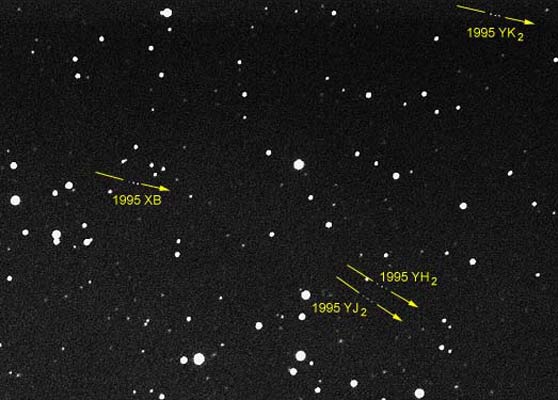
At
left, recording of 4 new asteroids discovered in a 25' field in Taurus on 24 December
1995 by Dennis
Di Cicco. He used a Meade LX200 of 400 mm f/10 equipped with a
CCD camera SBIG ST-7 and an Optec MAXfield focal reducer
yielding the relative aperture to f/3.3. It is a stacking of
three-minute exposures. At right, the astrometry and photometry MPO
Canopus software (50$) able to identify any asteroïd
on a digital picture, and so by extension, all moving
"dot" not cataloged yet. |
|
Imagine
that you have observed a suspect object last night in Europe (23h GMT). In place of
sleeping you do a first check and you send your confirmation request to a
US friend in the morning at 4 AM (TZ GMT-5 on US East coast or TZ GMT-8
on the Pacific coast, this is still the night on all USA, except Hawaii). Do not call
your Japanese or Australian friend because he could not confirm your
observation before ten hours, when it will be locally night (Japan is
in TZ GMT +9. On the other side, a Japanese can ask you to confirm his observation).
With chance your
correspondent can look for your suspect object immediately and reply with all details
some hours later, in the first lights of the sunrise in Europe.
The
ideal is to find a correspondent who can access to a public or
professional observatory registered to IAU, like the Observatoire
du Cégep or Mégantic
in Québec, what insures it a quasi professional status and a greater
credibility.
Then
there are two possibilities. Your observation is not confirmed. In that case you
have to request new observations from your friend in the "dark
side" of the Earth, this time in Japan or Australia. Send him your
email as soon as possible and at the latest early in the afternoon. Ask
him to use the same instrumentation as you (at least the
same magnification) or that he follows the same procedure to record the image
or to process it. Send him by email print screen or any file showing the
place of your suspect object among the other stars in order he had some
points of reference. Complete your email with all necessary explanations
that you will judge useful about your object concerning its magnitude,
possible move, etc.
Some amateurs are
also in relation with professionals astronomers or subscribed to dedicated
maillists. This is a very efficient method to get an immediate confirmation of a discovery.
If this is not
the case and your object disappeared or is well plotted in some catalogs,
you lost your night but in return you gained experience. Remember that it
exists few amateurs able to find several new celestial objects each year.
To be the first is a very hard task which requests much rigor and motivation
in which professionals are also your concurrents... (professionals usually discover
new celestial bodies two months before amateurs...).
3°. Send your observation
If you have
successfully passed through all these steps, if your experienced friend calls you back
and confirms your suspicions, congratulation, you have probably discover
something new !
Without
hesitation it is time now to prepare your email and alert in the CBAT with the certitude they will not tell you to clean up your
eyepiece or worst you did a mistake...

Central
Bureau for Astronomical Telegrams
The CBAT webpage
highlighted here has information about how to properly report a possible
discovery, including an online report form and links to check services as
the ones listed above.
Then
it is the discoverer's responsibility to follow the confirmation and
reporting procedures as outlined by the CBAT. Following those procedures
does not guarantee your find will be an actual discovery. But it will
ensure that you and your report are taken seriously.
The
care in that field is preferable than too much impressments. The quickest
way to gain a reputation as a crank is to submit a half-passed report
without taking the time and making the effort to eliminate all other
possibilities than a new object. Worse, this lack of rigor should reduce
to nothing the reputation of the amateurs community, specially the
perseverance of some amateurs trying to make a rigorous work with
professionals. Take care.
Good luck !
Back
to Reports & Reviews
|