|
|
|
Don't be afraid of CCD
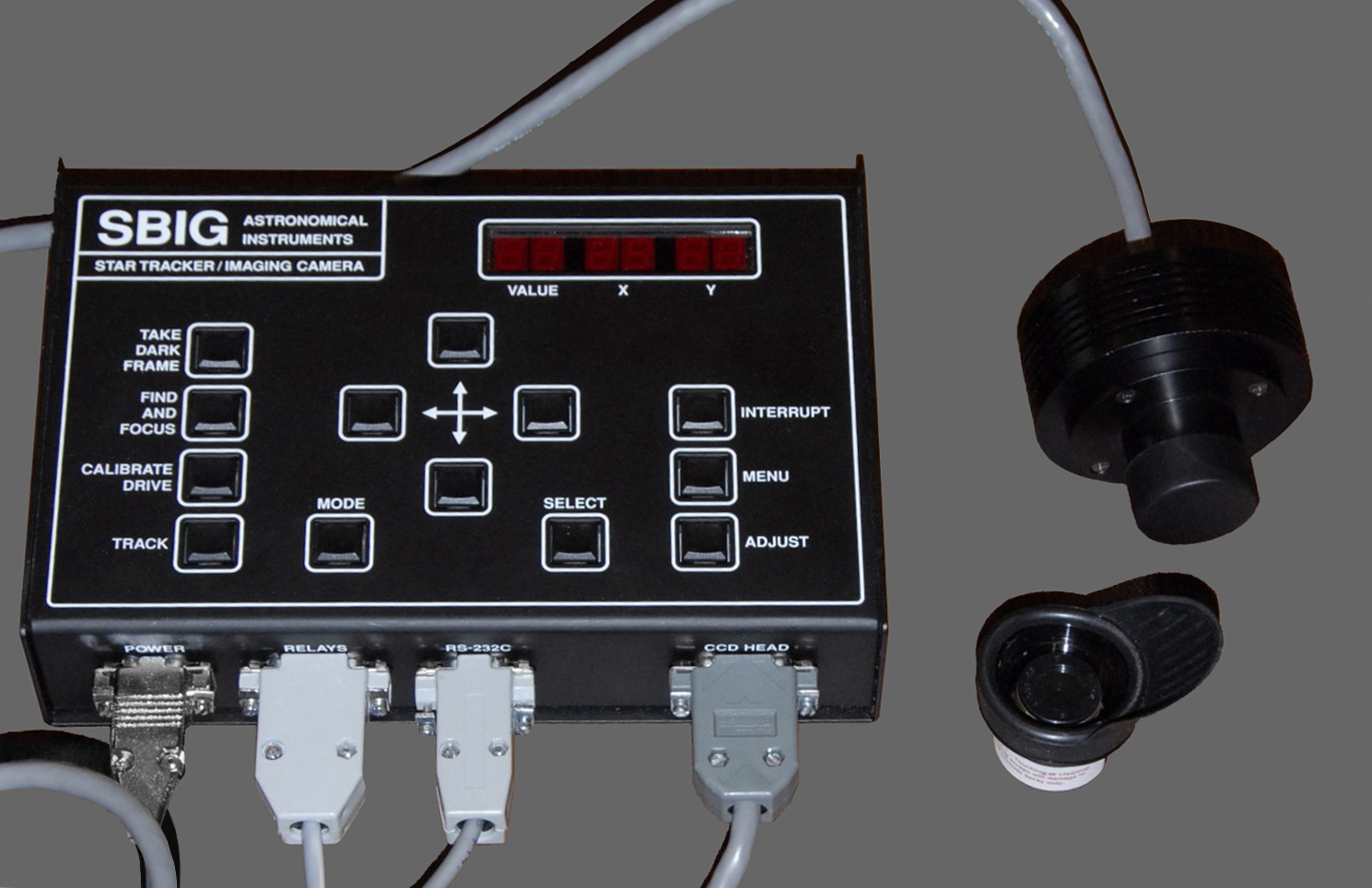
The digital revolution (I) Amateurs are sometimes reluctant of using new technologies due to a lack of information and their apparent complexity. For years however many of us are using computers and electronic devices in their hobby. Today CCDs are at an afforable price, except some high-end models, they are available in various definitions (the number of pixels in the image), in black and white or color and provided with more or less built-in functions. But prior investing in a CCD camera, we need to answer to some questions : what are performances of current models, how to work with a CCD and optionally with what image processing software ? We will answer to all these questions and some others in this article. In a constantly evolving market, we will review the next subjects : - The History of amateur CCDs, their specifications and performances (this page) - Webcams and other video cameras - Guiding systems including new CCD designs - Integration times and common problems - The calibration of image pre-processing Ce document est disponible en français History of a deserved success Invention of the CCD sensor The CCD (charge-coupled device) camera was developed in 1969 at Bell Labs Electronics Technology in Murray Hill, New Jersey (USA). On October 17 of that year, Willard Boyle and George Smith succeeded in designing a solid state analog to magnetic bubble memory using semiconductor technology. During a meeting, the two engineers explained to Jack Morton, vice president of the enterprise, the basic structure of the CCD, the operating principles and some preliminary ideas concerning the applications, in particular in imaging. Shortly after, in April 1972, they published an article on the possible applications of their invention in the "Bell System Technical Journal". For this invention, they received the Nobel Prize in Physics in 2009. Then Michael F. Tompsett and his team, including Ed Zimany and Carlo Sequin of Bell Labs developed this system specifically for imaging applications. In 1972, Tompsett proposed a modification of the original design so that the CCD could read off an image and store it on another part of the device, while the next image was recorded on the silicon surface. This intuitive leap allowed him and his team to produce the first CCD imagers and the first all-solid-state color camera (cf. the paper "All-Solid-State Color TV Camera, the First, Is Built Experimentally "published in the "Electronic Design" journal, Vol. 20 in 1972. The first amateur CCD When was marketed the first CCD camera dedicated to amateur astrophotographers ? Excluding digital cameras also equipped with a CCD or CMOS sensor, it is in 1988 that SBIG, bought by Diffraction Limited in 2014, released the first compact CCD camera ST-1 "Star Tracker", a guide camera that was replaced in 1989 by the famous ST-4 equipped with a Texas Instruments TC-211 sensor. This camera used a 8-bit A/D converter allowing to obtain 256 levels of gray and was dedicated to autoguiding. Its weight was 200 g, and it was delivered with a controller of 900 g measuring 15x23x5 cm, an IFocus parfocal eyepiece, a focal reducer, adapters, and connection cables to the computer and the computer to the scope mount. It was offered at 995$ or 1555$ at constant value in 2016. ST-4 was sensitive enough to follow a star of 8th magnitude on a scope of 60 mm in diameter or a 12th magnitude on a scope of 200 mm in diameter. The advantages of ST-4 were already numerous. It was cooled to about 30° below ambient temperature, included an anti-blooming function, it was sensitive from 400 to 900 nm, and above all it could transfer the image via a serial link to the screen of a computer to control the framing, focus and the resulting image in 8-bit format. A software for PC or McIntosh also ensured the basic image processing functions. SBIG stopped producing the ST-4 in 2001 in favor of new, more efficient models.
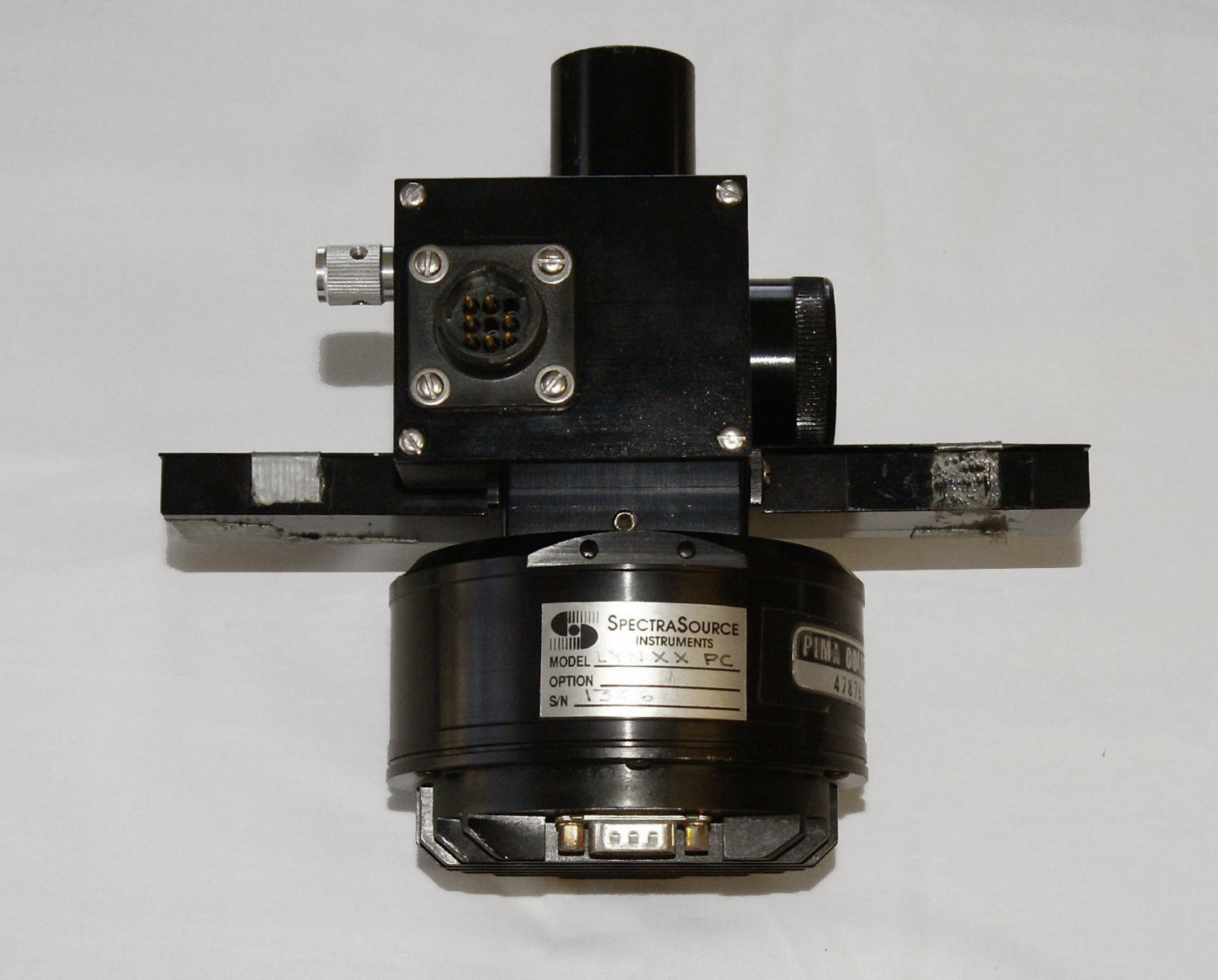
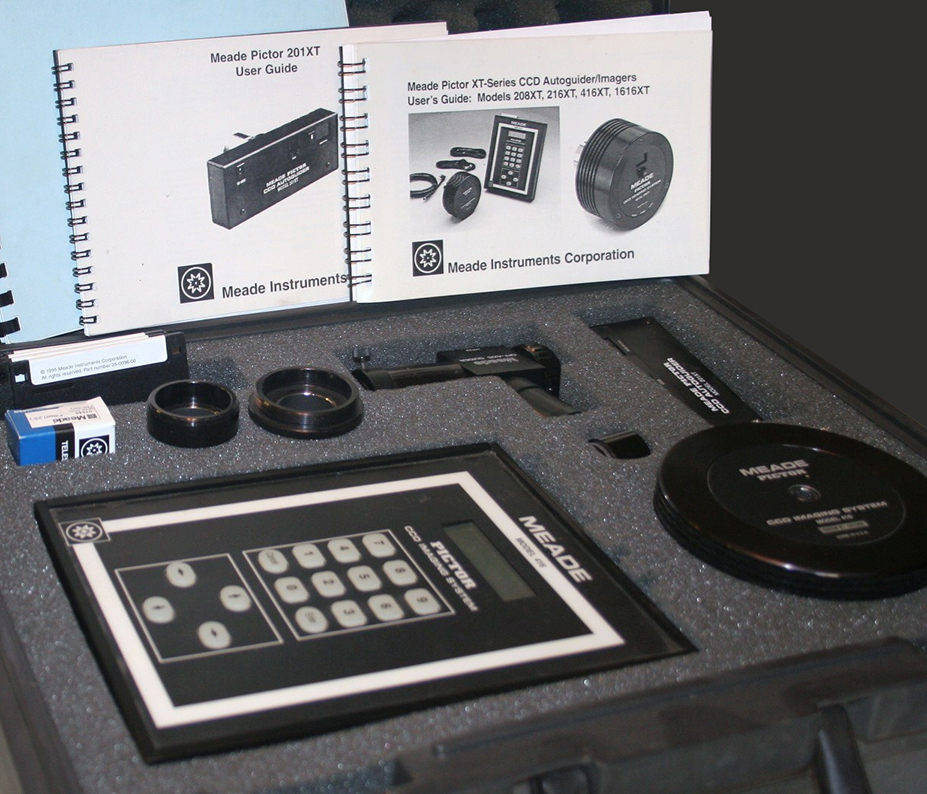
Then, in 1991 Spectra Source Instruments released the Lynxx PC Plus CCD that was cooled to -30°C but not regulated, the dark current varying depending on the ambient temperature. It offered an A/D conversion on 12-bit or 496 levels of gray and was equipped with an electro-mechanical shutter. An adapter 31.75/50.8 mm was provided as well as cables for computer, and an image processing and photometric analysis software (accuracy up to 0.036 magnitude). Lynxx PC Plus was proposed at 1500$. The company was out of business in 2005. Then it will take until 1994 for Meade sells the Pictor 201 CCD guide camera quickly upgraded into 201XT (Extended Performance) but offering no mean to view the image. It was completed with the Pictor 416 CCD guide and imager also quickly upgraded in the 416XT model, a 16-bit guide and imager equipped with the new Kodak KAF-0400 sensor providing additional functions. This camera was cooled to 40° below ambient temperature. Supplied with an image processing software, an eyepiece, a focal reducer and an adapter, it could directly create RGB images from individual monochrome frames recorded with a filter wheel. Pictor 416XT was proposed at 1695$. Today the Pictor series are no more in production and have been replaced by more efficient models, and only the PictorView software is still available. Thanks to this great invention, amateur astrophotographers have been used to work with CCD's to record the faint light falling down the sky. CCD characteristics One of the numerous reasons of the success of CCD cameras is the reduction of the electronic components size. The second one is the increasing of CCD definition that doubles each 2 years following Moore's Law. Then because in the century of the Information Technology, a digital device can be computer controlled. CCD cameras are light sensitive devices with this plus to be designed to be driven by an instrument thanks to a built-in microcontroller. Their images can also be downloaded in a computer to be processed (autoguiding or to record pictures).
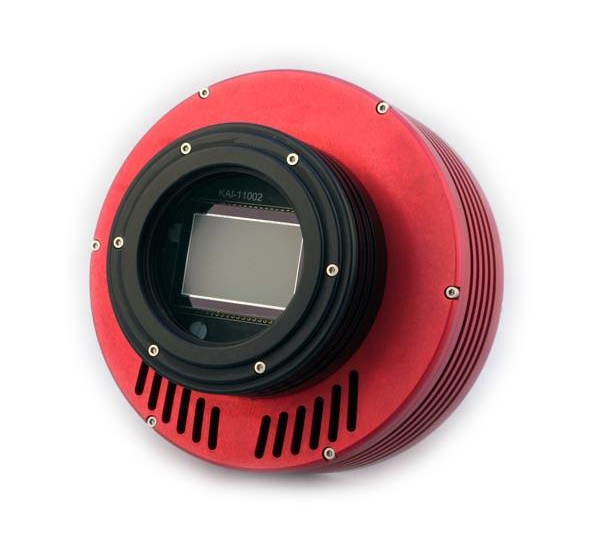
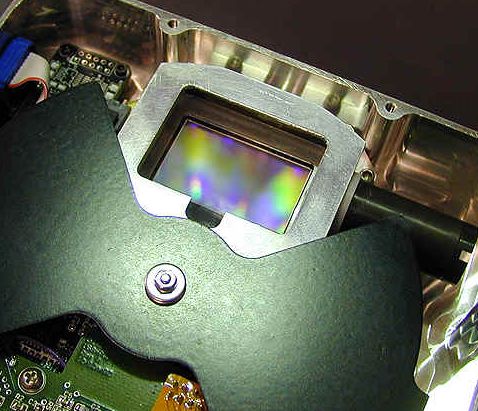
A CCD detector looks like a small solar cell which photosensitive array covers often less than 1 cm2 encapsuled in a electronic circuit. The detector is fixed in a frame that looks like to a chip and placed in a house with various input-outputs for the cooling system, the eyepiece holder, the filters wheel, the connexion to the computer and the power line. The chip of a CCD camera (as well as the one of a webcam or a digital camcorder) is constituted of rows and columns made of photosensitive cells called pixels (picture elements), although this term is faulty as technically speaking pixels are the components of the resulting image. We will however continue to use this term as it is entered in the every days language. As all high-tech electronic accessories, CCD chips used to work with the physics vocabulary. Therefore we will not be amazed if even a newby in this field borrows the vocabulary to quantum physics and electronic to explain his work. Like in radioastronomy "integration time" means "exposure", "dark current" means "noise" or "parasitic signal", "blooming" means "overexposition", "binning" means "larger pixel", etc. But don't worry, after one hour of reading you will be ready to enter this exciting field. Note that in view of their size and weight, CCD cameras support with difficulties the lightest installations at a few hundreds euros which weight does not exceed 1 kg; the camera and its accessories (Barlow, adapters and possible filter wheel) are heavier than the whole installation ! We can conversely mount them without problem on small scopes from 70 to 127 mm of aperture at the condition that they be supported by a sturdy mount and equipped with the appropriated photo adapter. CCD performances CCDs have a high quantum efficiency; up to 82 % of the photons striking the chip are recorded (e.g. KAF-3200ME). They have an excellent linearity (the output signal is nearly proportional to the number of incident photons), without reciprocity failure in long exposures as we know using argentic emulsions when trying to catch faint DSOs. Even the famous hypersensitized Kodak TP2415 cannot compete against the extreme high response time and resolution of a CCD chip. Indeed, with a CCD camera you can get in 2 minutes of exposure what you tediously got in around half an hour using an argentic emulsion. With such performances, we quickly realize what benefit offers a digital camera. The CCD technology is a true revolution that has found many applications. In astrophotography, this remarkable technology allows to reach magnitude 15 in one second of exposure and magnitude 19 in only one minute at the prime focus of a 200 mm f/10 telescope ! These CCD cameras have a sensitivity equivalent between 20,000 to 100,000 ISO, without the grainy (or almost) ! For short, a CCD sensor is ~20000 times more sensitive than a film !
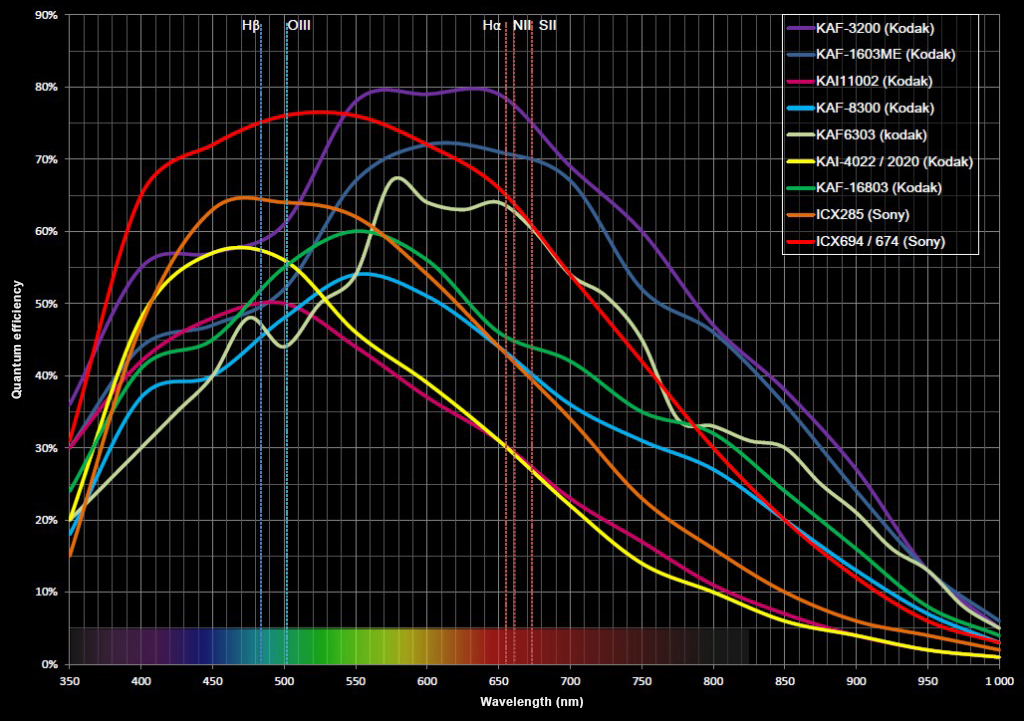
CCD cameras performances differ from each other in several significant aspects. The first is the number of pixels contained in the chip, the product of the number of rows and the number of columns; in astronomy one speaks of devices gathering from 1 million to ~10 million pixels on the most advanced amateur sensors to more than 100 million pixels on professional CCD sensors. This parameter defines the definition of the sensor. The second aspect is the physical size of each pixel (usually between 9 and 24 microns) and whether it is square or rectangular. The third aspect is called the pixel depth; it determines how many bits (usually from 10 to 16 bits) can be stored to code the brightness or color level of the pixel. Then, there is the wavelength sensitivity of the chip, i.e. the curve of its spectral sensitivity as we see below left. At last, some CCD also include additional features and functions : a shutter, a regulated cooling system, a filter wheel, an anti-fog, an anti-blooming (pixels saturation), a system for auto-guiding combined to the imager, a system for long integration times, the automatic recording of dark and flat-field frames, and more. All these very useful options increase the price of the CCD camera. Let's take for example the Apogee AP-9 CCD camera, one of the most performing on the place at its time. It uses a KAF-1600 chip containing 3072 columns and 2048 rows, offering a definition of 6.3 million pixels. Each pixel measures 9 microns (0.009 mm) on a side, so the entire chip is only 27.6x18.4 mm, not larger than a piece of sugar. 16 bits are used to digitize the brightness of each pixel, resulting in 216 or 65536 gray levels. As it takes 2 bytes to code 16 bits, each image takes about 12 MB on disk ! Unfortunately, up to now CCD cameras have no built-in memory except their buffer (RAM) able to store an entire high-definition image. That means that e.g. on a SBIG STL-11000M it takes about 30 seconds to transfer a binned 1x1 image to the computer via an USB 1.1 port, and you cannot start taking a new image until the first image is downloaded. Advantage, this camera includes a built-in chip for autoguiding without requiring an addition guide scope or off-axis guider (see next page). As most CCD detectors, their spectral response is quite high in the red and infrared part of the spectrum up to about 1100 nm but drops to very low values to the shorter wavelengths in the near ultraviolet, lower than 350 nm, in the same way as the response curve of photoamplifiers. To read : High Performance Cooled CCD Camera Systems (PDF), Apogee, 2011
Note that trying to record a galaxy of 21st magnitude per square arc-second with a chip having 1 arc-second pixel is like trying to record a 21st magnitude star ! One understands why we have to find the optimal correlation between the scope focal ratio and the pixel size to get the best sensitivity. A good compromise will give an image presenting a high signal-to-noise ratio and a smooth appearance without reducing too much the resolution. One trick : for stars the CCDs optimum detectability is reached when the star's image is about twice the pixel size (around 20-25 microns) but a too large pixel will also increase noise. On the other side, the larger pixel has a greater sensitivity to nebulosity but smaller pixels record easier faint stars... At last, for DSOs you need the largest aperture and the fastest f/ratio in order to produce well defined star images across the CCD chip. So what to choose ? Here comes your skills ! To help you, we can say that the resolution has to be pretty much fixed for your subject; in taking as a rule the Nyquist sampling theorem, it states that he pixel size (photosite) should be one-half the size of the Airy diffraction disk. Given this, it is easy to find the focal ratio needed to get this optimum resolution : f = 2 x Photosite size / λ In addition, here are two useful formulae : CCD Field of View (arc-minutes) = 3438 x CCD size (mm) / focal length (mm) CCD Resolution (arc sec/pixel) = 206 x pixel size (microns) / focal length (mm) In summary, the smallest the pixel size the largest is the chip size, the highest is the potential resolution and the sky coverage (smaller pixel coverage but larger chip coverage). Note that two additional factors influence the image size : - the scope f/ ratio that affects directly the CCD field of view - the "binning mode" that impacts directly the effective pixel size which is doubled in 2x2 binning mode. The image is thus smaller but brighter too. With a 10 microns pixel size and a sensitivity peak at λ = 0.7 micron, we get a focal ratio of about f/29 in planetary astrophotography. This corresponds to a resolution of about 0.25"/pixel (206 * Pixel size / focal length), a value rarely found in planetary imaging where the resolution is more often near 0.7"/pixel (for a 300 mm f/10 scope, 0.7"/pixel corresponds to a resolution of about 1.5 km on the Moon surface, enough to picture small features like domes or rilles in high resolution). On deep sky objects, due to the decreasing of the focal ratio by a factor 5 or higher, the resolution exceeds rarely 2"/pixel. To download : CCD Calculator v1.4 by Ron Wodaski (and v1.5) Field-of-View Simulator, Cloudmakers Field of view calculator, 12 Dimensional String
Choosing a higher resolution to record galaxies surely produces amazing pictures but it also requests local seeing conditions rarely observed, the resolution being often not better than 1.5" during long exposures. Without to forget that the field of view is often small. For information, a CCD chip like KAF-0400 used in the SBIG ST-7 camera covers around 18.5'x12.4' on a 200 mm f/6.3 SCT (6 times lower than a 35 mm format) and several other chips are even below these values. Hopefully, with time larger CCDs have been marketed up to exceeding the 35 mm format and offering a field of view exceeding 1° on a C8 f/10. The next table displays the main specifications of some CCD cameras. To read : How to choose your first camera, SBIG Choosing the right camera, Starizona
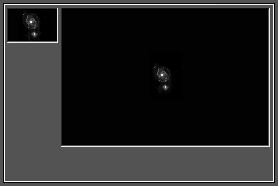
Here are some examples of simulated coverage. At left, the size of Jupiter (0.8 mm) as recorded using a 200 mm f/10 scope with a 2x Barlow compared to a 35 mm film (grayed background). The small box represents the resulting image on a KAF-0400 chip, the larger one on a KAF-6300 chip. At right, the size of M51 galaxy (5.1 mm) as recorded using a 8" f/10 scope with a 0.63x focal reducer compared to a 35 mm film. Similar comparison.
Of course each of us would like to use the largest CCD equipped with the smallest pixels. But their price remains disuasive for most casual users (e.g. 13190$ for Apogee Alta F16M showing a FOV of 1.3°x1.3° on a C8 f/10). Such a price is equivalent to the one of a 300 mm SCT or a quality apochromatic refractor with its mount, and you haven't either the accessories nor the computer yet... Next chapter Webcams and other video cameras |
||||||||||||||||||||||||||||||||||||||||||||||||||||||||||||||||||||||||||||||||||||||||||||||||||||||||||||||||||||||||||||||||||||||||||||||||||||||||||||||||||||||||||||||||||