|
|
|
CQ DX for a SWL
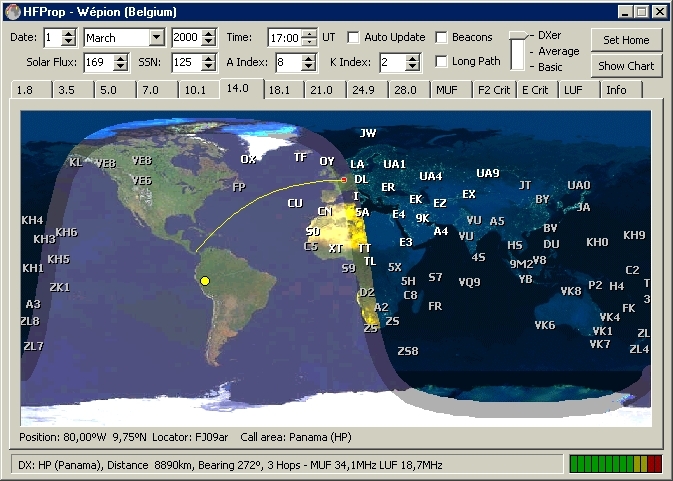
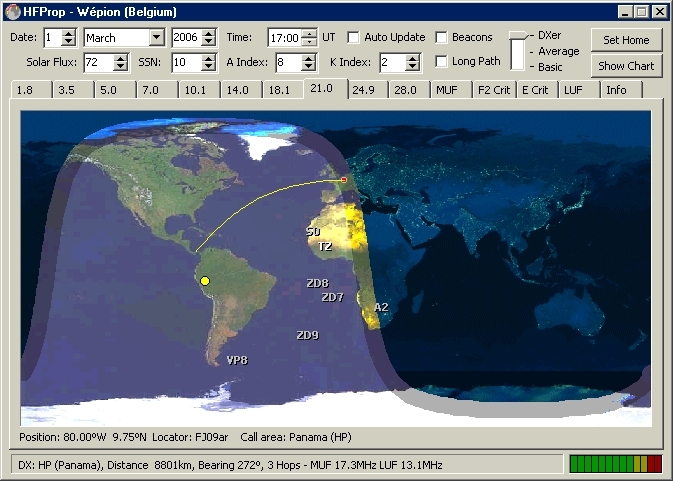
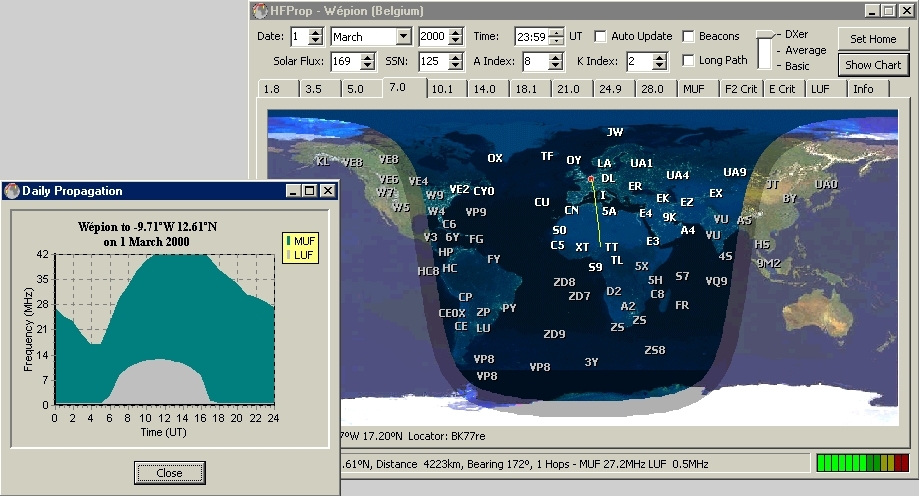
The MUF and its impact on DX transmissions (II) Having a quality radio equipment (a sensitive receiver, a quality antenna system, the best antenna tuning, etc) is not enough for listen shortwaves in good conditions because the quality of radiowaves depends on the propagation conditions. These latter are influenced by various factors including the soil conductivity, the regional weather, possible QRM and QRN, the ionospheric conditions and the sun activity. One of the most important parameter to take into account when speaking about long distance transmissions, but even for regional QSOs, is the Maximum Usable Frequency, aka MUF, the critical frequency that is reflected from the F2-layer at a distance of 3000 km from the transmitter by a single hop refraction. It is a median value, what means that it is generally valid (or the circuit open) 50% of the time, or 15 days per month. But 50% also means that a particular day this upper frequency can be close (0%) or wide open (100%), this is thus 50-50... one day it's good, another day it's no more, and nobody can tell you what day of this month will match to the MUF. The MUF depends first of all on the solar activity characterized through the solar flux index, SFI, which is correlated with the smoothed sunspot number, SSN. For short, to understand how this critical frequency affects your ability to hear DX stations, I suggest you to test various setup in the very simple propagation prediction program HFProp written by G4ILO. Then you will quickly understand what's the matter with the MUF according to the time of the day, the value you give to SFI (or SSN), and in a lesser extent to Ap and Kp indices that affect high latitude propagation. Of course, you can use other propagation programs, all providing a MUF forecast, the most complete and accurate showing the MUF status at earth scale in high resolution (e.g. DXAtlas or GeoAlert-Extreme Wizard 3 that deserves your attention). To use : DXMaps Display DX spots visually
On frequencies from 14 MHz and up, the solar flux must reach high values to establish very long distance communications with ease. If equatorial regions display a MUF over 30 MHz like during the period of maximum solar activity, you have chance to work or hear some scarce DX entities whatever the band. On the contrary, when the same regions display a MUF lower than 14 MHz or so like during the period of minimum of the solar activity, if you want to hear far DX stations it is better to work at night on 7 MHz and down.
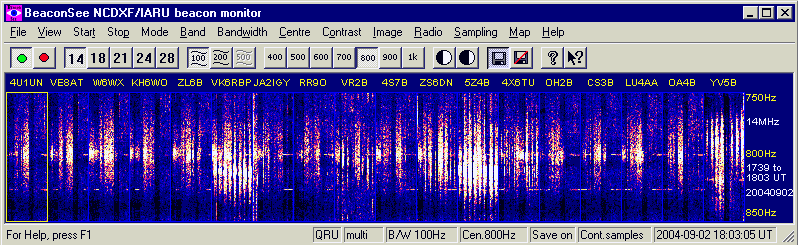
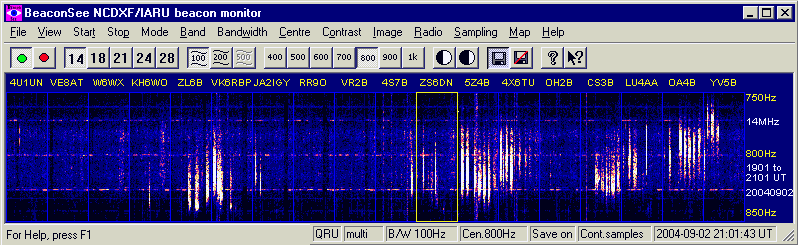
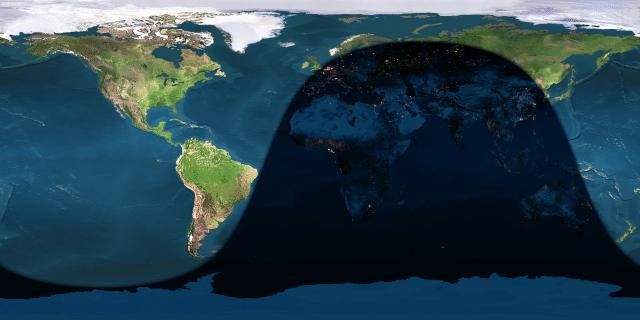
Seeing all these maps, it is clear that pick up DX stations is also a question of smart, for example taking advantage of propagation forecasts and checking band scope, and surely not a question of chance. First thing to remember, propagation turns clockwise from Japan to United States via Africa to end in the Pacific ocean in respect with the Sun position. If you take advantage of this simple rule you will understand how work 50% of the amateur traffic and how to listen such or such DX. The remaining 50% concern propagation conditions, the impact of solar and geomagnetic activities on the status of the ionosphere. Another efficient way to appreciate the propagation is to listen a few minutes to propagation beacons. The ones that interest us are stations using omnidirectional antennas. They are transmitting on 14.100, 18.110, 21.150, 24.930 and 28.200 MHz. On each of these frequencies, during three minutes and without interruption 18 stations of the NCDXF/IARU Beacon Network spread all over the world (4U, VE, W6, KH, ZL, VK, JA, RR, VR, 4S, ZS, 5Z, 4X, OH, CZ, LU, OA, and YV, cf. the link) transmit during 10 seconds their call sign in CW at 22 wpm at four power level decreasing gradually from 100 watts to 10 watts, 1 watt and 0.1 watt. Their signals are synchronized with GOS time signals. Every 10 seconds, the next beacon listed starts emitting while previously transmitting beacons setup up one bands (from 20m to 17m, etc). After 50 seconds of transmitting, a beacon has cycled through all five bands, and remains silent for 130 seconds. At multiples of 3 minutes past the hour, all 18 stations have completed the 20-m transmission and 4U1UN starts another cycle. To help you in the field, some developers provide small applications checking beacons in real-time, while some manufacturers sell e.g. a portable device monitoring them like the MFJ-890 Beacon Monitor. But read well its specifications before buying. To read : Review of beacon monitoring programs
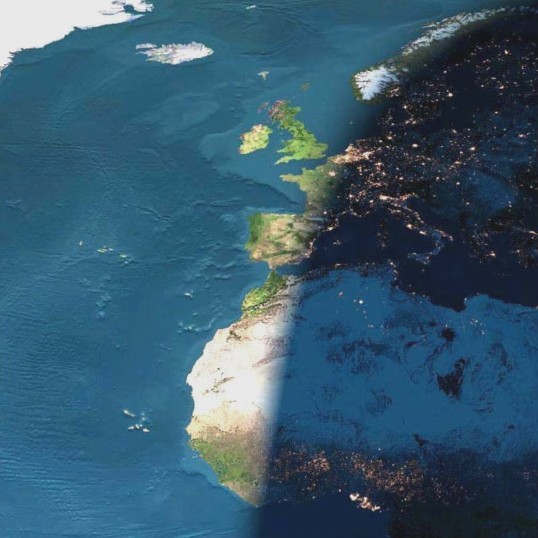
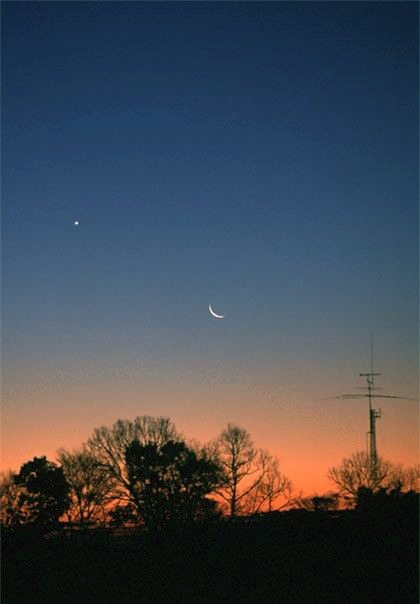
How to work with beacons ? Let's imagine that you are tuned on 14100 kHz. Nothing, but noise... Don't be surprised if you do not heard anything at all during a few tens of seconds, sometimes longer. But trust me, in 99% of cases emitters are well active ! Listen, there is one. Did-did-did-did-daad... (4S7B). In fact, if you are able to decode, or at least to hear, the first signal always transmitted at 100 W you are lucky; that means that the propagation in open from that country (e.g.from 4S), and for licenced amateurs with a little luck this is reciprocal and they might work that DX entity. But conversely, if you are not able to hear the least signal during 3 minutes or more, the propagation is really closed to most DX stations and it is better to change of band or to fill out your QSLs, Hi ! Thus these beacons offer you an excellent opportunity to appreciate the propagation "live" in listening simply bands. Parallel to beacons, you can also listen to AM broadcasters. For long distance propagation they all use the F2-layer. In using a database of AM emitters (e.g. the Klingenfuss CD-ROM) and searching for the strongest of them in different DX countries you can also get a good status of propagation conditions. As we told previously, for DXing the propagation on the 20-15 m bands becomes very favorable around one hour before the sunset and until about one hour after the sunrise, where euopean stations usually hear loud and clear emissions from South America (PY, LU, CE, etc) and from Asia and Oceania (YF, JA, VK, etc). At first sight it is not specially amazing to hear them in HF bands, but after check some influencing factors appear. Amateurs can hear of work these DX stations at sunset or sunrise because they are just on the gray line of the terminator (the line separating the day from the night), known to increase propagation via the F-layer. When I was a young amateur radio I noted that improvement, and used properties of the grayline without even knowing it ! That being said, even during the years of high solar activity, most other DX stations located over 10-12000 km away remain difficult if not impossible to hear while the Sun is not set. In this context, a good propagation program is a very helpful tool.
Time zones From Europe you can occasionally hear very far DX stations located over 10000 km away from Chile, Argentina, Indonesia, Japan, Australia, New Zealand, Polynesia, etc. Their number is however reduced, but not only because they are far from your station or because they transmit from small islands on which live few amateurs. They are also more difficult to listen because they show a large time shift. A time shift from 10 to 12 hours can be big advantage because at 1800 UTC, in summer it is 8 pm local time in Europe but already 8 am in New Zealand and in a few Pacific islands (KH8, FO, FW, T2, ZK1, etc). However it is only 2 am in Thailand (H+6), 4 am in Japan (H+8) and 6 am on the eastern coast of Australia (Sidney, H+10). These countries will be hard to work if these amateurs are still in a deep sleep... You will have much more chances to listen to these stations if you wait until noon or early in the afternoon. At 11:00 UTC in Europe (1 pm in winter) it will be 7 pm in Thailand, 9 pm in Japan and 10 pm in Sidney. Both extremes of the world have chances to work together.
The same is true for european stations looking for DX stations in America. Europeans amateurs have all chances to hear or work K, VP, XE, HK or PY stations late in the evening in Europe; at 2300 UTC, midnight in Europe in winter, it is 9 pm in Sao Paulo, 8 pm in Chile, 7 pm in New York, 6 pm in Columbia and 5 pm in Mexico, but it is only 3 pm in California. Another good period is the early morning in Europe; by 0500 UTC, it is 1 am in Caribean islands and midnight in Colombia or Chile. At these occasions you have the opportunity to listen or work tens of DX stations during a short period. So, most of the time I have worked Central and South America either late in the evening or in the early morning. Of course most of these stations are in pray to pile-ups. In that matter, the western U.S. coast and Alaska (H-9) without speaking of islands like Hawaii (H-11) are always harder to work from Europe than any other K station. They are not only far in distance but the time shift does not help communications. In spite of the very conductive sea, their signal is much attenuated due to the distance and the Sun influence. Listen to a KL or a KH6 gives often rise to a pile-up. Remember also the different time zones used in the U.S.A. That could help you in filling out correctly your QSL date and time group or to convert your local time in the right UTC. First of all, note that for DT (daylight saving time) you must add 1 hr at the Standard local time, e.g. PDT = PST+1 or GMT-7. So, PST = GMT-8, MST = GMT-7, CST = GMT-6, EST = GMT-5, EDT= GMT-4. And of course, after midnight you have to change the date as well. That seems obvious but on a significant fraction of QSLs (up to 30% sometimes) the date and time group is incorrect in this regard. To check : The Time in the world Download : MetaWrap Time Converter
Documents LX4SKY. Listen to more QSO. On the other side, do no worry about the "most wanted DX", I mean all these small islands that you will maybe hear a handful times in all your amateur live like FO, FW, KH8, T2, T3, ZK1, etc. Transmitting usually during DX-peditions, these stations are QRV 24 hours a day and work easily 5000 QSOs a day, up to 6 contacts each minute ! Whatever the time of the day, the mode and the frequency used you have some chances to hear them more than once during the pile-up if your antenna is large enough (1/4l or better) and somewhat in height. Conversely, to work those far DX is another affair... But this opportunity will not be true with individuals calling CQ DX from their small island lost in the Pacific ocean. Contrarily to DX-peditions that use quite large antennas coupled to kW-amplifiers (not always but often), at local noon in your country, if these far stations work bare foot (without external amplification) and do not steer their antenna in your direction, their signal will be very weak if not impossible to hear due to the Sun presence and their low power. Worse, when it is night in your country most JAs, VKs and islander workers from Pacific are not back home yet. However we cannot generalize such observations. Because at mid-way, the opposite is also true : JT amateurs for example in Mongolia can no more use the 20-m band for DXing after 8 am local time during the summer because of the Sun, and have to QSY to the 15-m band or even QRT. In Europe it is near 1 am and the QRN is usually very low and we could hear them all night long if they could still hear their correspondents. The problem is still worse with Far East countries and Oceania where the time shift means that the Sun culminates above the horizon to the remote station creating much QRN and limiting progressively the propagation to short distances. So, in listening to ham bands, also think to the working conditions at the remote station, and try to anticipate their difficulties before to conclude that your installation is faulty or the band close if you don't succeed in listening your favorite DX entity... First of all, be patient, and if you are really interested in picking up signals from the Pacific or from stations located at antipodes, I suggest you to invest in a directional antenna (e.g. a three element beam or 2 element quad is enough) or try to exercice your skill in CW. Indeed, many of the "most wanted DX" stations work essentially in Morse code for a simple question of reliability and ease to work DX stations, that thanks to its narrower bandwidth than SSB supports much better QRM and other noise on the frequency. Last chapter
|
|||||||||||||||||||||||||||||||||||||||||||||||||||||