|
|
|
The History of Amateur Radio The 1920s : The discovery of HF and DX communications (VI) In January 1921 a group of californian amateurs published Pacific Radio News, a new magazine dealing with amateur radio activities. In 1945, it will merge with other publications to became the famous CQ magazine. We will come back on the activities of its ancestor in the '30s.
In 1921, it was asked to amateurs to organize the first wireless CW communication across the Atlantic to see how far a low power amateur signal could carry wavelenghts shorter than 200 meters (higher than 1.5 Mc). In fact the idea was not new. Remember that in 1901 Marconi did a first successful test between England and Canada using a spark gap transmitter. But this time it was a original test because amateurs used for the first time a tube transmitter. After some unsuccessful tests, on November 15, 1921 the ARRL decided to send Paul Godley, 2XE, to Ardossan, Scotland, aboard the ocean liner "Aquatania" with state-of-the-art receiving equipment to listen for amateur signals from the United States. On December 7, the equipment was set up under a tent on the coast of Scotland. With his official witness called a "checking operator" D.E. Pearson of the Marconi Marine Communications Company, Paul waited until midnight with the hope that the propagation should be open to the United States.
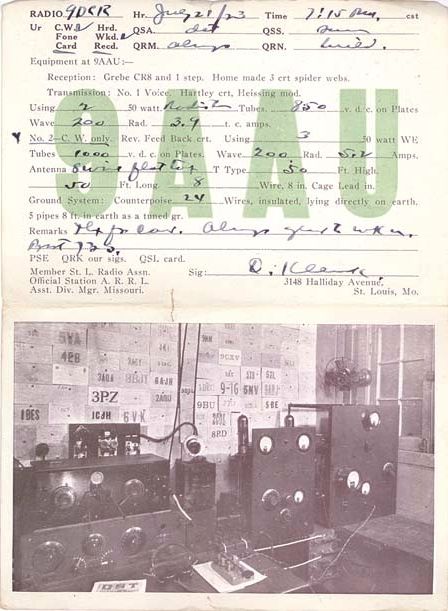
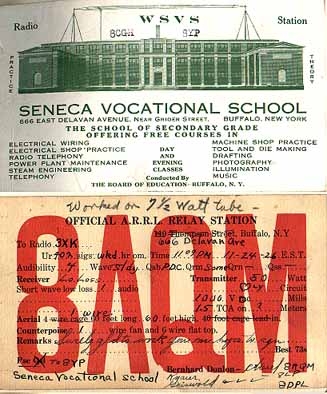
Then at 1:42 UT Paul heard the first CQ and the call sign 1AAW rising out of the static. In the next hours and days he would hear more than 30 amateurs signals from the U.S.A. The strongest signal came at 00:50 UT on December 9, 1921 from a special transmitter used by 1BCG located near Greenwich, Connecticut, on 230 meters (1.30 Mc). The station was operated by six members of the Radio Club of America. One of the operators was Edwin H. Armstrong, inventor of the regenerative detector (see 1913), the super-regeneration and the superheterodyne receiver (1918). Two days later Paul got the complete message of 1BCG that read : "No.1 de 1BCG. Words 12. New York December 11 1921. To Paul Godley Ardrossan Scotland. Hearty Congratulations. Signed Burghard Inman Grinan Armstrong Amy Cronkhite." At last the first one-way transatlantic transmission was established ! Hearing so many signals from the U.S.A., Paul regretted not having a transmitter to reply them. He wrote in his journal , "I would give a year of my life for a 1-kW tube transmitter [...] To be forced to listen to a Yankee ham and only listen is a hard blow". But Marconi could be pride, his invention exceeded all his hopes. Hams had covered a distance of about 5000 km (3100 miles), and it was only a beginning... Europeans assign their call signs Following the Convention entered into force in 1913 after the International Radiotelegraphic Conference of London, all national administrations started assigning the first call signs to the few tens of existing amateurs, call signs in which the first character was a number, as it was in the U.S.A. In 1920, the United Kingdom received the prefix number 2, then 5 and 6 the next year. About 20 amateurs were active. In 1921, a small network of French amateurs worked from Marseille. Still under the influence of the Great War, the ex-members of "8e Génie de Transmission" were used to call using the same call sign 8AAA. Pushed by the amateurs, the P&T administration assigned the number 8 to France and released on July 13, 1921 the first emitting license "8AA" to André Riss from Boulogne-sur-Mer. Other amateurs worked from Nice (Léon Deloy, 8AB and president of Radio Club de Nice), Marseille (M.Lagier, 8AC), Juvisy-sur-Orge (J.Roussel, 8AD), Versailles (Dr Corret, 8AE) and Paris (Radio Club de France, 8AF). They were a handful. In 1923, Luxembourg and Italy received the number 1. In Luxembourg, the call sign included the initials of the name(s) : Greg Gillen received the call sign 1AG, Auguste Schumacher 1AS, Math Wagener 1AW, and Jean Wolff, 1JW. Till today LX amateurs can get a call sign with custom trailing letters. In 1924, Finland received the 3, Belgium and Germany the 4, Denmark the 7, Switzerland the 9 and the Netherlands the 0. 1923 : First two-way transatlantic communications In summer 1922, Léon Deloy (8AB) from Nice heard the first British stations but had difficulties to hear US stations. After a visit to the U.S.A. and based on de Forest's inventions (vacuum tubes like tetrodes) and Armstrong's invention (superheterodyne receiver), Léon improved his equipment. Next year, on November 27, 1923, at about 21:30 UT John L. Reinartz (1XAM) and Fred Schnell (1MO), in the U.S.A. made the first two-way contact with Léon Deloy on the wavelength specially authorized for this event of 110 meters (2.72 Mc). In the following months a ten of european and american amateurs confirmed a transatlantic QSO by means of shortwaves, and exchanged their first QSLs identifying the ham station, the working conditions and the QSO information. To
watch: Grimeton
Transatlantic Radio Station, Sweden, 1924
Short waves herald a new eraAccording to Wireless Age magazine, as of June 30, 1921, there were 10,809 licensed amateurs in the U.S.A. On September 1, 1922, there were 16,467 licensed US amateurs transmitting on the 200-meter band. The ham community had increased threefold since 1916 ! This time the triumph was complete. Amateurs proofed that the "useless" short waves could carry signals across the ocean, even using amateur and low power equipment. They demonstrated also the superiority of CW over spark, all the signal energy being concentrated in a narrow spectrum, signals could be heard across much greater distances. These events marked the end of the spark era.
The good news travelled around the world at the speed of short waves. Within a year, amateurs had communicated with most continents : there was QSOs worked between North and South America, South America and New Zealand, North America and New Zealand, and between Europe and New Zealand. The quest for DX stations was born ! In a few years more than 60 countries were active on the air. Like ragchewing between hams at short distance, the DX hunting was entered in habits. In 1926, Brandon Wentworth, 6OI achieved what was considered at that time as the "ultimate DX", work all continents from his base station in California; the first WAC award was born, but not released until 1930. The next year Hiram Percy Maxim, now 1AW and the ARRL organized the first international DX-party, the precursor of international DX contests. Like in 1894 when Marconi believed that he could pass over the sea using shortwaves, and succeeded, 30 years later amateurs demonstrated that ionospheric refraction (waves enter into the ionospheric layers and are then reflected to the ground) could enable worldwide communication by shortwaves. Experimented amateurs confirmed that using high frequencies (HF) between 3-30 Mc long distance communications could be established at any time of the day or the night when propagation conditions are favorable fo DXing. In addition, in the 1920s the price of the vaccuum tube continued to drop, and amateurs can now use transmitters of low input power, giving up the huge kilowatts transmitters to AM broadcasters who worked at the lower frequencies. Now that Marconists occupied the long wave bands and radio amateurs had been relegated to the short waves, some kind of peace between the different services ended to regn on the bands. But in all cases this venture showed to the world all the utility of shortwaves.
Birth of the RSGB On November 11, 1922, the Wireless Society of London founded in 1913 was changed to the Radio Society of Great Britain (RSGB). In 1929, the british government decided that existing licenses to transmit were terminated, and that all amateurs have to use the new prefix G, as was the need to measure the sending frequency to a greater degree of accuracy. This led to the non-renewal of some of the Old-Timers' calls. It was estimated that of the previous total of 1,500 licenses, only 900 had been renewed in the U.K. 1923 : First assignation of K and W prefixes After the Great War it appeared some problems in assigning US call signs, specially to foreign stations, there was also a difference between land and sea stations, experimental and training stations requested to be identified, and there was a lack of vowels as well as other constraints. In 1922, the first 4-letters calls were distributed to US broadcasters while amateurs continue using a call constituted of a number and two or three letters.
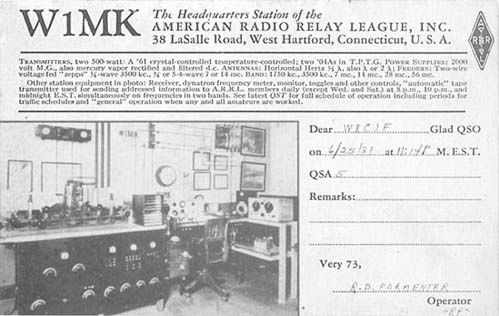
The Department of Commerce assigned K and W prefixes to all stations, dividing the country in relation to the eastern borders of New Mexico, Colorado, Wyoming, Montana. It is only in January 1923 that the border was moved to the Mississippi that cut practically the land in two equal parts from north to south : all stations west of the river were assigned the K letter, all stations at east, W. By a strange mystery ship stations in Atlantic and Gulf of Mexico were assigned a K prefix while all ship stations in the Pacific area were assigned W, a way maybe to not confuse land and sea stations. In 1927, All US amateurs added a "W" or a "K" in front on their call depending on the area in which they lived. ARRL HQ emitted first with the call 1MK then received the call W1MK until they change for W1AW when they moved to Newington, CT, a call always used nowadays for his club operations. From 1929 all countries members of ITU had to revise their call signs in adding a national prefix in respect with acts signed at the Washington Conference that sit between December 10, 1928 and January 5, 1929. United States received letters A, N, W and KDA to KZZ, Germany (Deutschland) received letters DAA to DQZ, France and colonies received the letters FAA to FZZ, all Great Britain received letters G and M. R was assigned to all Russia, LXA to LZZ to Bulgaria, ONA to OTZ to Belgium and colonies, etc. The Grand Duchy of Luxembourg that was assigned the letters EX in 1913 asked "L" as second letter. It received UL then LX after WW II. Call signs assignation What about the call signs assigned to the other services ? This is ITU that manages the prefix attribution to each country but each national administration (FCC, ART, IBPT, etc) assigns informally and without official coordination his range of call signs, including vanity and custom call signs. So in the field, until the end of World War II, all US stations were assigned W prefixes. K prefixes were used in US possessions (Puerto Rico, Guam, Alaska, Hawaii, etc.). This is only in the 1950s that FCC assigned the K prefix to US amateurs when the W calls ran out, then they eventually respected the country map edicted tirthy year earlier. The U.S.A. are one of the scarce countries to assign call signs to broadcasters. With the use of new technologies, most broadcasters kept their 4- or 5-letter call sign but are allowed to use the abbreviation of the mode in their suffix, like -FM (working on FM), -LP (low power), -TV (television), -DT (digital TV), etc.
There is however one exception. Some broadcasters use a trade name (e.g. Voice of America, etc). Dan Ferguson, from the International Broadcasting Bureau (IBB), Spectrum Management Division, remind us that in the U.S.A, the FCC oversees the operations of private sector international broadcasters, and assigns them 4 character alphabetic call signs. Operations of a station like "Voice of America" (VOA) and similar international services are the responsibility of the Spectrum Management Division of the IBB (set up in 1994) and do not fall under the regulatory authority of the FCC. In the '50s, broadcasts were transmitted from facilities in the U.S.A. owned by private entities. Those private owners were regulated by the FCC, and operated under FCC assigned call signs (e.g. Bound Brook, New Jersey, call WBOU). By 1965, all domestic facilities used for VOA broadcasts were government owned. This explain why they no longer operated with call signs - all programs were identified with a Voice of America announcement. At last, in the U.S.A. assignment of radio frequencies to government stations is managed by the Interdepartmental Radio Advisory Committee (IRAC). When assigning frequencies that are shared with (or primarily used by) civilians, like broadcasting channels, they cooperate with the FCC. Stations used for military two-way communications are assigned call signs by the military. These call signs are often assigned by officers in the field, for tactical reasons. Abroad, the assignation of calls to governmental stations is completely different. In the U.K. for example like in many other european countries, the MoD who has the general responsibilty for all military radio communications, but with the exception of certain (mostly) naval units, there are no permanent military radio call signs, and operational call signs are issued on an 'ad-hoc' basis.
Birth of three majors : IARU, FCC and CCIR Three other events must also be highlighted. Between April 14-19, 1925 about 200 delegates from 23 countries met in Paris, France, and founded the International Amateur Radio Union (IARU) to be the "watchdog" as they still write, and the spokesman for the world amateur radio community. IARU was organized for better mutual use of the radio spectrum among radio amateurs throughout the world, to develop amateur radio worldwide, and to successfully interact with the agencies responsible for regulating and allocating radio frequencies. Since that time, at each World Radio Conference (WARC then WRC) IARU negociates hardly with all users of the spectrum to preserve our privilege of using two-way amateur radio communication. Their fight is never won in advance. Even between members of the IARU there are conflicts... Take for example the very short 30m band which is subject to many conflicts from some national administrations that do not seem to understand that IARU was established to protect their interests and the ones of the amateur community, not to manage conflicts between administrations. I am not sure that Hiram Percy Maxim would appreciate their attitude. Refer to the next insert for more details. But the problem is not new. Yet in the 1920s, in the U.S.A. the broadcast industry suffered of a deep lack of legislative authority and was in total chaos. To solve this the Congress passed a new Radio Act in 1927 and created the Federal Radio Commission, FRC. It was renamed Federal Communications Commission (FCC) by the Communications Act of 1934 as it had to include not only radio communication but also the recent television. Today FCC is in charge with regulating interstate and international communications by radio, television, wire, satellite and cable. The FCC's jurisdiction covers the 50 states, the District of Columbia, and U.S. possessions. His foreign equivalent are OFTEL in United Kingdom, ART in France, RTP in Germany, IBPT in Belgium, AGC in Italy, or MCI in Russia. In 1927, the International Radio Consultative Committee (CCIR) was established at the Washington conference (see below). The International Telephone Consultative Committee (CCIF set up in 1924), the International Telegraph Consultative Committee (CCIT, set up in 1925), and the CCIR were made responsible for coordinating the technical studies, tests and measurements being carried out in the various fields of telecommunications, as well as for drawing up international standards. The ITC (future ITU) headed all committees. 1927 : The Washington conference The use of call signs including a prefix number last some years, but more and more amateurs claimed that during transatlantic QSOs they mixed up countries based on the leading number. So, at the first IARU conference in 1925, Member States declared that this system was not satisfactory. France suggested to use the letter F as their national prefix and Luxembourg the letter L. Other prefixes were also assigned to new Member States. The agreement was signed but didn't last. It is at the Radiotelegraph Regulations conference of Washington in 1927 that an official list of call signs was established. The Article 14 (p68) specifically states that "private experimental stations must have a call sign taken from the international series assigned to each country in the following table of distribution. In this table, the first letter or the first letters provided for the call signs show the nationality of the stations." In this new table all call signs usually begin with two (or three) letters followed with one number and two or three letters depending on the number of amateurs in each country, but there are exceptions that were neither noted in 1912 nor in 1927. After some decades and the increasing number of amateurs and entities, in combining the 26 letters of the alphabet and the 10 numbers we cannot assign a unique call sign to each amateur in each Member State. Hence the inclusion in the next ITU conferences of new combinations like "2A" for United Kindom, "3A" for Monaco, "8Z" for Saudi Arabia, etc., as listed in this table (xls). Birth of mobile, 5 meters and up
By the mid '20s a few amateurs ventured onto the new 5-meter band between 65 and 75 Mc that was just open to amateurs. In March 1925, amateurs received a small segment in the 75-cm band (400-401 Mc). Quickly QST's Technical editor's Robert S. Kruse wrote numerous articles dealing with equipment and antennas suited for UHF frequencies. This is also at that time that amateurs put their first transmitter and receiver in their car and work mobile. By March 1927, repeated QSOs occured on 5-m band between 2EB in New York City and 2NZ in New Jersey, some 24 km away (15 miles). It was not a great distance yet but QST reported this first two-way contact. In June, the barrier of 1000 miles (1609 km) what broken. On June 11-12, 1927 ARRL sponsored the first 5 meter CQ Party. By the end of the decade amateurs were permitted to work on wavelengths from 160 through 5 meter, and 75 cm. We will see that it is only after World War II that amateurs will access to the 2-m band. First taxes on radio licenses Belgium was one of the first country that, in accordance with the law of 1920, allowed to each citizen to get a license to own a receiver for a tax of 10 francs ($0.25) per station. This is only in 1926 that the belgian administration issued the first emitting licenses, of course accompanied with a tax varying according to the emitting power. The first call signs began with "EB", standing for "Europe Belgium", followed with the number 4 and two letters (e.g. EB4CQ). This prefix was used until the 1929 Washington Conference. This is at the same time that in most countries we saw the birth of first radio clubs whose members met in private or in community houses.
Birth of JARL In the country of the rising sun, like everywhere the first amateurs where unlicensed and started their experiments and research by 1925. In 1926, a group of 37 radio amateurs founded the Japan Amateur Radio League (JARL). Next year Kankichi Kusama, JXAX, received the first Governmental license. Within the year about 10 private experimental telegraphy/telephony licenses were released. From then on, the experimental radio stations were subject to strict regulation about frequencies ranges, power output, and operating procedures. In 1929, call signs J0 through J9 were allocated by district, and JARL issued his first bulletin, "JARL NEWS". This is in 1934 that IARU admitted JARL as an affiliated member. We will come back on the activities of JARL during WWII. 1928 : The ham spirit and the Art of radio The hearth of the ham spirit began to beat in 1928 when Paul M.Segal, W9EEA, suggested, to reinforce the ham community, to publish a code of ethic that the amateur radio should be pride to respect. His moral code was soon printed in the introduction page of the "ARRL Handbook for the Radio Amateur" This ham spirit as it will be named, states that an amateur radio is :
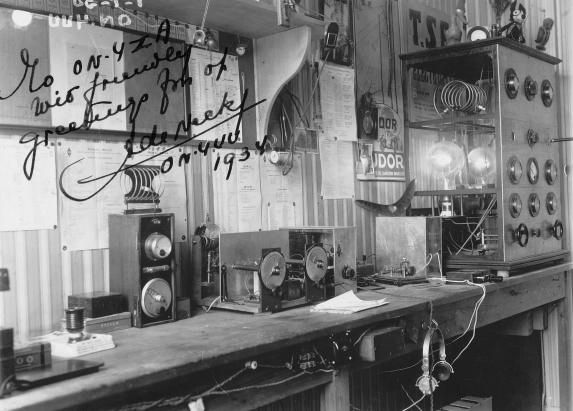
If this code of ethic is always in application, since the late of the years 1970s and the fast growing of many new technologies (repeaters, computers, space communications, packet, clusters, etc) there are too many situations where the ham spirit is debased. Many young amateur radio operators lack of consideration for the other OM, some OT refuse or almost to make QSO if you do not count among their "friends" while on weekends or during pile-ups many operators lack of patience and use coarse words on the air, here are some among many unacceptable situations that regularly occur on the air. It is high time to come back to the origins of the ham spirit if we don't want to loose all the interest of this activity ! Hopefully, some amateurs more diplomatic than others, radio clubs and ham magazines try to inculcate the principle of the ham spirit and the "Art of radio" to the newbies. The baton is in good hands. The Belgian Network and the first Belgian Radio Clubs In 1914, the famous Paul de Neck, future ON4UU, Robert Deloor, P2 then ON4SA, Joseph Mussche, ON4BJ then ON4BK, G. Pollart, D2 then ON4BY, Couppez, W2, and Haumont, B7, met in the house of the "Cercle belge d'études radioélectriques" (CBER) in Brussels to share their interest for the amateur radio. In 1922, they decided to take for name the "Réseau des Deux" (Network of 2) like there was a "Réseau des Huit" (Network of 8) in France by reference to their first call signs.
In 1932, on G.Pollart's initiative, the network was dissolved and they founded the Belgian Network, aka "Réseau Belge" (RB). The RB published its first magazine QSO in February 1926. At that time the association gathered 220 members and many of them had already made contacts with stations worldwide. The association was officially set up as a non-profit 501c organization, an "ASBL" in French, in 1932. Meanwhile, between the two wars, the first belgian radio clubs were founded in most large cities of Belgium : Brussels, Ghent, Louvain, Charleroi, Brugge, Verviers, Knokke, etc. In 1924, these different clubs founded the Union des Radio Clubs de Belgique (URCB), which secretary was located at the home address of comte de Liedekerke, ON4DL. The URCB became a non lucrative association aka an ASBL in 1932. Its President was Paul de Neck, ON4UU. At that time the mission of these clubs was to build receivers to pick up transmissions of time signals and weather bulletins as well as to perform the first radio transmissions. The first amateurs picked up emissions from Tour Eifel in Paris, the one from Scheveningen, Nordeich, etc, and later the first experimental transmissions from Haren air field, EB4BVA, and the ones from the Royal Palace of Laeken. The URCB published also a magazine called CQ. In 1932, the headquarters of the URCB and RB were located at the same place, at ON4DL's home address. Both associations merged to become the "Union Belge des Amateurs Emetteurs" (UBA), the belgian IARU society, on December 1, 1946. On June 1947 the magazines of both associations merged also to become CQ-QSO that till exists. However the UBA will receive its own transmitter and radio shack only ten years later, during the Brussels Universal Exhibition of 1958 thanks to military surplus.
The Crash of 1929 Unfortunately, in 1929 our grandparents were the witness of the world largest economic crash. The depression was so wide, so deep and so long that hundreds of US banks and mutualities closed, and tens of millions people lost their job and became homeless in the U.S.A.. Europe suffered a bit less of this situation but the time was not to the fun. This crash occured because the international economic system was, for short, rendered unstable by British inability and United States unwillingness to assume responsibility for stabilizing it due to three main factors. First, both governments refuse to maintain a relatively open market for distress goods (for financial reason they told), then they refuse to provide counter-cyclical long-term lending; and third, they refuse discounting in crisis. The world was subject to a first shock caused by the overproduction of certain primary products such as wheat, then there was a reduction of interest rates in the United States in 1927, added to the halt of lending to Germany in 1928. These shocks were handled in the stock-market break in the spring of 1920 and the 1927 recession in the United States, but this time the world economic system was too unstable unless some country stabilized it. But Britain had done in the nineteenth century and up to 1913. In 1929, the British couldn't support the charge and the United States wouldn't. When every country turned to protect its national private interest, the world public interest went down the drain, and with it the private interests of all. On October 29, 1929, it was the crash. The first financial "Big wave" stroke. The "Black Tuesday" entered in the History, setting off officially the Great Depression of the years '30s in North America. For a while the largest part of the mankind didn't believe any more in his capacity of invention and of work. But slowly, with tears, sweat and much suffering he succeeded to overcome these difficulties. Next chapter The 1930s : The Great Depression and Non-stop progress
|
||||||||||||||||||||||||||||||||||||||||||||||||||||||||||||||||