|
|
|
The History of Amateur Radio Birth of Radioastronomy (VIII) With the invention of radio, Thomas Edison was probably the first to recognize the possibility to listen signals emitted by stars. Professor A.Kennelly, one of Edison's assistant, suggested in 1890 an experiment going in that direction. In a letter addressed to a astronomer working at Lick Observatory, he suggested among others : "Simultaneously, to the electromagnetic perturbations coming from the Sun, and that we perceive, as you know, in the form of light and heat, perturbations on longer wavelengths are perfectly plausibles. If it was so, we could convert them in sound". Although his experiment was not conclusive, his project went to give birth to a amazing innovaiton, the radioastronomy.
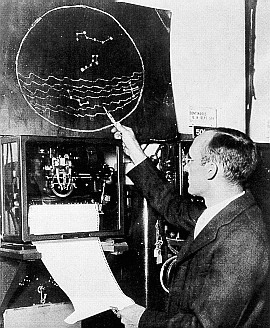
Listening to the sky, in December 1932 the american radioastronomer Karl Jansky from Bell Telephone announced in the Proceedings of the IRE the detection of radio waves emitted from the center of the Milky Way, where at first sight there was no visible source of radiation. Radioastronomy was born. Almost at the same time, an amateur name Grote Reber, W9GFZ, began to look at the sky. A passion for the radioastronomy was growing. Grote Reber and Radioastronomy
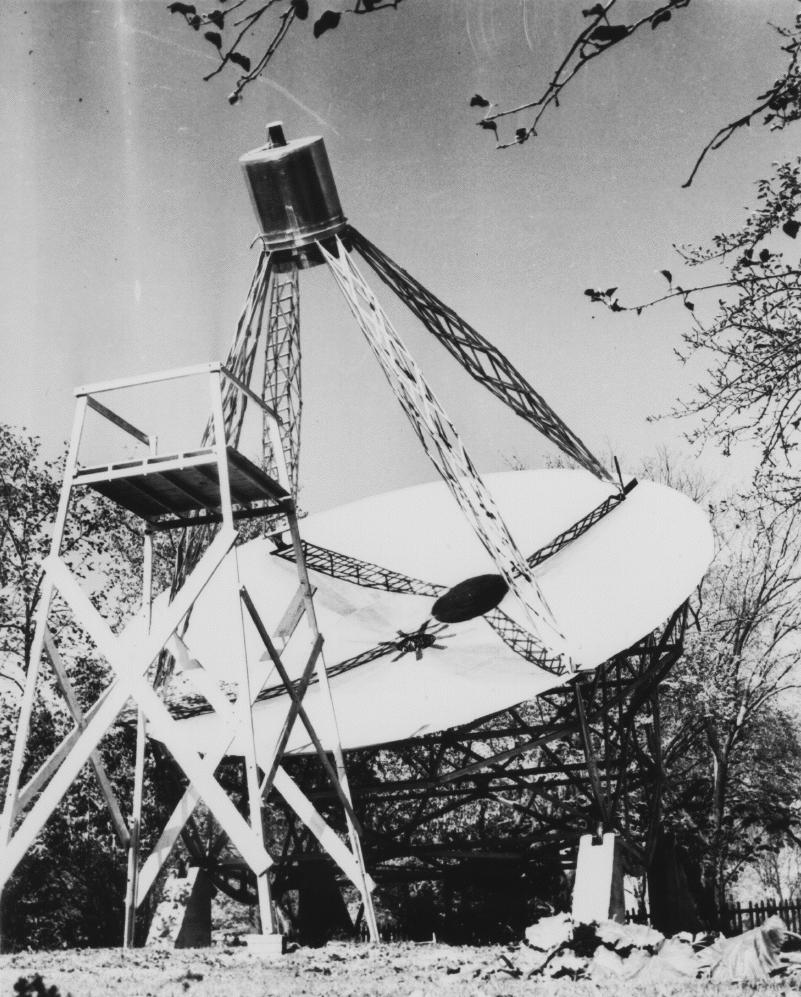
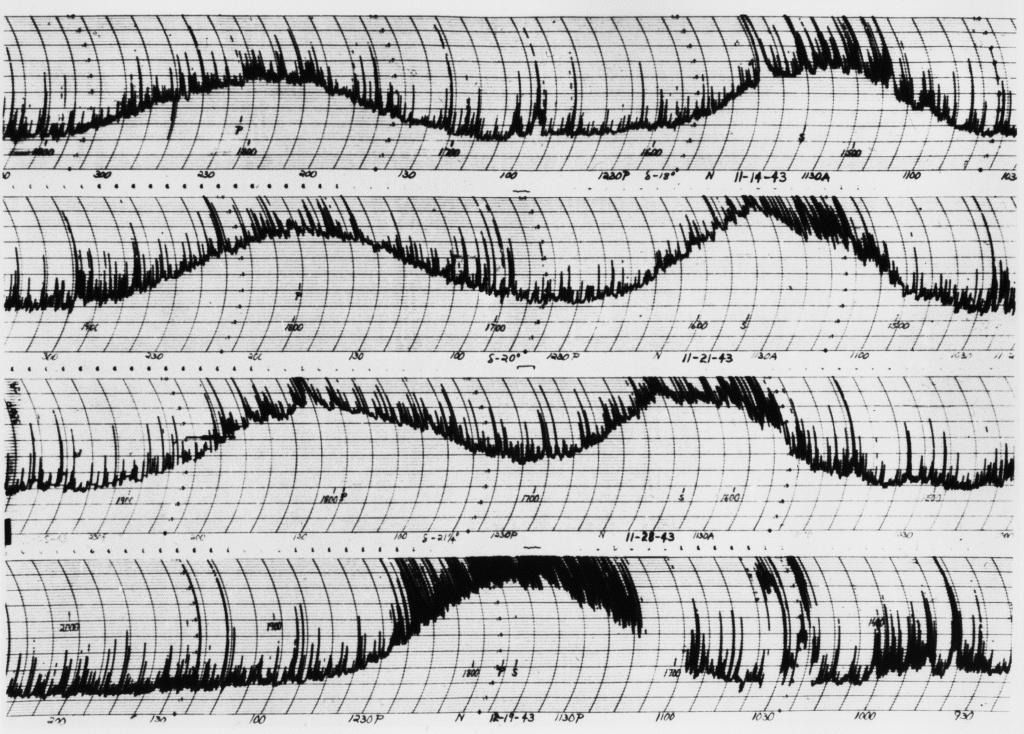
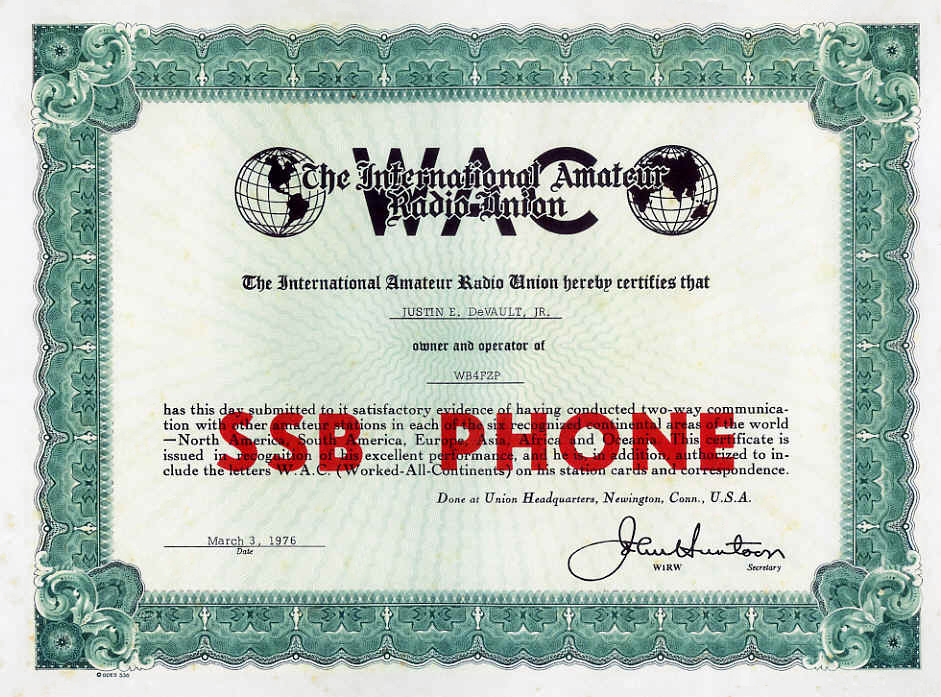
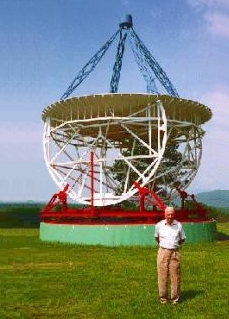
Radioastronomy is a direct descendant of amateur radio. In 1936, the famous Grote Reber, W9GFZ, contacted hams in more than 60 countries and achieved WAC award, and thought that "there did not appear to be any more worlds to conquer". After have read Karl Jansky's article in the Proceedings of the IRE, explaining how he discovered the first emission from the centre of the Galaxy, Rebert found a new DX challenge ! He spent the summer holidays of 1937 to build a 10m-diameter parabolic dish antenna made of wood and iron tuned on what he called the "ultra high" frequency of 160 Mc to listen to the celestial bodies. He made also some tests at 900 and 3300 Mc but recorded too much made-made interferences. This is at this occasion that he discovered the radio emissions the Sun, Jupiter storms, the emission of the Milky Way and several deep sky radiosources among them Cygnus-A and Cassiopeia-A. Working for his own, Reber published his first radio map of the Milky Way in 1939 in the same Proceedings as well as in Nature, confirming Karl Jansky's observations made in 1933 who worked then for Bell laboratories then for the NRAO. Quickly, Reber was integrated in the NRAO team. In the '60s he donated his antenna to the NRAO and is today set up permanently on the NRAO grounds in Green Bank, WV. Meanwhile, Reber continued to study the sky and published many scientific works until the late 1980s. He was a Silent Key in 2002. To read : Hams in the sky
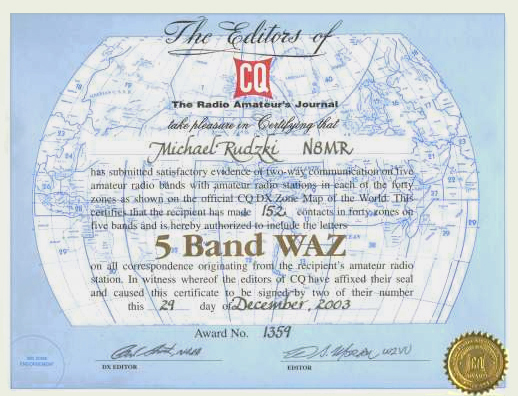
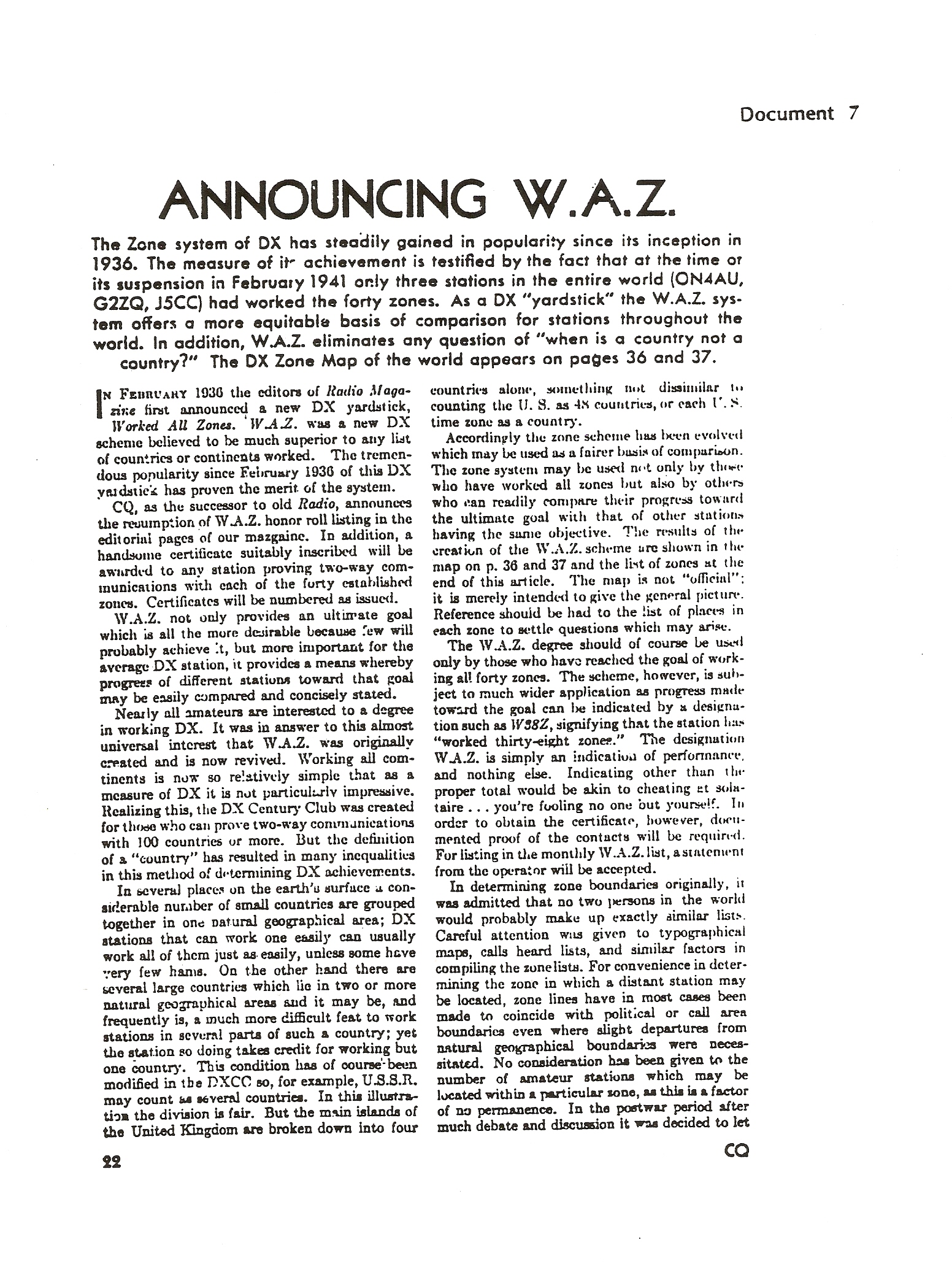
Creation of ARES The amateur radio service was codified into law by Congress in 1932. One of the purposes of this service, cited in the Communications Act, was the creation of a pool of trained operators available to assist during emergencies. Initially the objective was to draft these technically trained amateurs into military and government communications programs, but that focus shifted to emergency preparedness and the need for a backup communications system in time of disaster. Very recently (11 September 2001 attack) the world discovered that this role has become increasingly important for homeland security. Therefore the ARRL sponsored a nationwide volunteer organization dedicated to emergency communications preparedness : the Amateur Radio Emergency Service, ARES, that was created in 1932. This service is organized nationally on the basis of sections created in each state, their number depending on population. Although this idea of servicing the nation was adopted by most other countries in their regulation, it was transformed in the U.S.A. in true networks of volunteers, including the Army (MARS, Military Affiliate Radio System) in 1948. Today it is still one of the scarce country having developed such emergency networks that all work together with the local and national authorities. Every month QST remind us how active could be these amateur networks through their respective local section activities, contests and other field experience. Nowadays and since several decades, in United Kingdom, France, Germany and Belgium the emergency services (Red Cross) work in collaboration with amateurs too. These networks are not as developed as in the U.S.A. but amateurs provide the authorities with some radiolocation facilities like APRS for example to locate the teams or ambulances in the field. Of course, with the development of cell phones (GSM) and Wi-Fi technologies, these short-wave networks are less used but they are always useful for several reasons. First, their calls can simultaneously be heard by hundreds of people worldwide, then you can participate to call conferences on the air including experts or amateurs from abroad if needed, and at last a transceiver can always replace a cell phone if by misfortune its battery is discharged, cellular relays are out of reach, saturated or out of use after a disaster. First WAZ and WAS awards and DX contest It is in the November 1934 issue of R/9 magazine, formely The Oscillator, that the WAZ award was announced for the first time. It was called "R/9 DX Zones of the World". WAZ is standing for "Worked All Zones". The first WAZ map that prefigured the CQ zones was drawn along boundaries of states or territories active at that time. The WAZ award was established by the staff and DX editor of Radio News magazine (formely Pacific Radio News) in 1936 to reward amateurs having proved communications with each of the 16 DX zones defined at that time. In issuing WAZ award, Radio News had the opportunity to create the first CQ WW DX contest. It last 96 hours spread over 2 weekends between November 25 and December 2, 1939. 204 stations joined the contest, 127 CW from 19 countries and 77 phone from 15 countries. Results were published in the June 1940 issue of Radio News. In 1945, Radio News magazine Inc. founded CQ magazine to take up the needs of amateurs. They kept the WAZ award with its pre-war layout (1939). It is only in 1949 that all 40 CQ zones were activated and that general conditions of WAZ award were updated and announced in CQ. Dick Ross, K2MGA, former publisher of CQ magazine remind us that CQ zones are totally different from the 75 ITU zones that were only created when ITU moved to Geneva after WW II. Beside the 40-zone worked award on one or several bands, much later new WAZ awards were issued. First, a 40-zone worked on each of the 5 HF bands or "200" zones, named 5-Band WAZ or 5BWAZ. Then specific WAZ awards were released for the 160-meter band, 6-meter band, and Satellite. The 5BWAZ can be earned with only 150 zones, and endorsements are accepted until the operator has confirmed all 200 zones. At that time, a special gold seal is awarded to the operator so he can add it to his basic 5BWAZ certificate. Only a very few minor corrections and adjustments have been made since the first amateur won the WAZ. Although it is not as known as other awards, the 5BWAZ is one of the hardest to win. In 1996, only 1000 hams got it. In 2013, less than 1900 hams got it.
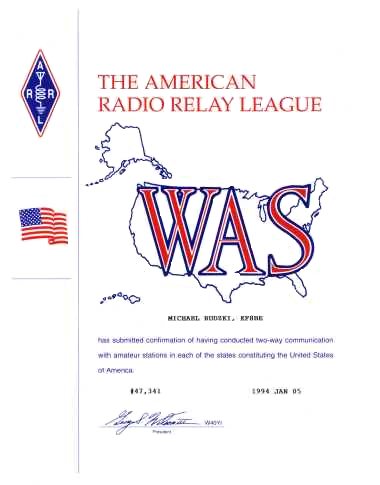
In 1936, ARRL issued the WAS award standing for "Worked All States". Along with the Basic award, ARRL also issued specific WAS certificates for a variety of bands and modes, including RTTY, SSTV, QRP and even EME. Contrarily to most other awards, like the DXCC issued later, WAC, WAZ and WAS awards are only accessible to licensed radio amateurs, not to SWLs, as they require a two-way contact; they are what we call "operating awards". Later ARRL also released a 5BWAS. Belgian hams won the first WAZ and WAS awards Although there were only 158 licensed amateur radios in Belgium in 1934, they where quickly famous for their activities on bands and their know-how in award chasing. For example, who was the first amateur to won the WAZ and WAS awards ? This is Jacques Mahieu, ON4AU (ex EB4AU), in 1930, who was the first ham in the world to win the WAZ in phone, then working in AM. Even years later, belgian amateurs have continued to surprise the ham community. The first 5-band WAZ (200 zones) was granted to John Devoldere, ON4UN, former president of the UBA, who won the first 5BWAZ award in 1979. In 2013, Gust Kegelaers, ON6KE, was the first ON ham to win Digital WAZ (and the 9th in the world). Egbert Hertsen, ON4CAS, had gathered over 1000 awards, and is today the DXCC Field Checker and official checkpoint for WAZ, WAS, UIA, DCI and WABA/WASA awards for several european countries. Silent birth of FM On November 6, 1935, one more time the genius and prolific Edwin Armstrong invented something completely new, presenting a paper entitled "A Method of Reducing Disturbances in Radio Signaling by a System of Frequency Modulation". It was the first description of the future FM radio. It preceeded the discovery made by the New York Institute of Radio Engineers, IRE, who became the IEEE in 1963.
Yagi-Uta's invention In the '30s, in Japan, Dr. Hidetsugu Yagi of Tohoku Imperial University and his assistant, Dr. Shintaro Uda developed a new design of antenna combining a simple structure with high performance. It was a directional antenna made of parallel segments supported by a boom, and placed horizontally above the ground. It was dedicated to short and ultra short waves shortwaves like HF and upper frequencies. This is only a few years later, in 1940, that Dr Yagi and Uda registered their invention at the Japan Patent Office. The Yagi as it will be called was ahead of its time and no Japanese understood its utility. In Europe and North America on the contrary this revolutionnary antenna was immediately commercialized as receiving antenna, mainly for TV receivers. It is said that Japanese realized the true value of the Yagi during World War II when it was discovered that the invention was used as a radar antenna by the Allied Forces. Hams experimented this new design too, and soon "the beam" was reproduced at hundreds of units, using either a boom made of iron or wood. Although it was bulky to work on HF bands, many amateurs selected the Yagi because it was not only easy to design, but it offered a very important gain compared to dipoles and verticals. ARRL echoed this discovery. In 1936, one of the cofounder of ARRL and IARU, Hiram Percy Maxim, passed away and rejoigned the large family of Silent Keys. The ham community lost an inventor, an engineer, an author, a photographer and a talented leader and manager. Let's pay tribute to this Old Timer who fought hardly to give to all of us our privileges on the air. Invention of DCXX entities In 1935, Clinton B. DeSoto, W1CBD, assistant to the ARRL Secretary, published in QST magazine an article in which he defined what is a "country" or entity in the radio amateur context. He wrote : "The basic rule is simple and direct: Each discrete geographical or political entity is considered to be a country".
To be clear, he takes several example like "Alaska, Mexico and the United States are separate because of the geographical division or political boundaries". Islands like "ZS, ZT and ZU are counted as one country because there is no geographical and political distinction". In 1937, ARRL issued the famous DXCC certificate (DX Century Club), a program which objective was and is always to encourage hams to contact at least 100 DX stations in the new list of entities. Soon an "Honor Roll" was attributed to those who contacted the top ten DXCC entities (in 2013 it includes 331 entities on 340, in excluding the deleted entities). While ARRL has defined exactly what they heard by "country" and "entity", a debate is always pending three generations later because not everybody accepts that an isolated rock lost in the Pacific ocean be called "entity" when there is no the slightest activity on it for years or when it is prohibited to access for political reasons... See the article DX entities without ham activity. Death of Marconi Another great famous Old Man rejoined the Silent Key family. On July 20, 1937, after more than fourthy years in the wireless industry, Guglielmo Marconi died in Bezzi-Scali, near Roma, Italy, not far from his birthplace in Bologna. He was 62 years old. In a tribute that was never more repeated thereafter, wireless stations worldwide shut down one minute, and for the first time for one hundred years the silent of the ether invaded again receivers. Wrapped in a white noise shroud the air became as quiet as it was before Marconi's birth. Next chapter The 1940s : All at war, single on sideband
|
|||||||||||||||||||||||||||||||||||||