|
|
|
Equipment for portable HF operations
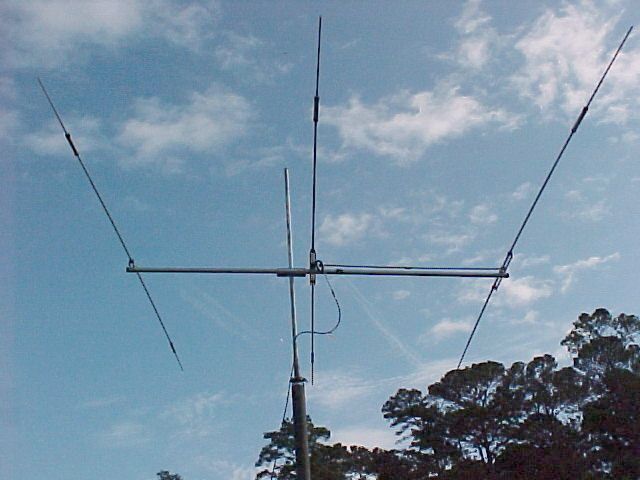
Selecting a portable HF antenna (II) What antennas are today available on the place for portable operations ? By definition a portable station is a station located at another location that the base one but not set up as a fixed station (thus /P, not /A). Optionally this second station is subject to move from time to time, but not as regularly or as fast as a mobile one. This location has not only to be located a few km away from the QTH but can be a spot selected for the holidays, sometimes abroad and that you can also sometimes only reach by boat or by plane. So that means than the antenna used for a portable operation must be light but it can be heavier that the one use in mobile, and even cumbersome in some cases. Let's take the case of Field Days, these special events where many amateurs work outdoors. We observe quite often radio clubs or even isolated amateurs working with large antennas, verticals or beams. At such occasions, antennas are temporary fixed in the ground or at the rear of a van, ontop of a tree or on the building roof. Some teams do not hesitate to install HF beams which wingspan exceeds 8m or verticals 8m long that they place 5 to 10m high or on top of a crane shaft to benefit of a good takeoff angle in emission ! Of course setting such systems if you are alone in the field can be an impossible task, and each of us has to known his limits. In my humble opinion the maximum weight that a slender man can handle alone and quickly is about 15 kg to prevent any accident. For the ease of working, this antenna should be omnidirectional but this design offers some drawbacks. As alternative the directive array must be light enough to be easy to rotate manually or using the lightest TV rotator. In that matter, I suggest you to read the next page to well understand what are the expected characteristics of a good rotator. Selection criteria Knowing these specs, in that range of products there are tens of antenna models : dipoles and wire antennas, verticals, beams, quads, log-periodics and even more exotic designs like rhombics, Moxons or rotary dipoles to name a few. The choice is huge, manufacturers as much; we have thus to reduce our scope. I have chose six major arguments that might determine your selection : - First there is the price that you want to invest in your antenna system. It will be surely your first criterion to consider : you could never beat the very cheap multi-band dipole or off-centered dipole, home-made or bought at 80-100 €, but at another price scale you could never beat either the gain offered by a multi-element quad or a full length beam... In-between there are many multi-bands beams and quads, sometimes shortened (FD3, HF5B, TMG and alike), and many wire antennas and verticals. - Then there is the kind of traffic and mode that you want to work, how far you want to emit, to work local QSOs or DX stations. If any stick work fine for ragchewing and offers report of "59" up to 5000 km away, sometime more, to work DX and break through pile-ups you need a performing installation, and very few amateurs using a dipole and low powers (QRP to 100W) can really compete against users equipped with big guns and amplifiers. So in my mind there are only two possibilities to work pile-ups or DX stations without amplifier : in SSB using a gain antenna, what means using a directive array, or to work in CW with the hope that your DX will hear your "QRP" station emitting bare foot among all kW emitters, HI ! Personally I did the first choice for the pleasure to speak orally with my correspondent a few minutes. Of course many morsists will prefer by far to work in CW to be out of the phone QRM that we all have experimented one or another day working in SSB. It's up to you to select the mode in which you are at best.
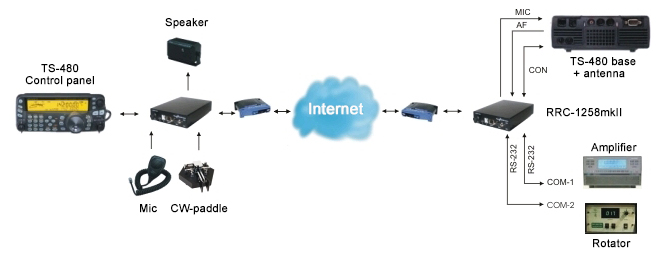
- The bands coverage will be propably your third criterion : some antennas are multi-bands by design, others are mono-banders and need to add either new elements or some accessories to become true multi-bands (resonant). At last some models are so-called "multi-bands" but they must be manually adjusted to work on another band (changing a coil or moving it along the mast). Multi-banders and mono-banders have both advantages and drawbacks, the first for example will never offer the high efficiency (best SWR and higher gain) of the second, but it can work on several bands... This is a choice. However, I suggest you to use a mono-bander in a permanent installation or during a DX-pedition. - The antenna design will also affect your selection. In a restricted space or for discretional reasons for example, a stealth antenna like a dipole, a vertical, a shortened beam or even a loop is very appreciated. Your municipality administration or even the owner of your house might also have edicted some strict rules in this matter. At last, if you work in the field, it can be also very difficult to handle the long elements of a beam, even shortened and so-called light, or the many wires of a quad if arms are not telescopic or wires/spreaders not pre-strung (hopefully, most are) - Sizing and weight : depending on the design, some antennas are much more cumbersome than others, lighter or heavier than their competitors altough they display the same gain or the same radiation pattern. All this depends on the design, the material used, its quality and construction, parameters that affect the size and quality of the boom, the one of the mast as well as elements. If it concerns a beam or a quad, its wingspan must be considered with care as its size and its weight affect the rotator power too, and increase the risk of torque. Of course, you will not be the first amateur to rotate manually your beam in the field. At last the weight of your antenna has some influence on the wind load, and most heavy antennas do not support wind speed exceeding 170 km/h (110 mph) where a lighter model will do. So in case of doubt about the stability and sturdiness of your antenna, do install guy wires, otherwise you take the risk to see your beautiful antenna break in parts at the first wind gust ! Never forget that dame Nature is stronger that you and appear when you don't expect her. Remember Murphy's Law... - Assembly time : due to their design, some models are quasi dedicated for permanent installations as you cannot necessary lost a full day to assemble then dismantle elements that request to be fine tuned or adjusted. Others, using material of poor quality, can be hard to dismantle once assembled or risk to be damaged. For short, the simplest and fastest will be the assembly, the quickest you will be on the air, and will be the dismounting in the same occasion. So you will have to make compromises, and still compromises if you want to work on portable or from a restricted free space area, don't forget it. Of course the situation is much different is you work in a team on an open field, and if you can find some help to your friends to assembly and set up your antenna. Usually an isolated person or a couple of amateurs can erect a 20m vertical or a beam made of titanium but you will need of 2 to 3 more people to erect a classic beam (> 20 kg), two participants erecting the mast while two others will pull on wires and check the system. In such circumstances, a good reflexion is mandatory prior any work and the use of a winch and some sturdy steel pulleys is recommanded. See my page about assembling an antenna system for more detail. If you work alone in the field or at home, to avoid a possible accident or loosing time in assembling, better to use a light and short antenna, although this criteria is subjective (what is "light" or "short" for someone can be heavy or too long for another). Therefore we have also included such models in our selection. For short I searched to meet the next criteria : I desired a HF multi-band antenna, if possible directional, offering gain, at moderate price (less than $500 if possible), light, that I can easy install anywhere and carry by car (inside) when dismantled in two or more parts, the longer elements (director or boom) being 4m long maximum (it must enter into a car, backdoor open or not). I quickly realized that my selection was still very wide and had to be divided in two categories : - The lightest and smallest HF antennas, not necessary the cheapest, but that you can handle alone in the field - The (trans)portable HF antennas, that you can assemble alone but to use preferably in a semi-permanent installation due to their large wingspan or their weight or to use on a holiday spot or during a Field Day event helped by friends. It is a subjective selection from which some well-known models have been excluded because their design was very close to the one displayed. I have tried to sort this list according to the performance and quality/price ratio, completed with their technical specifications and some comments. To see : Operate a Remote station per subscription over Internet Video tutorial, by Remotehamradio
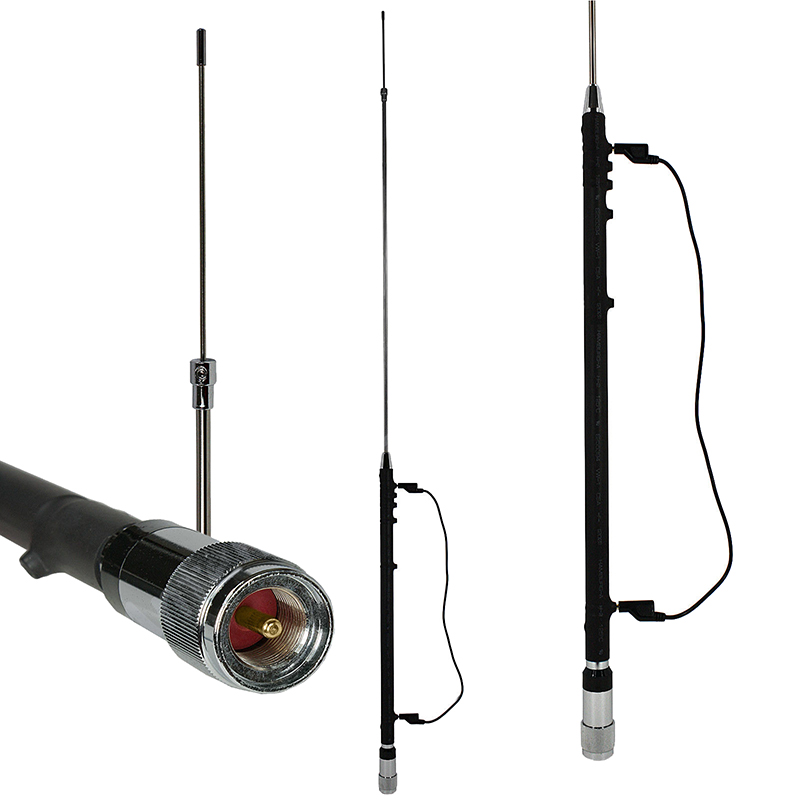
Performance The antenna gain displays in these tables is the value given by the manufacturer. In other words, a value measured in "unknown conditions of use" as most of them never list the heigth of the antenna and the soil properties. Their figures are thus more than probably subject to correction in your working conditions to... a lower value (usually 1-2 dB less). As we told previously, real gain values of some commercial antennas are available on various websites like DM2BLE, and technical design notes on L.B. Cebik's website, W4RNL (sk 2008). Comparing apples and peers like beams vs. verticals or dipoles, or full length beams with shortened models is always unfair from one of another model and misleading. But it is generally well so that you and me select our antennas. We check first all existing designs, then we select a short list of models, then the item that fit our needs. In selecting an antenna you must be aware of these "juggling numbers" and well understand what dbd and dbi units mean and how performances of an antenna system can be affected by many factors, the main one being the height above ground and the ground conductivity without forgetting the use or not of radials with verticals (see basics of antennas, the mystery of radials, All about transmission lines, etc). Anyway, as told me Cornelius, DF2SA, "Guess I will never succeed convincing those marketing people not to exagerate so badly". Here is my selection knowing that I am not in the business or in relation with these brands, and therefore neither pro or con any brand in particular. Prices were updated in 2022 (most increased of 50% in 7 years). Unfortuntaley some models are out of stock (listed in the comment). The lightest and smallest HF antennas
Due to their low profile and lightweight, all portable antennas reviewed above are small enough to fit in baggage on air transports without additional charge. It is a major advantage if you want to work on the air from a holiday and DX spot. Indeed, these models can be used in the field successfully in their classic configuration or any variante (dipole in inverted-V or inverted-L, wire beam rigged in a shallow inverted "V" form, loop in horizontal position or installed indoors, vertical in arrays, etc). Out of the car, installed on the ground, a yard or on a terrace, and fully assembled all these antennas can be ready to work between a few minutes and a quarter of an hour maximum. If you are searching for a portable gain antenna, for DXing or even to work contests, the ones listed above do not meet your specifications. I do not state that they can be used to work DX or contest stations but their performances are limited by design; they are not great competitors, but simply more adapted to local and regional QSOs. However, when propagation permits, they allow you to work stations located over 10000 km away, even if they receive you not loud always and clear. Therefore in the next table I have listed larger antennas, light enough to be moved on portable operations but mostly designed for a semi-permanent installation (a week-end, on holidays, etc) or a field activity, and to work DX. These are shortened directional antennas and one vertical. Next chapter
|