|
|
Equipment
for portable HF operations
(Trans)portable
HF antennas (III)
In
the second table displayed below, I have listed larger antennas,
mostly designed for a semi-permanent installation or a field
activity, that you are alone or in group. All models meet our requirements
and enter into our scope even if some look large.
First
requisit, most of these antennas display a higher gain that dipoles
or verticals, and are therefore very appreciated by DXers. Only drawback
it is often paid by the size. The best are of course
bulky displaying a wingspan that can reach 10 meters for wire beams.
Plus side, many of them offer a lightweight below 10 kg,
a load that each of us can lift without much problem (as we said it is
equivalent to a 8-10 m long aluminium ladder) and that can
be supported by a relatively light mast, even a large pole with guy
wires, hence their selection in this category.
Some
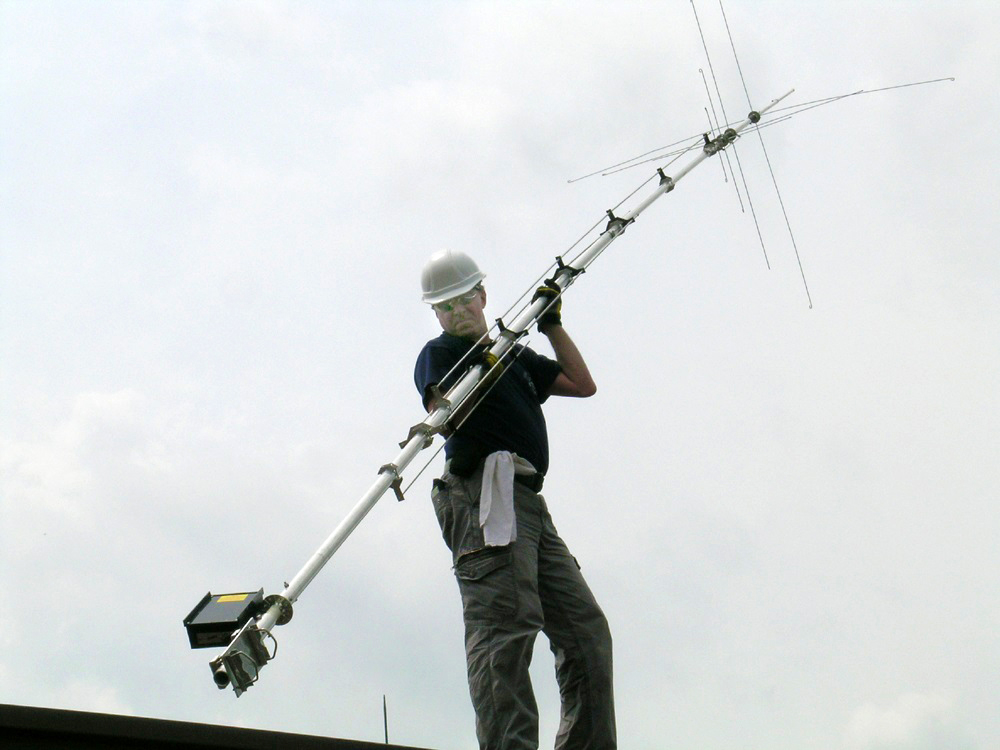
models however are heavier (14-17 kg) what is at the limit of the weight that
an amateur alone can lift. If some quads or wire beams can still be assembled
and erected on a mast fixed at ground level by one person (working some hours
for the first assembly), its installation with a rotator ontop of a pylon or on a
sloping roof should require between two and four persons for security reasons.
Why
have selected these "monsters" for portable operations,
do you wonder ? Sometimes, on holiday or when participating to Field Days
and other CQ WW activities, a simple dipole or a short vertical does not allow
you to get high scores or to contact far DX stations due to a poor
gain and radiation pattern.
You can also be on the
spot for a few days or weeks and if you are considered as one among
the "most wanted DX" and want to give points to amateurs, you have
to be on the air as often as possible during this short period. In these special
occasions a true vertical (cut at least at 1/2λ or at 5/8λ) or a
directional antenna showing a very low takeoff angle (5-15°) is very
appreciated, all the more if it is light, cheap or easy to install.
At
last, purists will say that an antenna equipped with traps is not
more performing and loses power. Indeed, a trap inserted on an
antenna reduces the power between 0.003-0.005 dB on 28.6 MHz and
between 0.4 and 1.5 dB on 7.15 MHz. With 2 traps on 40m, you lose up
to 3 dB or 50% of your power !
In the field, we observe that the
radiation efficiency can drop of 30% using only one trap of large
size (but I will not extend on this matter as they are many ways to
build traps).
But between you and me what is the best solution ?
Working with a dipole or a vertical without trap or with a beam
equipped with 2 traps to reduce a little its wingspan ? Of course
one will always select the beam for its directivity and higher gain.
Therefore, all antennas listed below satisfy to at least one of the
previous critera.
If
you work alone and have some times left, each of these models can be
assembled in half a day or quicker in following strictly the
instruction manual. But do no expect to dismantle them as easily and
as fast as antennas displayed in the previous selection as some
of them require the assembling of 25 segments (e.g. the 5-element
Titanex log-periodic) ! These antennas have to be
considered as trans-portable models rather than portables, so in
other words for semi-permanent installations at a few exceptions for
the shortest or lightest models. The shade is of
importance.
Here is my selection. A summary is available in
this Excel sheet and here is
the XE currency
converter. Unless I wrote the contrary, remember that all
gain values are those from the manufacturer and are subject to
correction...up to 2 dB less than the value listed.
(Trans)portable
HF antennas
|
Model |
Price |
Comments |
|
Tak-Tenna |
278€ |
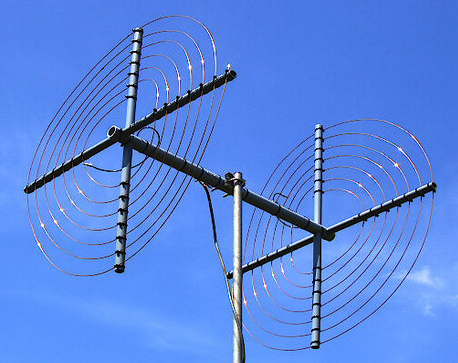
It
is an electrical antenna, a 1/2λ-dipole designed in spiral
to drastically reduce its size both horizontally and vertically.
The
Tak-Tenna is available in 4 models : 75/80m, 40m, 20m and
10m directly fed with 50 ohm coax.
The
boom of the 40m and 80m models are respectively 76 cm (30")
and 1.22m (48") long with a spiral of 75 cm and 1
m in diameter, and the weigth of the antenna is 2.3 kg
and 3.2 kg.
The
model cut for 40m is a multibander that can also be
used on 40, 30, 20, 15 and 10m with an additional
antenna tuner. Tests performed by N4UJW were also successful on 17m
band.
The
75/80m model can be tuned up to 6m with an antenna
tuner.
The
SWR can reach 1.5:1 on 40m according to K6SGH, and
other customers underline they got the antenna
resonance at ground level.
The assembly time is about 45
minutes for the 40 multibander and about 90 minutes
for the 80 multiband model.
The
Tak-Tenna was successfully tested up to 1 kW in SSB
and 1.4 kW in CW, and supports wind gusts up to 120 km/h (75 mph).
The signal improves between 10-14 dB in transmit
with a 90° rotation (or F/S ratio), increasing the horizontal
directivity over 2 S-units. So, it works like a directional
dipole. Most users have erected this antenna at low heights
(3-6 m above ground) and report a good directivity.
The
price is $278 for the 40m model and $364 for the 80m
model plus $18 for a delivery in the U.S.A. and
between $50-110 to Europe depending on the model and the
country. |
|
M0PLK |
£159.99 |
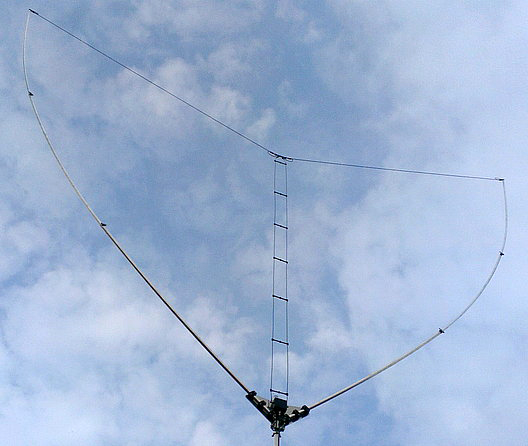
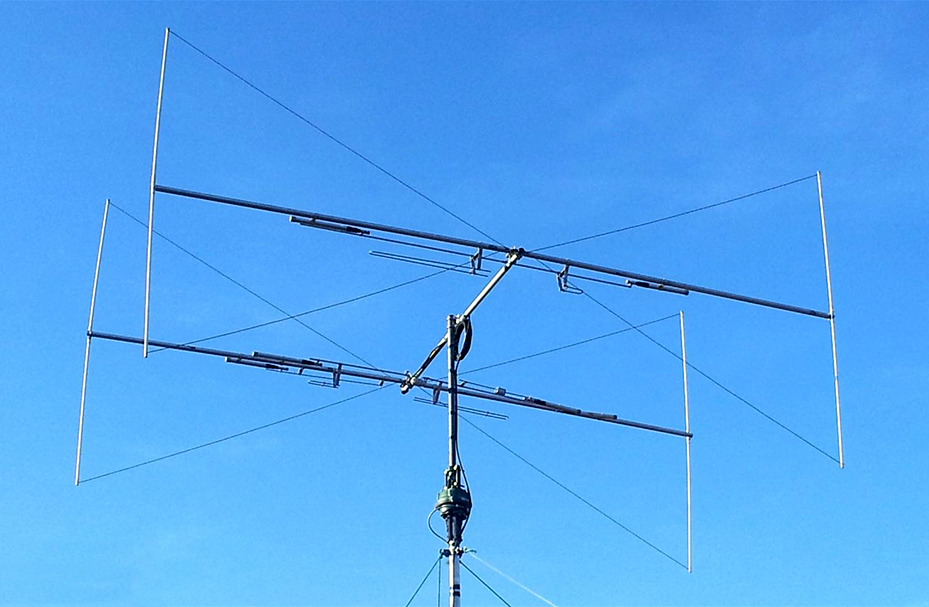
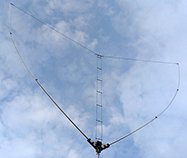
This
delta loop is a directional wire antenna designed by
M0PLK. It shows a profile practically as thin as a
double vertical mast. Its weight is not listed but it
is probably below 5 kg.
It
is a multiband antenna cut for 30-20-15-12-10 meters.
It is non-resonant by design, thus requires an antenna
tuner. We can use it on 20m and even on 80m with an
antenna tuner.
Its
wingspan (the longest horizontal wire segment on top)
is 5.8m with rods (on the side) of 5.6m long.
Depending
on the model and the balun used, its sustains between
150 W and 2 kW SSB between 10-50 MHz.
This
delta loop uses an improved BalUn 4:1, a low loss
ladder line, it shows a better isolation than the
previous model, and is waterproofed.
It
already gives a low SWR set up 3 meters above ground
level at the feed point.
As
all quads or delta loops, it displays a low radiation
angle and is particulary adapted for portable
operations.
Like
all single element delta loops, this model shows a
symmetrical radiation pattern (F/B = 0 dB). Set 5m
above ground, the antenna gain is 8.42 dBi on 28.500
MHz (elevation angle of 18.3°, azimut angle of 120°)
and 4.9 dBi on 14.150 MHz (elevation angle of 43.4°,
azimut angle of 120°).
It
is delivered with the ladder line, the main loop wire,
aluminium telescopic rods and the matching transformer
(without guying system). Some elements are
preassembled.
The
price is 220€ plus tax and delivery to Ham
Radio Shop. It is no more sold since 2020.
|
|
Antenna
D2T |
513€ |
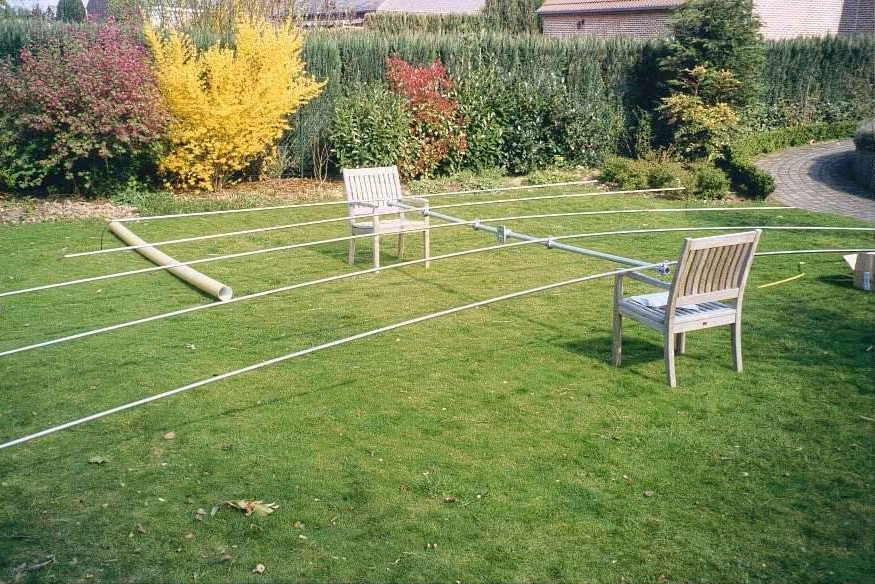
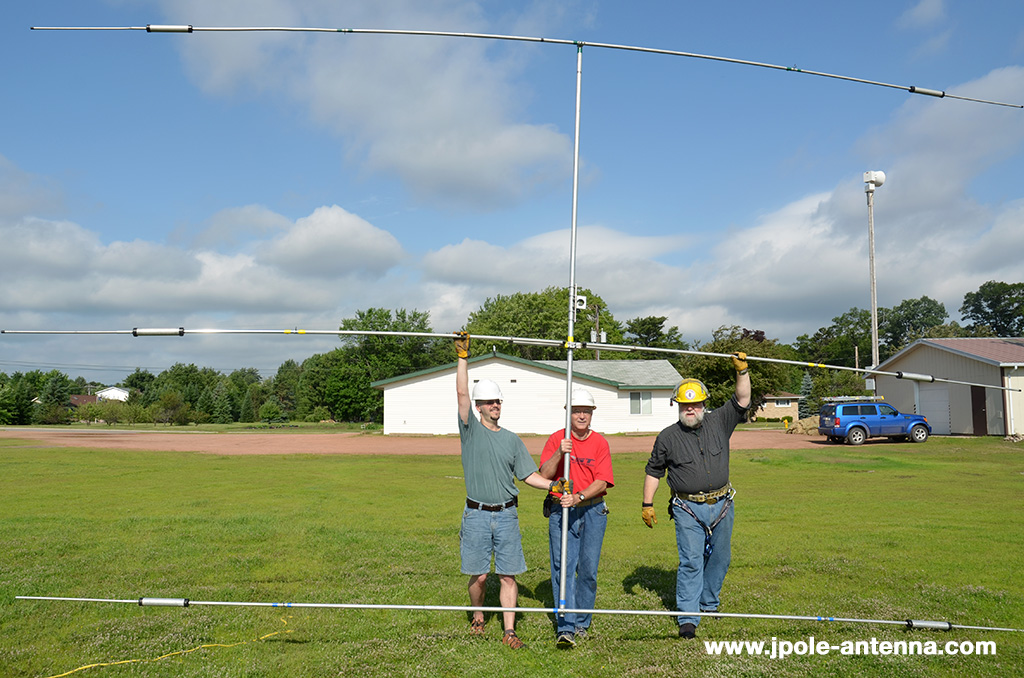
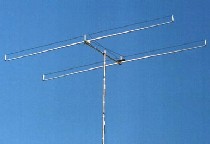
The
D2T is manufactured by GIOVANNINI Elettromeccanica. It
is the first wire beam antenna offering a continous coverage
between 1.5 and 200 MHz at my knowledge.
In
SSB the D2T supports 1kW PEP in HF and up to 500W PEP in VHF.
DT2
displays a boom 2m long, the longest element is 6m long
that can colapse for transport in segments 1 m long
only. Its weight is 8 kg.
Is is an hybrid between a dipole
and a 2-element Yagi, constituted of two dipoles folden fed and dephased by
180°, fed with 50-ohm coax. Its mean SWR is 1.5:1.
According
to DM2BLE this directive antenna offers a gain up to 1.7 dBd on 10 meters with a
F/B ratio of 5 dB and a F/S ratio of 20 dB. However on 20 meters this antenna
appeared to perform similar to a dipole (0.3 dBd) or the HF5B
beam described below. Its gain declines as the frequency decreases
but where it continues to show a very low radiation angle.
In lower bands its main competitor is the full length
G5RV-E or the GAP VI vertical.
In VHF
it performs quite well, showing a 6-lobes radiation pattern.
|
|

Cushcraft
MA5-B |
$574 |
The
Cushcraft beam model MA5-B is a new concept, designed
for amateurs wishing to work in limited space.
This
shorten Yagi is a true 5 bander which weight is only 12 kg that
can be easily driven by a mid-range rotator. It cover bands
from 20 to 10m including WARC, handling a power of
1.2kW PEP in SSB.
The
boom length is 2.2m and the longest element is 5.2m
long. It is made of elements from 0.2 to 2.1m long.
Longer X-hat rods measure about 1m long.
According
to DM2BLE, this beam displays a 3.9 dBd on 20m and 3.6 dBd on
10m, showing on WARC bands a gain similar to the one of a
dipole (~0 dBd). Its F/B ratio reaches 22 dB on 20m and
falls down to 10 dB on 10m. Its F/S ratio is 25 dB.
Plus
side the hardware is made of stainless steel and heavy
aluminium, the assembly manual is very well written,
as usual, and its price is very competitive.
MA5-B
is sold by MFJ
Enterprises and WiMo. |
|

Hy-Gain
AV-640 HF |
$549 |
The
Hy-Gain V-640 Patriot HF vertical is one of the best multiband vertical available
today in terms of performance, size and price.
Its
height is 7.77 m and its weight is 8 kg and supports up to 1500 W.
The AV-640 uses
1/4λ stubs on 6, 10, 12, and 17 meters and efficient end loading coil
and capacity hats on 15, 20, 30, 40 meters. Instead of typical lossy can traps,
the AV-640 resonators are placed in parallel rather than in series. End loading
of the lower HF bands allows efficient operation with a manageable antenna height.
Among
its advantages, the AV-640 does no need a ground or radials, the bandswitching
is automatic with a wide VSWR bandwith on each band up to 2:1, it is sleek with
a low profile, it can survive to gusts up to 128 km/h, and it is built to last.
Sold
by many dealers, including MFJ
Enterprises and WiMo. |
|
Cushcraft
R8 |
$700 |
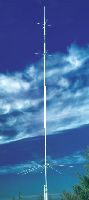
The Cushcraft
R8 is one among the very few 8-banders covering from 40 to 6m,
WARC included, reason for which I selected it among
the many performing verticals.
It
is 8.7m high, cut at 1/4λ
and its weight is 10.5 kg. According to DM2BLE it offers a
gain of -0.43 dBd (1.71 dBi) on 20m with two opposites and directional
radiation lobes. Among all Cushcraft R series of
antennas, R8 displays the best gain.
R8 uses two kinds or radials and counterpoises which
once installed are not always easy to dismantle. It performs
very well placed 10m high and is able to work any pile-up
barefoot in CW. It supports an emitting power up to 1.5
kW PEP in SSB.
Minus side,
once placed on a mast or a pylon, due to its weight it is
not easy to get it down without help. Thus to reserve
for a semi-permanent installation, and to secure with
guy wires.
Its
best competitors are Hy-Gain AV-640
and GAP TITAN
DX that show similar performances. Butternut,
Diamond
or Hustler
come a few dB behind. Titanex is
unfortunately out of our scope, its verticals being
dedicated to low bands (160, 80 and 40m), for
permanent or portable installations.
Sold
by many dealers, including MFJ
Enterprises. |
|

Butternut
HF5B Butterfly
|
£700 |
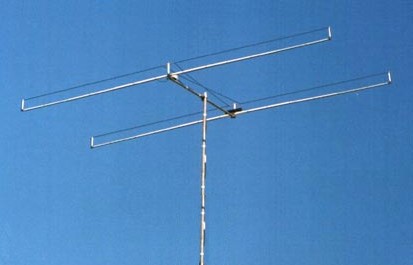
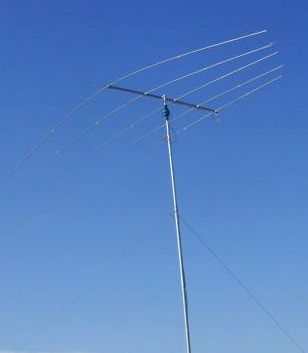
Butternut
model HF5B is probably the shortest five-band beam available on the market,
covering bands from 20 to 10m including WARC at 1.2 kW PEP in
SSB. It has been designed for hams working in a limited space.
This is a
2-element beam offering a wingspan of 3.8m, vertical
spreaders 1.8m long and a boom 1.8m long. Its weight
is only 10 kg and it can be driven by the smallest TV rotor
you can find.
Its gain is 3 dBd on 20m and up to 5 dBd on all other
bands except 17 m where it acts as a rotary dipole. Its F/B ratio
reaches 20 dB and the F/S is 25 dB. It displays a SWR
below 2:1 for a bandwidth less than 200 kHz.
Minus
side wires are not coated with UV resistant insulation
and should be replaced.
Note
that antenna is light enough to support a TV rotator.
HF5B is sold by DX
Engineering (USA), RadioWorld
(UK) or Funktechnik
(CH). Several dealers have no more stock.
|
|

TGM
MQ-36SR |
C$
945 |
TGM
is a canadian company specialized in compact hybrid
quad antennas. Among the various models offered, there
is the MQ-36SR, a 6-bander operating in bands from 20
to 6m, WARC included, supporting 1.2 kW PEP in SSB.
Materials
used are 6061/T6 aluminium, stainless steel, Lexan
and G12 fiber-glass coils, what explains its weight
quite important of about 13 kg. Drawback, due to its
weight this model requests at least a medium rotator
and a robust mast.
This
hybrid MQ-36SR quad is made of 3 elements 3.6m long
each; the boom is 4.3m long with the reflector, this
latter measuring 1.21m high.
Its
gain is substantial, ranging from 6 dBd on 20m to 7 dBd on upper
bands, with a F/B ratio from 15 to 20 dB and a F/S ratio
of 25 dB. The bandwidth is quite narrow, with a mean
SWR of 1.2:1 that exceeds easily 2.0:1 at the end of
the band.
Excepted
its high price, this antenna is one of my favorites, both by its performances and sizing.
Like all beams, to preserve its performance install it
at least 10m over the ground.
This
model was available in Europe to RadioWorld
(UK) but is out of stock.
|
|
Mosley
beam TA-33-JR-N WARC |
$725 |
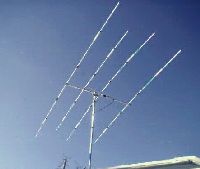
After
the Mosley MINI-33 tribander) the most interesting five-bander Mosley beam is the
TA-33-JRN-WARC model. This is 4-element beam with
traps completed with a dipole to cover from 20 to 10m including
WARC bands. It supports 1.2 kW PEP in SSB.
The
weight of this beam is in the average, 13 kg, with a boom 3.7m long,
the largest element measuring 8.3m, with a mast
diameter of 38 mm. Due to its weight and to support
the windload, this beam requests a medium to heavy rotator.
It can be supported by a robust mast or better, a small pylon.
So minus side, this beam is more suited to a semi-permanent
installation or a small DXpedition than an portable
operation.
According
to DM2BLE, this beam offers an excellent gain, from 4.5 dBd
on 20m to 6 dBd on 10m with a F/B ratio of 20 dB. On WARC bands
this beam acts like a dipole with this advantage to be directive.
Minus side,
this mid-range beam is quite wide and expensive compared to
its competitors, and the waiting delay can reach 4 months ! Plus
side, Mosley has a huge stock of spare parts and has dealers in most countries.
Download
the TA-33 Jr assembly manual. |
|
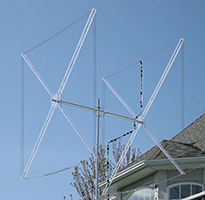
Light
Beam Antenna & Apparatus
|
$350 |
Light
Beam antennas are based on Moxon design that has been
computer optimized to offer a maximum performance at
only 10m above ground.
The
manufacturer sells monobands quads (e.g. model LBP-20M
or LB-20M) or dual band quads (model LBM-17M+20M).
The
2-element quad uses 4 elements, two of which being
active on each band, 20m and 17m bands. It displays
half the width of a classic quad and the quarter of a classic
Yagi.
This
quad is made of polycarbonate (plastic). Its structure is thus
practically transparent as light can pass through,
improving its relative low profile compared to metal
quads or beams.
The
elements of LBM-17M+20M show a width of 7.7m, the boom
is 3.7 m long with a turning radius of 4.21m.
Its
weight is 14.6 kg, probably one of the lightest quad on the market.
This
quad displays a formard gain of 9.36 dBi and a F/B ratio of 18.09 dBd. The
major lobe elevation is 28.9°.
It
shows a broad 50 ohms impedance, supports up to 1.5 kW
and does not use traps. It doesn't require antenna
tuner either. Only a Balun is needed and only one
coaxial is used to feed the antenna. It shows a SWR
ratio <2:0:1 on the entire band of 20 and 17 m (one
can reach 1.2:1 in the mid of band).
Prices
range between $350 for the Light Beam LB-10 M and $750
for the Light Beam Plus LBP-20M.
|
|

Cubex
Starmaster / MK II PT3 |
$650 |
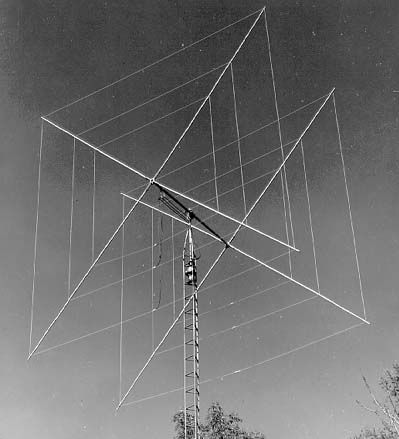
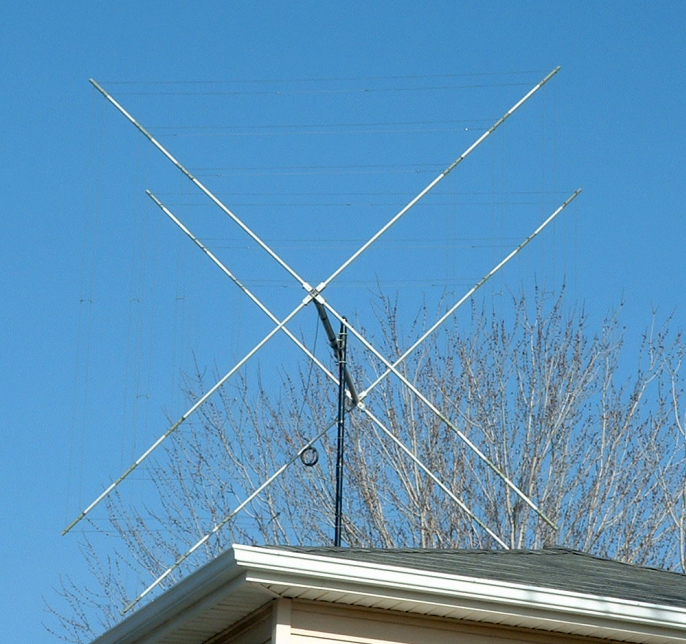
Cubex
sell quad antennas since 1960, token of serious. Among
their different models, name the
"Starmaster" kits that allow amateurs to
reduce the price of their antenna.
In
the field, DM2BLE
measured a gain of about 5 dBd on all bands with a F/B ratio
between 20-25 dB and a beam width of 60°. Some users
experienced difficulties to get a low SWR on WARC
bands.
Spreaders
are made of fiberglass while the boom 2.4m long for
2" dia. is made of aluminium. Its overall weight
is 14.5 kg for a turning radius of 3m.
Delivered
in kit, Starmaster series is Cubex
"do-it-yourself" solution suited to Field
Days or portable operations, preferably in group (even well-built,
you will have difficulties to erect it alone). In this
kit version, telescopic fiberglass arms must be pierced
and wires cut at the required dimensions. All these specs are
well explained in the manual (available in English or French).
Unfortunately
some models are out of stock for a while, and there is
no restocking.
In
Europe, Cubex antennas are available to Zenith
Antennes (F) and there is no more stock to WiMo
(D). |
|

Degen
BBQ 101520
|
$1450 |
Degen
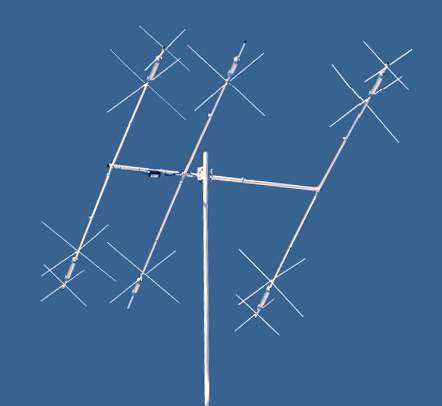
is a canadian company that sells innovative antenna solutions like compact quads
and stacked Vwaves (beams which elements are in
V-shape). The
Baby Boomer Quad, BBQ for short, is a multi-band
2-element shortened quad displaying a wingspan of about
3.4m per side. It is made of aluminium, fiberglass, 14
gauge tinned Flexweave wire, heavy duty eyelets and stainless
steel electrical connexions. Wires are pre-tuned and
pre-strung. Its weight is quite high, 17 kg, what requires
a medium rotator, but hopefully it can be erected by
one person once you are used to assemble/disassemble it.
Degen's installation
manuals will give you a better understanding of the
assembly of their antennas.
BBQ
is designed from factory to operate on 20, 15 and 10m
only. Its gain is 4.1 dBd on 20m, 4 dBd on 15m and 3.6 dBd on
10m (and up to 8.9 dBd erected 15m high), with a F/B
ratio of respectively 12, 26 and 18 dB. On 12 and 17m it
offers also some gain with an excellent F/B ratio. Connected
to an external antenna tuner (only) it is able to
cover all bands from 160 to 6m, where it acts like a
dipole, with the advantage to be directive. Its
maximum power is 1.5 kW PEP in SSB. Drawback of it
shortened design, at the end of each band the SWR is
between 2.8:1 and 3.2:1.
BBQ
is less performing than a full size quad and is on par
with wire beams. However, like all quads, you
can install it quite low over the ground and still
have a good takeoff angle, what you cannot get with a
beam.
The DX
Option allows the antenna to be shipped in a shorter
and bulkier package (better for airline transport),
other than that it is the same antenna (add
$130).
|
|
K4KIO
Hexagonal beam |
$689 |
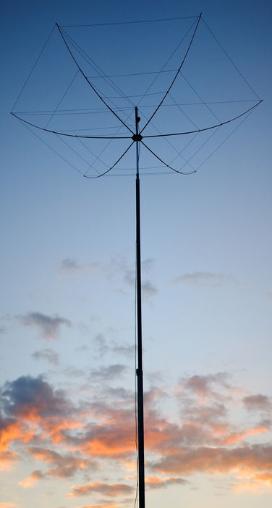
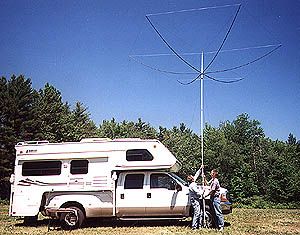
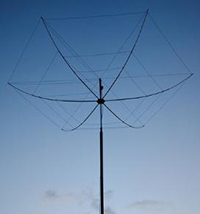
Traffie
tech., the manufacturer of the "Hex-beam"
closed down production in May 2015. In the meantime he
inspired many manufacturers. Among them K4KIO
and G3TXQ.
K4KIO
hexagonal wired beam is a bit shorter than a quad with a height
from the base to the top of 1m (39"), a turning
radius of 3.3m (10.8 ft) and a diameter of 6.5m
(21.6f) on 20m band.
The
hexagonal beam is designed to work between 20-10m + 6/2m
in option. It is suited for permanent or portable operations.
Mono-band elements yield a gain of
about 4 dBd with a F/B ratio exceeding 20 dB. Based on the Hex-beam figures,
it should shows an excellent rejection of QRM, a lesser sensitivity to
fading and better signal reports than a delta loop.
Made
of spreaders in fiberglass with support cords in
Kevlar UV resistant, and some parts in aluminum and
stainless steel, the weight of this beam is 11.3 kg.
The
Hexagonal beam is delivered from factory as a 5 bander with 2
elements per band but can be delivered as monoband as
well.
Currently
the KIO Hexbeam 20 m is out of stock. |
|
DF4SA's
Spider beam |
329€ |
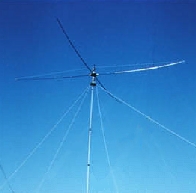
Cornelius,
alias DF4SA sells this wire beam in kit for a very
affordable price compared to other commercial models. This is the first
reason for which I included it in this review.
This is a real 3 bander, 20-15-10m beam using respectively 3, 3 and
4 aluminium elements placed in V along the boom.
The
weight of this beam is about 5.5 kg. It offers a gain of 4.3 dBd on 20m and
a F/B ratio over 17.8 dB.
Minus side, the
wingspan of this antenna is huge, 10m, and it requires some hours to
be assembled. So I see better this huge wire beam in a semi-permanent
installation than in the field for a one day shot. The
price depends on the model. A heavy duty model costs
439€ and a 5-band heavy duty model costs 459€. |
|
Titanex
LP5 |
666€ |
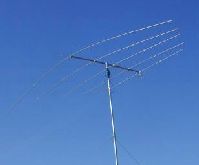
Thanks
to new technologies, Titanex in Germany is specialized
in ultra light but resistant antennas made of
titanium, verticals, beams, quads, log periodics, and
rotary dipoles without to forget some tilting towers.
LP5
is 5 bander log periodic covering 20-10m which weight is less than 9 kg.
Note that the DLP-11L model (11 elements, lighter
model, 890 € covers bands from 40 to 10m.
LP5
is a 5 elements displaying a wingspan rather huge of 10.3m and a
boom diameter of 40 mm ! The windload is about 50 kg under windspeed reaching 120 km/h.
Able
to support a power of 5 kW PEP, according to DM2BLE this log periodic offers
a gain from 2 to 3.1 dBd, and a F/B ratio of 15-20 dB.
Since
2014, the LP5 model is no more produced. There are
several other models like TS5 (5 bands, 11 elements at
1985 €) or TB 7S (7 bands, 4 elements at 962 €).
|
|
Support
and servicing
At
last, do not forget that any (trans)portable antenna will not support
long time the stress of being regularly disassembled and reassembled...
Most screws, U-bolts, clamps, guy colars, clips or small parts that you often handle
have chance to loose their profile or to break if they are made of
light material, and you will have maybe to return them for
servicing or to replace them after a while. So select well your
material not only for its performances but also for the quality of
its smallest parts that, like a sand grain in your gearing can
grip all your system...
If
a handyman can easily
find spare parts in any Do-it-yourself shop or make them from
scrach using pieces of galvanized aluminium, screw and bolts, I suggest
to the casual amateur to buy some spare parts from the manufacturer
when you order your antenna (hopefully most provide them).
You should
also coat all unprotected accessories made of steel or aluminium
not galvanized before assembly (I think to U-bolts, turn-buckles,
etc) and to place grease on all screw pitches as well as at the
ends of segments that might be disassembled to avoid some bad
surprises the day you will try to dismantle them (mainly in
tropical and wet countries). Replace at the
same time all ordinary wires (including your guy-wires) with
cables protected with a PVC jacket and UV resistant. These are not
high expenses (maybe 100 €) and they will prevent your material
to get rusty after a few years.
Generally
speaking, the servicing and support offered by the company that you have
selected is very important, all the more that you ignore usually
its quality at purchase, except in reading some reviews. So
think twice about it before ordering material abroad or to a
dealer that nobody knows yet.
Last
chapter
Portable
accessories
|