|
SSN
or the short history of the Smoothed Sunspot Number
|
|
|
Propagation
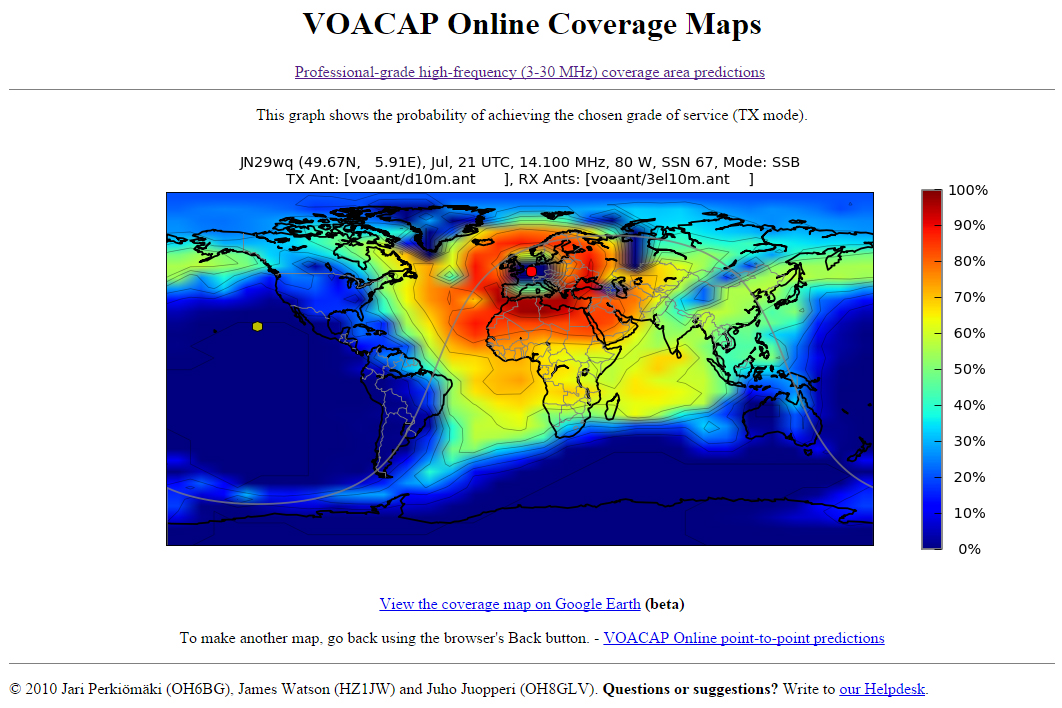
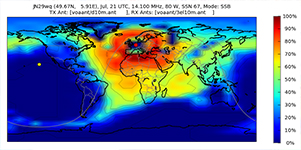
prediction calculated by VOACAP online
for the 20m band. The SSN was manually added to calculate the global
coverage. |
How
to get the correct SSN ?
Foreword.
VOACAP and other propagation prediction programs
based on the same engine use an old and specific data set
of the sunspot numbers named “Predicted smoothed sunspot number” to NGDC.
This
data are not the historical and classic SunSpot Numbers (SSN as described in this
document
from NGDC) but a monthly smoothed SSN, both qualifier being essential. So in
this review as in all VOACAP-based applications, SSN only refers to the Smoothed
Sunspot Number.
In
addition to what we have just underlined, as
you have probably noted, there are different SSN, and without more
information the (radio) amateur cannot know what value to select.
Indeed, if you don't
take care, this is a superb trap for most HF propagation prediction programs,
specially for VOACAP-based models. In fact, all depends on what we speak about,
what adds to the confusion !
So
let's tackle this problem and resolve it. First, what does suggest George
Lane, one of the main VOACAP developer who worked on ionospheric models during
30 years ?
Because other SSNs are supposed to give erroneous
results, George recommends
to use the SSN listed at the National Geophysical Data Center available at
NGDC
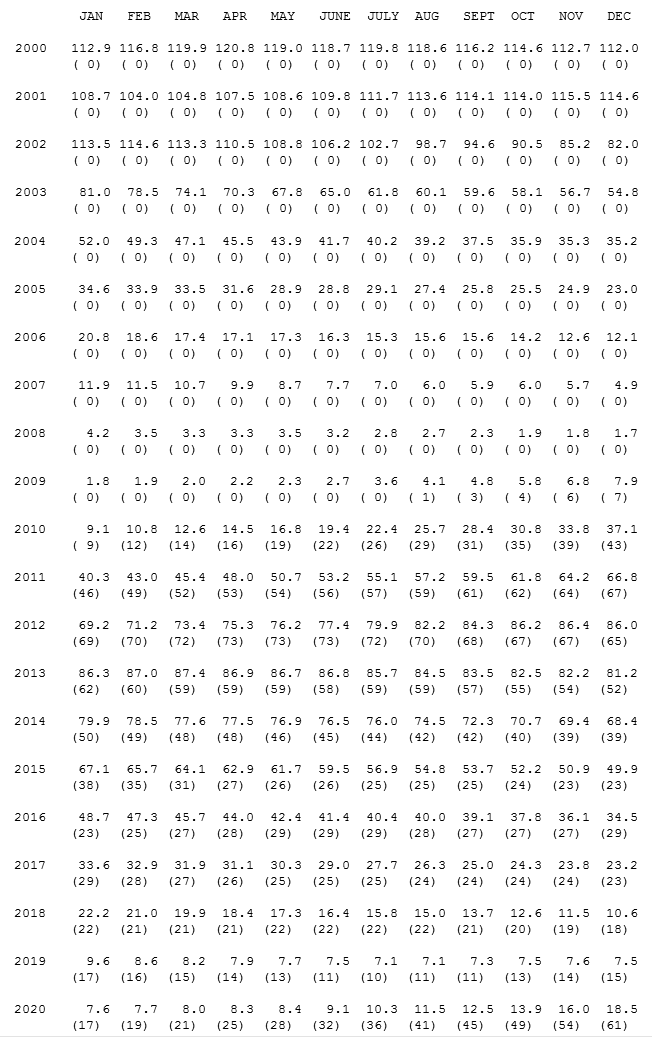
FTP website (for backup purpose, here is a GIF
image of this file valid until 2020) : "These SSN figures are based on
the Lincoln-McNish smoothing function. These are the sunspot numbers used in the
database reduction for the worldwide ionospheric maps used in IONCAP and
VOACAP".
As
states Georges, only the NGDC' SSN was used to calibrate algorithms and thus predictions
generated by VOACAP, hence his recommendation.
So
the discussion is closed as the engine has never been updated since its release.
But
some well informed readers will arg that the SSN provided by NGDC (and
calculated by SIDC) is neither
the most accurate nor the data that we should use. Indeed, since July 1, 2015,
SIDC scientifically endorsed by the International Astronomical Union (IAU) replaced
all data by a new entirely revised data series and assigned them other names
(see below). This remark is correct.
However, as explained above,
amateurs using VOACAP till
have to use the SSN provided by NGDC ! To understand this apparent contradiction,
let's review the history of SSN. Explanations.
The
variety of data
Looking
for the "good SSN" to enter into his VOACAP-based
application, what are available data on the web wonders the amateur ? Reply:
read the VOACAP News where there is a entry
directing the reader to the NGDC's
file or read the page titled "Choosing
the correct Sunspot Number".
The
other amateurs, those who never read manuals and would till ignore this hint,
will investigate the web and will be face to a serious problem !
The
first introduced in the foreword is on the NGDC website itself. The first entry related to SSN directs the
reader to a document titled "Readme:
Sunspot Numbers" in which it is written : "The SunSpot Number
(SSN) is a commonly used index of solar activity. The daily sunspot number was
first introduced in 1848 by the Swiss astronomer, Johann Rudolph Wolf [...]
Beginning January 1, 1981, the Zurich relative sunspot number program was
replaced by the Solar Influences Data analysis Center (SIDC).[...]".
So
we have now two different SSN : the "SunSpot Number" and the
"Smoothed Sunspot Number" ! It is really annoying.
But
it is not the sole issue. Indeed,
without knowing how VOACAP was programmed or without having the specific scientific
background, the amateur cannot make the difference between all available SSN and
others sunspot numbers : there is the predicted SSN, the equivalent SSN, the
current SSN, the effective SSN, without to forget the smoothed, mean, weekly,
monthly and others yearly SSN. The amateur is thus face to numerous possible SSN what adds to the confusion.
But
monthly, smoothed or predicted value to name some data set are of different
nature; they do not have the same meaning and information content.
So knowing
that VOACAP was calibrated for a specific type of information (scale of input values, time filtering, sampling interval,
etc.), we cannot select a priori a data set and injecting the SSN for a specific
month in VOACAP, and expect that the resulting forecast will be correct. At a
few exceptions (low solar activity and thus a poor propagation that often does
not merit to switch on a HF receiver or a transceiver), the prediction will be
partly or totally false.
Here is a list
of institutions releasing the famous Smoothed Sunspot Number (SSN). If some websites clearly
state that their figure is not the NGDC or SIDC's SSN (like Spaceweather
who displays the Boulder sunspot number), other sites supporting VOACAP-based
programs claim or at least infer that their so-called "SSN" is the one to use in their
rapplication, what is totally wrong :
To
read : Why
the Sunspot Number Needs Re-examination
(PDF), E.W.Cliver, AFRL
Predicted
SSN for the current day,
Sunspot Watch
|
SSN
: current, predicted, equivalent, effective, mean, smoothed... |
|
SIDC : |
13-month
total SSN = 63 (the official SSN value) |
|
SIDC : |
Monthly
mean total SN = 69.7 (the official ISN or RI) |
|
NOAA/NGDC
: |
Monthly
predicted
SSN = 39.2 (the historical source for VOACAP) |
|
IPS
: |
Monthly
predicted SSN
= 39.3 (got from SIDC since 07/2015) |
|
SWPC
: |
Weekly
Predicted
SSN = 33.6 (got from SIDC since 07/2015) |
|
HFradio.org
: |
Predicted
SSN = 33.6 (got from IPS but no more available today) |
|
GeoAlert-Extreme
: |
Equivalent
SSN = 31 (got from SEC) |
|
WinCAP
Wizard : |
SSN
= 34 (got from SEC, today closed down) |
|
DX
ToolBox : |
SSN
= 36 (in fact calculated for August 29) |
|
IonoProbe
: |
Current
SSN = 36 (in fact the Sunspot number for Aug 30)
Effective
SSN = 89 (from real-time interpolation) |
|
HFProp
: |
SSN
= 29 |
|
These data are calculated for
August 2004 and compiled from various observatories
and applications to get a point-to-point prediction for August 30 at 16h30 UTC.
While SIDC data are the official and the most accurate, VOACAP
algorithms having been fine-tuned for the "old SSN",
it is recommended to keep using NGDC
monthly predicted SSN (calculated until 2020). |
|
SWPC/NOAA
is one of the major observatories maintaining SSN
indices. However until 2015, their numbers were slightly different from
the one published by NOAA/NGDC. The discrepancy between "SSN" published
by both observatories reached 60%... Unfortunately, SSN published by
SWPC (formely SEC), and in spite of the advise displayed on their web pages, it
was used by many VOACAP-based applications (see the table
below), and is refered as such in their help file as well, hence
the believe that SWPC provided SSN for VOACAP. Hopefully, since July 2015, SWPC
also use the SSN calculated by SIDC.
HFradio.org
managed by NW7US has well understood the message and for years suggested to all readers searching for
archive and data approved for research to connect on NGDC website. Today it only
lists the sunspot number but it is not used in VOACAP.
IPS
Radio Space Services, in Australia, like SWPC provided the "Predicted
SSN" until they also use data provided by SIDC since July 2015. You
can subscribe to IPS
Mailist to get the SSN by email but it does not refer to the data used by VOACAP.
In addition,
there are two other parameters called "SSN" :
-
There is a sunspot number derived from the 10.7 cm
solar radio flux called SSNf (the one used in correlation with SFI).
-
There is a sunspot number derived from fitting an ionospheric model to ionospheric
measurements.
without
to forget the Effective Sunspot Number or SSNe calculated from
real-time foF2 observations.
All
these indices are sometimes used as inputs to model the ionosphere in HF propagation
predictions programs based on VOACAP engine, but all give different results, and not
minors, as the next plot shows. It is thus not surprising that HFradio.org states that
"forecasting is an inexact science"..., Hi!
 |
|
This plot shows that scientists don't always agree as to what the SSN
should be in a particular context. Hopefully, since July 2015,
sunspots data series have been harmonized and only SIDC in Belgium
is allowed to calculate them. Document NWRA. |
|
The
short history of SSN
As
you understood, nobody predicts the same SSN as SIDC, not even NGDC that
download their data from their site !
But there is a
good reason. Larry Combs and William Murtagh work for SWPC. The observed SSN values
that they manage with their colleagues are initially the preliminary values which
are periodically replaced with the final values. Until 2000s, the
official data archive were handled at NGDC and it was not the SWPC real-time/near
real-time operational responsibility.
The
SSN discrepancy between SWPC and the International Sunspot Index (ISN or RI) exists because
of Solar Influences Data Center, aka SIDC's
(located in Belgium) responsibility for the
official SSN database.
This database dates back to the early
18th
century. In the late 20th
century, SIDC introduced a 0.6 scaling factor, so measurements of sunspots from the
much improved telescopes matched measurements of old. This, of course, aid
greatly in the assessment of the historical cycle records. But if we refer to
the new models, this scaling factor is of course useless, and SSN forecast
should taken into account this change.
The SSN released by SWPC was based on measurements recorded by USAF
observatories using modern telescopes. No adjustments were made to their SSN calculation.
However, like the NOAA-Boulder SSN, the USAF series are meant only for short-term use
and are based on a limited number of stations (1 to 5). So in no case they are compatible
with long term series like the smoothed SSN
Sunspot
observations
Generally
speaking, one can also wonder which "sunspot number" is really based on sunspot observations?
The few examples that we mentionned above (e.g. IPS, SWPS, etc) are only indirect proxies of
the sunspot number, i.e. approximations of the sunspot number based on statistical relations
with other indirect indices (F10.7, foF2). In other words, sunspots were not at the base of those "sunspot
numbers". In fact the name is misleading.
|

|
|
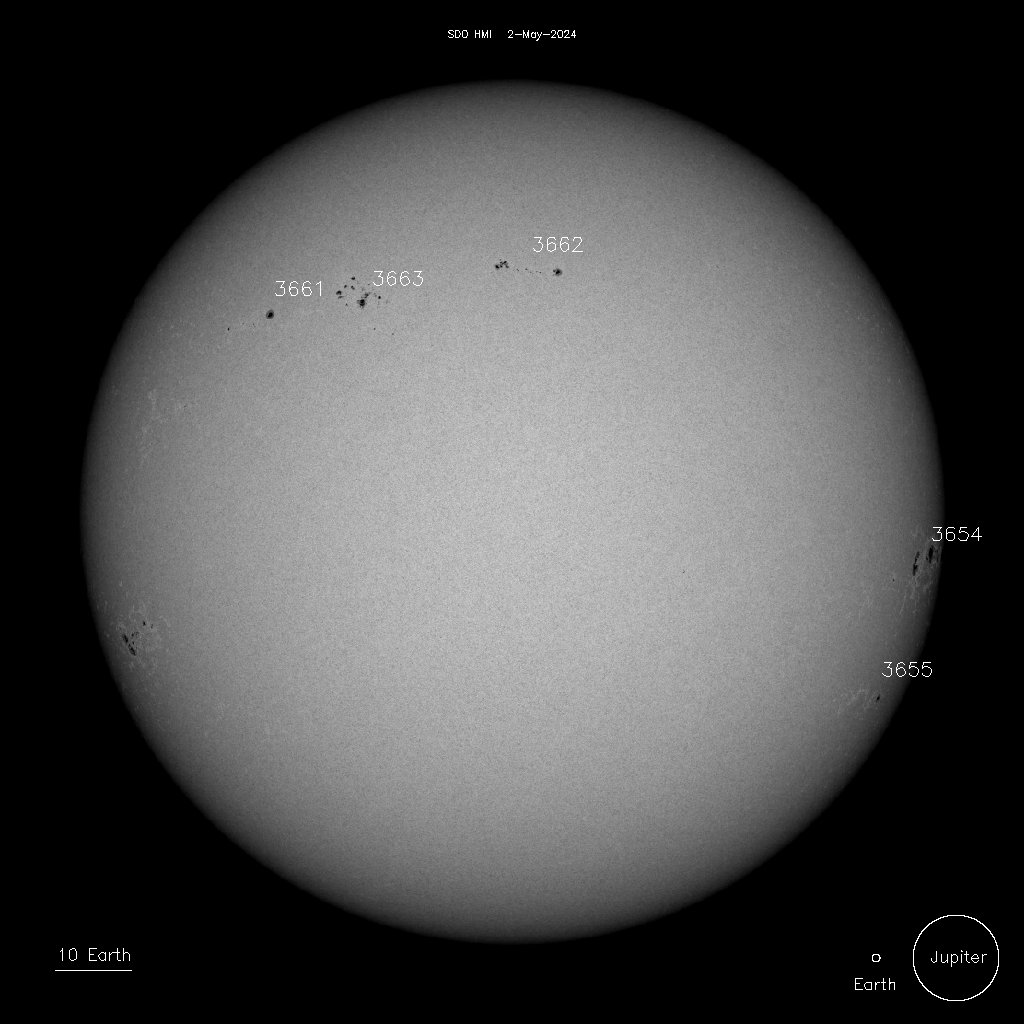
The
solar surface on 4 June 2016 showed no sunspot while SSN = 39.4 for that day.
Doc SOHO/MDI. |
This
means that we need to be very careful and aware to the method used by
astronomers when we use SSN to simulate the radio propagation.
If it is not a good news, in contrast it allows us to better
understand how professionnal calculate it and why all values are not
the same.
Those
proxy values contain assumptions and are often based on statistics over a limited time interval.
In fact, they were often only created to obtain a daily "sunspot number" value, as
the primary sunspot numbers calculated by SIDC were only computed on a monthly basis in the past.
So, they were meant only for temporarily bridging this monthly waiting time for the
real value. However, today SIDC produce also a daily
estimated sunspot number (EISN) directly based on a sunspot observations. That means
that today many of those "quick daily proxies" have become redundant and
largely obsolete as they were produced when the official sunspot number was only published once a month.
As
shows the picture at left of the solar surface with no the least
sunspot, neither EISN or SSN predicted for a specific day will match
with the real number of sunspots. So, for that 4 June 2016, the
predicted SSN for that specific day was 39.4. But this difference does
not call into question the EISN or SSN calculation method. However,
in a simulation software like VOACAP, for that day it can be pertinent
to set the SSN to 0 and to check what difference there is in
propagation chart vs. the default smoothed value. The differences can be
important (in other circumstances, using SSN=100 instead of 125 can reduce the
signal propagation up to 25%).
If
you search for a web site providing the predicted SSN for the current day, Sunspot
Watch provides daily and weekly values as well as the radio flux at 10.7 cm
and other data related to the current and forecasted solar activity. But in all
cases, remember that the SSN listed for a specific day remains a smoothed value, averaged, and
thus does not match with the sunspot number. This lead us to deal with the
calculation method.
Smoothing
method
The
amateur can wonder which smoothing or time averaging should be used? By heritage from the early 20th century,
SIDC provide a serie named "13-month smoothed sunspot
number" (and a copy)
calculated from 1749 to now.
It
is the series that is traditionally used for defining the times of minima and maxima.
Looking on data available on the web, we note that depending on one site to
another, they give either the monthly means, yearly means or this 13-month smoothed number.
This leads to different values for the same time, leading to confusion, especially as sites that mirror some of
SIDC data often don't mention which series they chose. It is not without reason
that SIDC provides a description (info box) for all primary series. On its side
NGDC also provide some kind of documentation in the same FTP directory where the
data files are archived.
Prediction
algorithms
The
prediction issue is more confusing. We need to make a clear distinction between
short-term predictions (trends over one or two years) and predictions of full cycles and the next cycles.
There are several methods or algorithms to predict
sunspots, many of them being available on the web. Certain people like one method over
another; consequently, until recently it was impossible to agree on a "one for all"
method or algorithm. Between scientists, this situation becomes ridiculous !
While trend estimates can be done fairly
reliably thanks to the Lincoln-McNish algorithm, long-term cycle estimates are still
a field of research (there is no consensus and many failures).
To
read : Realiability
of the McNish-Lincoln Technique
for
Predicting Solar Cycle Amplitude in Timing
(PDF)
by
E.Hildner and M.Sue Greer, NOAA, 1990
The sunspot prediction established at
SWPC was officially sanctioned by the International Space Environment Service, ISES.
ISES, with representatives from several different countries, is a permanent
service of the Federations of Astronomical and Geophysical Data Analysis Services (FAGDS).
For years, it was considered by some experts as the "official" forecast. But
other scientists argued that it was not the best and opted for a different method.
Hopefully, today SIDC solved this issue.
|

|
|
Sunspot
cycle and predictions from NASA/MSFC. |
The
solar cycle 24 forecasts
calculated by ISES (cycle 2008~2021) was the outcome of an international meeting
gathering a panel of 12 scientists who met to consider a number of predictions
(including the McNish-Lincoln smoothing function used for the SSN estimation) of
the profile and amplitude of Cycle 24.
Note
that the 24th solar cycle began on
4 January 2008 with the appearence of a magnetic knot at the solar surface,
preceeded on 3
January 2008 with a reversed-polarity bipolar sunspot group.
Precursor
techniques which use cycle behavior in the declining phase of the
previous cycle as a predictor of the next cycle were a big
consideration.
The predicted Cycle
24 minimum and maximum were established and graphed by a curve fit which smoothes
between the most recent observed values and the remaining forecast values, as shown
the graph displayed at right prepared by NASA/MSFC.
There
have been a few revisions, mostly because the cycle maximum prediction of 160
sunspots was considerably off. But the prediction for a March 2000 maximum date was very
good so the overall curve did not change much. Since then, SEC astronomers have
worked with the ISES community again for another update.
NGDC uses a more pure McNish-Lincoln statistical prediction technique that keys
on the date of solar minimum. This method is quite popular, but by the authors
own admission, it is a better near-term solar cycle predictor (1 year). So even
using NGDC value, we can expect some minor fluctuations for short or mid-terms
predictions.
Indeed, theoretically SSN represents predictions for
what we call the "predicted SSN" or simply the SSN. The
smoothing is usually over time periods of about 6 months to one year or more.
Knowing this, both the daily and the monthly values for the sunspot number
will always fluctuate around predicted numbers.
But
in the meantime, science has progressed and models have evolved as well. So,
today we need to forget the possible SSN forecasted by ISES or NGDC and only
refer toSIDC.
Bottom
line Up to now there is no agreement
among institutions, as those different instances of a "sunspot number" are created
for different more narrow purposes. The
sole good news is that from end of July 2015, SIDC released the first end-to-end
revision of the sunspot number. Their sunspot numbers now match the raw numbers
in modern observations. This means that existing software like VOACAP should be
adapted to this change of scale (a warning about this change was broadcasted via
different channels). VOACAP
users
As
explained above, as far as we know, VOACAP algorithms have never been
updated for the new data. As by design, the international sunspot number
(ISN or RI) was formerly 0.6 times lower than raw numbers like the NOAA numbers, and
working for a US company, George Lane chose to design the VOACAP software for the NOAA scale.
Now, as
SIDC suppressed the 0.6 conventional factor in the new recalibrated sunspot number,
it might be actually largely interchangeable with the NOAA numbers (as far as the scale
compatibility is concerned) and thus directly compatible with VOACAP. So, this requires
deeper discussions with the possible new developers of VOACAP program. But as long as
nobody wants to take this project in charge, unfortunately SWLs and radio
amateurs have till to use the "old SSN" released by NGDC.
At
last, as states the VOACAP
Online help : "VOACAP Online knows about the correct SSN values. Therefore
DO NOT set any value to SSN, unless you want to experiment", what confirms what we explained above.
Back
to VOACAP settings
Back
to the review of VOACAP-based propagation prediction software
Back
to Radio amateur activities
|