Research activities for amateurs
Amateur or professional ?
If
each of us can define what are his/her activities as amateur astronomer, what
qualify an astronomer as "professional" ?
Let's
take an example. In the radioastronomy world, many "observers" are in
fact electronics technician or engineer and are paid to maintain and operate
radiotelescopes. Many astronomers specialized in the solar study are
physicists in disciplines other than plain astronomy, etc.
In
other words, we usually qualify as professional people working in the large
field of astronomy but who are engineer or physicists by trade. But does
being paid for climbing on radiotelescopes or operating in a dark room make
them professional astronomers ? Surely not. Or not really.
Take
another example. An amateur operating several nights each year at Pic-du-Midi
monitoring the sun activity or even being paid to observe Jupiter using major
observatory equipment does not qualify him/her as a professional astronomer;
he/she is qualify as an amateur doing professional work.
That
occurs each time a researcher gets some money to do his/her experiments. He
has then to find observers to do the so-called boring job. In some cases
amateurs have the opportunity to do the tedious job of looking the sky all
night long from a far exotic site, compare pictures or measure data plots.
In fact, there are a few happy amateurs whose astronomy pictures are hard to
distinguish of that taken by the Hubble Space Telescope (without getting closer). But do not
dream, these opportunities are not numerous but occasionally it happens.
Some
authors will tell you "amateurs cannot help scientists"
or "due to their lack of support, amateurs cannot compete vs professionals".
Such commentaries are all but true and only reflect their lack of
knowledge on this subject.
Here are clues that confirm amateurs can be very
useful to professionals.
You
will find on the next pages a list of research programs that experienced and well equipped amateurs
can practice successfully
to help professional astronomers. Take your chance
to discover something new !
|
What equipment ?
We
often read here and there or hear in meetings that large amateurs scopes
are useless to conduct a research program. Strange opinion, doesn't it...
Indeed, this assertion is not true. For those who like to do a rigorous
science, large instruments will always be appreciated.
This
idea finds however a logical explanation.
An
amateur trying to get good results in astrophotography or applied sciences
is soon or late interested in buying an instrument as performing as possible
what usually means as large as possible, up to 1 meter of aperture for the
largest and luckiest. And one day he/she enters intothe "realm of professionals".
Usually this people is
almost "lost" for the amateur community. The others, ourselves, remain
and have to satisfy with smaller instruments, largely commercialized which
present occasionally an exceptional quality. But what we lost there we gain
it here by another appreciated advantage : amateurs are not constraint by a
fixed observatory, we have a greater mobility than professionals and may
count on a large number of observers.
So
the remaining question is not to know if such or such people is an amateur
or a professional but rather does he/she wants to make scientific observations
or to participate in a scientific project ? If the answer is largely "yes",
this people should move into the professional community.
The other solution is participating in professional
projects by subscribing first in international amateur networks like ALPO,
AAVSO, NOAO, IMS, ISN. In practice, better to own a telescope to actively
participate in these groups.
If
you do not own any instrument, an alternative to work hand in hand
with professionals is to participate to their project(s) thanks to either
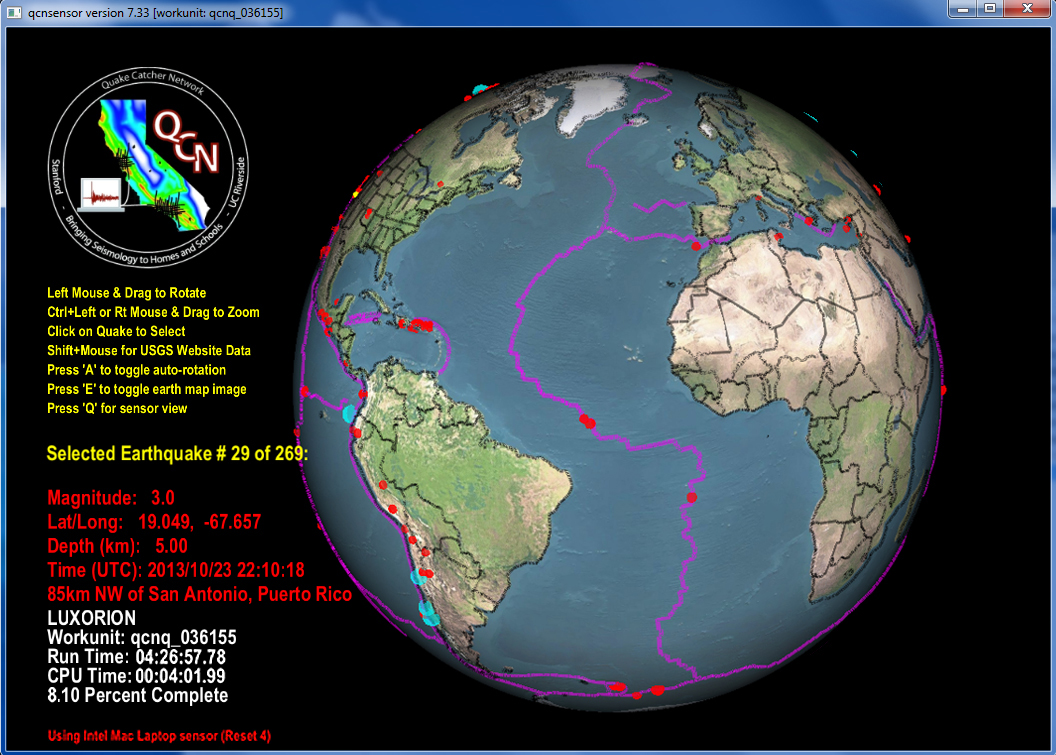
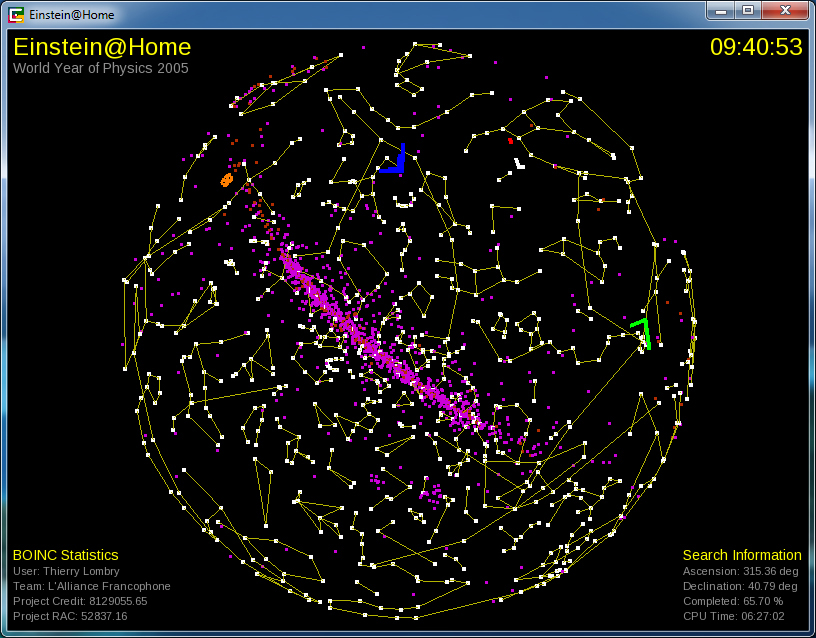
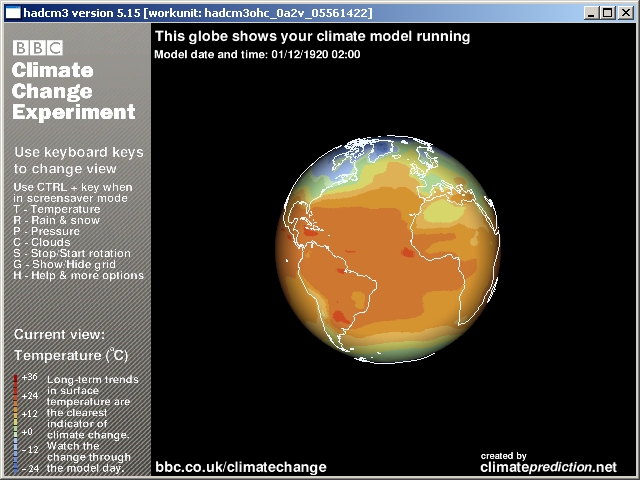
remote robotic telescopes or distributed computing, aka grid applications like Einstein@Home,
SETI@home, etc
(there are more than 130 projects so far).
For
readers using a telescope, there are tens of examples of amateurs
using large but also small instruments, and conducting a scientific
project or having discovered a comet or an asteroïd.
Example
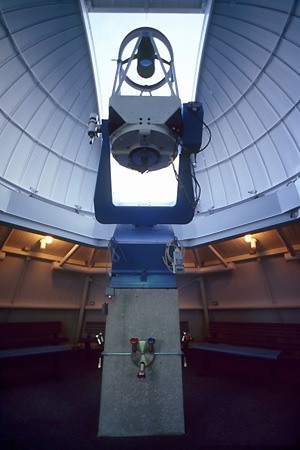
of advanced amateurs conducting monitoring programs with large scopes :
-
The 16" SCT maintained by NOAO is involved in an amateur astrophotography program
-
In Australia, Gordon Garradd's 17.7" is dedicated to the study of asteroids
-
Tim Pucket's 24" conducts a supernovae monitoring program
-
A 29" Obsession is used to do visual magnitude estimations of
bright quasars
-
The "small" 1 meter of Pic-du-Midi is dedicated to amateurs a few nights each year
-
The 3.50 m at Lowell Observatory opens his door to amateurs according a strict
schedule too, etc.
For
smaller budgets and telescopes, discoveries may occasionally happen and
professional results can be achieved :
-
Akira Fujii produces his best results using a reflex camera, 12" scope
and an astrograph.
-
Mark Armstrong discovered several supernovae using a 12" LX200 with CCD
-
The Optical SETI at Columbus uses a 10" SCT
-
Osawa discovered the spikes in Saturn's ring using a homemade 8" scope
-
New comets are till discovered by amateurs using 4" to 8" instruments and CCD
-
New asteroids and supernovae are discovered nearly each month by amateurs using 8" instruments and CCD.
To
read : Eurêka!
What
to do if you find something unusual in the sky ?
 |
 |
 |
 |
|
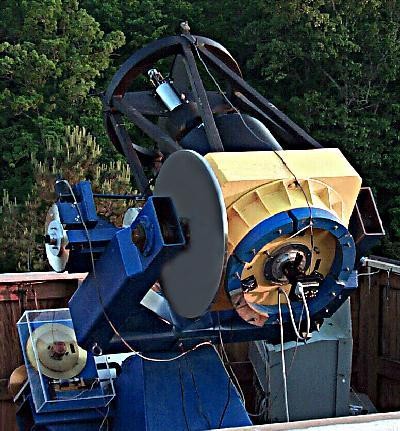
Obs.du Mt-Mégantic
610 mm |
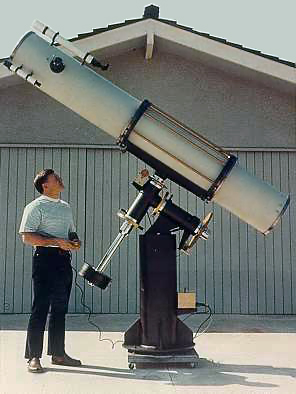
Tim Pucket
600 mm |
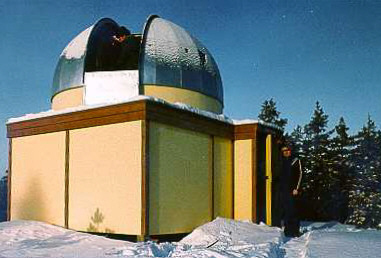
Ralph
Nye
400 mm |
Juan
Salmi
300 mm |
|
Famous
or incognito ?
Amateur
astronomy is a hobby first, that brings you enjoyable moments of relaxing
while your mind is directed towards the sky and its mysteries. The purpose
of this hobby depends on your resources, both in time and financial
participation and of course of weather conditions.
This is to you to decide what you want to spend in this
activity. According to your decision you will buy a more or less large scope
and more or less accessories. You are free to work alone or sharing your
knowledge with the members of a club. If you like applied sciences you can
conduct some scientific observations otherwise nobody will hurt you if you
simply look at the sky for the pure pleasure, what most of amateurs do. For
an amateur Science must be consider as a bonus rather than a basic
requirement. Of course for a minority of us it will be always gratifying to
know the why and the how of things.
I
am always amazed by the fact that many of my friends amateur astronomers are
doing astronomy but with no desire to join in a club or to be known. They do
their observations and go throughout life nearly incognito. Many of them use
medium scopes (8-12") but complete them with expensive accessories
transforming their observatory in a mini-Palomar and do a rigorous
scientific job. Sometimes they temporary acquire some celebrity in
publishing a report in an international magazine or are visited by the local
television. But quickly this attitude slows down.
These
amateurs are known in some regional circles but very few really know how these
amateurs work once back under their dome or in their garden.
Some
of these famous unknown discover a few supernovae each year. Others record
light variations of some 60 variables stars each night using robotic telescopes, while
others discover asteroids using CCD or Sun grazer comets by analysing SOHO
pictures. All these activities are fascinating
and erect these amateurs on places envy by professionals ! But the celebrity
does not interest them.
The
most amazing is that these days there are amateurs who are not intimated by
NASA near daily discoveries and the differentiation between their both
investments in rigorous science, the first sparing his few bucks each year
to buy his expensive accessories, the second searching for billionaires
sponsors.
But
the first, the clever amateur, own something more than NASA, le Feu-sacré,
the feeling to be the first, the one "suited" for that activity as nobody
else, because this is all his live, his small but useful participation in
the big Science.
These
amateurs, fierty of our community have to be preserved by maintaining the
amateur status. Because if we had to work as NASA, blasting our instruments
in pieces for economical reasons, then there would not have had place for
people like Hershel, lord Rosse and their peers. Hopefully we have preserved some
vocations, the one of explorers able to be fascinated by a variable star,
the slow move of an asteroid or the blast... of a supernova.
Useful
reading
Eurêka
(on this web)
The Sky is Your Laboratory: Advanced Astronomy Projects for Amateurs,
Robert K. Buchheim, Springer Praxis, 2007.
List of
Research activities
Back
to Reports & Reviews
|