ICTIOPLÂNCTON DA REGIÃO CENTRAL
DA COSTA PORTUGUESA E DO ESTUÁRIO DO TEJO
ECOLOGIA DA POSTURA E DA FASE
PLANCTÓNICA DE SARDINA PILCHARDUS(WALBAUM, 1792) E DE ENGRAULIS
ENCRASICOLUS (LINNÉ, 1758)
LISBOA
1984
ABSTRACT
Very few studies have
been made in Portugal on marine fish eggs and larvae. The present work deals
with: (i) the diversity and abundance of the ichthyoplankton along the central
portion of the portuguese coast and within Tejo estuary; (ii) The ecology of
the spawning and of the planktonic phase of Sardina pilchardus (Walbaum,
1792); (iii) The ecology of the spawning and of the planktonic phase of
Engraulis encrasicolus (Linné, 1758), within Tejo estuary. Fish eggs and
larvae were sampled over a period of two years off the central part of the
Portuguese coast and over a period of four years within Tejo estuary. The
diversity and abundance of the ichthyoplankton was analysed and related with
upwelling conditions and plankton biomass. Ichthyoplankton diversity was
highest in spring and summer and lower in winter, along the central part of the
Portuguese coast. Off the coast of Sines (1981/1982) the diversity of the
ichthyoplankton was probably influenced by upwelling conditions. Within Tejo
estuary the diversity was, with few exceptions, highest at exterior stations
and lower at interior stations during the four year survey (1978/1981). A
significant correlation was found to exist between plankton biomass and the
number of larvae sampled per month at each station off the coast of Peniche
(1979/1980). Within Tejo estuary the ichthyoplankton was nearly always more
abundant at interior stations. Sardina pilchardus eggs and larval stages
were the most abundant forms sampled along the central part of the Portuguese
coast. The analyses of the Euclidean distance cladograms of collected fish
larval stages, showed that off the central part of the Portuguese coast the
stations sampled were not very dissimilar and that there was not a definite gradient
of ichthyoplankton abundance. Within Tejo estuary interior stations were
normally very dissimilar in relation to the lower estuary. It was included
under the designations of winter spawners, spring spawners, summer spawners and
autumn spawners the species whose eggs and larvae were captured along the
central part of the Portuguese coast during these seasons. Within Tejo estuary
it was possible to distinguish between the species that use the estuary as a
primary spawning area from those that do not. The eggs of Sardina pilchardus
were sampled throughout a period of twelve months along the inshore waters of
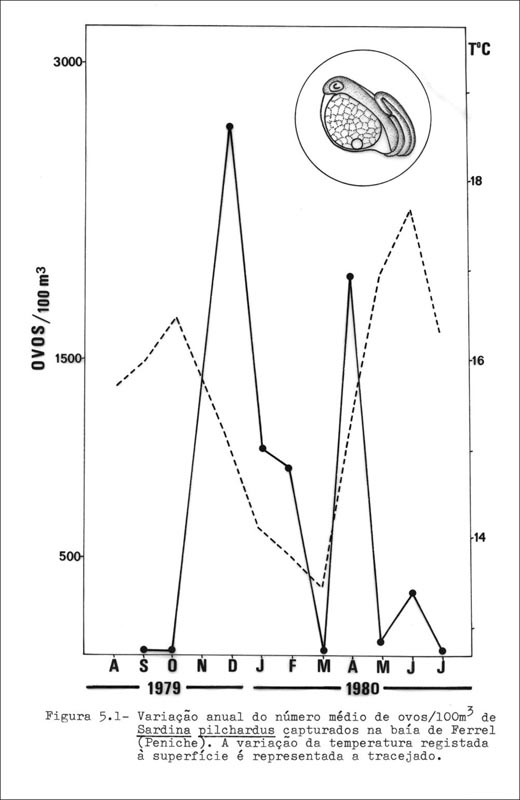
the central portion of the Portuguese coast. Peak periods were found in
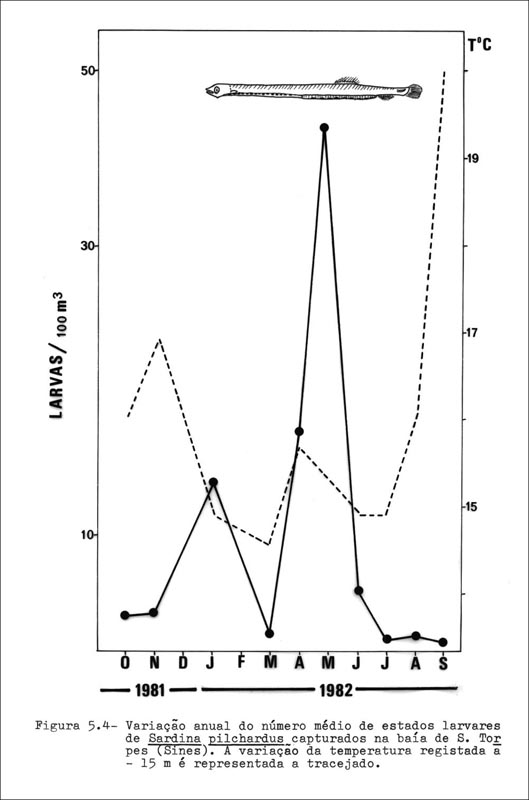
December and April (1979/1980) off the coast of Peniche and in March and June
(1981/1982) off the coast of Sines. Spawning was temperature dependent. Eggs
were sampled in greatest numbers when water temperatures were not higher than
15‑16ºC. Off the coast of Sines the upwelling conditions influenced both
spawning activity and duration. The existence of two spawning peaks off the
coast of Peniche in 1979/1980 was related to the age structure of the
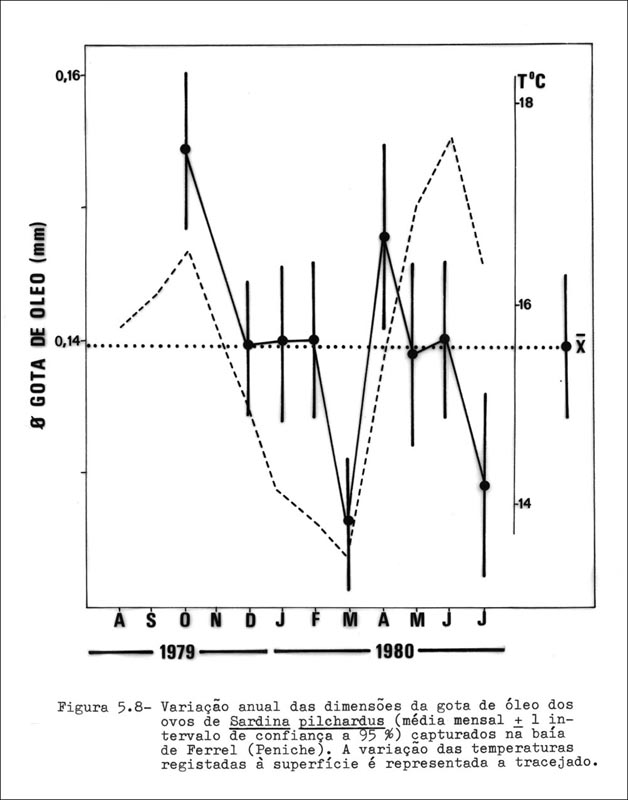
spawners. The size and relative mortality of pilchard eggs varied seasonally.
The time of spawning was deduced from the presence of early stage eggs in the
plankton. Sardina pilchardus seems to spawn during the first hours of
darkness. Pilchard larvae showed a clear diel vertical migration being found
predominantly at a daytime depht somewhere near 20 meters and at the surface
during the night. Larvae also showed a cycle of feeding activity, suggesting
that feeding took place mainly if not exclusively during daytime. Sardine
larvae were aged using daily growth increments in sagittal otoliths. Growth
and thickness of daily units were found to varie in relation to the time of
the year. This variation was related to differences in food availability and
different feeding conditions. No obvious relationship was found with
temperature. The hour of the formation of the two parts of each daily unit
(organic and inorganic) was established. The protein‑rich portion of the
daily increment is deposited during the first hours of darkness. The
initiation of a new daily growth increment begins around midnight. The number
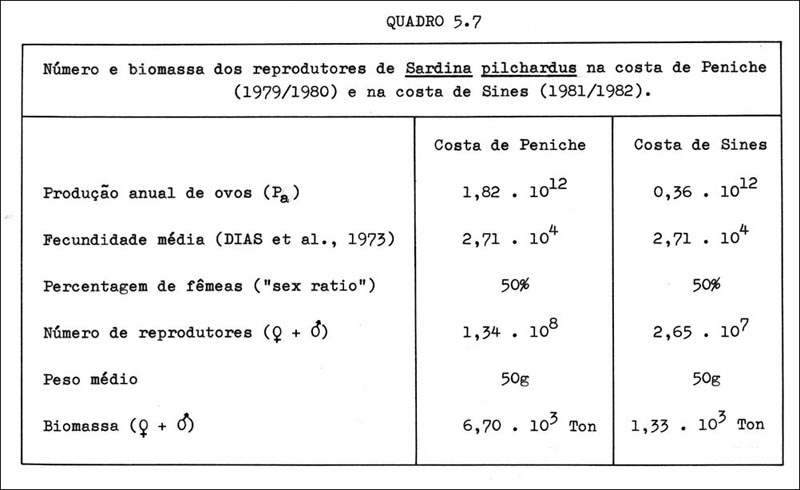
and biomass of Sardina pilchardus spawners was estimated from
quantitative egg surveys: coast of Peniche (1979/1980) (6,70.103
Ton); coast of Sines (1981/1982) (1,33.103 Ton). The eggs and larval
stages of Engraulis encrasicolus were sampled troughout a period of six
months (February to July) during four years (1978/1981) within Tejo estuary.
Spawning activity was highest in April and took place with greater intensity at
the interior portions of the estuary. The fact that anchovy larvae were present
in greater concentrations in the upper portions of Tejo estuary, and that
larvae of higher length‑classes were always found at interior stations,
led us to believe that there must be some mechanism responsible for its
retention within the estuary. Egg mortality increased and its dimensions
decreased as the spawning season progressed. Anchovy showed a crepuscular
spawning; early stage eggs were found between 18:00 and 00:30h, local time.
Retention of anchovy larvae within Tejo estuary was also studied. This
retention was mainly associated with the location of the spawning grounds and
coupled with the average conditions of water circulation inside the estuary.
O estudo dos ovos e dos
estados larvares planctónicos dos peixes (isto é do ictioplâncton) tem
contribuído sobremaneira para o avanço da investigação da biologia marinha,
nomeadamente nos domínios da ictiologia. Os diferentes aspectos desse estudo
podem ser sintetizados do seguinte modo (HEMPEL,1973; AHLSTROM & MOSER,
1976, 1981):
(i) Estudos de biologia e
sistemática
‑ Estudos do
desenvolvimento, crescimento, mortalidade, hábitos alimentares e comportamento
dos estados larvares dos peixes, relacionados com alguns factores ambientais.
‑ Clarificação da
posição sistemática e/ou filogenética de certas espécies ou grupos de espécies.
‑ Estudos da ecologia dos estados
larvares.
(ii) Estudos de
identificação e avaliação de recursos pesqueiros e dinâmica de populações.
‑ Conhecimento das
épocas de postura a partir do período de captura dos ictioplânctontes.
‑ Delimitação das
áreas frequentadas pela população adulta no momento da postura (área de
postura).
‑ Estimativa da
biomassa da população adulta através da avaliação da abundância e distribuição
dos ictioplanctontes.
‑ Estimativa do
recrutamento larvar anual resultante da postura antecedente.
‑ Avaliação das
abundâncias relativas dos "stocks" de espécies de interesse
económico.
‑ Avaliação das
modificações espacio‑temporais da composição e abundância dos recursos
pesqueiros .
‑ Identificação e
avaliação de novos recursos pesqueiros.
O início do estudo dos
ovos e estados larvares dos peixes situa‑se no final do século XIX. Em
1865, G. 0. SARS efectua as primeiras investigações sobre a pesca de Gadus.
Estes mesmos factos contribuíram para que
diversos autores se tenham debruçado sobre o estudo da postura de algumas
espécies comercializáveis, particularmente na Europa, no período que decorreu
de 1880 a 1900.
Verificou‑se deste
modo que a maioria das espécies com interesse económico possuíam ovos e
estados larvares planctónicos. Podem‑se citar como pioneiros trabalhos de
investigadores ingleses tais como: CUNNINGHAM (1889, 1896); M'INTOSH &
MASTERMAN (1897); M'INTOSH & PRINCE (1890); HOLT (1899), de alemães como
EHRENBAUM (1905‑1909) e de italianos como RAFAELE (1888). Através de
fecundações artificiais no laboratório estes autores puderam descrever os ovos
e primeiros estados larvares de cerca de 80% dos teleósteos de interesse
comercial com um pormenor suficiente para permitir a identificação segura dos
ictioplanctontes susceptíveis de serem capturados na área em que efectuaram os
seus estudos.
A descrição dos estados
larvares mais avançados só pôde ser levada a cabo após a utilização
generalizada de engenhos de colheita de plâncton, os quais foram pela primeira
vez aperfeiçoados e usados com este fim por C. G. PETERSEN. Com o auxílio das
referidas redes de plâncton, concebidas para a colheita de ictioplanctontes,
foi possível filtrar um volume de água suficiente para se capturarem a maioria
dos estados larvares dos teleósteos.
Estes estudos foram
empreendidos no início do século XX (1900 a 1930) fundamentalmente por dois
investigadores dinamarqueses: SCHMIDT (1905, 1906, 1909, 1918) e PETERSEN
(1904, 1905, 1909, 1917, 1919) e ainda por CIARK (1914, 1920), FORD (1920,
1922a, 1922b) e IEBOUR (1919c, l919d, 1920a, 1921a). De entre estes autores há
que salientar os trabalhos dos dois primeiros que constituíram um ponto de
partida para a realização de publicações subsequentes.
SCHMIDT (1905), num
primeiro trabalho que publicou sobre a descrição de algumas espécies atlanticas
da família Gadidae, refere o processo que seguiu com vista ao estabelecimento
de séries cronológicas dos estados larvares, que passamos a citar: "the
order of procedure has been, to begin with such older stages as were so far
developed, that they could be identified from characters similar to those which
mark the adult fish. Then, earlier and still earlier stages were taken and compared with the
older, and the determinations were in this maner, if the material was rich
enough, successfully carried down to the youngest, postlarval stages, attention
being directed to certain outstanding characters whose sucessive development
could be followed through the development series. The method thus employed for
the determination of unknown pelagic fish‑young might be called the series‑method,
and it stands in contrast to the hatching‑method in that, instead of
making the certain starting‑point with the egg and following its further
development onwards (...), it begins at the opposite end with the oldest sbages
and follows the development backwards. The condition for being able to use the
series‑method is, that a large material has to be at disposal, but in
such cases it will lead to certain results, especially if the material contains
whole series of the species".
A metodologia descrita
foi fundamentalmente seguida por autores subsequentes tendo‑se desta
maneira descrito os ictioplanctontes de um grande número de espécies.
O referido autor é, no
entanto, mais conhecido pelos trabalhos que efectuou sobre a enguia europeia (Anguilla
anguilla), particularmente no que diz respeito ao estabelecimento da área
preferencial de postura (SCHMIDT, 1923).
EHRENBAUM (1905‑1909)
compilou, num trabalho em dois tomos, os conhecimentos adquiridos até à data,
sobre os ovos e estados larvares dos peixes marinhos do Atlântico nordeste. 0
referido trabalho constitui ainda hoje uma referência fundamental para a
identificação dos ovos e estados larvares planctónicos de teleósteos.
Os trabalhos pioneiros de
SANZ0‑ que publicou entre 1905 e 1940 cerca de 65 contribuições para o
conhecimento dos ictioplanctontes que ocorrem no mar Mediterrâneo serviram de
base à elaboração de uma monografia intitulada "Uova, larve e stadi
giovanili di Teleostei" que surgiu integrada na série de estudos
efectuados sobre a fauna e flora do golfo de Nápoles. A referida monografia foi
publicada em quatro tomos durante um período de cerca de 25 anos (1931-1956),
tendo sido elaborada a partir de material biológico relhido por S. Lo BIANCO.
Este último, no entanto, não surge como autor de nenhuma secção da monografia,
sendo D'ANCONA o responsável pela sua edição (D'ANCONA et al., 1931‑1956).
BERTELSEN (1951) foi o
primeiro autor a utilizar os caracteres larvares na revisão sistemática de um
grupo de peixes marinhos (Ceratoidei). Este autor, recorrendo ao uso de
caracteres ontogenéticos e do animal adulto, pôde resolver alguns problemas
relacionados com a diagnose específica, dimorfismo sexual e filogenia do grupo.
A profusão de trabalhos
publicados sobre este tema demonstra bem o interesse que tem a inclusão futura
de caracteres larvares no estudo das relações filogenéticas entre os diversos
taxa.
O grande número de
trabalhos efectuados até à data sobre os ovos e estados planctónicos dos
teleósteos contribuiu para que se conheçam os ictioplanctontes de cerca de 2/3
das 450 famílias actuais (NELSON, 1976) de peixes marinhos (AHLSTROM &
MOSER, 1981).
Após um período inicial
em que a investigação se debruçou sobre a inventariação e descrição dos
ictioplanctontes recolhidos, o trabalho subsequente incidiu prioritariamente
sobre a delimitação das épocas de postura, assim como sobre o cálculo dos
"stocks" de algumas espécies com interesse económico, a partir da
colheita de ictioplanctontes.
Com efeito, a partir da
estimativa do número de ovos emitidos por uma dada espécie no decurso do seu
ciclo anual de reprodução (produção anual), e com base no conhecimento da fecundidade
absoluta das fêmeas, é possível calcular o número de indivíduos do referido
sexo que participaram da postura. Acresce ainda que, se se conhecer a proporção
de fêmeas na população ("sex ratio") e o peso médio dos indivíduos
que a compõem, é possível avaliar o número de reprodutores dos dois sexos assim
como a sua biomassa.
Além do referido cálculo
retroactivo, pode‑se ainda considerar um cálculo preditivo que a partir
do estudo da mortalidade larvar permite avaliar o recrutamento resultante da
postura antecedente.
Deste modo a estimativa
da abundância (N) e da biomassa (B) dos reprodutores pode ser calculada a
partir das seguintes fórmulas (SAVILLE, 1964, 1977; ULLTANG, 1977):
N ♀♂
=P / F x K
B
♀♂ =N ♀♂ x pm
em
que:
P=número
de ovos emitidos por uma dada espécie no decurso do seu ciclo anual de
reprodução (produção anual)
F=número
médio de ovos emitidos por uma fêmea adulta durante uma época de postura (fecundidade
"sensu lato ")
K=proporção
de fêmeas na população ("sex‑ratio")
pm=peso
médio dos indivíduos que compõem a população
Os primeiros trabalhos
efectuados com o fim de se calcularem os "stocks" de algumas espécies
de interesse económico a partir de colheitas de ictioplanctontes foram
realizados por AHLSTROM (1943, 1954, 1959) e SETTE & AHLSTROM (1948) para a
sardinha do Pacífico, por TANAKA (1955a, 1955b) para a sardinha japonesa e por
SAVILLE (1956), CUSHING (1957), SIMPSON (1959) e BRIDGER (1960) para algumas
espécies do Atlântico nordeste.
Os principais erros
decorrentes da estimativa do "stock" de uma dada espécie por este
processo são principalmente devidos ao cálculo da produção anual de ovos e/ou
larvas (ENGLISH, 1964; SAVILLE, 1964; ULLTANG, 1977).
Estas estimativas exigem,
no entanto, que se faça uma cobertura espaçio‑temporal da postura da
espécie estudada, o que requer a utilização de meios operacionais importantes.
A avalição do
recrutamento larvar resultante da postura antecedente, assim como a sua variação
anual, implica o acesso à estimativa da mortalidade larvar, bem como às suas
causas.
E necessária, no entanto,
uma melhor compreensão das condições ecológicas experimentadas pelos primeiros
estados de desenvolvimento dos peixes para que as previsões do recrutamento se
tornem menos aleatórias (SAVILLE & SCHNACK, 1981).
O estudo destes
parâmetros permitiu desenvolver novas linhas de trabalho, isto é, estudos de
dispersão, crescimento e mortalidade larvar e dos factores ambientais susceptíveis
de os controlar.
A sobrevivência larvar
depende fundamentalmente das condições ambientais (bióticas ou abióticas), das
disponibilidades alimentares no momento da primeira alimentação após a
absorção das reservas vitelinas e da acção de predadores, podendo os referidos
parâmetros interactuar (HUNTER, 1976).
Os primeiros estudos
efectuados sobre os hábitos alimentares de alguns estados larvares planctónicos
de peixes foram realizados por LEBOUR (1918, 1919a, 1919b, 1920b, 1921b, 1924),
trabalhos estes que serviram de ponto de partida para numerosas publicações
ulteriores sobre a ecologia alimentar na fase larvar dos teleósteos.
A acção de zooplanctontes
como potenciais predadores foi ainda analisada pela primeira vez por LEBOUR
(1922, 1923, 1925). Esta autora mostrou que certos organismos zooplanctónicos
predavam activamente os primeiros estados larvares dos peixes. Muito poucos
trabalhos ulteriores foram realizados sobre este tema, o que torna difícil a
avaliação da importância que este factor tem na sobrevivência larvar.
A determinação da idade e
das taxas de crescimento dos estados larvares dos peixes foi grandemente
facilitada e melhorada após os trabalhos realizados por PANNELLA (1971, 1974) e
BROTHERS et al. (1976). Estes autores mostraram que certas marcas
observáveis nos otólitos dos peixes adultos e no estado larvar, correspondiam a
anéis de crescimento diário, cuja contagem permite, um cálculo rigoroso e
seguro da idade. BROTHERS
et al.(1976) verificaram que o primeiro anel se de posita, nas larvas de Engraulis
mordax, após a absorção das reservas vitelinas.
O mesmo autor num
trabalho ulterior (BROTHERS, 1981) refere que a micro‑estrutura dos
otólitos pode fornecer dois tipos de informação: (i) a que se baseia na
contagem dos anéis de crescimento diário, única forma de determinar com
precisão a idade de uma dada larva, e a partir da qual se podem estimar taxas
médias de crescimento e datas de eclosão, podendo a referida informação ser
posteriormente utilizada no estudo das taxas de mortalidade, sucesso do
recrutamento larvar e localização de áreas de postura; e (ii) a que se baseia
no estudo da espessura, constituição e estrutura sub‑diária dos anéis
diários, como fonte adicional de informação sobre vários aspectos do ciclo
vital dos peixes. Exemplos de aplicações de dados desta natureza incluem a
determinação directa de: padrões diários de crescimento dos indivíduos em
função da espécie e das condições ambientais; efeitos a curto prazo de algumas
variáveis ambientais, como o ciclo diário da temperatura das águas,
fotoperíodo, e ritmicidade da alimentação no crescimento dos indivíduos
capturados na natureza ou criados em condições experimentais; altura exacta de
movimentos ou transições no ciclo de vida, como a passagem de uma fase larvar
planctónica para uma existência bentónica dos juvenis entre outros.
As causas da formação,
deposição e desenvolvimento das unidades de crescimento diário são ainda mal
conhecidas. Alguns autores relacionaram a formação destes incrementos com a
acção directa de certos factores ambientais, como o fotoperíodo, a ritmicidade
da alimentação ou a flutuação diária da temperatura das águas. Há, no entanto
razões para crer que os referidos parâmetros podem interactuar e que existe na
realidade uma ritmicidade endógena responsável pela formação das unidades
diárias de crescimento. Este eventual ritmo endógeno pode ser mais ou menos
afectado por certos factores ambientais podendo a sua influência relativa
variar nas diferentes espécies de peixes sujeitas naturalmente a condições ecológicas
diversas (cf. 5.8).
O estudo dos
ictioplanctontes que ocorrem nos estuários revela‑se de muito interesse,
uma vez que permite avaliar o papel que os referidos estuários desempenham no
ciclo vital de algumas espécies de peixes. Através de colheitas quantitativas
realizadas no interior e nas regiões adjacentes de um estuário, pode‑se
determinar se uma certa espécie se reproduz preferencialmente naquela área,
assim como se existem eventuais movimentos larvares responsáveis pela retenção
dos estados planctónicos no seu interior. Para algumas espécies ainda, o
estuário pode funcionar como uma "nursery", isto é, como um local de
alimentação e protecção dos estados juvenis. Este facto só pode ser comprovado
se fôr realizado, juntamente com as colheitas de ictioplanctontes, um outro
tipo de amostragem tendente a avaliar a distribuição das formas jovens (RÉ et
al., 1983; RÉ, 1983d).
O estudo dos ovos e
estados planctónicos dos peixes que ocorrem ao longo da costa portuguesa tem
sido objecto de um número reduzido de trabalhos. RAMALHO (1927, 1929, 1933)
foi o primeiro autor a fazer algumas referências respeitantes à época de
postura de Sardina pilchardus. FAGE (1920) havia já colhido alguns ovos
e estados planctónicos de sardinha em diversas estações repartidas pela costa
portuguesa, tendo chegado a conclusões idênticas às referidas por RAMALHO (ops
cits), no tocante ao período de postura desta espécie.
Mais recentemente SOBRAL
(1975), baseando‑se numa série de campanhas efectuadas ao longo da costa
portuguesa no período que decorreu de Janeiro de 1971 a Janeiro de 1974 estudou
a distribuição anual da postura de Sardina pilchardus e Engraulis
encrasicolus assim como a variação dos biovolumes de zooplancton.
Os primeiros estudos
preliminares relativos à ocorrência, abundância, distribuição e ecologia do
ictioplâncton marinho português foram realizados por RÉ (1979a, 1979b, 1981a,
1981b, 1983a, 1983b, 1983c, 1983d) e RÉ et al. (1982, 1983). As
referidas publicações incidiram sobre a delimitação temporal das posturas de
algumas espécies de peixes marinhos portugueses (RÉ, 1979a ; RÉ et al.,
1982); sobre alguns aspectos da ecologia da postura de Sardina pilchardus
(RÉ, 1981b); sobre o crescimento das larvas de sardinha baseado no estudo dos
anéis micro‑estruturais de crescimento enumerados nos seus otólitos (RÉ,
1983a, 1983b, 1983c) e ainda sobre o ictioplâncton do estuário do Tejo e
ecologia da postura de Engraulis encrasicolus no interior do referido estuário
(RÉ, 1979b, 1983d; RÉ et al., 1983).
Os objectivos do presente
trabalho podem ser sintetizados em três pontos principais a serem
desenvolvidos em três capítulos distintos:
(i) Estudo da diversidade
e abundância do ictioplâncton na região central da costa portuguesa e no
estuário do Tejo.
(ii) Estudo da ecologia
da postura e da fase planctónica de Sardina pilchardus ao longo da região
central da costa portuguesa.
(iii) Estudo da ecologia
da postura e da fase planctónica de Engraulis encrasicolus no interior
do estuário do Tejo.
As colheitas de
ictioplanctontes levadas a cabo na região central da costa portuguesa foram
realizadas no âmbito de dois projectos de estudos aplicados referentesa
contratos celebrados com a Electricidade de Portugal (EDP). Ambos os projectos
foram coordenados pelo Prof. L. SALDANHA estando relacionados com a eventual
instalação de uma central nuclear (região de Ferrel/Peniche, 1979‑1980)
e de uma central térmica (região de S. Torpes/Sines, 1981‑1982).
Consistiram em estudos de sítio e de impacto das referidas centrais nas regiões
marinhas adjacentes.
A realização de colheitas
no âmbito dos projectos referidos permitiu estudar os povoamentos marinhos
litorais das duas regiões mencionadas, sobretudo no que diz respeito à
caracterização das comunidades fitoplanctónicas e zooplanctónicas, ao estudo da
diversidade e abundância dos ictioplanctontes e ainda ao estudo da ecologia da
postura e da fase planctónica de Sardina pilchardus.
Foi sobretudo a partir de
meios operacionais postos à disposição durante a realização dos supracitados
projectos que foi possível levar a cabo os estudos em que se baseia parte do
presente trabalho.
O estudo do ictioplâncton
do estuário do Tejo foi empreendido como parte integrante do "Projecto de
Estudos do Estuário do Tejo". O referido projecto coordenado pela Comissão
Nacional do Ambiente, sendo o Prof. L. SALDANHA responsável pelo sub‑grupo
de Biologia, permitiu a realização de várias campanhas durante um peródo de 4
anos (1978‑1981), tendo sido possível abordar problemas relacionados com
a reprodução de algumas espécies no interior do estuário assim como o estudo
da ecologia da postura e da fase planctónica de Engraulis encrasicolus.
Com vista à prossecução
dos objectivos atrás definidos, foram prospectadas três áreas distintas da
região central da costa portuguesa: costa de Peniche, costa de Sines e
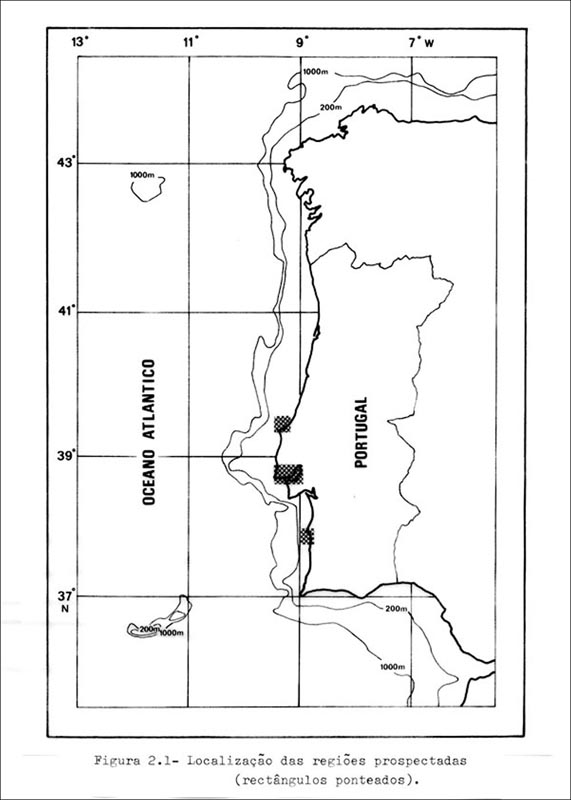
estuário do Tejo (Figura 2.1).
A época em que se
realizaram as campanhas foi diferente no que respeita às duas zonas costeiras
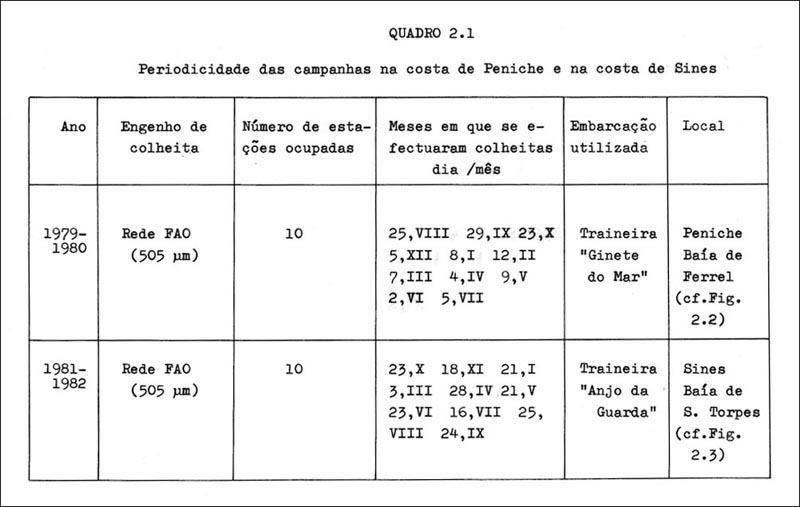
marinhas. Assim, foram feitas colheitas de ictioplanctontes na região de
Ferrel (Peniche) no período que decorreu de Agosto de 1979 a Julho de 1980 e na
região de S. Torpes (Sines) entre Outubro de 1981 e Setembro de 1982. Em ambos
os casos tentou‑se, tanto quanto possível, realizar campanhas para
colheita de ictioplanctontes com uma periodicidade mensal. Deste modo, na
costa de Peniche efectuaram‑se 11 cruzeiros enquanto que na costa de
Sines se realizaram 10 cruzeiros (QUADRO 2.1).
A metodologia seguida
aquando da colheita de plâncton, assim como a área prospectada e o número de
estações ocupadas, foram idênticasnas duas regiões mencionadas. Desta
maneira, tanto na costa de Peniche como na costa de Sines prospectou‑se
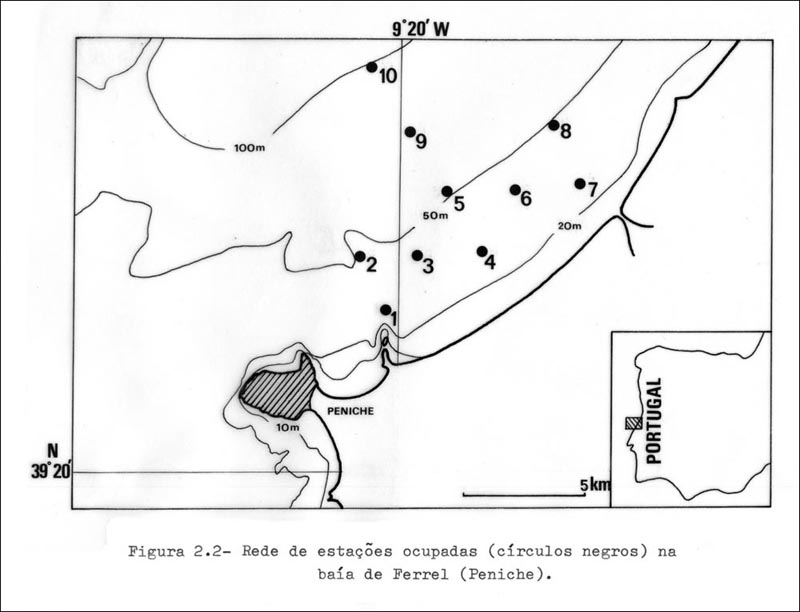
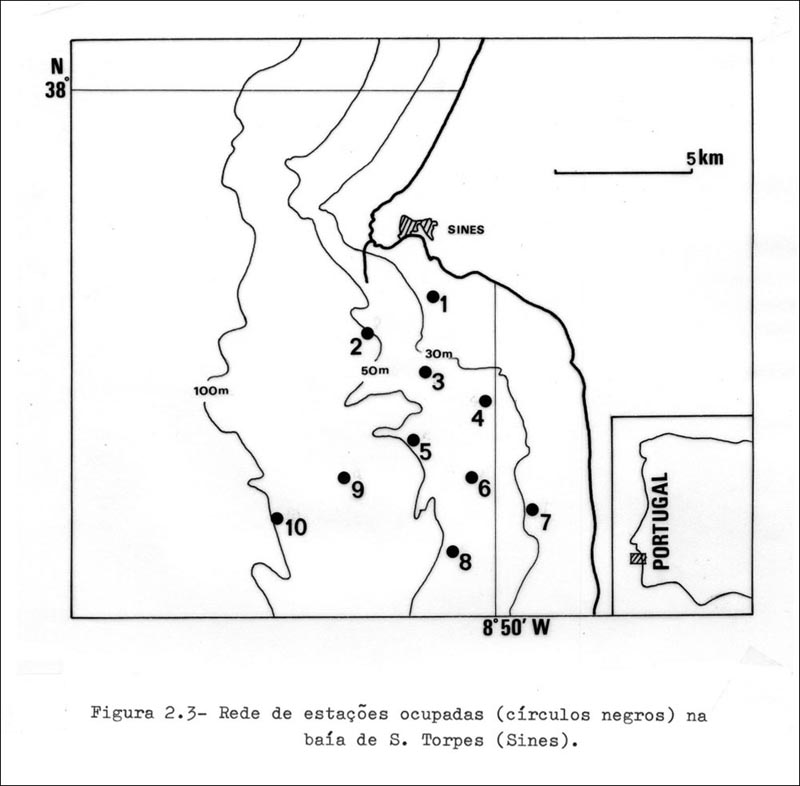
uma área de aproximadamente 90 km2. As colheitas foram efectuadas
em 10 estações (Figura 2.2 e 2.3) estabelecidas ao longo de três radiais
paralelas e uma radial perpendicular à linha de costa, entre as isóbatas dos
30 e dos 100 metros. As referidas estações foram escolhidas tendo em vista a
avaliação da existência de eventuais gradientes de abundância de
ictioplanctontes costa‑largo.Realizaram‑se colheitas em
oito estações entre as isóbatas dos 30 e 50 metros e em duas estações com
profundidades médias de 75 e 100 metros (cf. Figura
2.2 e 2.3).
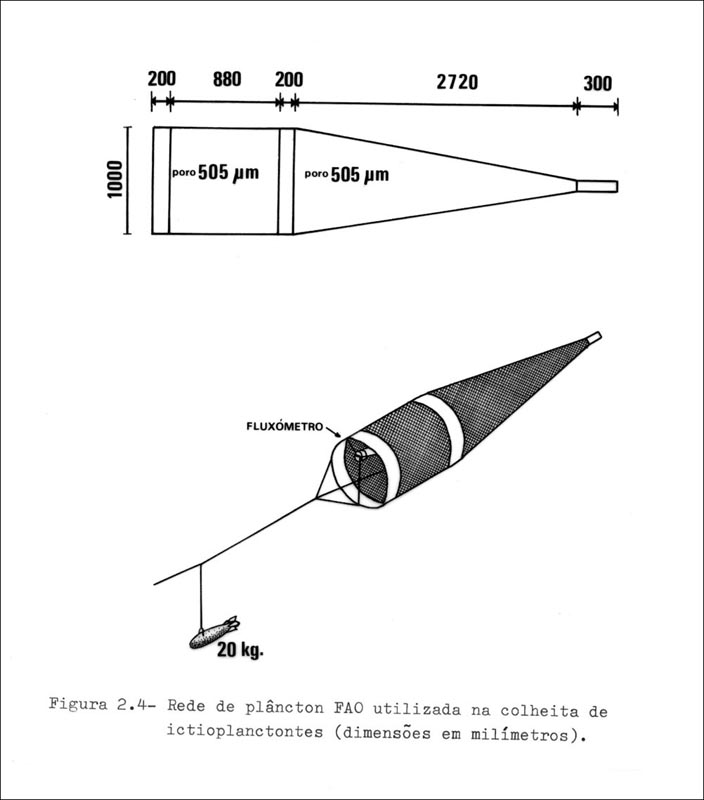
As colheitas de
ictioplanctontes foram efectuadas nas duas zonas referidas com uma rede de
plancton FAO. Esta foi concebida para a colheita de larvas de Tunídeos e
consiste num engenho cilindrico‑cónico com 1 metro de abertura (área da
boca de 0,785 m2), 4 metros de comprimento e 505 μm de poro (FA0, 1967, 1969, 1972)
(Figura 2.4). 0 copo colector onde se
recolhe a massa de plâncton consiste num cilindro de polivinilo com duas
aberturas laterais cobertas por uma rede metálica de poro igual ao da rede de
plâncton.
Os métodos de colheita
foram idênticos ao longo das campanhas realizadas. A rede foi, em todos os
casos, arrastada num trajecto oblíquo a uma velocidade constante de 1, 5 a 2
nós, durante um período máximo de 10 minutos. O volume de água filtrado foi
medido com o auxílio de um fluxómetro Kahlsico 005WA200, tendo variado entre
204 e 445 m3 (x=318 m3, s=57, n=113) nas colheitas
realizadas na costa de Peniche, e entre 101 e 445 m3 (x=307 m3,
s=144, n=100) nas colheitas efectuadas na costa de Sines.
A rede de plâncton foi
arrastada até uma profundidade máxima sensivelmente igual a metade da
profundidade de cada estação. Utilizou‑se um inclinómetro com o fim de
controlar o ângulo (α) que o cabo utilizado apresentava relativamente à vertical, tendo‑se
ainda lastrado a rede com um peso de cerca de 20 kg. (Figura 2.4). A profundidade máxima atingida
pela rede pôde, deste modo, calcular‑se através da expressão:
Comprimento
do cabo largado. coseno α=profundidade máxima atingida pela rede
Teve‑se ainda o
cuidado de manter a velocidade de arrasto constante ao longo do tempo de
amostragem (10 minutos). Assim, a velocidade com que o cabo foi largado foi
sempre cerca de duas vezes superior à velocidade com que este foi recolhido.
Optou‑se por
arrastar a rede de plâncton num trajecto oblíquo por duas razões principais:
(i) por este processo de amostragem ser de maior precisão relativamente ao arrasto
vertical e (ii) por se poder amostrar toda a extensão da coluna de água e ainda
filtrar um volume de água importante (>100 m3) (HEMPEL, 1973).
A velocidade de arrasto
de 2 nós foi escolhida (100 cm/seg.) com o intuito de recolher a maioria dos
ictioplanctontes, minimizando os fenómenos de evitamento e/ou extrusão
(TRANTER, 1968; SMITH & RICHARDSON; 1977).
Procurou‑se por
outro lado, sempre que possível, não ultrapassar os 400 m3 de água
filtrada, para se evitar a colmatagem da rede, o que diminuiria necessariamente
a sua eficiência de filtragem (HEMPEL, 1973; SMITH & RICEARDSON, 1977).
As colheitas foram sempre
realizadas durante o período diurno entre as 11:00h e as 18:00h na costa de
Peniche e entre as 11:00h e as 16:00h na costa de Sines (tempo local).
O evitamento das larvas
de peixes relativamente ao engenho de colheita é de um modo geral mais
acentuado nas colheitas efectuadas durante o dia do que nas colheitas realizadas
durante a noite (BRIDGER, 1956; AHLSTROM, 1954, 1959a, 1959b, 1971, 1972). Uma
vez que as colheitas de ictioplanctontes foram sempre realizadas durante o dia
consideraram‑se estas como comparáveis entre si.
Tentou‑se, tanto
quanto possível, seguir um trajecto idêntico entre as estações uma vez que
este factor pode influenciar sobremaneira a interpretação quantitativa dos resultados
(IBANEZ, 1976).
No que diz respeito ao
estuário do Tejo a estratégia de amostragem foi algo diferente. As primeiras
colheitas de plâncton foram realizadas em Dezembro de 1977, tendo‑se
efectuado arrastos horizontais à superfície das águas em três estações com o
auxílio de uma rede WP‑2 de 200 μm de poro. A metodologia seguida a partir de 1978 foi
diversa. 0 engenho de colheita utilizado durante os anos de 1978 e 1979
consistiu numa rede de plâncton cilindrico‑cónica de 2 metros de
abertura (área da boca de 3,142 m2 ), 5 metros de comprimento e 300 μm de poro. Realizaram‑se
com este engenho três arrastos oblíquos sucessivos por estação a uma velocidade
constante de 1,5 a 2 nós, durante um período de 10 minutos. Em 1980 e 1981 usou‑se
uma rede de plancton FA0 (505 μm de poro) tendo‑se seguido uma metodologia idêntica à atrás
descrita (QUADR0 2.2).
A realização de três
arrastos oblíquos sucessivos por estação permitiu amostrar toda a extensão da
coluna de água, e ainda filtrar um volume de água relativamente elevado, em
estações situadas no interior do estuário com profundidades necessariamente
baixas. Este tipo de amostragem foi conseguido mantendo a velocidade da
embarcação constante e fazendo variar o comprimento do cabo utilizado assim
como a velocidade com que este foi largado e recolhido. A profundidade máxima atingida
pela rede pôde ser avaliada através da inclinação do cabo e do seu comprimento,
tendo‑se ainda mantido a velocidade de arrasto constante ao longo do
período de amostragem.
O volume de água filtrado
variou naturalmente consoante o engenho de colheita utilizado: aproximadamente
2000 m3 (volume teórico) no caso da rede de 2 metros de abertura
(1978/1979); 170 a 608 m3 (x=396 m3, s=78, n=78) no caso
da rede FA0 (1980/1981).
A periodicidade das
campanhas foi bastante irregular durante os quatro anos em que se efectuaram
colheitas no estuário do Tejo (cf. QUADR0 2.2), devido fundamentalmente a
questões operacionais relacionadas com as embarcações utilizadas. Os períodos
em que as colheitas foram efectuadas com maior intensidade referem‑se aos
anos de 1978 e 1981.
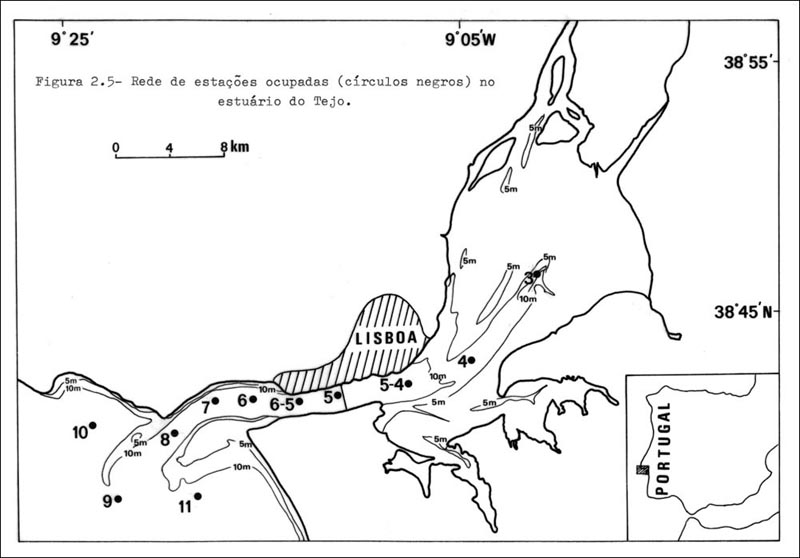
Realizaram‑se
colheitas de ictioplanctontes em 11 estações repartidas por praticamente toda a
extensão do estuário e regiões marinhas adjacentes (Figura 2.5). As regiões mais interiores do
estuário não foram prospectadas devido à pequena profundidade das mesmas o que
impediu o acesso das embarcações utilizadas durante as campanhas, devido às
dimensões do seu calado. Pôde‑se, no entanto, efectuar colheitas em 3
estações exteriores ao estuário (Ell, E10 e E9) e em 8 estações no interior do
mesmo: 5 estabelecidas no canal de saída (E8, E7, E6, E6‑5 e E5) e 3 na
parte central do estuário, correspondente a zonas de menores profundidades (E5‑4,
E4 e E3) (cf. Figura 2.5).
As estações frequentadas
variaram ao longo dos quatro anos de estudo. As exteriores foram ocupadas
somente durante as campanhas realizadas em 1979 e 1980. Durante o ano de 1981
ocuparam‑se unicamente estações no interior do interior do estuário.
O grande número de
Cifomedusas (Catostylus tagi (HAECKEL) registado nos meses de Junho a
Setembro, principalmente nas estações interiores (E4 e E3), impossibilitou a
realização de quaisquer colheitas de plancton nos referidos meses naquelas
estações. 0 número de C. tagi era de tal modo elevado que, mesmo
reduzindo o arrasto de plâncton a cerca de 1 minuto, a rede capturava sempre
indivíduos da supracitada medusa (RÉ, 1983d).
As colheitas não
coincidiram com nenhum estado particular da maré e foram normalmente realizadas
durante o dia (9:00h a 18:00h tempo local), excepto durante o ano de 1978 em
que foram efectuadas amostras durante a noite.
Fizeram‑se ainda
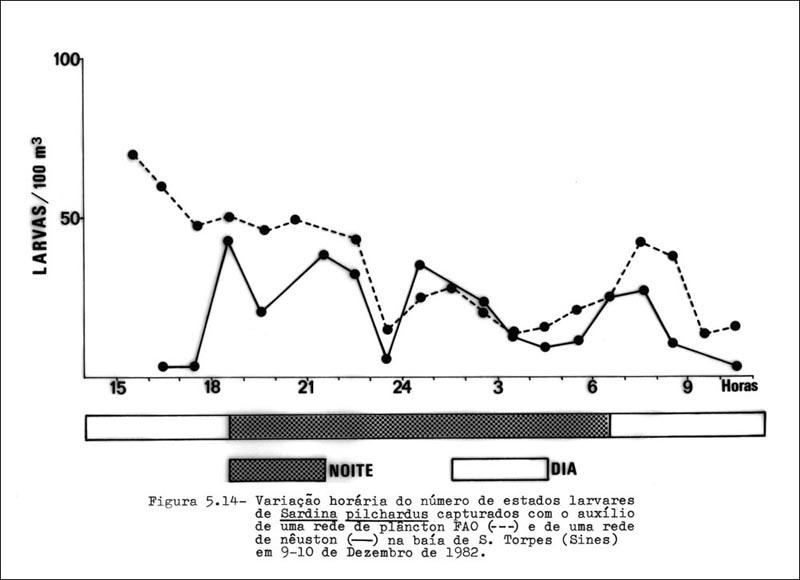
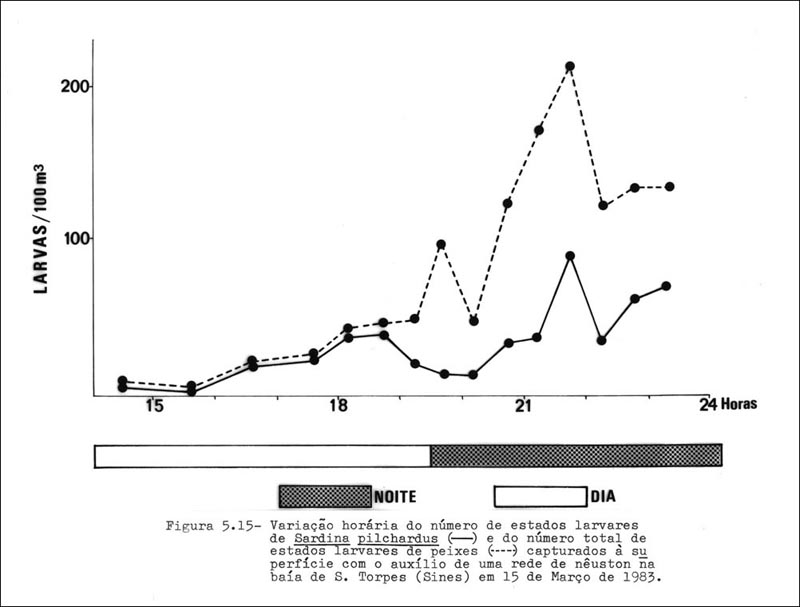
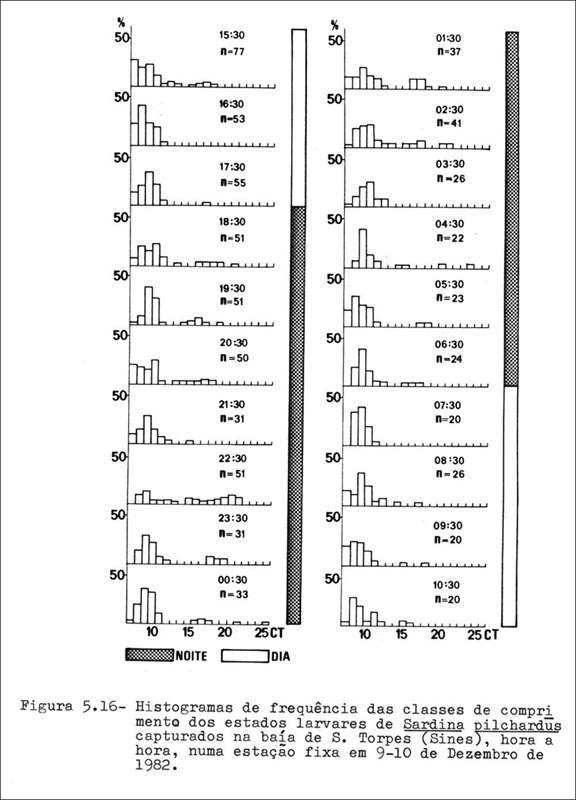
colheitas ao longo de dois ciclos nictemerais na região de S. Torpes (Sines)
com o objectivo principal de se recolherem ovos e estados larvares de Sardina
pilchardus. Os referidos ciclos foram realizados em duas épocas de maior
intensidade da postura desta espécie, Dezembro e Março (cf. 5.2). Nesses ciclos
efectuaram‑se colheitas de hora a hora, durante um período de vinte horas
em 9‑10 de Dezembro de 1982, e durante um período de dez horas em 15 de
Março de 1983. Na primeira campanha (Dezembro) as colheitas de plâncton foram
todas levadas a cabo na estação 4, enquanto que em Março estas foram realizadas
na estação 1 (cf. Figura 2.3). Foram
utilizados dois engenhos de colheita, arrastados simultaneamente durante um
período de 10 minutos a uma velocidade constante de 1,5 a 2 nós: uma rede de
plâncton FA0 (505 μm de poro), arrastada num
trajecto oblíquo até uma profundidade máxima de 20 metros, e uma rede de
nêuston. Esta última capturou os ictioplanctontes presentes à superfície das
águas até uma profundidade máxima de 10 cm e foi utilizada por dois motivos
principais: (i) amostrar os ovos e estados neustónicos de peixes e (ii)
avaliar a extensão e duração das migrações verticais efectuadas por algumas
larvas de peixes e particularmente pelos estados larvares planctónicos de Sardina
pilchardus durante um ciclo nictemeral.
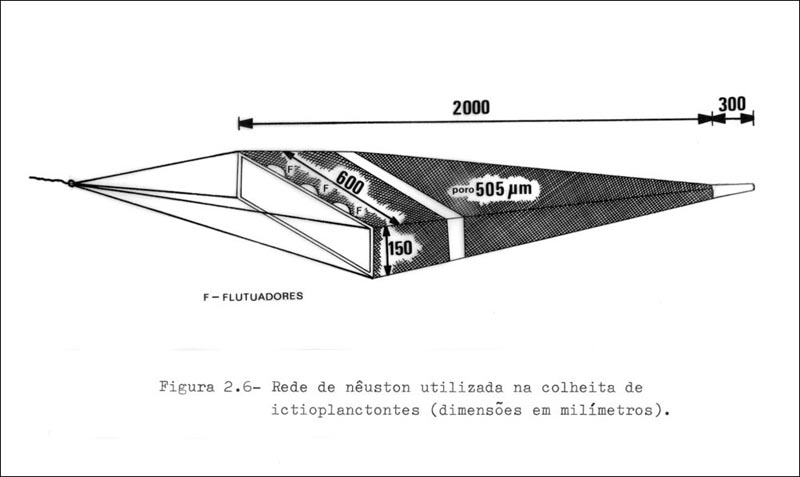
A referida rede de
nêuston consiste num engenho de 2 metros de comprimento, 505 μm de poro e com uma abertura
rectangular (0,60 x 0,15 metros) onde se fixaram três flutuadores de polivinilo
(Figura 2.6). Este tipo de colector foi
utilizado em vez da rede de DAVID (DAVID, 1965; HEMPEL & WEIKERT, 1972),
por esta última ser de difícil manuseamento.
Realizaram‑se ainda
colheitas durante dois ciclosde maré no estuário do Tejo em 4‑5
de Abril de 1982 na estação 4 (cf. Figura 2.5)
com o objectivo de comprovar a hipótese formulada por RÉ et al.(1983) e
RÉ (1983d) respeitante à retenção das larvas de Engraulis encrasicolus
no interior do referido estuário (cf. 6.6). Para o efeito efectuaram‑se
uma série de colheitas numa estação fixa (E4), de hora a hora, durante dois
ciclos de maré completos (24 horas) com uma rede FAO, tendo esta sido arrastada
horizontalmente à superfície das águas a uma velocidade constante de 1,5 a 2
nós, durante um período de 5 minutos.
A metodologia seguida a
bordo foi idêntica em todas as campanhas efectuadas, quer nas regiões marinhas
costeiras quer no estuário do Tejo. Após a realização de cada colheita de
plâncton a rede era cuidadosamente lavada com água salgada corrente, com o fim
de evitar a contaminação de amostras ulteriores. Esta operação foi levada a
cabo com o auxílio de uma mangueira, sendo utilizada a água bombeada pela bomba
hidráulica da embarcação usada. A pressão da água foi suficiente para
destacar os organismos planctónicos aderentes à rede, sem no entanto os
danificar.
A massa de plâncton
recolhida foi fixada, imediatamente após a colheita, com formol a 5 %
tamponizado com borax (pH 8,5 ‑ 9). A fixação do plâncton foi feita com
alguns cuidados. Assim, o formol tamponizado foi adicionado por etapas à massa
de plâncton recolhida com o fim de reduzir ao mínimo o inerente processo de
encolhimento dos ictioplanctontes. Com efeito, o encolhimento, particularmente
nas larvas de Clupeidae, pode ser provocado e agravado por factores de vária
ordem: tempo de arrasto, intervalo de tempo que decorre entre a morte e a
fixação, concentração e constituição do fixador utilizado e tempo de
conservação entre outros (HAY, 1981, 1982).
As amostras foram
armazenadas em frascos com uma capacidade de cerca de 1 litro, convenientemente
etiquetados. Teve‑se o cuidado de fazer com que o líquido conservante
preenche‑se cerca de dois terços do volume do recipiente onde a amostra
foi guardada, sem o que esta era repartida por dois ou mais frascos.
Sempre que possível
mediram‑se alguns parâmetros hidrológicos no momento das campanhas. A
temperatura e a salinidade foram determinadas a várias profundidades com o auxílio
de uma sonda hidrográfica "Kent Industrial Instruments" modelo 5005.
O emprego da referida sonda permitiu medir rapidamente "in situ"
estes dois parâmetros em toda a extensão da coluna de água. O oxigénio
dissolvido na água foi determinado a partir de amostras colhidas com o auxílio
de garrafas VAN DORN (6 litros de capacidade) a diferentes profundidades e em
diferentes estações, através do método de WINKLER (1988 in STRIKLAND
& PARSONS,1972). Efectuaram‑se ainda medições da transparência das
águas com o auxílio de um disco de Secchi e do pH à superfície das águas tendo‑se
utilizado para o efeito uma sonda "Horiba" modelo U‑7.
As colheitas de plâncton
foram inteiramente triadas no laboratório com o auxílio de uma lupa binocular
estereoscópica, tendo‑se separado os ovos e estados larvares
planctónicos de peixes dos restantes zooplanctontes para estudo ulterior. A
separação dos ictioplanctontes foi efectuada na totalidade da amostra,
particularmente no que diz respeito às larvas de teleósteos. Nos casos em que
os ovos de peixes eram muito numerosos estudou‑se unicamente uma fracção
da colheita. O fraccionador usado foi um "Folsom Plankton Splitter"
(McEWEN et al., 1954).
A conservação definitiva
dos ictioplanctontes foi feita com formol a 5 % tamponizado com borax sendo
estes armazenados em frascos de pequena capacidade (20 ml) convenientemente
etiquetados.
A identificação dos ovos
e larvas de peixes recolhidos foi feita, sempre que possível, pouco tempo após
as campanhas, isto é, com um tempo de conservação reduzido, uma vez que o
líquido conservante (formol) provoca a descoloração dos ictioplanctontes por
oxidação dos pigmentos (MASTAIL & BATTAGLIA, 1978).
Além da pigmentação a
observação de certos caracteres merísticos como o número de raios das
barbatanas número de vértebras são por vezes essenciais na identificação de alguns
estados planctónicos de peixes. Se é certo que nalguns estados larvares, como
por exemplo no género Arnoglossus, é possível contar directamente ao
microscópio, com luz transmitida, o número de miótomos, vértebras e raios, a
sua enumeração é por vezes extremamente difícil, pelo que se tem de recorrer
ao emprego de métodos de coloração dos elementos esqueléticos calcificados.
O método de coloração
utilizado no presente trabalho consistiu numa modificação do processo descrito
inicialmente por SCHULTZE (1897 in DUNN, 1983), DAWSON (1926) e
HOLLISTER (1934):
(i) Fixação da larva com
formol a 5 % tamponizado com borax (mínimo dois dias).
(ii) Lavagem da larva em
água corrente com o fim de eliminar o formol (2 a 24 horas).
(iii) Imersão da larva numa
solução de hidróxido de potássio (KOH) em água destilada com uma concentração
de 1 a 4 % conforme as dimensões desta (1 a 8 dias).
(iv) Imersão da larva
numa solução do corante de HOLLISTER (1934) em KOH a 3% (1 a 8 dias). Corante
de HOLLISTER:
‑ 1 parte de uma
solução de alizarina red S em ácido acetico glacial ‑ 2 partes de
glicerina a 100 % ‑ 12 partes de água destilada.
(v) Imersão sucessiva da
larva em três soluções com concentrações crescentes de glicerina em KOH: (1)
glicerina, 20%, KOH 80%; (2) glicerina 40%, KOH 60%; (3) glicerina 80%, KOH
20%.
(vi) Conservação
definitiva da larva em glicerina a 100 %.
Todas as medições dos
ictioplanctontes foram efectuadas sobre material conservado, tendo‑se
utilizado uma ocular micrométrica calibrada e uma lupa binocular. Os ovos foram
medidos com uma precisão de 0,01 mm e os estados larvares com uma precisão de
0,5 mm. As medições foram efectuadas, sempre que possível, em ovos num mesmo
estado de desenvolvimento com o fim de minimizar os erros devidosa
eventuais mudanças de dimensões dos mesmos sofridas no decurso do desenvolvimento
embrionário. O encolhimento dos ovos provocado pela fixação e posterior
preservação foi ignorado uma vez que se considerou que a baixa concentração de
formol utilizada (5%) não causava quaisquer mudanças significativas.
A mortalidade relativa
dos ovos (particularmente de Sardina pilchardus e Engraulis
encrasicolus) foi estimada usando critérios definidos por LEE (1961, 1966)
e RÉ (1981b). Os ovos de teleósteos recolhidos no plâncton apresentam um
aspecto distinto segundo o seu estado biológico, distinguindo‑se os ovos
fecundados e viáveis dos não fecundados ou não viáveis. Cinco casos tipo são
susceptíveis de serem observados:
(i) Todos os elementos
constituintes do ovo visíveis. Espaço perivitelino transparente. Nota‑se
facilmente o estado de desenvolvimento embrionário.
(ii) Vitelo disperso na
totalidade do ovo e apresentando um aspecto leitoso. Ovo parcialmente opaco
não se observando nenhum elemento diferenciado.
(iii) Ovo vazio. Vitelo e
embrião ausentes. Visível somente uma ou várias gotas de óleo (no caso de
estarem presentes) justaposta à cápsula.
(iv) Ovo parcialmente
opaco. Embrião aparente. Estado de desenvolvimento embrionário geralmente
pouco avançado.
(v) Embrião e vitelo
aparentes mas separados. Vitelo disperso pelo espaço perivitelino. Ovo mais ou
menos opaco segundo o grau de dispersão do vitelo. Embrião opaco e deformado.
Estado de desenvolvimento embrionário avançado.
No primeiro caso (i)
tratar‑se‑à de um ovo fecundado viável; (ii) e (iii) correspondem
a óvulos mortos antes da fecundação e em estado de desagregação; (iv) e (v)
correspondem a ovos fecundados não viáveis (mortos). A morte de um ovo num
estado de desenvolvimento avançado (caso v) é quase sempre devida a um
dinoflagelado parasita Ichthyodinium chabelardi HOLLAND & CACHON,
1952. A presença deste dinoflagelado pode ser detectada através do
aparecimento, no seio do vitelo de pequenas esférulas refringentes de contorno
irregular, as quais não afectando o desenvolvimento normal do ovo, provocam a
morte da larva pouco tempo após a eclosão (HOLLAND & CACHON, 1952, 1953).
Por outro lado a
mortalidade provocada pelo processo de captura dos ictioplanctontes pode
intervir no sentido de falsear a interpretação dos resultados. ROLLEFSEN (1933 in
SOUTHWARD & DEMIR, 1974) mostrou, pela primeira vez, que os ovos dos
peixes, nos primeiros estados de desenvolvimento, são susceptíveis a danos
provocados por acção mecânica (agitação). Com efeito, vários autores têm
sugerido que a mortalidade estimada "a posteriori" sobre uma
determinada amostra, é substancialmente aumentada pelo uso de engenhos de
colheita de plâncton arrastados a velocidades elevadas (CIECHOMSKI, 1967,
CIECHOMSKI & CAPEZZANI, 1973; SOUTHWARD & DEMIR, 1974; POMMERANZ,
1974). A determinação da mortalidade relativa dos ovos de Sardina pilchardus
e Engraulis encrasicolus foi, no entanto, baseada em amostras de
plâncton recolhidas em condições idênticas, isto é, com um mesmo engenho de
colheita arrastado num trajecto oblíquo, durante o mesmo intervalo de tempo e à
mesma velocidade. A baixa velocidade utilizada na colheita dos
ictioplanctontes (1,5 a 2 nós) aliada às condições de amostragem, permitem pois
considerar as estimativas da mortalidade relativa dos ovos como comparáveis
entre si e provavelmente pouco falseadas pelo método de captura.
A mortalidade relativa
dos ovos planctónicos é referida no presente trabalho como a percentagem de
ovos não viáveis (mortos) relativamente ao número total de ovos na amostra.
A hora da postura da
sardinha e da anchova foi determinada a partir das colheitas efectuadas durante
os 3 ciclos nictemerais. Os ovos capturados hora a hora foram escalonados nos
estados de desenvolvimento descritos por GAMULIN & HURE (1955) para a
sardinha e por ABOUSSOUAN para a anchova.
A idade dos estados
larvares planctónicos de Sardina pilchardus foi estimada a partir do
número de anéis de crescimento diário observáveis nos sagittae (RÉ,
1983a, 1983b, 1983c). Os otólitos foram extraídos das larvas, após um período
de conservação mais ou menos prolongado (1 a 2 meses), em formol a 5 %
tamponizado com borax (pH 8,5‑9). 0 líquido conservante foi tamponizado
com o fim de manter intactas as formações esqueléticas calcificadas das larvas,
mesmo após um intervalo de tempo considerável. A extracção dos sagittae foi
levada a cabo com o auxílio de agulhas e pinças de bicos finos, tendo‑se
utilizado uma lupa binocular. Os otólitos foram montados entre lâmina e lamela
num meio neutro e de secagem rápida (DEPEX). Teve‑se o cuidado de
colocar a face plana (=face interna) dos sagittae (forma plano‑convexa)
virada para cima, uma vez que se verificou que os anéis de crescimento diário
eram, deste modo, mais facilmente enumerados.
Tornou‑se
desnecessário desbastar e polir os otólitos, visto a espessura destes ser
suficientemente pequena para se poderem observar os anéis diários directamente
ao microscópio com iluminação inferior (luz transmitida). As unidades de crescimento
diário foram enumeradas com o auxílio de um microscópio óptico, utilizando‑se
ampliações que variaram entre 400 e 1250x, tendo‑se usado
preferencialmente as ampliações mais elevadas (objectivas de imersão). Foram
normalmente utilizados os dois sagittae na determinação da idade dos
estados larvares. Os anéis diários presentes em cada otólito foram enumerados
várias vezes, em diferentes ocasiões e por vezes por diferentes observadores,
com o fim de minimizar erros pessoais. O diâmetro dos otólitos foi medido com o
auxílio de uma ocular micrométrica e de um microscópio óptico. O diâmetro de
cada unidade diária de crescimento foi igualmente medido, com o intuito de
avaliar as diferentes taxas de crescimento dos estados larvares relativamente a
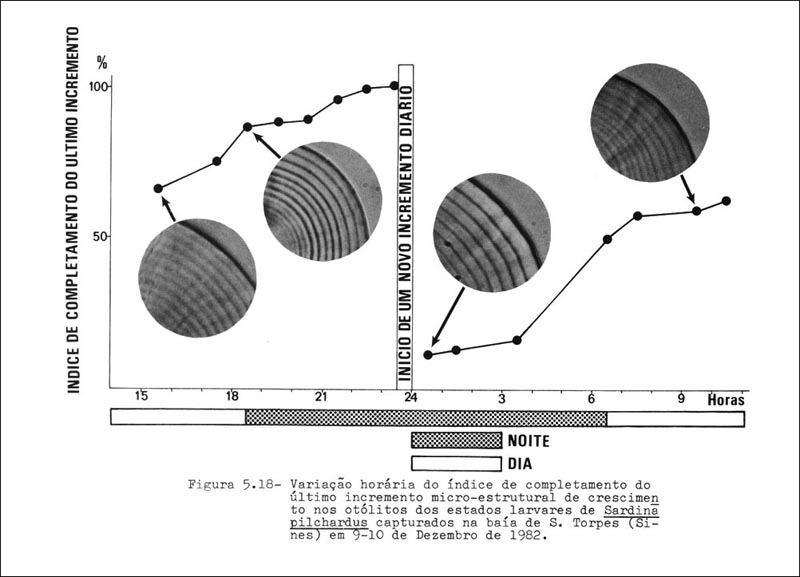
alguns factores ambientais. Utilizou‑se ainda o índice de TANAKA et
al. (1981) com o fim de determinar a hora exacta de completamento de cada
incremento micro‑estrutural de crescimento (cf. 5.8).
Os biovolumes de plâncton
foram medidos com o auxílio de uma proveta cilíndrica graduada, após um
período de sedimentação nunca inferior a 4 horas, sem se ter retirado o líquido
conservante. Estes biovolumes foram posteriormente correlacionados com a
abundância de ictioplanctontes.
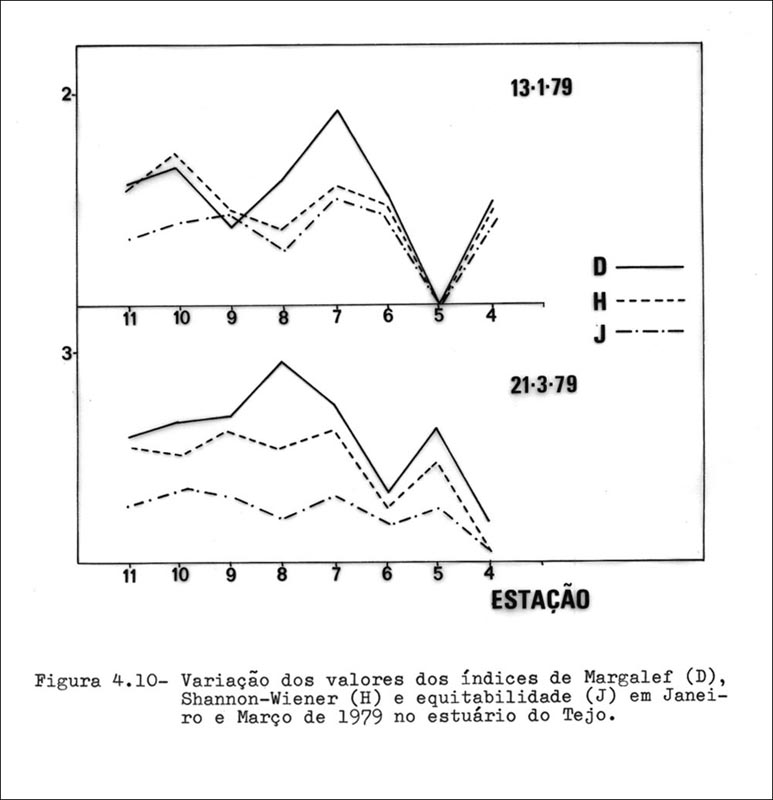
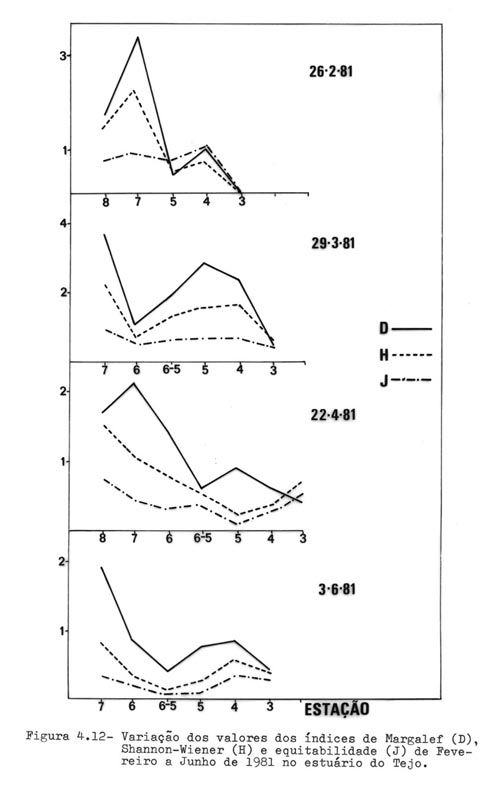
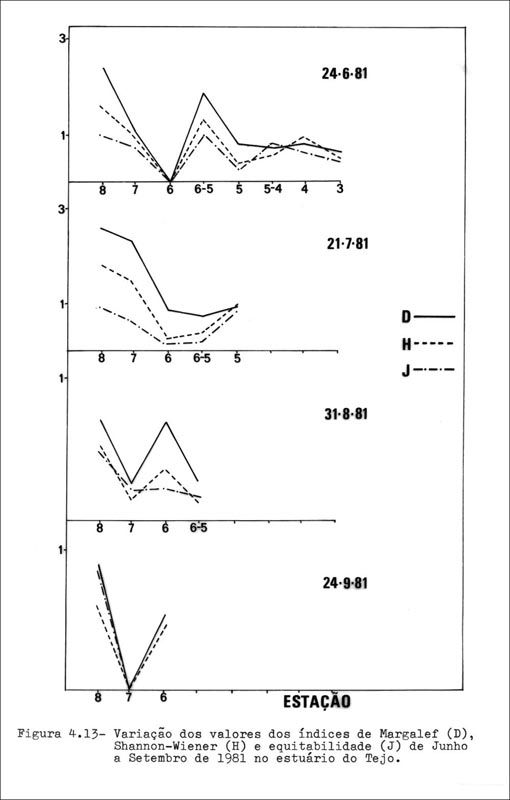
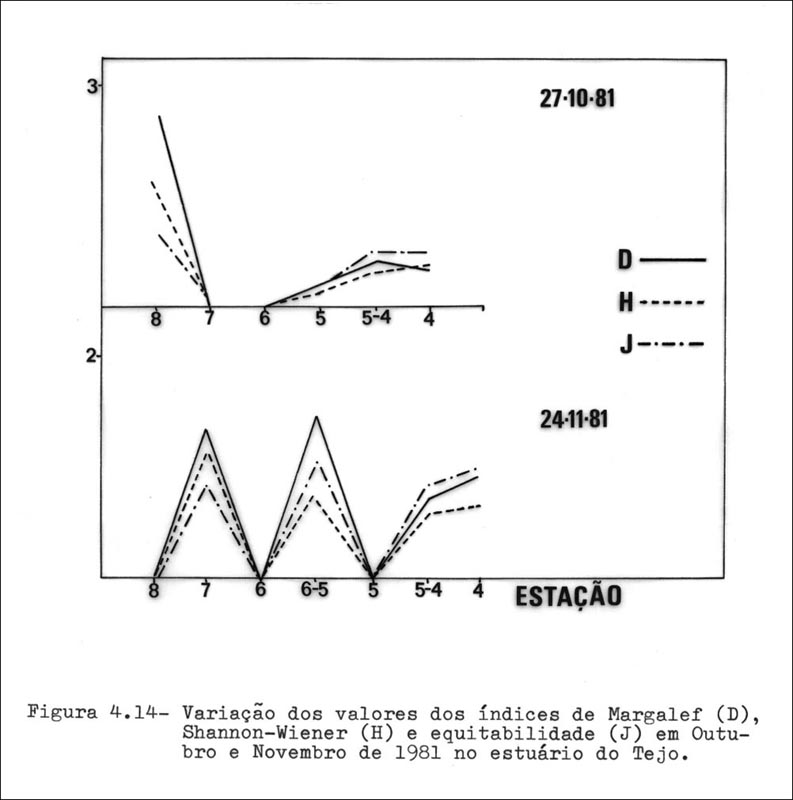
Calcularam‑se três
índices de diversidade para cada colheita, respeitantes unicamente aos estados
larvares planctónicos de peixes:
(i)
Indice de Margalef (D) (MARGAGEF, 1951, 1958)
D=S‑1
/ log n N
S=número
de espécies na amostra
N=número
total de indivíduos na amostra
(ii)
Indice de Shannon‑Wiener (H) (SHANNON & WEAVER, 1949)
H=Σ pi . log n pi
S=número
de espécies na amostra
pi=proporção
de indivíduos de uma dada espécie i
(iii)
Indice de equitabilidade (J) (LLOYD & GHELARDI, 1964)
J=H /
log n S
S=número
de espécies na amostra
H=índice
de Shannon‑Wiener
Os referidos índices
foram calculados com o auxílio de um computador Tektronix 4051. Utilizaram-se
ainda programas da autoria de F. ANDRADE em funcionamento no sistema Tektronix
4051 do Laboratório Marítimo da Guia (Faculdade de Ciências de Lisboa), a fim
de estabelecer matrizes de similaridade entre as estações amostradas (modo Q),
consideradas mês a mês, e, a partir destas estabelecer os correspondentes
dendrogramas utilizando o método UPGMA (SNEATH & SOKAL, 1973). Os referidos
dendrogramas foram elaborados usando o coeficiente de distância euclidiana
(LEGENDRE & LEGENDRE, 1979) a partir da matriz de dados brutos (não
estandartizada) (cf. 4.3).
A terminologia das formas
larvares dos teleósteos não se encontra ainda uniformizada apesar de numerosos
autores se terem debruçado sobre o problema (HUBBS, 1943; RASS, 1946 in
BALON, 1975; BALON, 1958, 1971, 1975; ABOUSSOUAN, 1964; RUSSEL, 1976).
As várias designações
propostas para as fases de desenvolvimento dos peixes, sobretudo no que diz
respeito aos estados larvares, não são contudo utilizadas com o mesmo sentido
por autores subsequentes havendo necessidade de definir os termos empregues.
Ao longo do presente
trabalho utilizar‑se‑ão as designações de: ovo para a fase
compreendida entre a fecundação e a eclosão (período embrionário); larva
para a fase compreendida entre a eclosão e a metamorfose (período larvar), sendo
esta última marcada pelo final da vida planctónica, aparecimento das escamas e
de uma pigmentação e forma essencialmente idênticas às do indivíduo na fase
adulta. A designação de larva é pois utilizada como sinónimo de: larva
lecitotrófica e alecítica (sensu ABOUSSOUAN, 1964); eleuteroembrião,
protopterigiolarva e pterigiolarva (sensu BALON, 1975); larva e post‑larva
(sensu RUSSEL, 1976).
Os dados meteorológicos e
hidrológicos referidos a seguir são fundamentalmente baseados em quatro
publicações: SERVIÇO METEOROLÓGICO NACIONAL (1965); SWECO (1977); INSTITUTO
HIDROGRÁFICO (1982) e BETTENCOURT (1979), respeitantes respectivamente à costa
de Peniche, à costa de Sines e ao estuário do Tejo. Juntou‑se ainda a
estes dados outros parâmetros hidrológicos obtidos durante as campanhas
realizadas para a colheita de ictioplanctontes.
As condições
meteorológicas foram obtidas a partir de dados fornecidos pelo Serviço
Meteorológico Nacional relativos à estação do Cabo Carvoeiro (SERVIÇO
METEOROLÓGICO NACIONAL, 1965).
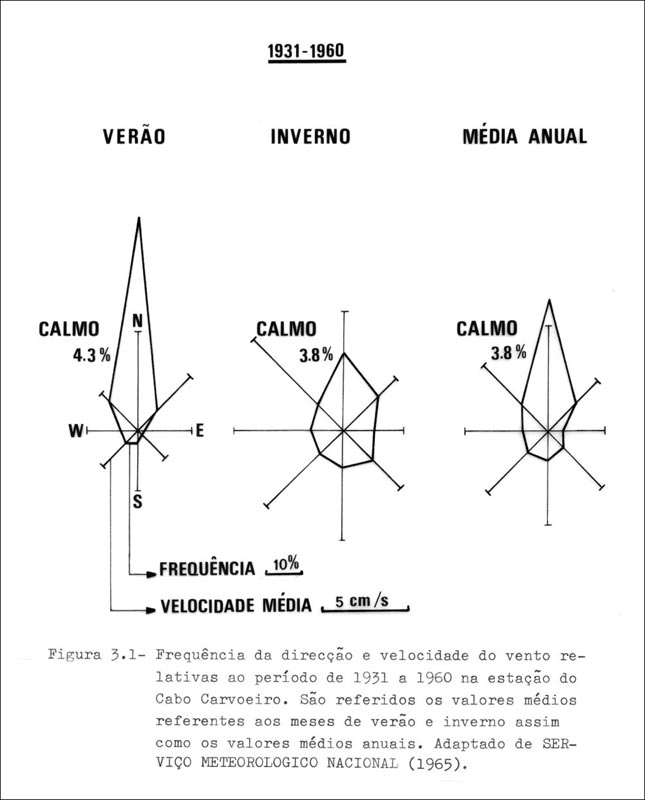
As observações
respeitantes à direcção e velocidade do vento, relativas a um período de 30
anos (1931‑1960), mostraram que este apresentou uma forte variação anual.
Durante os meses de verão, o vento soprou predominantemente do quadrante
Norte. Nos meses de Inverno, soprou de todos os quadrantes mas com uma certa
preponderância do quadrante Norte.
Por outro lado, as
velocidades médias observadas mostram que os ventos do quadrante Norte foram
mais intensos (x=6,9 m/s), enquanto que os do quadrante Este foram mais fracos
(x=3,5 m/s) (Figura 3.1).
Sendo o vento e as marés
os principais elementos geradores de correntes a avaliação do regime de ventos
é importante para a compreensão do sistema de circulação das águas.
Verificou‑se
existir uma estratificação térmica marcada durante os meses de verão e
princípio do Outono. Durante os meses de Inverno, a referida estratificação
desaparece. Nos meses de primavera esta é fraca ou praticamente inexistente.
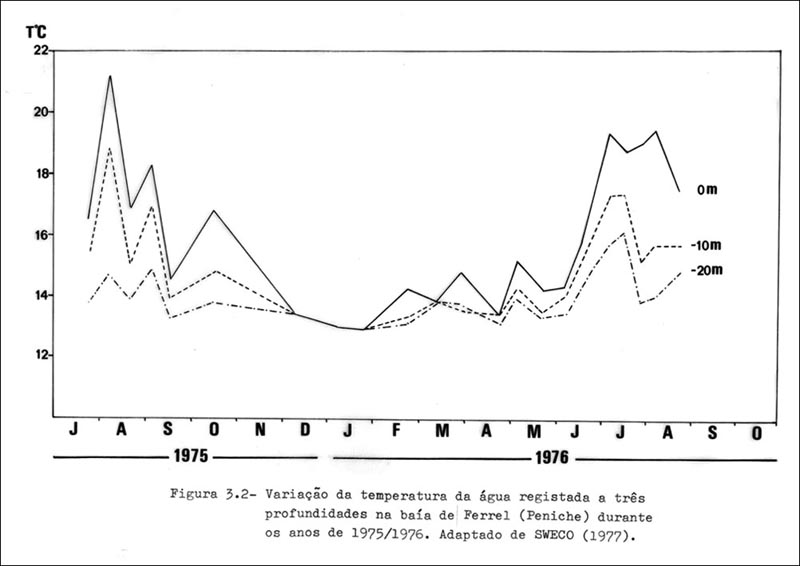
A variação anual das
temperaturas médias registadas a três profundidades (0 m, l0 m e 20 m) durante
os anos de 1975/1976 (SWECO, 1977) é referida na Figura
3.2, verificando‑se que estas foram máximas nos meses de Julho e
Agosto e mínimas no mês de Janeiro.
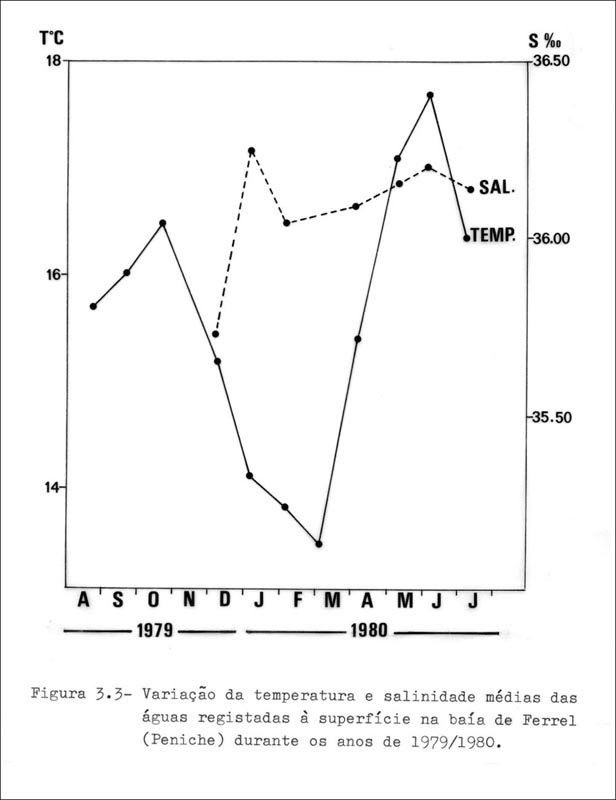
A variação das
temperaturas médias registadas à superfície durante os anos de 1979/1980, na
altura das campanhas levadas a cabo para a colheita de ictioplanctontes, é
referida na Figura 3.3. A amplitude térmica
verificada foi de cerca de 7°C. Os valores de temperatura mais altos registaram‑se
nos meses de Junho, Julho e Agosto e os mais baixos de Janeiro a Março.
3.1.3‑ Salinidades
e parâmetros químicos
a) Salinidade
As variações da
salinidade observadas durante os anos de 1975/1976 (SWECO, 1977), foram muito
reduzidas (amplitude 0,33‰), tendo os seus valores extremos oscilado entre
35,97 %o e 35,64‰. Verificou‑se, por outro lado, existir uma
estratificação da salinidade muito fraca, inexistente ou invertida consoante a
época do ano (na maioria dos casos inferior a 0,06 ‰).
Na Figura 3.3 referem‑se
os valores médios da salinidade obtidos durante as campanhas realizadas em
1979/1980. Verificou‑se que a salinidade média foi mais elevada no mês de
Janeiro (36,27‰) e menos elevada no mês de Dezembro (35,74‰).
b) Oxigénio dissolvido
Os valores de oxigénio
dissolvido nas águas variaram entre 4,1 e 10,7 mg/l durante os anos de
1975/1976 (SWECO, 1977). As águas superficiais da região mostraram estar
sobressaturadas em oxigénio, ou próximo da sobressaturação (> 80%).A
sobressaturação é fundamentalmente devida à produção biológica na zona
eufótica, ou seja, na zona onde a luz penetra e a produção de oxigénio por
fotossíntese excede por vezes o consumo deste gás por respiração (animal ou
vegetal) ou deterioração.
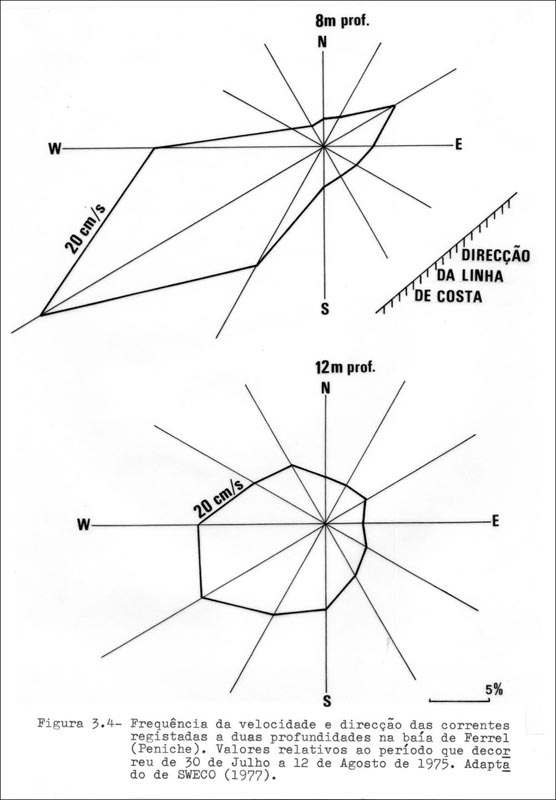
As correntes medidas
durante os anos de 1975/1976 mostraram existir uma marcada tendência para as
massas de água se deslocarem na direcção de quadrante Sudoeste, isto é,
paralelamente à linha de costa. No que diz respeito à velocidade das
correntes, estas foram frequentemente alteradas pelo acentuado hidrodinamismo
que se faz sentir na região, sendo por isso os resultados fornecidos pelos
correntógrafos fundeados (Figura 3.4)
necessariamente superiores aos realmente verificados (SWECO, 1977).
Os dados meteorológicos
foram obtidos por uma estação automática montada a Norte da baía de S. Torpes
a qual registou a velocidade média e máxima e a direcção do vento, a
temperatura do ar, a pressão atmosférica, a radiação solar e a pluviosidade.
Durante o período que decorreu do início do ano de 1979 ao início de 1982, pode‑se
considerar que as condições meteorológicas foram normais, apenas se registando
condições de temporal em Dezembro de 1981 (INSTITUTO HIDROGRÁFICO, 1982).
O vento soprou
predominantemente dos quadrantes Norte e Este, observando‑se também com
frequência direcções de Sudoeste. As velocidades médias foram normalmente
inferiores a 10 m/s, raramente excedendo os 25 m/s.
Os ventos do quadrante
Norte, quando sopraram com alguma constância, o que aconteceu com bastante
frequência especialmente no verão, deram origem a fenómenos de nítido afloramento
costeiro ("upwelling") (INSTITUTO HIDROGRÁFICO, 1982).
Os valores da temperatura
medidos durante todo o período de observações (1979/1982) estão de acordo com
as estatísticas existentes para a região (INSTITUTO HIDROGRÁFICO, 1982).
Verticalmente verifica‑se
existir homogeneidade na coluna de água durante os meses de Inverno,
nomeadamente desde os fins de Outubro até Março, começando então a verificar‑se
uma estratificação que se mantêm durante o resto do ano. Os gradientes de
temperatura observados foram normalmente inferiores a 0,1° C/m excepto, na camada
superficial onde por vezes atingiram 0,5°C/m. A amplitude térmica
verificada foi de 7° C, tendo‑se registado valores máximos (cerca de 20°C) em Setembro/Outubro e
mínimos (cerca de 13° C) em Fevereiro/Março.
Nos meses de verão
registaram‑se, por vezes, acentuados abaixamentos da temperatura das
águas, chegando a descer abaixo dos 14° C. Este fenómeno ficou a dever‑se
a efeitos de ressurgência de águas profundas mais frias ("upwelling"),
provocados pelo regime de nortada que se fez sentir frequentemente na região
durante aqueles meses (INSTITUTO HIDROGRÁFICO, 1982).
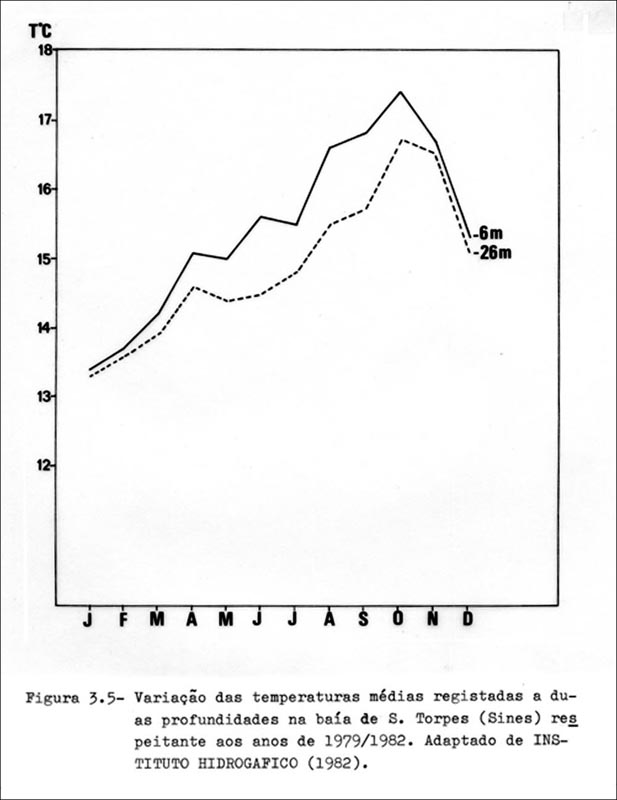
Na Figura 3.5 referem‑se as temperaturas
médias mensais observadas a duas profundidades (6 m e 26 m) na região
prospectada (1979/1982) (INSTITUTO HIDROGRÁFICO, 1982).
As temperaturas médias
registadas à superfície e a 15 metros de profundidade obtidas durante as
campanhas efectuadas nos anos de 1981/1982 constam da Figura 3.6. As temperaturas médias registadas
na zona foram superiores aos valores obtidos na região de Peniche em cerca de 1
a 2 °C.
A salinidade apresentou
variações muito pequenas quer temporal quer espacialmente. Durante todo o
período em que se efectuaram observações (1979/1981), os valores máximos e
mínimos encontrados foram respectivamente 36,44 ‰ e 35,61 ‰, o que representa
uma variação pouco superior a 2 %. A amplitude máxima foi de 0,23 ‰ sendo
geralmente inferior a 0,1‰. O valor médio observado, cerca de 36,00 ‰, está de
acordo com os valores normais para esta região da costa (INSTITUTO HIDROGRÁFICO,
1982). Na Figura 3.6 referem‑se os
valores médios da salinidade determinados na altura das campanhas efectuadas
para a colheita de ictioplanctontes (1981/1982).
b) Oxigénio dissolvido
Os valores de oxigénio
dissolvido nas águas variaram entre 4,6 e 7,9 mg/l. Grande parte dos valores
determinados apresentava sobressaturação em oxigénio devido à baixa
profundidade e ao hidrodinamismo.
c) Fosfatos, nitratos e
silicatos
Os fosfatos, nitratos e
silicatos apresentaram valores habituais para a região e de acordo com as
condições prevalecentes (INSTITUTO HIDROGRÁFICO, 1982). Durante todo o período
de observação (1979/1981) foram verificados vários casos de ressurgência ou
afloramento costeiro ("upwelling"), alguns bastante acentuados, em
que os vários parâmetros observados denotaram um afloramento de águas
profundas, frias e ricas em nutrientes (INSTITUTO HIDROGRÁFICO, 1982).
Para a medição das
correntes foram usados três processos: por seguimento de "drogues",
por correntógrafos fundeados e por correntógrafos suspensos (INSTITUTO HIDROGRÁFICO,
1982). Verificou‑se que junto à costa as correntes eram de fraca
intensidade, cerca de 5 cm/s em média, raramente excedendo os 10 cm/s, sendo
as direcções observadas mais frequentemente as paralelas à linha de costa,
quer no sentido Norte que no sentido Sul. Verificou‑se ainda que, próximo
da costa, as correntes da camada superficial das águas apresentavam direcções
semelhantes às observadas pelos correntógrafos, isto é, o sentido Sul foi
preferencial relativamente ao sentido Norte, atingindo por vezes intensidades
da ordem dos 15 a 20 cm/s. Os ventos locais, quando sopraram sistematicamente
numa direcção, mostraram tendência para provocar um alinhamento da corrente com
a direcção dos mesmos. As correntes medidas um pouco mais ao largo (a cerca de
7 milhas da costa) ultrapassaram os 20 cm/s, sendo a direcção das mesmas
idêntica à observada junto à costa.
Nesta zona o efeito da
maré foi bastante acentuado do que junto à linha de costa, tendo as
intensidades das correntes de maré ultrapassado por vezes, os 10 cm/s, provocando
rotações quer no sentido directo quer no sentido retrógrado (INSTITUTO
HIDROGRÁFICO, 1982).
O estuário do Tejo tem o
seu limite a montante perto de Muge, no termo da propagação normal da maré e a
jusante, de um modo menos definido, no limite da pluma de água salobra na zona
costeira adjacente (Figura 2.5). A
superfície do estuário é de cerca de 325 km2 e o seu comprimento é
de exactamente 50 km, medidos ao longo do eixo central. A área intertidal
atinge, em média, aproximadamente 130 km2, ou seja cerca de 41% da
área total considerada (BETTENCOURT, 1979).
De uma maneira geral, as
zonas que ocupam a parte central do estuário correspondem a zonas de menores
profundidades. Ao contrário, as maiores profundidades ocorrem nos troços que
estabelecem a comunicacão com o rio e com o mar, respectivamente a montante e a
jusante (Figura 3.7).
A profundidade máxima do
estuário é de cerca de 32 metros, sendo a profundidade média de 10,6 metros. Em
grande parte da área do estuário a profundidade é, no entanto, inferior ou
igual a 5 metros (BETTENCOURT, 1979).
De uma maneira geral,
pode‑se dizer que o regime de marés não se encontra suficientemente
caracterizado no estuário do Tejo. A maré é do tipo semi‑diurno, com uma
ligeira diferença entre os tempos de vazante e de enchente, sendo os de
enchente mais longos. Esta situação, que se deve considerar atípica, manifesta‑se
sobretudo a jusante, mantendo‑se no entanto de forma mais atenuada para
montante.
É de referir ainda o
facto de a amplitude da maré ser crescente para montante, atingindo um máximo
que parece situar‑se próximo de Alverca, e decrescendo em seguida até se
anular na região de Muge, a cerca de 50 km do oceano (cf. Figura 3.7) (BETTENCOURT, 1979).
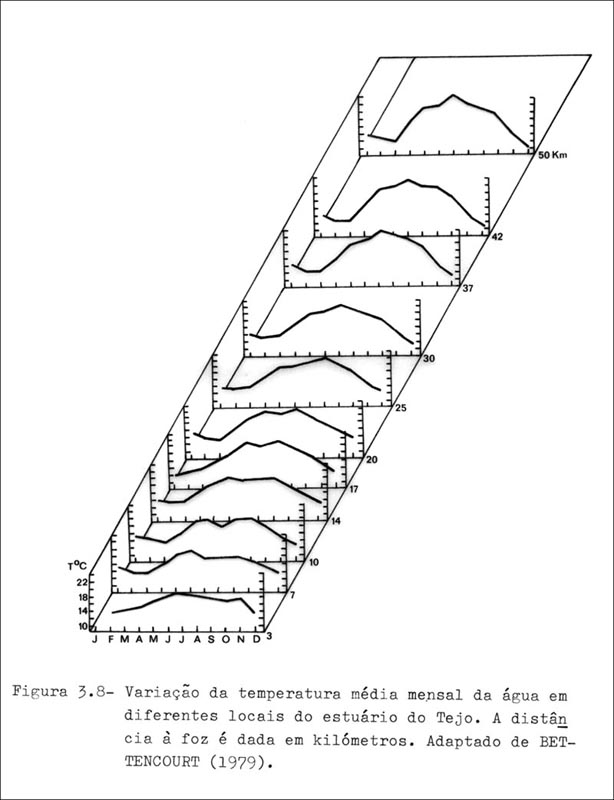
Na Figura 3.8 representou‑se as variações
das temperaturas médias mensais das águas, registadas em diferentes zonas do
estuário. Pode‑se constatar da análise destes dados que a amplitude
térmica anual é superior nas estações a montante relativamente às estações a
jusante.
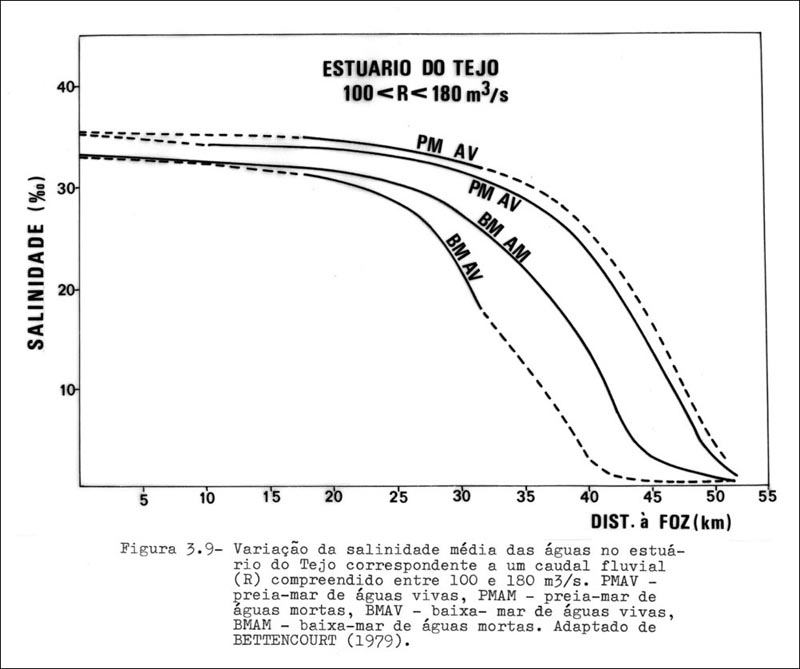
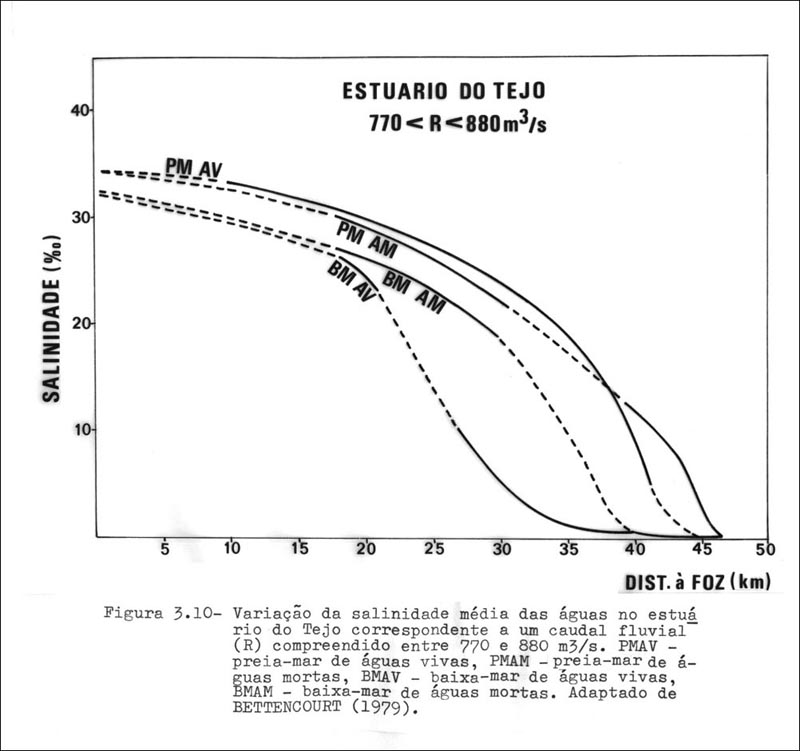
As Figuras 3.9 e 3.10
representam as variações da salinidade média, ao longo do estuário do Tejo,
função de dois caudais fluviais diferentes, em condições de marés vivas e marés
mortas. Nelas se pode observar um contraste claro entre o comportamento da zona
de montante relativamente à zona de jusante, no que respeita às variações da
salinidade em função da força da maré em condições de baixa‑mar. A
jusante as variações da salinidade são mínimas, tendendo os valores registados
em baixa‑mar de águas vivas a coincidirem ou mesmo ultrapassarem os
valores obtidos em baixa‑mar de águas mortas. A montante, pelo contrário,
a influência da força da maré em baixa‑mar é dominante, verificando‑se
um aumento substancial da salinidade entre águas vivas e mortas.
Em condições de preia‑mar,
as diferenças de salinidade decorrentes da força da maré parecem distribuir‑se
com uma relativa constância ao longo do estuário sendo praticamente sempre as
salinidades correspondentes a águas vivas superiores às salinidades
correspondentes a águas mortas (BETTENCOURT, 1979).
No que diz respeito à
estratificação salina das águas do estuário, verifica‑se que esta diminui
para montante e aumenta com o caudal fluvial. A referida estratificação nunca
é muito acentuada sendo unicamente marcada em regime de cheia (CNA, 1976).
De acordo com a relação
entre o prisma da maré e o caudal fluvial (PRITCHARD, 1967) em regime médio ou
de estiagem, o estuário do Tejo pode considerar‑se como sendo do tipo
"parcialmente estratificado" ou de "escoamento por intermédio de
duas camadas com mistura vertical" (CNA, 1976).
No que diz respeito à
circulação das águas no estuário, o sentido da corrente é nitidamente
longitudinal, com ligeiras inflexões comandadas pelas linhas de maiores fundos
situadas sensivelmente no eixo do canal de saída e na região de montante. No
canal de saída regista‑se, quer na enchente, quer na vazante, um desvio
gradual da corrente para Sul.
A esta circulação geral
no estuário, acentuadamente longitudinal e ao longo dos "talwegs" ou
linhas de maiores fundos, há que opor zonas de menor circulação e de revessas.
As referidas revessas formam‑se na vazante, parecendo ser tanto mais
acentuadas quanto mais viva é a maré, e localizam‑se em regiões bem
definidas do estuário.
A análise da circulação
residual no estuário mostrou existir uma entrada preferencial da água junto ao
Bugio, na enchente, e uma saída preferencial junto à margem norte, na vazante
(BETTENCOURT, 1979).
FIUZA et al.
(1978) mostrou ‑ a partir de uma análise da direcção, velocidade e
frequência dos ventos médios durante um período de 30 anos (1931/1960) ‑
que de Junho a Setembro as condições são favoráveis para se estabelecer um regime
de afloramento costeiro (upwelling) em certos locais da costa portuguesa. Os
mesmos autores analisaram ainda a distribuição das temperaturas registadas à
superfície das águas, tendo as diferenças observadas junto à costa portuguesa
relativamente às temperaturas determinadas no Atlântico central Norte, sido
interpretadas como indicação de afloramentos costeiros. Deste modo puderam verificar
que os referidos fenómenos de ressurgência ocorriam principalmente durante o
verão, restringindo‑se praticamente à costa Oeste da península Ibérica,
ficando a dever‑se este facto à orientação de linha de costa
relativamente aos ventos dominantes do quadrante Norte.
Num trabalho subsequente
(FIUZA, 1982) concluiu que, após o estabelecimento de um regime de ventos dos
quadrantes Norte‑Noroeste, ocorre um afloramento costeiro mais intenso
na região Sul de todos os cabos da costa Oeste portuguesa. Com o
desenvolvimento deste fenómeno, águas mais frias ressurgem ao longo de
praticamente toda a costa, podendo influenciar uma área algo extensa (70 a 150
km desde a linha de costa).
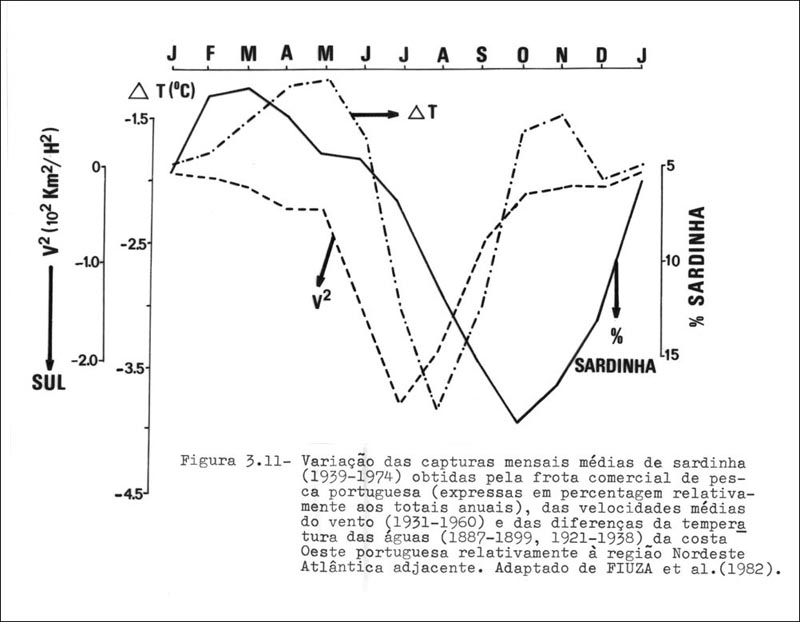
No que diz respeito à
actividade piscatória ao longo da costa portuguesa e a sua relação com os
fenómenos de afloramento costeiro, FIUZA (1980b) e FIUZA et al. (1978,
1982) verificaram existir uma relação óbvia entre estes dois factores, pelo
menos no que diz respeito à pesca da sardinha (Figura
3.11). Com efeito, os coeficientes de correlação encontrados por este autor
foram altamente significativos: velocidade do vento favorável ao
estabelecimento de "upwelling" versus diferenças verificadas
nas temperaturas superficiais, r=0,91; capturas de sardinha versus
anomalias térmicas, r=0,77; capturas de sardinha versus velocidade do
vento, r=0,91. Estes resultados ilustram bem a dependência dos fenómenos de
afloramento costeiro ao longo da costa portuguesa relativamente ao regime de
ventos, e ainda ao papel importante que este fenómeno desempenha na produção
biológica das águas costeiras. De facto, o desfasamento do máximo de ocorrência
de ventos favoráveis ao estabelecimento de "upwelling" (Junho)
relativamente ao máximo de "upwelling" (Julho‑Agosto) e
capturas preferenciais de sardinha (Setembro‑ Outubro) (cf. Figura 3.11) é facilmente interpretável. Com
efeito, os fenómenos de ressurgência são responsáveis pelo transporte de
grande quantidade de nutrientes para a zona eufótica, o que se traduz no estabelecimento
de condições óptimas para a ocorrência de um "bloom" de fitoplâncton
(produção primária). No caso do ritmo do afloramento se manter durante algum
tempo, ocorrerá também um marcado "bloom" de zooplãncton (produção
secundária). Sendo a sardinha uma espécie fundamentalmente planctófaga
alimentando‑se essencialmente à base de zooplanctontes (MASSUTI, 1955;
VUCETIC, 1963; CUSHING, 1978) o facto de as capturas serem feitas
preferencialmente nos meses de Setembro a Novembro é em parte explicado. E de
notar ainda que a ocorrência preferencial da sardinha próximo da costa nos
referidos meses não é unicamente devida a razões tróficas, uma vez que esta
espécie efectua a postura em águas pouco profundas da plataforma continental
(cf. 5.1, 5.2).
O crescimento do
fitoplâncton no mar é controlado fundamentalmente pela abundância relativa de
nutrientes e pela intensidade luminosa. Existem actualmente diversas
tentativas de modelação dos efeitos simultâneos destes dois factores; contudo
não se encontra ainda claramente compreendida a natureza da sua interacção
(BANNISTER, 1979).
Na zona de Peniche o ciclo
anual do fitoplâncton foi estudado, durante um período de 10 meses (1979/1980),
através das variações mensais da biomassa fitoplanctónica expressa em termos de
concentração de clorofila‑a (CABEÇADAS & COSTA, 1980).
Durante o período que
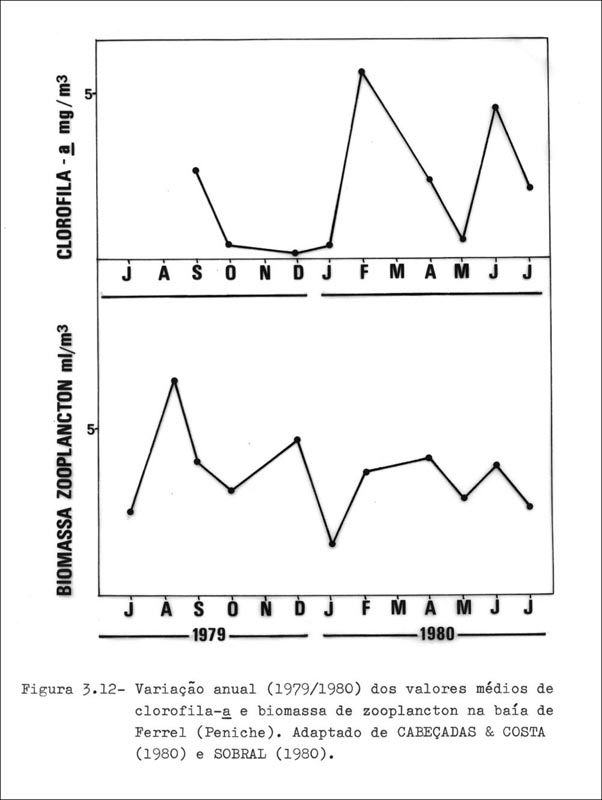
decorreu de Setembro de 1979 a Julho de 1980 as concentrações de clorofila‑a
registadas à superfície em 4 estações costeiras, variaram entre 0,02 e 9,65
mg/m3, tendo sido observado um valor médio anual de 2,00 mg/m3.0s
valores mais baixos =<1 mg/m3, observaram‑se durante o
Inverno nos meses de Dezembro e Janeiro e no mês de Maio. Em todos os outros
meses as concentrações observadas foram superiores a 1 mg/m3, tendo
sido atingidos valores médios máximos de 5,65 e 4,64 mg/m3 em
Fevereiro e Junho respectivamente (Figura
3.12).
No Inverno, entre os
meses de Novembro e Fevereiro registou‑se um crescimento mínimo de
fitoplâncton, sendo lícito supor que este se encontre limitado pela luz e/ou
temperatura nesta altura do ano. No mês de Fevereiro observou‑se o
início do "bloom" da primavera. O aumento do crescimento, ocorrido
nesta estação do ano, não permaneceu durante muito tempo numa fase estacionária
devido ao esgotamento dos nutrientes e ao aumento de "grazing" por
parte dos organismos zooplanctónicos, tendo‑se assistido deste modo a um
decréscimo das concentrações fitoplanctónicas nos princípios de Maio.
No fim da primavera e no
início do verão verificou ‑se existir uma estratificação térmica marcada
das águas, o que, em condições normais nos mares das zonas temperadas, dificultaria
o transporte de nutrientes para a zona eufótica. Contudo, observou‑se
durante os meses de verão um crescimento importante do fitoplâncton,
provavelmente devido ao estabelecimento de eventuais regimes de afloramento
costeiro por pequenos períodos na região considerada (cf. FIUZA et al.,
1982).
Na área estudada observou‑se
uma evolução sazonal do fitoplâncton aproximada à que ocorre nos mares das zonas
temperadas, sendo de referir que as alterações sazonais na estrutura fisico‑química
vertical da coluna de água são de grande importância no ciclo anual de
crescimento (SVERDRUP, 1953; BOUGIS, 1974a).
O zooplâncton da baía de
Ferrel (Peniche) foi estudado no período que decorreu de Julho de 1979 a Julho
de 1980, tendo apresentado variações sazonais normais para os mares das regiões
temperadas (BOUGIS, 1974b). Observaram‑se densidades mínimas da ordem dos
200 indivíduos/m3 e máximas da ordem dos 30.000 indivíduos/m3
(SOBRAL, 1980).
O ciclo anual do
zooplâncton (microplâncton) foi estudado através do biovolume de plâncton e
abundância relativa dos diversos grupos de zooplanctontes recolhidos em 4 estações
costeiras, tendo‑se utilizado como engenho de colheita uma rede WP‑2.
Deste modo, e em relação aos biovolumes de plâncton, verificou‑se existir
uma flutuação sazonal cíclica com mínimos em Janeiro e Julho e dois máximos,
estival e primaveril (Figura 3.12).
No que respeita à
abundância relativa dos diversos grupos, observou‑se que os organismos
holoplanctónicos melhor representados foram os Sifonóforos, os Cladóceros, os
Copépodes e os Apendiculários, enquanto que os organismos meroplanctónicos
mais representativos foram as Medusas, os Poliquetas, os Lamelibrfinqueos, os
Cirrípedes e os Equinodermes.A todos estes grupos foi comum um aumento de
densidade nos meses da primavera, na sequência do "bloom" de
fitoplâncton ocorrido em Fevereiro, assim como um aumento de densidade no mês
de Setembro.
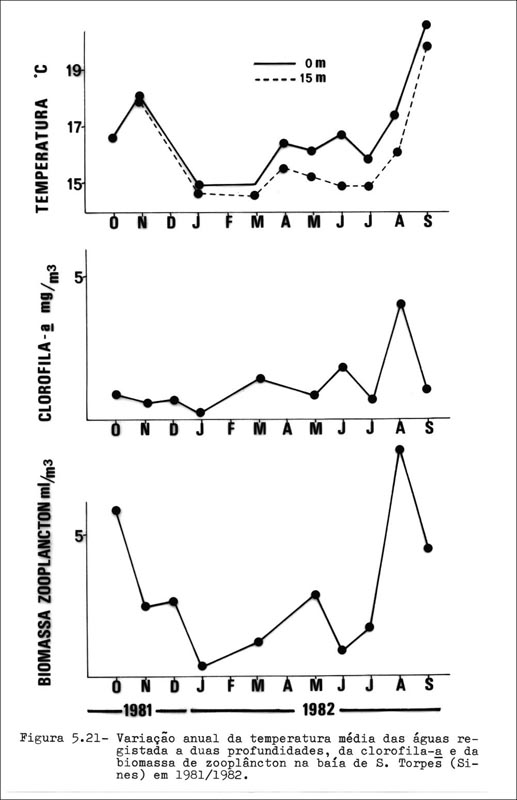
Na baía de S. Torpes o
ciclo anual do fitoplâncton foi estudado através das concentrações de clorofila‑a
no período que decorreu entre Outubro de 1981 e Setembro de 1982 (GONÇALVES
& COSTA, 1983).
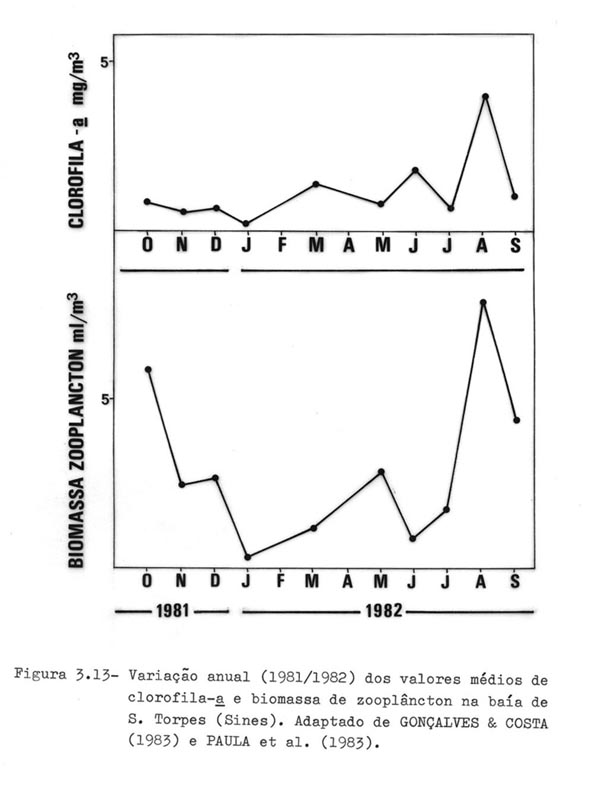
Registou‑se a
ocorrência de três picos de abundância fitoplanctónica (Março, Junho e Agosto)
e valores geralmente mais elevados na primavera e verão (Figura 3.13). Os valores mínimos referentes
às concentrações de clorofila‑a foram observados em Janeiro (0,15
mg/m3) e os mais elevados em Agosto (7,49 mg/m3). A
média anual (1,19 mg/m3) foi inferior à obtida na zona de Ferrel,
estando no entanto os resultados na mesma ordem de grandeza dos referidos para
a supracitada região e dos referenciados para as águas costeiras de clima
temperado (RAYMOND, 1963).
Nos meses de Inverno não
foi encontrada qualquer diferença entre as concentrações de clorofila‑a
à superfície, a meio da coluna de água e junto ao fundo. Esta diferença surgiu
a partir de Maio prolongando‑se até Agosto, mês em que as concentrações
junto ao fundo são mais elevadas.
No mês de Agosto registou‑se
uma quantidade elevada de clorofila. Este facto deve‑se provavelmente ao
estabelecimento na região de fenómenos de "upwelling" durante o mês
de Julho, situação já detectada no referido mês durante os anos de 1980 e 1981
(INSTITUTO HIDROGRÁFICO, 1982). Os referidos fenómenos de afloramento costeiro
das camadas de água profundas e ricas em nutrientes, podem deste modo influenciar
o crescimento das populações fitoplanctónicas a nível local.
O zooplâncton da baía de
S. Torpes (Sines) foi estudado durante um período de 12 meses (1981/1982) por
PAULA et al. (1983), no período que decorreu de Outubro de 1981 a
Setembro de 1982.
Qualitativamente as
comunidades microplanctónicas da região de S. Torpes seguiram o padrão normal
para as zonas costeiras dos mares temperados (dominância de Copépodes e de
Apendiculários na fracção holopanctónica e de Cirrípedes e de Moluscos na
fracção meroplanctónica).
A variação dos biovolumes
e densidades apresentou também valores normais para os mares de climas
temperados, isto é, dois máximos de abundância anuais, um na primavera e outro
no verão. No que respeita às densidades estas apresentaram valores mínimos e
máximos da ordem dos 1000 indivíduos/m3 (Janeiro) e 15.000
indivíduos/m3 (Outubro) respectivamente.
Notou‑se, por outro
lado, a existência de uma correlação entre os valores da biomassa de
zooplâncton relativamente à abundância de clorofila‑a (Figura 3.13), excepto no mês de Agosto em que
o aumento destes dois parâmetros é simultâneo e não desfasado, como é típico.
As elevadas biomassas
zooplanctónicas registadas no máximo estival em relação ao máximo primaveril,
reflectem provavelmente as condições de afloramento costeiro
("upwelling") que se estabelecem nos meses de Junho a Setembro na
região, afectando o desenvolvimento das populações fito‑ e zooplanctónicas
a nível local.
O estudo dos pigmentos em
amostras colhidas no estuário do Tejo de Fevereiro a Dezembro de 1980, mostrou
que ao longo do ano ocorreram dois máximos de abundância de clorofila‑a
(MOITA, 1982).
O primeiro pico, maior,
foi observado na primavera, com dois máximos, em Abril e Maio. O segundo,
menor, durante o Outono, apresentou dois máximos, em Setembro e Novembro. Os
referidos resultados foram obtidos a partir de colheitas efectuadas em 18
estações repartidas ao longo do estuário e no rio Tejo, em condições de preia‑mar
e baixa‑mar. As estações em pleno rio apresentaram uma variação anual diferente
das estações consideradas estuarinas. No limite de penetração da maré (Vila
Franca de Xira) encontraram‑se as maiores concentrações de clorofila‑a,
tendo‑se verificado que, de uma maneira geral, os seus teores eram
menores a montante e a jusante.
Considerando a variação
das concentrações de clorofila‑a nas várias estações de colheita,
verificou‑se que os valores mínimos oscilaram entre 0,1 e 5,1 mg/m3,
tendo os valores máximos oscilado entre 11,9 e 88,0 mg/m3 (estes
últimos registados nas estações a montante, próximas do limite de penetração
da maré).
MARTINS et al.
(1982) verificaram, por outro lado, a partir da análise de dados recolhidos no
estuário do Te jo durante os anos de 1980 e 1981, que nas estações E4 e E5 (cf.
Figura 2.5) a clorofila‑a dependia
essencialmente do número de organismos fitoplanctónicos, enquanto que na
estação E3 a montante esta mostrou ser sobretudo de origem detrítica. Segundo
estes autores estes resultados podem ser melhor compreendidos se se
considerarem as zonas do estuário onde as três estações estão localizadas. Na
estação E3 a influência marcada dos detritos pode ser devida às formações de
macrófitos e sapais da área circundante e provavelmente também aos organismos
fitoplanctónicos dulçaquícolas destruídos pelo aumento da salinidade das
águas. A retenção destes detritose a sua oscilação cíclica entre as
estações E3 e E4 pode, por outro lado, estar relacionada com a retenção passiva
dos planctontes no interior do estuário, por sua vez associada à circulação
das águas e consequentemente com a fisiografia do estuário (cf. 6.6).
Segundo SOBRAL (1982), o
ciclo anual do zooplâncton no estuário do Tejo apresenta um padrão geral
normal, com valores elevados no que respeita à sua abundância nos meses da
primavera, baixos nos meses do verão e aumentando de novo a partir de Setembro.
Ainda segundo a mesma autora, a referida variação está de acordo com o ciclo
anual da clorofila‑a no estuário.
No que diz respeito à
composição qualitativa e quantitativa do zooplâncton, varia consideravelmente
quer espacial quer temporalmente. Deste modo, as estações a montante, no
termo da propagação da maré são essencialmente caracterizadas pela presença de
espécies dulçaquícolas e por uma baixa diversidade. As estações com uma posição
intermédia apresentam características mistas, uma vez que nelas ocorrem
espécies marinhas e estuarinas, sendo os Misidáceos muito importantes em termos
de biomassa. As estações a jusante apresentam já características nitidamente
marinhas, diferindo fundamentalmente das estações intermédias pela ocorrência
esporádica de Misidáceos.
A diversidade específica
constitui um dos conceitos básicos utilizados na caracterização das
comunidades e ecossistemas, podendo ser definida sumariamente como a medida da
composição em espécies, expressa em termos do número de espécies (riqueza
específica) e da sua abundância relativa (equitabilidade) (PIELOU, 1975;
LEGENDRE & LEGENDRE, 1979). O referido conceito tem, no entanto, sido
definido de muitas maneiras tendo‑se deste modo desenvolvido vários
índices para o expressar.
A noção de diversidade
foi abordada pela primeira vez por GLEASON (1922) que estabeleceu uma relação
linear entre o número de espécies e o logarítmo da superfície estudada. Este
conceito foi retomado por um certo número de autores na década de quarenta
(FISHER et al., 1943; PRESTON, 1948; SIMPSON, 1949) e desenvolveu‑se
conjuntamente com as noções de comunidade, nicho, ecossistema e biótopo (BRUNEL
& CANCELA DA FONSECA, 1979).
FISHER et al.(1943) foram os primeiros
autores a introduzir a noção de diversidade expressa em termos do número de
espécies de uma comunidade e da sua abundancia relativa. LLOYD & GHELARDI
(1964) sugeriram que os referidos conceitos podiam ser designados
respectivamente por número de espécies e equitabilidade. A primeira designação
caiu, no entan to em desuso, fundamentalmente por parecer indicar que o número
total de espécies de uma comunidade poder ser facilmente determinado. Em seu
lugar foi introduzida a designação de riqueza específica (McINTOSH, 1967).
O conceito de riqueza
específica é todavia muito difícil de definir. Esta dificuldade prende‑se
com o facto de a sua medida ser inerente às dimensões da amostra (quanto maior
fôr a amostra maior será o número provável de espécies inventariadas). Por
este motivo, e por ser virtualmente impossível determinar o número total de
espécies de uma comunidade, o índice a ser utilizado como medida de riqueza específica
deverá, tanto quanto possível, ser independente da amostra.
Pelas razões atrás
apontadas torna‑se difícil determinar a riqueza específica de uma
comunidade, recorrendo muitos autores ao estudo de uma taxocenose (PIELOU,
1975) que pode ser ser sumariamente definida como o conjunto de membros de um
taxon supra‑específico comparáveis em modo de vida e dimensões e que
ocupam o mesmo biótopo (DEEVEY, 1969 in LEGENDRE & LEGENDRE, 1979).
Uma dada taxocenose ocupa deste modo um lugar limitado no espaco e no biótopo,
sendo necessário que todas as medidas respeitantes à sua diversidade específica
sejam acompanhadas de certos parâmetros: (i) limites espaciais da área ou do
volume que a contêm; (ii) limites temporais entre os quais as amostras foram
efectuadas; (iii) taxocenose considerada (PIELOU, 1975).
Vários índices têm sido
definidos na literatura para expressar a diversidade específica (MARGALEF,
1974; PIELOU, 1969, 1975; DAGET, 1976; LEGENDRE & LEGENDRE, 1979; BRUNEL
& CANCELA DA FONSECA, 1979). Um dos índices mais usados é sem dúvida, o
índice de SHANNON‑WIENER (H) (SHANNON & WEAVER, 1949) baseado na
teoria da informação.
H=‑Σ pi. log pi
S=número de espécies na
amostra
pi=proporção de
indivíduos de uma dada espécie i.
Segundo a fórmula acima indicada,
H=0 (valor mínimo) quando a amostra contém uma única espécie, e por outro
lado, H é máximo quando todas as espécies estão igualmente representadas na
amostra. No último caso H=log S, sendo S o número de espécies. De referir ainda
que o valor de H depende da base do logarítmo escolhida (2, n, 10), que deve
ser especificada uma vez que fixa a unidade de medida.
Baseado no que acima
ficou dito, várias medidas de equitabilidade ou regularidade (J) têm sido
propostas, as quais consistem em comparar a diversidade de uma dada amostra com
o valor máximo que esta (diversidade) poderá atingir. Deste modo, o valor
máximo da diversidade específica é atingido quando todas as espécies estão
igualmente representadas na amostra.
assim:
H max.=‑Σ l/S. log l/S=log S
donde:
J=H/H max.=H/log S
Enquanto que as medidas
de diversidade baseadas na teoria da informação são as mais utilizadas,
diversos outros processos têm sido propostos para a avaliação da diversidade
específica. O número de espécies (S), um dos componentes da diversidade, pode
ser utilizado como medida da riqueza específica (PATRICK, 1949 in
LEGENDRE & LEGENDRE, 1979). Uma estandartização do número de espécies (S)
relativamente ao número de indivíduos (N) foi porposta por MARGALEF (1951,
1958) para a avaliação da riqueza específica de comunidades planctónicas.
ODUM et al. (1960)
e MENHINICK (1964) propuseram como medidas de riqueza específica
respectivamente S/log N e S/ÚN. Estas duas fórmulas, assim como o índice de MARGALEF
(1951, 1958), têm como particularidade o facto de não serem independentes das
dimensões da amostra, sendo a medida proposta por MENHINICK (1964) a que mais
minimiza esta desvantagem (WILHM, 1972 in BRUNEL & CANCELA DA
FONSECA, 1979).
Qualquer que seja o
índice utilizado na medida da diversidade específica (na verdade a maioria dos
índices foram idealizados para reflectirem a mesma realidade) os resultados
obtidos têm de ser judiciosamente interpretados. Alguns autores (MARGALEF,
1974) propõem uma interpretação directa da diversidade específica em função
das variáveis físicas, geográficas, biológicas ou temporais, enquanto que outros
autores preferem considerar a diversidade específica como constituída por duas
entidades que devem ser interpretadas separadamente: (i) o número de espécies e
(ii) a sua abundância relativa (equitabilidade ou regularidade) (LEGENDRE
& LEGENDRE, 1979). A interpretação dos dois componentes da diversidade
pode fazer‑se nos termos propostos por LEGENDRE (1973): (i) o número de
espécies presentes é função da estabilidade do meio; (ii) a regularidade da
sua distribuição é inversamente proporcional à actividade biológica no meio, isto
é, quanto mais baixa for a regularidade mais elevada será a actividade
biológica. Outros factores podem porém influenciar a abundância relativa das
espécies de uma comunidade numa base sazonal, como é o caso da dimuição dos
recursos alimentares e/ou mudanças climáticas num meio onde a competição
interespecífica é reduzida (equitabilidade elevada), ou ainda a ocorrência de
poluições.
Para a análise da
variação sazonal da diversidade da taxocenose estudada (ictioplâncton),
considerou‑se unicamente os estados larvares planctónicos de peixes
capturados nas três zonas em que se efectuaram colheitas, uma vez que a maioria
dos ovos dos teleósteos colhidos não puderam ser facilmente identificados a
nível específico. Deste modo calcularam‑se três índices de diversidade
anteriormente definidos (cf. 2.3), para cada colheita realizada, com o intuito
de avaliar as diferenças sazonais dos valores obtidos para os referidos
índices nas três zonas consideradas.
Apesar das épocas em que
se efectuaram as colheitas terem sido diferentes julgamos ter podido
estabelecer o padrão geral anual da variação da diversidade específica, assim
como da abundância dos estados larvares planctónicos dos teleósteos em duas
zonas marinhas costeiras e no estuário do Tejo.
a) Costa de Peniche e
costa de Sines
A evolução anual dos
valores obtidos para os três índices de diversidade específica utilizados
mostra a existência de um padrão geral de variação idêntico nas duas zonas
costeiras marinhas estudadas.
Da análise da Figura 4.1, onde se representou a variação
temporal do número total de taxa de estados larvares de peixes colhidos
nas baías de Ferrel (Peniche) e S. Torpes (Sines), pode‑se verificar a
existência de um máximo primaveril e de um mínimo invernal nas duas regiões
consideradas. Pode‑se verificar ainda, após a análise da variação anual
dos três índices usados, respeitantes unicamente à diversidade de estados
larvares de teleósteos que:
(i)
Os valores encontrados para o índice de riqueza específica ou índice de
Margalef, embora diferentes nas duas regiões, mostraram seguir um padrão geral
idêntico, com um mínimo nos meses de inverno e um máximo nos meses da
primavera (Figuras 4.2 e 4.5).
(ii)
Analogamente os valores encontrados no que respeita ao índice de Shannon‑Wiener,
nas duas regiões consideradas seguiram uma evolução anual próxima, com um
mínimo invernal e um máximo primaveril ‑ estival (Figuras 4.3 e 4.6).
(iii)
O índice de equitabilidade apresentou valores aproximadamente constantes ao
longo do período de amostragem com dois mínimos algo acentuados nos meses de
Dezembro e Abril na costa de Peniche e Janeiro e Maio na costa de Sines (Figuras 4.4 e 4.7).
(iv)
Não se verificou existir uma diferença acentuada, em termos absolutos, entre
os valores calculados para os três índices no que diz respeito às estações
interiores (El a E8) relativamente às estações exteriores (E9 e E10) (Figuras 2.2 e 2.3,
4.2, 4.3,
4.4, 4.5,
4.6 e 4.7).
No que diz respeito à
riqueza específica, verificou‑se que o maior número de estados
planctónicos pertencentes a diferentes taxa foi encontrado no mês de
Abril na costa de Peniche (34) e no mês de Maio na costa de Sines (32) (Figura 4.1). No entanto o índice de Margalef
não apresentou valores elevados nos referidos meses nas duas regiões mencionadas,
uma vez que tanto num caso como noutro as amostras eram bastante heterogéneas,
sendo as larvas de Sardina pilchardus predominantes.
A mesma observação pode
fazer‑se relativamente aos valores comparativamente baixos encontrados
para a função de Shannon‑Wiener nos referidos meses. Os valores elevados
de diversidade específica registados no mês de Setembro na costa de Sines,
ficaram a dever‑se mais à homogeneidade das amostras do que ao elevado
número de espécies presentes. O abaixamento da diversidade verificado durante
os meses de Junho, Julho e Agosto ainda na costa de Sines, ficou a dever‑se
provavelmente às condições de ressurgência ("upwelling") verificadas
na área estudada, responsáveis por uma diminuição considerável da temperatura
das águas na região costeira.
Se se considerar que a
temperatura das águas é um dos factores predominantes na distribuição sazonal
da postura da maioria das espécies de peixes (RUSSEL, 1976), facilmente se
compreende que um abaixamento bruscoda temperatura pode funcionar como
um factor limitante da referida postura. É um facto bem conhecido que um grande
número de espécies efectuam a postura em limites bem definidos de temperatura
de tal modo que se pode estabelecer uma relação entre a época do ano e o seu
período de postura. Uma alteração do ciclo normal anual da temperatura
das águas, como a verificada numa região em que se façam sentir os efeitos de
ressurgência de águas profundas mais frias, pode influenciar de certo modo a
repartição sazonal da postura de algumas espécies. FISH & JOHNSON (1937)
referiram pela primeira vez que a reprodução de algumas espécies de peixes
podia estar estreitamente relacionada com o ciclo produtivo de uma determinada
área geográfica. Esta estratégia reprodutiva parece ser válida para um certo
número de espécies (CUSHING, 1969, 1975; BAGENAL, 1971) podendo estas adaptar‑se
a pequenas alterações do ciclo anual de produção fito‑ e zooplanctónica
(cf. 5.2).
Por outro lado, a alta
produtividade verificada nas áreas de "upwelling" pode ser um factor
importante na sobrevivência dos estados larvares dos peixes, nomeadamente no
que diz respeito às quantidades de alimento disponíveis no momento da primeira
alimentação (MAY, 1974; HUNTER, 1976).
Estes dois factores
(temperatura e disponibilidades alimentares) constituem uma possível
explicação para o abaixamento da diversidade específica de ictioplanctontes verificado
nos meses de Junho a Agosto, logo seguido por um aumento brusco no mês de
Setembro, na costa de Sines (1981/1982).
A referida diminuição da
temperatura das águas provocada pelos fenómenos de ressurgência pode, por outro
lado, provocar o prolongamento da época de postura de certas espécies que se
reproduzam em limites termicos estreitos de um modo mais intensivo, como é o
caso da sardinha (cf. 5.2).
O índice de
equitabilidade apresentou valores mais baixos nos meses de Dezembro e Abril na
costa de Peniche e em Janeiro e Maio na costa de Sines, ficando este facto a
dever‑se ao elevado número de larvas de sardinha capturadas nos
referidos meses relativamente aos restantes ictioplanctontes recolhidos.
Embora não se tenha
encontrado uma diferença significativa no que diz respeito aos três índices de
diversidade computados para as estações exteriores relativamente às estações
interiores, a sua composição específica foi na maioria dos casos distinta nos
dois grupos de estações considerados.
b) Estuário do Tejo
A análise da evolução
anual da diversidade de ictioplanctontes (unicamente estados larvares)
capturados no interior e regiões adjacentes do estuário do Tejo durante os
quatro anos (1978/1981) em que se efectuaram colheitas mostrou que:
(i) A
variação dos três índices de diversidade utilizados, considerada mês a mês,
seguiu um padrão idêntico, aproximadamente constante ao longo do período de
estudo.
(ii)
Os valores encontrados para o índice de Margalef e de Shannon‑Wiener
foram, com poucas excepções, mais elevados nas estações exteriores (Ell, E10 e
E9) e próximas da boca do estuário (E8, E7 e E6), apresentando efectivos
numéricos mais baixos nas estações interiores (E5, E4 e E3) (Figuras 2.5 e 4.8,
4.9, 4.10,
4.11, 4.12,
4.13 e 4.14).
(iii)
O índice de equitabilidade apresentou geralmente valores menos elevados nas
estações interiores (E5, E4 e E3) e valores mais elevados nas restantes
estações (Figuras 4.8, 4.9, 4.10,
4.11, 4.12,
4.13 e 4.14).
O facto de se ter
encontrado uma maior diversidade nas estações exteriores e próximas da boca do
estuário, pode ser interpretado pelo facto de ter sido capturado naquelas
estações um elevado número de estados larvares de espécies que passam todo o
seu ciclo vital no meio marinho, podendo ser a presenca dos seus
ictioplanctontes explicada pelo transporte passivo (acidental) dos mesmos.
Dentro dos limites do estuário (estações interiores) recolheram‑se
preferencialmente larvas de espécies euri‑halinas e espécies residentes
que são em menor número.
Os valores mais baixos
encontrados para o índice de equitabilidade nas estações interiores denotam a
heterogeneidade das amostras, facto que se depreende do que atrás ficou dito.
Os números totais de
estados larvares recolhidos foram relacionados com a biomassa de plâncton nas
colheitas efectuadas ao longo de dois anos nas baías de Ferrel e S. Torpes.
Uma vez que o volume de
plâncton representa uma medida aproximada da biomassa zooplanctónica (AHLSTROM et
al., 1963, 1969), utilizou‑se este valor nas correspondências que se
estabeleceram. O biovolume de zooplâncton foi medido com o auxílio de uma
proveta cilíndrica graduada, sem se ter retirado o líquido conservante, e após
se terem separado os organismos megaplanctónicos, ou seja os zooplanctontes
com dimensões iguais ou superiores a 5 centímetros (PÉRÈS, 1976). Os referidos
biovolumes foram sempre determinados após a triagem dos ictioplanctontes nas
colheitas levadas a cabo com os engenhos utilizados na recolha de ovos e larvas
de peixes.
Na costa de Peniche os
estados larvares de peixes foram capturados principalmente nos meses de
Dezembro (x=18,5 larvas/100 m3), Fevereiro (x=30,1 larvas/100 m3)
e Abril (x=46,8 larvas/100 m3) (Figura
4.15), períodos que corresponderam às épocas de maior abundancia de larvas
de Sardina pilchardus (54,7 % do número total de estados larvares
recolhidos).
Na costa de Sines as duas
épocas em que se capturou um maior número de estados larvares planctónicos
(Janeiro, x=33,7 larvas/100 m3 e Maio, x=80,9 larvas/100 m3)
(Figura 4.16) corresponderam igualmente
aos períodos em que as larvas de sardinha foram mais numerosas na referida
região (50,5 do número total de estados larvares recolhidos).
O número de
ictioplanctontes colhidos numa determinada área pode estar relacionado com a
biomassa de plâncton, pelo que se torna interessante verificar se existir uma
correlação entre os dois parâmetros referidos (LEE et al., 1967; ALI
KHAN & HEMPEL, 1974).
Como já foi mencionado, a
sobrevivência dos estados larvares dos peixes depende fundamentalmente de
algumas condições ambientais (bióticas e abióticas) e das disponibilidades
alimentares na altura da primeira alimentação após a absorção das reservas
vitelinas, entre outros factores (HUNTER, 1976). A evolução anual da biomassa
de fito‑ e zooplâncton pode deste modo, condicionar a abundância
relativa de ictioplanctontes numa determinada área uma vez que a primeira
alimentacão e quantidade de alimento disponível tem uma importância primordial
na sobrevivência e subsequente crescimento dos estados larvares (MAY, 1974; RÉ,
1983b) (cf. 5.2).
Na costa de Peniche
verificou‑se existir uma correlação significativa entre a biomassa de
zooplâncton e o número total de larvas capturadas (r=0,30, n=106, P<0,01) (Figura 4.15).Por outro lado na costa de Sines
não se encontrou qualquer correlação entre a biomassa de zooplâncton e o
número total de estados larvares planctónicos colhidos (r=0,09, n=56) (Figura 4.16).
b) Estuário do Tejo
No estuário do Tejo, e ao
longo dos quatro anos em que se efectuaram colheitas, verificou‑se que,
de uma maneira geral, o número de larvas de peixes capturadas foi superior nas
estações interiores (E5, E4 e E3) e inferior nas restantes estações (Figuras 4.17, 4.18,
4.19 e 4.20).
Este facto é em parte
explicado por se ter recolhido naquelas estações um número elevado de estados
larvares pertencentes a espécies que utilizam o estuário como um local
preferencial de postura, e ainda, como consequência do que atrás ficou dito,
por nas referidas estações os valores encontrados para os índices de
diversidade específica e regularidade no que respeita aos ictioplanctontes
serem comparativamente baixos, o que denota a heterogeneidade das amostras.
As grandes concentrações
de larvas registadas nos meses de Abril e Junho (1981) nas estações interiores
(cf. Figura 4.18) ficaram a dever‑se
respectivamente aos picos de postura de Engraulis encrasicolus e Pomatoschistus
minutus.
Por outro lado, verificou‑se
que o biovolume de zooplâncton determinado a partir das amostras efectuadas para
a colheita de ictioplanctontes, mostrou ser superior nas estações interiores
(E5, E4 e E3), apresentando valores quase sempre menos elevados nas estações
exteriores ou próximas da entrada do estuário (Ell, E10, E9 e E8) e valores
intermédios nas restantes estações (E7 e E6) (Figuras
4.17, 4.18, 4.19 e 4.20).
Embora não se tenha
encontrado uma relação nítida entre a abundância de ictioplanctontes e a
biomassa de zooplâncton registada nas diversas estaçães estabelecidas ao longo
do estuário do Tejo, verificou‑se haver uma certa tendência para estes
dois factores estarem correlacionados temporal‑ e espacialmente, isto é,
concentrações elevadas de ovos e/ou estados larvares de peixes corresponderam
geralmente a biovolumes zooplanctónicos importantes.
Uma possível explicação
para as elevadas biomassas zooplanctónicas registadas nas estações interiores,
independentemente do estado da maré, pode estar relacionada com a retenção
passiva e activa que estes organismos parecem apresentar. Com efeito certos
zooplanctontes poderão apresentar estratégias tendentes à sua retenção dentro
dos limites do estuário, assunto que será abordado em maior profundidade no
capítulo respeitante à ecologia da postura e da fase planctónica de Engraulis
encrasicolus.
A análise matemática dos
acontecimentos ecológicos em planctonologia é relativamente recente. A razão
principal deste facto prende‑se fundamentalmente com a dificuldade que o
planctonologista sente na amostragem de um "meio móvel".
Em ecologia terrestre, o
investigador pode destrinçar, ao nível da sua planificação, as dimensões
espacial e temporal. No entanto, em planctonologia esta destrinça torna‑se
difícil senão, impossível. Com efeito, se bem que no primeiro caso seja
possível seguir a evolução de um determinado fenómeno espacio‑temporal
no local, o mesmo é extremamente difícil no segundo caso uma vez que é
praticamente impossível efectuar uma experiência na mesma massa de água, devido
sobretudo aos movimentos da embarcação e do meio líquido.
Teoricamente, para evitar
qualquer interacção espacio‑temporal seria necessário efectuar todas as
amostras simultaneamente em todas as estações previamente estabelecidas e em todas
as profundidades no caso de um estudo espacial, ou seguindo a mesma massa de
água no caso de estudo temporal. Esta necessidade totalmente irrealizável
materialmente, obriga o investigador a introduzir erros sistemáticos, que
dependem necessariamente das características espacio‑temporaisinerentes à
estratégia de amostragem (IBANEZ, 1976).
Esta interacção entre a
amostragem e a interpretação da realidade deve ser entendida como uma função
da escala da experiência. Se se considerarem campanhas oceanográficas cobrindo
uma área considerável ou uma amostragem desenvolvida ao longo de vários anos,
os acontecimentos ecológicos predominantes podem ser reconhecidos, uma vez que
estes se desenrolam sobretudo numa única direcção, facilmente identificável.
Por outro lado, em áreas restritas, as referidas situações são de difícil
interpretação devido à aparição simultanea de fenómenos espacio‑temporais
de igual amplitude (IBANEZ, 1976).
Os primeiros
planctonologistas que aplicaram métodos quantitativos na interpretação dos
resultados dedicaram‑se fundamentalmente ao problema da amostragem. Os
referidos trabalhos foram baseados nos axiomas fundamentais da estatística: a
amostragem deve ser não selectiva, efectuada ao acaso e as amostras devem ser
consideradas como independentes entre si. Estes princípios nunca são
integralmente respeitados em planctonologia sendo praticamente impossível
controlar o conjunto das perturbações introduzidas no momento da amostragem de
planctontes (excepto em experiências desenvolvidas numa área muito vasta). E
exactamente esta contradição que faz com que exista uma ambiguidade inerente à
planctonologia quantitativa.
0s trabalhos recentes de
IBANEZ (1969, 1976) FRONTIER (1974) e FRONTIER & IBANEZ (1974) vieram pôr
em evidência a dificuldade da interpretação dos acontecimentos ecológicos em
planctonologia. O primeiro autor (IBANEZ, 1976) pôde constatar que as variações
temporais da distribuição do microplâncton eram sempre cerca de quatro vezes
superiores às variações espaciais, tendo verificado ainda que o gradiente costa‑largo
era muito flutuante podendo mesmo inverter‑se em algumas horas, estando a
estabilidade das comunidades planctonicas limitada a um máximo de duas horas na
baía de Villefranche.
A análise numérica que se
efectuou baseou‑se no estabelecimento de matrizes de similaridadeentre
as estações (distância euclidiana média), consideradas mês a mês, e a partir
destas, no estabelecimento dos correspondentes dendrogramas utilizando o método
UPGMA (SNEATH & SOKAL, 1973). Para o efeito recorreu‑se ao uso de um
conjunto de programas em funcionamento no sistema Tektronix 4051 do
Laboratório Marítimo da Guia, tendo‑se considerado na referida análise
somente os dados quantitativos referentes aos diversos estados larvares planctónicos
de peixes recolhidos na costa de Peniche, costa de Sines e estuário do Tejo
(cf. ANEXO IV).
a) Costa de Peniche e
costa de Sines
A análise dos
dendrogramas elaborados com base nas matrizes simétricas de distancias
euclidianas médias referentes às colheitas de ictioplanctontes na costa de
Peniche e na costa de Sines, (cf. ANEXO IV) mostrou:
(i) A
não existência de um gradiente nítido costa ‑ largo tanto na costa de
Peniche como na costa de Sines.
(ii)
Que as estações eram mais dissimilares nos meses em que os valores encontrados
para a diversidade específica de ictioplanctontes foram mais elevados.
(iii)
Que as estações se agrupam por vezes devido à sua proximidade relativa,
denotando uma associação temporal referente ao percurso efectuado pela
embarcação.
A interpretação dos
referidos dendrogramas torna‑se, por vezes, bastante difícil, devido
fundamentalmente ao carácter aleatório da intensidade e direcção das correntes
(principalmente na costa de Sines) assim como à distribuição descontínua dos
ictioplanctontes (microdistribuição ou "patchiness').
O facto de não se ter
encontrado um gradiente nítido costa ‑ largo (com poucas excepções) no
que respeita ao agrupamento das estações baseado na ocorrência de ictioplanctontes,
denota uma irregularidade do referido gradiente. Uma situação idêntica, embora
numa escala diferente, é referida por IBANEZ (1976), tendo este autor concluído
que o gradiente costa ‑ largo podia inverter‑se em poucas horas e
ainda que a tendência temporal (referente ao percurso da embarcação) é por
vezes sistemáticamente mais importante que a espacial.
b) Estuário do Tejo
Da análise das matrizes
simétricas de distâncias euclidianas médias e dos correspondentes dendrogramas
referentes às colheitas de ictioplanctontes levadas a cabo no estuário do Tejo
em 1981 (cf. ANEXO IV) verificou‑se que:
(i)
As diversas estações estabelecidas ao longo do estuário mostraram ser, de um
modo geral, dissimilares.
(ii)
As estações interiores (E4 e E3) mostraram ser distintas das restantes. A
estação E3 (mais interior) distanciou‑se nitidamente, na maior parte dos
casos, das estações exteriores ou próximas da entrada do estuário.
(iii)
As estações próximas da boca do estuário (E8, E7 e E6) mostraram ser bastante
similares no que respeita à ocorrência de ictioplanctontes.
Os resultados acima
indicados reflectem, de certa maneira, o que anteriormente ficou dito no
tocante à análise da evolução anual da distribuição de ictioplanctontes capturados
no interior do estuário do Tejo. Deste modo nas estações próximas da
entrada do estuário capturaram‑se geralmente ictioplanctontes de
espécies que passam todo o seu ciclo vital no meio marinho, podendo a presença
dos estados larvares ser explicada pelo transporte passivo dos mesmos. Nas estações
interiores recolheram‑se os ictioplanctontes de um número muito inferior
de espécies (espécies euri‑halinas e residentes).
A heterogeneidade das
amostras recolhidas nalgumas estações relativa ao pico da postura de duas
espécies que utilizam o estuário como um local de reprodução preferencial (Engraulis
encrasicolus e Pomatoschistus minutus) fez com que as referidas
estações se distanciassem das restantes uma vez que o número de estados
larvares capturados das referidas espécies foi muito elevado em comparação com
os restantes ictioplanctontes (Março, Abril, Junho, 1981, cf. Figura 4.18 e ANEXO IV).
Foram capturados estados
planctónicos de peixes pertencentes a 59 taxa e 65 taxa respectivamente
na baía de Ferrel (1979/1980) e na baía de S. Torpes (1981/1982) (cf. ANEXOS I
e II).
A época de postura das
espécies cujos ovos e/ou estados larvares planctónicos foram recolhidos ao
longo dos dois períodos em que se efectuaram colheitas nas duas regiões
estudadas, pôde ser indirectamente determinada tomando em consideração a
ocorrência temporal dos seus ictioplanctontes (cf. ANEXOS I e II).
Distinguiram‑se
deste modo, quatro grupos principais de espécies segundo efectuaram a postura
nos meses de inverno, primavera, verão e outono. Verificou‑se, por outro
lado, que os ictioplanctontes de algumas espécies foram colhidos durante
praticamente todos os meses do ano, denotando um período de postura extenso,
mas podendo, no entanto, estas espécies apresentar épocas preferenciais de
reprodução.
Incluiram‑se sob as
designacões de reprodutores invernais, primaveris, estivais e outonais, as
espécies cujos ictioplanctontes foram capturados naqueles períodos (a mesma
espécie pode vir mencionada em dois ou mais grupos se o seu período de
reprodução for algo extenso). Os resultados apresentados a seguir são
unicamente baseados na ausência ou presença de ovos e/ou estados larvares
planctónicos dos diversos taxa recolhidos. A ecologia da postura de
algumas espécies cujas formas larvares foram mais abundantemente amostradas é
referida posteriormente juntamente com as suas épocas preferenciais de
postura.
Sardina pilchardus (segundo pico de
postura), Argentina sphyraena, Myctophidae não identificado, Belone
belone, Macrorhamphosus scolopax, S,yngnathus abaster, Gadidae não
identificado, Gadiculus argenteus, Pollachius pollachius,Trisopterus
minutus, Ciliata mustela, Serranidae não identificado, Dicentrarchus
labrax, Cepola macrophthalma, Trachurus trachurus, Mullus surmuletus, Sparidae
não identificado I, Sparus pagrus, Spondylosomacantharus,
Labridae não identificado, Labrus bimaculatus, Centrolabrus exoletus,
Ctenolabrus rupestris, Symphodus melops, Gymnammodytes semisquamatus,
Hyperoplus lanceolatus, Trchinus vipera, Lebetus guilleti, Pomatoschistus sp.,
Callionymus sp., Callionymus lyra, Callionymus maculatus, Blenniidae não
identificado I, Blennius gattotugine, Blennius pholis, Coryphoblennius
galerita, Atherina presbyter, Triglidae não identificado I, Phrynorhombus
regius, Psetta maxima, Zeugopterus punctatus, Arnoglossus laterna, Pleuronectidae
não identificado, Platichthys flesus, Solea lascaris, Solea senegalensis,
Buglossidium luteum, Microchirus sp., Diplecogaster bimaculata, Lepadogaster
lepadogaster.
(iii) Reprodutores
estivais
Sardina pilchardus, Myctophidae não
identificado, Mvctophum punctatum, Ophisurus serpens, Belone belone,
Syngnathus abaster, Nerophis maculatus, Merluccius merluccius, Gadidae não
identificado, Capros aper, Serranidae não identificado, Serranus hepatus,
Serranus cabrilla, Cepola macrophthalma, Trachurus trachurus, Carangidae
não identificado, Sparidae não identificado I, Sparus pagrus,
Spondylosoma cantharus, Labridae não identificado, Symphodus melops,
Trachinus draco. Lebetus guilleti, Pomatoschistus sp., Callionymus sp., Blenniidae
não identificado I, Blennius ocellaris, Blennius gattorugine,
Coryphoblennius galerita, Scorpaena sp., Triglidae não identificado,
Arnoglossus laterna, Solea lascaris, Solea senegalensis, Buglossidium luteum,
Microchirus sp.
(iv) Reprodutores
outonais
Sardina pilchardus, Myctophidae não
identificado, Myctophum punctatum, Muraena helena? Merluccius merluccius,
Macrorhamphosus scolopax, Syngnatus sp., Hippocampus hippocampus, Zeus faber,
Dicentrarchus labrax, Cepola macrophthalma, Trachurus trachurus, Sparidae
não identificado I, Sparidae não identificado II, Labridae não
identificado, Trachinus draco, Lebetus scorpioides. Pomatoschistus sp., Blenniidae
não identificado I, Blennius pholis, Mugilidae não identificado,
Triglidae não identificado I, Triglidae não identificado II,
Arnoglossus laterna, Solea vulgaris.
O número diferente de
espécies pertencentes aos quatro grupos estabelecidas, assim como a renovação
sazonal de certos taxa no que diz respeito à ocorrência dos seus ictioplanctontes,
tem a nosso ver, uma explicacão de natureza térmica.
Na costa de Peniche
verificou‑se existir uma certa relação entre o número de estados
larvares planctónicos de peixes recolhidos e a variação anual da temperatura
das águas (cf. Figuras 4.1A e 3.3 respectivamente). Na costa de Sines, por
outro lado, a variação temporal do número de estados larvares de peixes
amostrados parece também estar relacionada com a evolução anual da temperatura
das águas, e ainda com as condições de ressurgência de águas profundas mais
frias, como já foi anteriormente mencionado (cf. Figuras 4.1 B e 3.6
respectivamente).
Verificou‑se ainda
que algumas espécies se reproduziam durante praticamente todo o ano enquanto
que outras efectuaram a postura entre limites estreitos da temperatura das
águas. Pertencentes ao primeiro grupo encontraram‑se três espécies: Sardina
pilchardus, Sparidae não identificado e Pomatoschistus sp. As três
espécies apresentaram, no entanto, períodos preferenciais de postura, apesar de
se terem capturado os seus ictioplanctontes durante todo o ano.
Como reprodutores
invernais preferenciais encontraram‑se oito espécies: Macrorhamphosus
scolopax, Pollachius pollachius, Trisopterus luscus, Dicentrarchus labrax,
Ammodytes tobianus, Hyperoplus lanceolatus, Blennius ocellaris e Mugilidae
não identificado. A postura destas espécies desenrolou‑se com maior
intensidade no período em que a temperatura das águas oscilou entre 13,4 e
14,9ºC.
Como reprodutores
estivais preferenciais encontraram‑se quatro espécies: Nerophis
maculatus, Ophisurus serpens, Capros aper, Serranus cabrilla.
Finalmente, como
reprodutores outonais preferenciais encontraram‑se três espécies: Mugilidae
não identificado, Muraena helena e Zeus faber.
Das restantes espécies,
por apresentarem um período de reprodução mais largo, recolheram‑se ovos
e estados larvares planctónicos em duas ou mais estacões do ano pelo que o seu
comportamento reprodutor denota uma certa euritermia.
As formas larvares
amostradas em maior número encontram‑se discriminadas abaixo, juntamente
com o mês (em numeração romana)em que foram preferencialmente capturadas
nas duas áreas em que se efectuaram colheitas.
Costa de Peniche: Sardina
pilchardus (XII, IV), Sparidae não identificado (II), Ctenolabrus
rupestris (V), Symphodus melops (V), Gymnammodytes semisquamatus
(III), Pomatoschistus sp. (VI, VII), Callionymus sp. (VI, VII).
Costa de Sines: Sardina
pilchardus (I, V), Trachurus trachurus (IV), Sparidae não
identificado I (IV, V), Sparidae não identificado II (XI), Symphodus melops
(IV, V), Gymnammodytes semisquamatus (I), Hyperoplus lanceolatus
(III), Callionymus sp. (V), Blennius gattorugine (III).
Os ovos e estados larvares
planctónicos de Sardina pilchardus representaram a grande maioria dos
ictioplanctontes recolhidos ao longo de todo o período em que se efectuaram
colheitas (QUADRO 4.1). Os ovos e larvas de
sardinha foram capturados nas duas áreas estudadas ao longo de todos os meses
do ano. No entanto, determinaram‑se as suas épocas preferenciais de
postura naquelas regiões, tendo em consideração a abundância relativa dos seus
ictioplanctontes. Pode‑se deste modo verificar a existência de duas
épocas em que a reprodução se desenrolou mais activamente na costa de Peniche
(Dezembro e Abril) (1979/1980) e na costa de Sines, com um pico preferencial
de postura (Março) logo seguido de um outro (Junho), menos marcado e provavelmente
relacionado com as condições de "upwelling" que se fizeram sentir na
região (1981/1982).
A ecologia da postura de Sardina
pilchardus será abordada num capítulo distinto onde se estudará a
mortalidade, dimensões e abundância relativa dos ovos em relação com alguns
factores ambientais, assim como a distribuição espacial e vertical e ainda o
crescimento dos seus estados larvares (cf. Capítulo V).
A maioria das formas mais
abundantemente recolhidas nas duas regiões prospectadas corresponderam (com
quatro excepções) a espécies litorais de reduzido interesse económico.
Os estados larvares
planctónicos de Trachurus trachurus foram preferencialmente capturados
na costa de Sines no mês de Abril (1982), embora se tenham amostrado
ictioplanctontes durante praticamente todos os meses do ano. Por outro lado os
ovos e estados larvares foram recolhidos em maior número nas estações
interiores (El a E8), o que parece indicar que esta espécie se reproduz mais
intensamente em águas costeiras da plataforma continental com profundidades
pouco elevadas.
O facto de se ter
capturado um número apreciável de ictioplanctontes de Trachurus trachurus
na costa de Sines e um número bem inferior na costa de Peniche, parece de
acordo com os dados referidos por ARRUDA (1982) respeitantes à postura desta
espécie ao longo da costa portuguesa. Este autor sugere, baseando‑se na
análise da distribuição de frequências dos diferentes estados de maturação, que
a espécie em causa não se reproduz de igual modo ao longo de toda a costa, mas,
preferencialmente, em áreas restritas. Ainda no que diz respeito à época de
reprodução do carapau, o referido autor menciona que as populações de Trachurus
trachurus iniciam o período de postura no Norte e Noroeste de Espanha
quando este atinge o seu termo na costa ocidental portuguesa, isto é, na
primeira região a postura tem lugar no verão, durante o período que de corre de
Maio‑Junho a Agosto, enquanto que na segunda área as gónadas iniciam o
seu desenvolvimento no princípio de Novembro, prosseguindo o processo de
maturação e postura até Março‑ Abril.
Os ictioplanctontes das
duas restantes espécies com interesse económico capturados em quantidades
apreciáveis na costa de Sines (Sparidae não identificado I e Sparidae não
identificado II) foram atribuídos com algumas reservas respectivamente a Diplodus
sp. e Pagellus sp. uma vez que a maioria dos ovos e estados larvares
planctónicos desta família são, à luz dos conhecimentos actuais, de
determinação difícil, senão impossível (MARINARO, 1971). Os estados planctónicos
da primeira espécie (Diplodus sp.?) foram recolhidos em maior número
durante os meses de Abril (x=12,1 larvas/100 m3) e Maio (x 6,9
larvas/100 m3) indistintamente nas estações interiores e exteriores.
As formas larvares da segunda espécie (Pagellus sp.?) foram unicamente
amostradas no mês de Novembro (x=8 larvas/100 m3).
b) Estuário do Tejo
Durante os quatro anos em
que se efectuaram colheitas de ictioplanctontes no interior e regiões
adjacentes do estuário do Tejo, puderam‑se recolher ovos e estados
larvares planctónicos pertencentes a 32 taxa distintos (cf. ANEXO III).
Verificou‑se, no entanto, num estudo preliminar dos ovos e larvas de
peixes que ocorreram no referido estuário durante o ano de 1978 (RÉ, 1979b)
que unicamente algumas espécies se reproduziam preferencialmente no seu
interior. No trabalho mencionado pôde‑se distinguir: (i) as espécies que
utilizam o estuário do Tejo como um local preferencial de postura; (ii) as que
nele não efectuam a postura, podendo os seus ictioplanctontes ocorrer
acidentalmente naquela área. Pertencentes ao primeiro grupo encontraram‑se
três espécies: Engraulis encrasicolus, Syngnathus abaster e Pomatoschistus
minutus, e pertencentes ao segundo grupo a maioria das restantes espécies.
Das três espécies
mencionadas anteriormente somente a primeira (Engraulis encrasicolus)
penetra no estuário para se reproduzir, sendo Syngnathus abaster e Pomatoschistus
minutus espécies residentes que ocorrem durante todo o seu ciclo vital no
interior do estuário (RÉ, 1983d).
Os ictioplanctontes das
três espécies referidas foram as formas mais abundantes durante todas as
campanhas efectuadas, estando presentes ao longo de praticamente todos os meses
do ano (cf. ANEXO III). Os ovos e estados larvares das restantes espécies foram
capturados mais esporadicamente e na maioria dos casos apenas nas estações
exteriores ou próximas da entrada do estuário.
Referem‑se em
seguida alguns dados respeitantes à ecologia da postura de algumas espécies
cujos ovos e/ou estados larvares foram capturados no interior do estuário do
Tejo
Sardina pilchardus
Capturaram‑se, de
1978 a 1981, um número muito reduzido de ovos e unicamente larvas num estado de
desenvolvimento avancado de sardinha, apesar de se terem efectuado colheitas
durante as épocas de maior intensidade da postura desta espécie (RÉ, 1981b). As
larvas foram preferencialmente colhidas nas estações exteriores e próximas da
boca do estuário, tendo estas, na maioria dos casos, dimensões superiores a
20 milímetros, (comprimento total) (x=20,5 mm, s=8,9, n=300) o que corresponde
a uma idade superior a um mês (RE, 1983a, 1983b, 1983c) (cf. 5.8).
Estes factos levam‑nos
a admitir que esta espécie não utilize o estuário como um local preferencial de
postura, passando todo o seu ciclo vital no meio marinho. A presenca de
ictioplanctontes no interior do estuário pode ser explicada pelo transporte
passivo (acidental) dos mesmos, como sucede com a maioria dos ovos e estados
planctónicos de peixes capturados nas estações exteriores e intermédias (RÉ,
1983d).
Engraulis encrasicolus
Os ovos e larvas de
anchova foram capturados em grande número ao longo dos quatro anos de colheita.
Os ictioplanctontes foram recolhidos de Março a Junho, sendo a actividade
reprodutora máxima no mês de Abril.
A ecologia da postura e
da fase planctónica de Engraulis encrasicolus no interior do estuário do
Tejo será abordada num capítulo distinto (cf. Capítulo VI), onde se analisará a
distrubuição sazonal e espacial dos ictioplanctontes, a variação temporal da mortalidade
relativa e dimensões dos ovos relacionadas com alguns factores ambientais e
ainda os mecanismos de retenção dos estados larvares planónicos no interior do
estuário.
Syngnathus abaster
Os estados planctónicos
desta espécie foram capturados em quantidades apreciáveis apenas durante 1978.
Neste ano a postura desenrolou‑se mais activamente durante os meses da
primavera, estando os ictioplanctontes presentes durante praticamente todo o
período de colheita. Em 1981 os estados planctónicos foram recolhidos durante
Junho e Julho.
Trata‑se de uma
espécie residente que ocupa os limites do estuário durante todo o seu ciclo
vital (COSTA, 1982), reproduzindo‑se preferencialmente, segundo nos foi
dado apreciar, nas zonas mais internas do estuário.
Pomatoschistus minutus
As formas larvares desta
espécie foram sem dúvida as mais abundantes durante todas as campanhas
efectuadas.
A postura desenrolou‑se
com maior incidência nos meses de Abril e Junho, tendo‑se capturado
larvas de Pomatoschistus minutus durante todo o ano. Verificou‑se,
por outro lado, que os estados larvares planctónicos eram mais abundantes nas
estações interiores (E4 e E3) (Figuras 4.21
e 4.22), e ainda que as larvas de maiores
dimensões (de classe de comprimento mais elevada) eram também
preferencialmente capturadas naquelas estações, independentemente do estado da
maré, registando‑se uma situação idêntica à descrita para Engraulis
encrasicolus (Figura 4.23) (cf. 6.2).
Deste modo, e analogamente à anchova verifica‑se existir uma retenção
dos estados larvares planctónicos de Pomatoschistus minutus no interior
do estuário do Tejo, relacionada com o seu comportamento reprodutor (cf. 6.6).
Sardina pilchardus (Walbaum, 1792) possui
uma vasta área de distribuição, que compreende parte do Atlântico nordeste e a
bacia mediterrânica (SVETOVIDOV, 1973a). A sua repartição é condicionada
fundamentalmente pela temperatura, de tal modo que os seus limites aproximados
de distribuição se situam a norte ao nível da isotérmica média anual de 10 ºC e
a sul ao nível da isotérmica de 20 ºC (FURNESTIN, 1952).
Os trabalhos ploneiros de
LE GALL (1928), BELLOC (1930), DESBROSSES (1933), FURNESTIN (1945, 1952) e
RUIVO (1951), permitiram pôr em evidência a existência de duas sub‑espécies
com áreas de distribuição bem definidas (Atlântico e Mediterrâneo), por sua
vez divididas em diversas populações locais bem individualizadas.
A sub‑espécie de
repartição Atlantica Sardina pilchardus pilchardus (Walbaum) foi
dividida em quatro populações locais bem definidas com base em carácteres
biométricos estatisticamente diferentes: (i) a população saariana; (ii) a
população marroquina; (iii.) a população ibérica ou atlântico‑meridional;
(iv) e a população atlântico‑setentrional (FURNESTIN, 1952; CENDRERO et
al., 1978).
A biologia da população
atlântico‑meridional de Sardina pilchardus tem sido objecto de
numerosos trabalhos tais como os de FERNANDEZ & NAVARRO (1952), CRUZ
(1955), PINTO & BARRACA (1958), BARRACA & FERREIRA (1965), BARRACA
(1966), VILELA et al. (1966), VILELA & BARRACA (1967), SOBRAL
(1975), BARRACA et al. (1977), CENDRERO et al. (1978), BARRACA et
al. (1979), BARRACA et al. (1980), BARRACA et al. (1981).
Com base nos trabalhos
anteriormente citados pode‑se constatar que, de um modo geral, a
população ibérica ou atlântico‑meridional de Sardina pilchardus
apresenta as seguintes características:
(i)
As dimensões dos indivíduos adultos, por classe de idade aumentam de um modo
gradual da região sul em direcção à região norte da costa portuguesa, pelo que
é lícito supor que existirá uma migração desta espécie, ao longo da costa
ibérica, no sentido sul‑norte.
(ii)
A proporção de femeas é ligeiramante superior à dos machos, sendo as dimensões
das primeiras quase sempre mais elevadas.
(iii)
A primeira maturação sexual é atingida no primeiro ano de idade por sardinhas
cujo comprimento standard pode variar entre 12,0 e 14,5 cm.
(iv)
A postura extende‑se por praticamente todo o ano sendo mínima no verão
(Julho e Agosto) e aumentando gradualmente até atingir o seu máximo nos meses
da primavera (Abril e Maio).
(v) A
reprodução é mais intensa na região norte da costa portuguesa durante os meses
de outono e na região sul durante os meses da primavera.
(vi)
Os ictioplanctontes de sardinha são encontrados num amplo intervalo térmico
(12,9‑23,4 ºC), registando‑se no entanto as maiores concentrações
em águas cujas temperaturas superficiais variam entre os 14 e os 17,7 ºC.
(vii)
As áreas de postura estão sempre localizadas ao longo da plataforma
continental, e sobretudo até uma distância da linha de costa de 10 a 15 milhas
náuticas.
CRUZ (1955) refere que a
sardinha do norte de Portugal pode reproduzir‑se de Novembro a Junho,
sendo este longo período de reprodução consequência de existirem dois que se
seguem um ao outro, chegando mesmo a sobrepôr‑se em parte e que
correspondem a épocas de postura de gerações distintas. Segundo o mesmo autor,
a época de reprodução preferencial das sardinhas de classe etária mais elevada
tem lugar nos meses de Dezembro e Janeiro, não coincidindo com a postura dos indivíduos
mais jovens que se reproduzem mais tardiamente, ao atingirem a primeira
maturação sexual.
A mesma opinião não é
todavia partilhada por PINTO & BARRACA (1958), que referem a existência de
diversas posturas realizadas por cada geração durante a mesma época de
reprodução. Estes autores notaram, no entanto, a existência de uma certa
precocidade na maturação das sardinhas de classes etárias superiores
relativamente às sardinhas que atingem a primeira maturação sexual, na região
central da costa portuguesa.
RÉ (1981b) verificou, a
partir da colheita de ictioplanctontes, que ocorrem duas épocas preferenciais
de postura (Dezembro e Abril), assim como uma variação cíclica das dimensões e
mortalidade dos ovos de sardinha.
No que diz respeito à
pescaria da sardinha, esta espécie é objecto de um esforço de pesca importante
na área de pesca n° 27 da FAO, pelas frotas portuguesa, espanhola e francesa.
Os quantitativos anuais desembarcados pela frota portuguesa são todavia sempre
superiores aos capturados pelas duas frotas anteriormente mencionadas (FAO,
1977, 1979, 1980, 1981).
Os desembarques anuais
totais de Sardina pilchardus respeitantes às capturas efectuadas pela
frota comercial de pesca portuguesa variaram, no período que decorreu de 1971 a
1981, de 74.524 a l3.717 Toneladas (FAO, 1977, 1979, 1980, 1981), BOLETIM
TRIMESTRAL DO PESCADO (1977, 1978, 1979, 1980, 1981) (cf. ANEXO VI). As
importantes flutuações das quantidades de pescado desembarcado devem‑se
sobretudo ao número decrescente de embarcações utilizadas na pesca da sardinha
(CENDREEO et al., 1978). Verifica‑se por outro lado que os quantitativos
mais importantes de sardinha são capturados pelas embarcações equipadas com
redes de cerco (BOLETIM TRIMESTRAL DO PESCADO, 1977, 1978, 1979, 1980, 1981).
Pode‑se ainda constatar que a pescaria da sardinha totaliza cerca de 20 a
40 % do total do pescado capturado na costa portuguesa por toda a frota de
pesca (cf. ANEXO VI).
A ecologia da postura e
da fase planctónica da população ibérica de Sardina pilchardus não foi
até ao momento estudada em detalhe. No presente capítulo abordar‑se‑ão
os seguintes aspectos: ocorrência anual e distribuição espacial dos ovos e
estados larvares na região central da costa portuguesa; mortalidade e
dimensões dos ovos; migração vertical, alimentação e crescimento dos estados
larvares assim como a hora da postura. Por fim, estimar‑se‑á o
número de reprodutores de sardinha, assim como a sua biomassa adulta nas duas
regiões estudadas, a partir da colheita quantitativa dos ictioplanctontes.
Os ictioplanctontes de Sardina
pilchardus representaram a grande maioria das formas capturadas ao longo de
todo o período em que se efectuaram colheitas (cf. QUADRO 4.1).
A avaliação da
intensidade da postura da sardinha baseou‑se nas colheitas efectuadas em
duas regiões distintas da costa portuguesa; na baía de Ferrel (Peniche), no
período que decorreu de Agosto de 1979 a Julho de 1980, e na baía de S. Torpes
(Sines) entre Outubro de 1981 e Setembro de 1982.
A metodologia seguida
durante a colheita dos ictioplanctontes, assim como a área prospectada e o
número de estações ocupadas, foi idêntica nas duas regiões. As colheitas foram
levadas a cabo em 10 estações estabelecidas na plataforma continental entre as
isóbatas dos 30 e dos 100 metros (cf. 2.1).
Os ovos foram colhidos
durante praticamente todos os meses do ano com excepção dos meses de Agosto
(baía de Ferrel 1979/1980) e Setembro (baía de S. Torpes 1981/1982) (cf. Figuras 5.1 e 5.3).
Os estados larvares planctónicos foram capturados durante todo o período em que
se efectuaram colheitas nas duas regiões prospectadas (cf. Figuras 5.2 e 5.4)
Nas Figuras 5.1 e 5.3
representou‑se a distribuição anual da intensidade da postura da
sardinha, respectivamente nas baías de Ferrel e de S. Torpes. Pôde‑se
deste modo verificar a existência de dois períodos de maior abundância de ovos
na costa de Peniche (1979/1980) que correspondem a dois picos de postura
(Dezembro e Abril). No mês de Dezembro capturou‑se um número maior de
ovos (x=26,8 ovos/m3, s=31,1, n=10) do que no mês de Abril (x=19,5
ovos/m3, s=33,2, n= 11) (cf. Figura
5.1). Na costa de Sines (1981/ 1982) foram igualmente detectados dois
períodos de maior intensidade de postura (Março e Junho). No mês de Março recolheu‑se
um número mais elevado de ovos (x=5,9 ovos/m3, s=6,5 , n=10) do que
no mês de Junho (x=2,4 ovos/m3, s=2,7 , n=10) (cf. Figura 5.3). Os estados larvares planctónicos
foram capturados em maior número na costa de Peniche em três períodos
sucessivos (Dezembro, Fevereiro e Abril). O número médio de formas larvares
recolhidas foi respectivamente: 17,6, 16,3 e 26,5 larvas/100 m3 (cf.
Figura 5.2). Na costa de Sines os estados
larvares foram recolhidos em maior número nos meses de Janeiro (x=14,7
larvas/100 m3), Abril (x=19,0 larvas/100 m3) e Maio (45,2
larvas/100 m3) (cf. Figura 5.4).
Verificou‑se por
outro lado, a partir da análise dos histogramas de frequência das classes de
comprimento dos estados larvares de Sardina pilchardus, que na baía de
Ferrel se capturaram, durante praticamente todo o período de colheita,
indivíduos com uma idade (cf. 5.8) não muito elevada, o que pressupõe uma
extensão da actividade reprodutora por um largo intervalo de tempo (os
histogramas, com uma única excepção, são todos unimodais, com comprimentos
modais compreendidos entre 5 e 7 mm). No mês de Março, mês em que o número de
ovos capturados foi muito reduzido, o histograma de frequência das classes de
comprimento dos estados larvares é bimodal, denotanto uma maior frequência de
larvas de dimensões elevadas e consequentemente de idade mais avançada (cf. Figura 5.5). Na baía de S. Torpes verificou‑se
que, apesar dos histogramas de frequência das classes de comprimento serem na
maioria dos casos unimodais, os pontos modais variaram consideravelmente ao
longo do período de reprodução (cf. Figura 5.6).
Assim, apesar de se ter registado em alguns meses uma frequência elevada de
indivíduos de pequenas dimensões (comprimentos totais compreendidos entre 5 e
7 mm), nos meses em que se capturou um número reduzido de ovos (Novembro,
Janeiro e Abril) a situação é distinta. Nestes meses capturaram‑se formas
larvares com dimensões mais elevadas e por consequência com uma idade (cf.
5.8) superior.
É pois de salientar que
tanto numa região como noutra, a actividade reprodutora decorreu ao longo de
todo o ano quase ininterruptamente, apresentando nos dois casos épocas
distintas de maior intensidade.
O ritmo de reprodução e a
distribuição sazonal da postura dos peixes em geral, e dos Clupeidae em
particular, está provavelmente relacionado com um mecanismo que sincroniza a
ocorrência dos ictioplanctontes com o ciclo anual de produção fito‑ e
zooplanctónica. CUSHING (1967, 1969, 1975) baseando‑se no facto de o
ritmo de reprodução da maioria dos Clupeidae parecer estar relacionado com
certas fases da produção anual planctónica, postulou que esta estratégia
reprodutora ("match mismatch hypothesis") seria válida para
um grande número de espécies de peixes. Admitindo que esta hipótese se
verifica, então os factores bióticos e abióticos que condicionam a
distribuição sazonal da postura têm uma influência directa no processo. Em
latitudes elevadas, onde, de um modo geral, os ciclos de produção anual
planctónica são de curta duração, o ritmo de reprodução de alguns Clupeidae, e
em particular de Clupea harengus, pode ser extremamante preciso
(CUSHING, 1969). Em latitudes médias e baixas, nas regiões onde se verifiquem
situações de ressurgência de águas profundas mais frias e mais ricas em
nutrientes ("upwelling"), a época de postura pode ser mais longa,
estando o ritmo de reprodução sujeito a variações importantes (CUSHING, 1969,
1975). Nos Clupeidae que efectuem posturas múltiplas a duração da época de
reprodução depende essencialmente da frequência da postura (BLAXTER &
HUNTER, 1982). A maior duração das épocas de postura de alguns Clupeidae de
latitudes intermédias é considerada por CUSHING (1975) como um processo de
obviar os efeitos de um ciclo de produção planctónica extremamente variável, na
mortalidade dos estados larvares.
O ritmo de reprodução
pode ainda ser condicionado pela estrutura da população. Deste modo, a duração
da postura pode ser condicionada pela composição etária distinta dos reprodutores
que atingem a maturação sexual em diferentes épocas do ano (BLAXTER &
HUNTER, 1982).
Os factores ecológicos
que controlam o ritmo de reprodução nos Clupeidae não estão ainda bem
esclarecidos (BLAXTER & HOLLIDAY, 1963; BLAXTER & HUNTER, 1982).
BLAXTER & HOLLIDAY (1963) concluiram que a evolução temporal da temperatura
das águas, as disponibilidades alimentares e o fotoperíodo têm uma certa
influência no processo. Diversos autores referem que a temperatura das águas
parece sér o factor mais importante, e consequentemente determinante, da
postura da sardinha (FURNESTIN, 1945; FURNESTIN & FURNESTIN, 1959; LEE et
al., 1967; ARBAULT & BOUTIN, 1968, 1969, 1971, 1977; ALDEBERT &
TOURNIER, 1971). Segundo FURNESTIN (1945) a reprodução da sardinha Atlântica
decorre em épocas diferentes segundo as localidades geográficas. De um modo
geral a postura é tanto mais tardia quanto maior for a latitude, devendo as
causas desta variação estar associadas às diferentes condições hidrológicas do
meio (cf. QUADRO 5.1). A época de reprodução
parece ser bastante longa na maioria dos casos, est6ndendo‑se
praticamente a todos os meses do ano. A intensidade máxima da postura tem lugar
normalmente em águas cujas temperaturas não sejam superiores a 16ºC (cf. QUADRO 5.1).
Ao longo da costa
portuguesa a postura da sardinha estende‑se, como já foi mencionado, por
um período de cerca de 12 meses, parecendo igualmente existir uma estreita relação
entre a temperatura das águas e a maior intensidade da reprodução. Assim, na
costa de Peniche (1979/1980) foi recolhido um maior número de ictioplanctontes
no período em que a temperatura média superficial da água oscilou entre 13,8 e
15,4 ºC (cf. Figuras 5.1 e 3.3). Na costa de Sines (1981/1982), os ovos e
estados larvares foram capturados mais intensamente quando as temperaturas
médias das águas registaram valores de 14,6 a 16,1 ºC (cf. Figuras 5.3 e 3.6).
A postura desenrolou‑se com maior intensidade quando as temperaturas
médias registadas não excediam os 15‑16 ºC.
Esta dependência é bem
evidente na situação registada na costa de Sines em 1981/1982. A subida mais ou
menos acentuada das temperaturas médias das águas verificada em Abril
determinou que o número de ovos colhidos naquele mês diminuisse
consideravelmente, para aumentar de novo nos meses de Maio e Junho. O
abaixamento da temperatura registado nos meses de Junho e Julho ficou e dever‑se
seguramente à existência de uma situação de ressurgência de águas profundas
mais frias ("upwelling"), fenómeno que já havia sido detectado nos
referidos meses durante o ano de 1981 (INSTITUTO HIDROGRÁFICO, 1982). As
temperaturas comparativamente pouco elevadas registadas nos meses de Maio e
Junho na região estudada estão na base de um segundo pico de reprodução da
sardinha. Com efeito, as temperaturas médias registadas durante os meses de
Maio e Junho ao longo da costa portuguesa são de um modo geral superiores, e
consequentemente não compatíveis com o desenvolvimento de uma postura intensa
(cf. Figuras 3.2 e 3.3).
A efectivação da
reprodução da sardinha em regiões de "upwelling" pode alterar
sobremaneira a sua extensão anual, assim como os seus períodos de maior
intensidade, como nos foi dado observar.
Por outro lado, a
existência de dois períodos de maior intensidade da postura registados na
região de Ferrel (1979/1980) está provavelmente relacionada com a estrutura da
população. Com efeito, apesar de Sardina pilchardus efectuar posturas
múltiplas (HICKLING & RUTENBERG, 1936; BLAXTER & HUNTER, 1982), a
existência de dois períodos distintos de maior intensidade reprodutora na costa
portuguesa pode estar relacionada com uma certa precocidade na maturação das
sardinhas de classe etária superior, relativamente às sardinhas que atingem
pela primeira vez a maturação sexual.
CRUZ (1955) atribuíu,
como já foi mencionado anteriormente, os dois períodos de postura da sardinha
do Norte de Portugal, à reprodução de duas gerações distintas.
A existência de migrações
da sardinha ao longo da costa portuguesa no sentido sul‑norte, aliada ao
facto de a sua reprodução ser mais intensa na região norte durante os meses de
outono e na região sul durante os meses da primavera, parece indicar que:
(i)
As duas épocas preferenciais de postura registadas na região norte da costa
portuguesa são devidas sobretudo à reprodução de classes etárias distintas.
(ii)
A primeira época mais intensa de postura (outono) na região norte é devida
sobretudo à reprodução dos índivíduos de classes etárias superiores, que
atingem a maturação sexual mais precocemente, e que não são, de uma maneira
geral, capturados na região sul.
(iii)
A segunda época mais intensa de postura (primavera) na região norte é devida
fundamentalmente à reprodução dos indivíduos que atingem a primeira maturação
sexual.
No que diz respeito à
distribuição espacial dos ictioplanctontes nas duas regiões estudadas,
verificou‑se que:
(i)
Os ovos e estados larvares de sardinha foram capturados em todas as estações
amostradas, estabelecidas entre as isóbatas dos 30 e dos 100 metros.
(ii)
Na região de Peniche (1979/1980) os ovos foram colhidos preferencialmente nas
estações interiores, com uma profundidade igual ou inferior a 75 metros,
durante as principais épocas de reprodução.
(iii)
Na região de Sines (1981/1982) os ovos foram capturados preferencialmente nas
estações exteriores, com profundidades compreendidas entre os 50 e os 100
metros, durante as principais épocas de reprodução.
(iv)
As larvas foram capturadas indiferentemente em todas as estações nas duas áreas
consideradas, não se tendo encontrado um gradiente bem definido de
distribuição.
Os Clupeidae que efectuam
posturas pelágicas reproduzem‑se em áreas de extensão variável,
dependendo esta da dimensão da população e de diversos factores ambientais. A
selecção de uma área de postura pode estar directamente relacionada com as
disponibilidades alimentares, de tal modo que os períodos de maior percentagem
de replecção dos estômagos dos adultos correspondem aos períodos de maior
intensidade reprodutora. A relação existente entre as disponibilidades alimentares
e a intensidade da postura poderá ser explicada em parte pelas elevadas
necessidades energéticas relacionadas com a efectivação de uma postura
múltipla, e ainda pelo facto de as áreas propícias para a alimentação dos
adultos serem de igual modo apropriadas para o desenvolvimento dos estados
larvares (cf. BLAXTER & HUNTER, 1982).
A sardinha da costa
portuguesa reproduz‑se ao longo da plataforma continental e sobretudo nos
fundos compreendidos entre 20 e os 100 metros (CENDRER0 et al., 1978).
A postura desenrolou‑se
mais activamante na região de Ferrel/Peniche (1979/1980) relativamente à região
de S. Torpes/Sines (1981/1982) (cf. 5.9). Apesar de a sardinha se reproduzir ao
longo de toda a costa portuguesa, a região norte parece representar uma área de
postura mais importante devido sobretudo às migrações efectuadas por esta
espécie no sentido sul ‑ norte.
A variação sazonal das
dimensões dos ovos parece ser uma característica comum a um certo número de
teleósteos marinhos (BAGENAL, 1971). Nos peixes que efectuem posturas
múltiplas, a variação das dimensões dos ovos pode ser relacionada
fundamentalmente com: (i) uma redução das reservas energéticas ao longo da
época de reprodução; (ii) uma variação na distribuição das reservas energéticas
entre o crescimento e a reprodução e (iii) uma variação sazonal da estrutura etária
dos reprodutores (BLAXTER & HUNTER, 1982).
De um modo geral, o
padrão de variação das dimensões dos ovos de alguns Clupeidae (Sardina,
Sardinops, Engraulis) é semelhante: os ovos de maiores dimensões surgem no
inverno, enquanto que os de menores dimensões surgem no verão (HEMPEL &
BLAXTER, 1967; BAGENAL, 1971; CIECHOMSKI, 1973; SOUTHWARD & DEMIR, 1974;
HUNTER & LELONG, 1981; BLAXTER & HUNTER, 1982).
Apesar de BAGENAL (1971)
referir que não existe qualquer relação entre as dimensões dos ovos dos teleósteos
e alguns factores ambientais, nomeadamente a temperatura e a salinidade das
águas, diversos autores não são da mesma opinião (cf. LUGOVAIA, 1963 in
CIECHOMSKI, 1973; DEMIR, 1959, 1965; SOLEMDAL, 1967; SOUTHWARD & DEMIR,
1974). SOUTHWARD & DEMIR (1974) encontraram uma relação entre a temperatura
e as dimensões dos ovos de Sardina pilchardus, tendo concluído que poderia
existir uma influência directa deste factor no grau de maturação dos oócitos,
de tal modo que um número superior de óvulos menores seria produzido nos meses
mais quentes e um número inferior de óvulos maiores seria produzido nos meses
mais frios. Os referidos autores mencionam que as causas da variação das
dimensões dos ovos (diâmetro da cápsula, gota de óleo e reservas vitelinas) estão
provavelmente relacionadas com os factores abióticos que influenciam a
maturação dos oócitos, e não com uma adaptação dos ovos às condições do meio
após a postura.
Por outro lado, verifica‑se
que os ovos de populações setentrionais de Sardina pilchardus apresentam
dimensões médias superiores aos ovos das populações meridionais, pelo que o
ciclo anual da temperatura das águas poderá ter uma certa influência no
processo (cf. QUADR0 5.2).
E de mencionar ainda que
os ovos de maiores dimensões conferem um maior potencial de sobrevivência dos
estados larvares relativamente aos ovos de menores dimensões em Clupea
harengus (BLAXTER & HEMPEL, 1963). Com efeito, as maiores dimensões das
reservas vitelinas dos óvulos emitidos nos períodos em que a temperatura das
águas é mais baixa pode aumentar muito o período em que a larva subsiste à
custa do vitelo. CUSHING (1967) sugeriu que este facto teria um valor
adaptativo, uma vez que os estados larvares resultantes da postura dos reprodutores
invernais encontrariam variações mais marcadas do ciclo anual de produção
planctónica, e consequentemente menores disponibilidades alimentares,
relativamente aos estados larvares no período estival.
Apesar de se terem
efectuado diversos estudos sobre o potencial de sobrevivência dos estados
larvares de Clupea harengus, conferido pelas dimensões das reservas
vitelinas, este não foi avaliado noutros Clupeidae. Julga‑se no entanto
que esta hipótese poderá ser válida para outras espécies, uma vez que existe
uma correlação nítida entre as dimensões dos ovos e das larvas dos teleósteos
de um modo geral (SHIROTA, 1970 in BLAXTER & HUNTER, 1982).
Nas duas regiões
prospectadas, as dimensões da cápsula e da gota de óleo dos ovos de Sardina
pilchardus variaram de um modo cíclico, apresentando, de um modo geral,
dimensões máximas nos meses de inverno e mínimas nos meses de primavera e
verão.
Todas as medidas foram
efectuadas sempre que possível em ovos no mesmo estado de desenvolvimento, com
o fim de minimizar os erros devidos a eventuais variações das dimensões no
decurso do desenvolvimento embrionário. Em todos os casos mediu‑se um
número não inferior a 100 ovos por cada mês em que se efectuaram colheitas de
ictioplanctontes.
Na costa de Peniche a
cápsula apresentou dimensões máximas no mês de Janeiro e mínimas no mês de
Março, tendo o seu diâmetro variado entre 1,43 e 1,81 mm (x=1,59 mm) (Figura 5.7). Na costa de Sines as dimensões
da cápsula variaram x=1,56 mm), tendo esta apresentado valores máximos nos
meses de Janeiro e Março e mínimos nos meses de Maio a Agosto (Figura 5.9).
As dimensões da gota de
óleo, também apresentaram uma variação cíclica anual, embora esta não tenha
sido tão nítida, provavelmente devido a dificuldades de medição (as medições
referem‑se ao diâmetro máximo, uma vez que a gota de óleo apresenta
outras formas além da esférica). Na costa de Peniche a gota de óleo apresentou
valores máximos nos meses de Outubro e Abril e mínimos no mês de Março, tendo o
seu diâmetro variado entre 0,09 e 0,19 mm (x=0,14 mm) (Figura 5.8). Na costa de Sines as dimensões da
gota de óleo variaram entre 0,12 e 0,18 mm (x= 0,14 mm), tendo apresentado
valores máximos nos meses de Maio a Agosto e mínimos no mês de Março (Figura 5.10).
Não se encontrou qualquer
relação entre os parâmetros hidrológicos medidos durante as campanhas de
colheita (temperatura, salinidade e oxigénio dissolvido), podendo‑se no
entanto verificar que os ovos apresentaram dimensões mais baixas nos meses em
que a temperatura das águas foi menos elevada. Esta relação é, no entanto,
mais evidente nas colheitas efectuadas na costa de Peniche relativamente às
colheitas efectuadas na costa de Sines.
A não existência de uma
relação óbvia com a temperatura está aparentemente em contradição com os
resultados mencionados por SOUTHWARD & DEMIR (1974) para a sardinha do
Canal da Mancha. Os referidos autores, apesar de terem encontrado uma relação
altamente significativa entre o diâmetro da cápsula e a temperatura média das
águas registada à superfície, referem no entanto, que tal facto não implica a
existência de uma relação única de causa‑efeito, podendo outros factores
ter uma certa influência no processo.
A explicação para este
fenómeno está provavelmente relacionada, a nosso ver, com a estrutura etária
da população, e não somente com a influência de certos factores abióticos.
Assim, se se considerar que a fecundidade nos Clupeidae, além de ser dependente
do peso e dimensões da fêmea, é ainda inversamente proporcional às dimensões
dos óvulos (BLAXTER & HUNTER, 1982), a variação das dimensões dos ovos de Sardina
pilchardus pode estar relacionada com o facto de as épocas de postura serem
devidas sobretudo à reprodução preferencial de classes etárias distintas ao
longo da costa portuguesa.
Deste modo, poder‑se‑á
postular, se esta hipótese for tida como válida, que durante a primeira época
de postura (outono) os indivíduos de classes etárias mais avançadas produzem
óvulos de maiores dimensões, enquanto que na segunda época de postura
(primavera) os indivíduos que atingem pela primeira vez a maturação sexual,
produzem óvulos de menores dimensões. Uma situação idêntica à descrita é
referida para Clupea harengus por BLAXTER & HEMPEL (1963) e HEMPEL
& BLAXTER (1967). Segundo estes autores, os reprodutores invernais de C.
harengus produzem óvulos de dimensões elevadas em número reduzido, enquanto
que os reprodutores estivais produzem óvulos de menores dimensões em maior
número.
Esta variação cíclica das
dimensões dos ovos de Sardina pilchardus capturados ao longo da costa
portuguesa é sobretudo evidente nos resultados apresentados para os diâmetros
da cápsula na costa de Peniche. Nesta região e durante os anos de 1979/1980
verificou‑se existirem dois períodos de maior intensidade da postura
(Dezembro e Abril). Se estes dois períodos corresponderem à reprodução de duas
classes etárias distintas, atingindo os indivíduos de classe etária superior a
maturação sexual mais cedo que os indivíduos que se reproduzem pela primeira
vez, então a variação verificada nas dimensões dos ovos pode ser interpretada à
luz do anteriormente exposto.
Na costa de Sines, por outro
lado, verificou‑se que o padrão de variação dos diâmetros da cápsula era
um pouco distinto. O facto de se ter detectado nesta região um único período de
intensidade reprodutora máxima (Marco), provavelmente correspondente à postura
dos indivíduos que atingiram pela primeira vez a maturação sexual e ainda a um
abaixamento da temperatura das águas provocado por uma situação de ressurgência
de águas profundas mais frias ("upwelling"), que está na base do
prolongamento da postura (cf. 5.2), torna de difícil interpretação a referida
variação das dimensões da cápsula.
Um dos problemas a
abordar no estudo dos ovos planctónicos de peixes consiste na avaliação do
número de ovos mortos (não viáveis) encontrados numa amostra. Esta noção não
deve contudo ser associada à taxa de mortalidade real, por dois motivos
principais: (i) os ovos não viáveis afundam rápidamente em virtude de
possuírem uma densidade comparativamen te elevada e (ii) uma certa percentagem
de ovos mortos pode dever‑se ao processo de colheita (CIECHOMSKI &
CAPEZZANI, 1973).
A avaliação da
mortalidade relativa dos ovos de Sardina pilchardus foi baseada em
amostras levadas a cabo na região central da costa portuguesa em duas regiões
distintas. A baixa velocidade com que se arrastou o engenho de colheita (1,5 a
2 nós), aliada às condições de amostragem (trajecto oblíquo), permitem
considerar que as estimativas da mortalidade dos ovos são comparáveis entre si,
sendo provavelmente pouco falseadas pelo método de captura.
A mortalidade dos ovos
foi determinada com base nos critérios definidos por LEE (1961, 1966) e RÉ
(1981b). Verificou‑se existir uma nítida variação sazonal cíclica da
mortalidade, nas duas regiões prospectadas, sendo esta mais importante nos
meses de inverno e menos acentuada nos meses da primavera e verão. Este facto
levou‑nos a supeitar que existiria alguma relação entre a referida
variação sazonal da mortalida de e alguns factores ambientais.
Na costa de Peniche as
mortalidades médias mais elevadas foram registadas nos meses em que as
temperaturas superficiais das águas foram mais baixas (Fevereiro, M=32,6%;
Março, M= 50,3%; Abril, M= 42,0%) (Figura 5.11).
Na costa de Sines, de um modo análogo, os valores mais altos de mortalida de
foram observados nos meses em que a temperatura foi menos elevada (Janeiro,
M=49,5%; Março, M=59,5%) (Figura 5.12).
Estes resultados parecem indicar a existência de uma relação entre a
temperatura das águas e a mortalidade observada nos ovos de sardinha. Assim,
verificou‑se que a correlação computada entre a mortalidade dos ovos e a
temperatura das águas registada à superfície em cada estação, ao longo do
período em que se efectuaram colheitas, era significativa (P <0,05) para os
valores obtidos na costa de Peniche (r= ‑0,25, n=69). Por outro lado, na
costa de Sines, apesar de a mesma correlação não ser significativa (r=0,099,
n=50), verificou‑se existir uma tendência para as referidas mortalidades
apresentarem valores mais altos nos meses em que as temperaturas registadas
eram mais reduzidas. A referida relação não é bem evidente na baía de S. Torpes
(Sines), uma vez que ao abaixamento da temperatura das águas verificado nos
meses de Maio a Julho, devido a uma situação de "upwelling"
correspondeu uma diminuição da mortalidade relativa dos ovos.
Não foi encontrada, tanto
numa área como noutra, qualquer relação entre as mortalidades relativas
estimadas e a salinidade ou o oxigénio dissolvido. Não se pode, no entanto,
atribuír unicamente à temperatura as variações sazonais observadas, sendo a
mortalidade dos ovos naturalmente condicionada por outros factores abióticos e
bióticos (e.g. salinidade, oxigénio dissolvido, poluições, acção mecânica
provocada pela agitação das águas, parasitismo e estrutura etária dos
reprodutores, entre outros). Por outro lado observou‑se um número muito
reduzido de ovos infestados pelo peridíneo parasita Ichthyodinium
chabelardi HOLLAND & CACHON, I952. Na costa de Peniche (1979/1980) no
mês de Abril o número de ovos parasitados representou somente 0,1% do número
total de ovos observados, enquanto que no mês de Junho a sua percentagem foi
ligeiramente superior (0,37%). Na costa de Sines (I981/1982) o número de ovos
parasitados por este peridíneo foi ainda inferior, denotando uma influência
pouco acentuada na mortalidade relativa estima da.
Os valores médios anuais
encontrados para as morlidades relativas dos ovos de sardinha nas duas regiões
prospectadas (Peniche, M=27,8%; Sines, M=43,0%) foram de certo modo inferiores
aos valores referidos por outros autores para diferentes regiões: SOUTHWARD
& DEMIR (1974) Canal da Mancha x=50 %; GAMULIN & HURE (1955) Adriático
M=3 a 50%; LEE et al. (1967) e ALDEBERT & TOURNIER (1971) Golfo de
Lion x=67% e x=61% respectivamente.
Por outro lado, a
mortalidade estimada revelou ser muito superior nos primeiros estados de
desenvolvimento dos ovos (estados 1 a 5 cf. GAMULIN & HURE, 1955), sendo
consideravelmente menor em estados posteriores, após o fecho do blastóporo
(estados 6 a 11). Uma situação idêntica é referida por SOUTHWARD & DEMIR
(1974) para os ovos de Sardina pilchardus e por SIMPSON & GONZALEZ
(1967 in SOUTHWARD & DEMIR, 1974) para Sardinella anchovia. É
pois provável que a elevada mortalidade dos ovos de sardinha nos primeiros
estados de desenvolvimento esteja relacionada com a permeabilidade da cápsula
no início do desenvolvimento embrionário (estados 1 e 2) coincidente com o
preenchimento do espaco perivitelino. A influência de alguns factores
abióticos, como a temperatura (SOUTHWARD & DEMIR, 1974), a salinidade
(ALDEBERT & TOURNIER, 1971), assim como a acção mecânica provocada pela
agitação das águas (POMMERANZ, 1974) e a poluição das águas, podem influenciar
notoriamente a viabilidade dos ovos nos primeiros estados de desenvolvimento.
A hora da postura de
alguns Clupeidae pode ser determinada a partir da presença no plâncton de ovos
nos primeiros estados de desenvolvimento.
AHLSTOM (1943) mencionou
pela primeira vez que a postura de Sardinops caerulea era limitada a um
período de 4 horas (20:00 ‑ 24:00h tempo local). GAMULIN & HURE
(1955) chegaram a resultados idênticos para a sardinha do Adriático (Sardina
pilchardus), tendo verificado que a postura se efectuava preferencialmente
nas primeiras horas da noite. Esta postura crepuscular ou nocturna parece ser
relativamente frequente entre algumas espécies de Clupeidae: e.g. Sprattus
sprattus, SIMPSOM (1971); Sardina pilchardus GAMULIN & HURE
(1955), KARLOVAC (1967), SIMPSON (1971), DEMIR & SOUTHWARD (1974) Engraulis
encrasicolus, VUCETIC (1957), REGNER (1972); Engraulis mordax,
HUNTER & GOLDBERG (1980); Engraulis anchoita, CIECOMSKI (1965); Stolephorus
purpureus, LEARY et al. (1975 in BLAXTER & HUNTER, 1982) .
O facto de a fecundação
ser limitada a um período determinado do dia é entendido por BLAXTER &
HUNTER (1982) como uma possível adaptação que tem por resultado minimizar a
acção de uma predação selectiva causada por alguns planctófagos de hábitos diurnos.
Outros factores poderão, no entanto, afectar a sobrevivência dos estados
planctónicos como por exemplo: a sincronia da época de postura com os períodos
de maior produção fito‑ e zooplanctónica, a localização da postura (área
da postura), as dimensões dos ovos e ainda a intensidade da postura.
As causas da postura se
limitar a um período restrito do dia não estão ainda esclarecidas. GAMULIN
& HURE (1955) referem que o fotoperíodo pode influenciar a hora da postura.
Com efeito, estes autores mencionam que no Adriático os ovos de Sardina
pilchardus nos primeiros estados de desenvolvimento foram capturados no mês
de Dezembro entre as 18:00 e as 22:00 horas, enquanto que no mês de Março foram
colhidos entre as 19:00 e as 24:00 horas, o que pressupõe uma relação provável
de causa‑efeito entre o início da ausência de luz e a emissão dos
gâmetas.
A hora da postura de Sardina
pichardus ao longo da costa portuguesa foi indirectamente determinada a
partir de colheitas efectuadas durante um ciclo nictemeral incompleto na baía
de S. Torpes (Sines) num dos períodos de maior intensidade reprodutora. As
colheitas foram levadas a cabo numa estação fixa (Estação 1, cf. Figura 2.3), com uma rede de nêuston, durante
um período de 10 horas em 15 de Março de 1983. Realizaram‑se colheitas
entre as 14:30 e as 23:30 horas (tempo local) com uma periodicidade de 60 e de
30 minutos. A rede de nêuston foi arrastada à superfície durante um período de
10 minutos a uma velocidade constante de 1,5 a 2 nós, tendo‑se filtrado
um volume médio de água de 40 m3 (cf. 2.1).
Os ovos de Sardinha
recolhidos foram escalonados nos estados de desenvolvimento descritos por
GAMULIN & HURE (1955), essencialmente idênticos aos descritos por AHLSTROM
(1943) para os ovos de Sardinops caerulea, tendo‑se recorrido à
análise de uma sub-amostragem sempre que o seu número por amostra era elevado.
Não se recolheram
quaisquer ovos nos primeiros estados de desenvolvimento (estados 1 e 2).
Verificou‑se, por outro lado, que os ovos de Sardina pilchardus
capturados foram emitidos num período bem determinado do dia (cf. Figura 5.13) (os histogramas são na maioria
dos casos unimodais, notando‑se um deslocamento dos pontos modais no sentido
incremental da escala com o decorrer do tempo). A análise dos resultados,
sintetisados na Figura 5.13, permite
provar a existência de uma periodicidade na emissão dos gametas.
O facto de se terem
capturado exclusivamente ovos em estados de desenvolvimento avançado poderá
indicar que as colheitas se realizaram fora da área de maior intensidade reprodutora.
Como já foi anteriormente mencionado, na região de Sines e durante os anos de
1981/1982, os ictioplanctontes de sardinha foram preferencialmente capturados
nas estações com profundidades compreendidas entre 50 e 100 metros (cf. 5.2).
De um modo geral, os ovos nos primeiros estados de desenvolvimento (não
fecundados ou recentemente fecundados) raramente são capturados. GAMULIN &
HURE (1955) após a análise de cerca de 100 amostras de ovos de sardinha,
enumeraram somente 10 no estado 1 (indivisos, não fecundados). Há duas
explicações para este facto: (i) os ovos nos primeiros estados de
desenvolvimento, no decurso do processo de preenchimento do espaço pevitelino,
de dimensões comparativamente menores, podem não ser capturados devido
sobretudo à sua extrusão através das malhas do engenho de colheita e (ii) os
mesmos podem ser emitidos e fecundados junto ao fundo, sendo principalmente
capturados em estados mais avançados.
Se se admitir que a
emissão dos gametas tem lugar junto ao fundo (MASSUTI, 1955b; ARBAULT &
BOUTIN, 1971), então o facto de se ter utilizado como engenho de colheita uma
rede de nêuston, que amostrou unicamente a camada superficial das águas até uma
profundidade máxima de 10 cm, poderá em parte explicar a ausência de ovos nos
estados. As referências bibliográficas respeitantes à distribuição vertical
dos ovos de Sardina pilchardus são escassas. RUSSEL (1926a) refere que
os ovos de sardinha nos primeiros estados de desenvolvimento se encontram
uniformemente distribuídos entre a superfície e os 60 metros de profundidade.
Os ovos em estados mais avançados apresentam, ainda segundo este autor, a mesma
gama de distribuição vertical, apesar de serem mais abundantes entre os 15 e
os 25 metros de profundidade. GAMULIN (1955 in JOHN et al., 1980)
refere que a maioria dos ovos de sardinha podem ser amostrados nos primeiros 50
metros de profundidade. CUSHING (1957) menciona que os ovos podem ser
encontrados nos primeiros 70 metros, apesar de RUSSEL (1976), baseando‑se
nos resultados do primeiro autor, ter concluído que estes se podiam recolher
sobretudo a partir dos 20 metros. BOHDE (1977 in JOHN et al., 1980)
comparou o número de ovos recolhido à superfície (nêuston) e num perfil
vertical com diferentes engenhos de colheita, tendo encontrado valores
idênticos da abundância dos ovos por unidade de superfície.
Na baía de S. Torpes
(Sines) e durante o período de maior intensidade reprodutora (Maio, 1982)
capturou‑se um número substancialmente mais elevado de ovos de sardinha
na camada superficial das águas com o auxílio de uma rede de nêuston (x=106,4
ovos/m3, s=169,9, n=10), do que com uma rede de plancton FAO
arrastada simultâneamente num trajecto oblíquo (x=5,9 ovos/m3, s=
6,5 , n=10).
Os dados mencionados
parecem indicar que os ovos de Sardina pilchardus se encontram de um
modo geral uniformemete distribuídos ao longo da coluna de água nos locais
preferenciais de postura. Será pois lícito admitir que a circunstância de não
se terem recolhido ovos de sardinha nos primeiros estados de desenvolvimento,
nas colheitas efectuadas na baía de S. Torpes em 15 de Março de 1983, parece
estar sobretudo relacionada com o facto de a amostragem se ter efectuado fora
da área de maior intensidade reprodutora, como já foi anteriormenet sugerido.
No que diz respeito ao
período de desenvolvimento embrionário, e tomando em consideração os valores
referidos por AHLSTROM (1943, 1954) para a sardinha do Pacífico, pode‑se
inferir com base nos dados obtidos, que este não ultarpassa as 72 horas à
temperatura a que os ovos foram amostrados (14,9 a 15,3 °C). Um valor idêntico é
referido por GAMULIN & HURE (1955) e ABOUSSOUAN (1964).
A distribuição vertical
dos estados larvares dos peixes assim como as suas migrações verticais, têm
sido objecto de estudo de numerosos autores. A sua abordagem torna‑se no
entanto, difícil, devido sobretudo a problemas operacionais relacionados com a
metodologia seguida durante a amostragem.
JOHANSEN (1925 in
BLAXTER & HOLLIDAY, 1963) referiu que as larvas de Clupea harengus
de 10 a 18 mm de comprimento total migravam verticalmente em direcção ao fundo
durante o dia e no sentido inverso durante a noite. RUSSEL (1926b, 1928)
apresentou resultados semelhantes no que diz respeito aos estados larvares de Sardina
pilchardus e Sprattus sprattus de comprimento total inferior a 24
mm. SILLIMAN (1950 in BLAXTER & HOLLIDAY, 1963) mencionou que as larvas de
Sardinops caerulea de comprimento total superior a 8 mm efectuavam movimentos
verticais activos durante um período de 24 horas.
Todos estes autores
referem que é capturado um número maior de larvas durante o período nocturno,
em particular as de dimensões mais elevadas. Estes factos foram interpretados
inicialmente pelos referidos autores como o resultado de uma migração vertical
activa, tendo estes contudo considerado o evitamento dos estados larvares
relativamente ao engenho de colheita.
BRIDGER (1956, 1958) foi
um dos primeiros autores a referir que o número de larvas de Clupea harengus
capturado durante o período diurno e durante o período nocturno era aproximadamente
igual, se estas fossem amostradas com um engenho de colheita arrastado a uma
velocidade elevada (6 nós). Este facto evidenciou que o evitamento das larvas
relativo ao engenho de colheita devia ser sempre tomado em consideração quando
se utilizavam baixas velocidades de arrasto em programas quantitativos de
amostragem. Segundo BLAXTER & HOLLIDAY (1963), o referido evitamento está
certamente relacionado com a detecção visual do engenho de colheita, de tal
modo que as redes arrastadas a velocidades reduzidas poderão capturar larvas de
dimensões elevadas apenas durante o período nocturno.
No due diz respeito à
distribuição vertical e às migrações verticais das larvas de Sardina
pilchardus, vários autores se debruçaram sobre o problema. RUSSEL (1926b,
1928), beseando‑se em material colhido ao longo de vários anos, retira
diversas conclusões que são em parte contraditórias. Tanto RUSSEL (1926b,
1928) como FAGE (1920), referem que as maiores concentrações de larvas se encontram
nos primeiros 25 metros de profundidade. FIVES & O'BRIEN (1976) amostraram
estados lar vares entre a superfície e ‑35 metros, mas sobretudo a uma
profundidade de 10 metros, durante o período diurno. JOHN (1973, 1978)
encontrou igualmente maiores concentrações larvares nos primeiros 30 metros. JOHN (1973, 1978) e JOHN et
al. (1980)
referem ainda que as larvas são sobretudo capturadas à superfície durante o
período nocturno. Os números de estados larvares capturados por unidade de
volume por estes autores com o auxílio de redes de nêuston arrastadas a duas
velocidades diferentes (2 e 6 nós) são idênticos, o que parece indicar uma
menor incidência dos fenómenos de evitamento nas colheitas de nêuston.
Os resultados referidos
parecem sugerir que os estados larvares de Sardina pilchardus ocorrem
sobretudo entre a superfície e os 30 metros de profundidade durante um ciclo
nictemeral. Durante o período diurno a abundância máxima situar‑se‑à
entre os 10 e os 25 metros, e durante o período nocturno as larvas ocorrerão
próximo da superfície, nos primeiros 5 a 10 metros.
A distribuição vertical
dos estados larvares dos Clupeidae em geral, parece seguir um padrão idêntico
ao descrito anteriormente (cf. BLAXTER & HUNTER, 1982). As larvas encontram‑se
predominantemente próximo dos 20 metros de profundidade durante o dia (apesar
de determinados estados larvares poderem ter uma distribuição vertical mais
alargada) e durante a noite regista‑se uma tendência para se efectuarem
migrações verticais em direcção à superfície.
As causas das migrações
verticais são atribuídas por BLAXTER & HOLLIDAY (1963) a fenómenos de
fototropismo, podendo ainda ser relacionados com um ritmo diário endógeno de
enchimento de bexiga gasosa nas larvas de Engraulis mordax segundo
HUNTER & SANCHEZ (1976). Segundo estes últimos autores as larvas de anchova
capturadas durante o período nocturno apresentam um volume da bexiga gasosa
cerca de 2,5 a 5 vezes superior ao volume da referida bexiga durante o período
diurno.
Segundo BLAXTER &
HUNTER (1982) é improvável que os estados larvares dos peixes migrem em função
da intensidade luminosa em virtude de a amplitude do movimento vertical ser
manifestamente insuficiente.
SELIVERSTOV (1974) é o
único autor a referir que a amplitude das migrações verticais de Clupea
harengus pode atingir 75 a 100 metros, a qual parece justificar a existência
de importantes variações na intensidade lumínica ao longo de um período de 24
horas.
As migrações verticais
podem, por outro lado, estar relacionadas com a alimentação, uma vez que um
grande número de zooplanctontes efectua importantes movimentos verticais (cf.
PÉRÈS, 1963; BOUGIS 1974b). As migrações verticais nictemerais efectuadas por
alguns zooplanctontes que estão na base da alimentação dos estados larvares de
sardinha, poderia explicar em parte a efectuação de deslocações verticais por
estes últimos, sobretudo nas primeiras horas da noite, apesar de se verificar
existir uma ritmicidade na sua alimentação cf. 5.7).
Pôde deste modo constatar‑se,
a partir das colheitas efectuadas, a existência de uma nítida migração vertical
dos estados larvares para a superfície durante o início do período nocturno.
No primeiro ciclo de
colheitas efectuado (9‑10.12.1982) é evidente a diminuição progressiva
durante o período nocturno do número de estados larvares capturados por unidade
de volume com o auxílio da rede FAO (cf. Figura
5.14). A esta diminuição corresponde um aumento brusco do número de larvas
capturadas com a rede de nêuston durante as primeiras horas da noite, mantendo‑se
a sua abundância, com algumas oscilações, aproximadamente constante durante a
noite para decrescer no início do período diurno. Pode‑se constatar que
os estados larvares de sardinha estão sobretudo presentes próximo da superfície
das águas durante o período nocturno, encontrando‑se durante o dia
distribuídos mais homogeneamente em toda a coluna de água. A extensão das
migrações verticais realizadas pelos estados larvares de sardinha não pôde ser
determinada, notando‑se contudo que as maiores concentrações das larvas
durante o dia se devem encontrar a uma profundidade próxima dos 20 metros (a
rede de plancton FAO colheu fundamentalmente os estados larvares a cerca de 20
metros de profundidade apesar de ter amostrado toda a coluna de água até à
profundidade anteriormen te mencionada).
Durante o segundo ciclo
de colheitas, efectuado em 15 de Março de 1983, deparou‑se com uma
situação idêntica à anteriormente descrita (cf. Figura
5.15). Os estados larvares de sardinha, assim como o número total de
estados larvares de peixes, foram amostrados em maior número junto à superfície
no início do período nocturno. A maior abundância de estados larvares
capturados por unidade de volume correspondeu às primeiras horas do período
nocturno, diminuindo a partir das 22:00 horas, para se manter sensivelmente
constante nas horas seguintes.
Constatou‑se ainda
que os volumes da bexiga gasosa dos estados larvares de Sardina pilchardus,
capturados durante o período nocturno em 9‑10 de Dezembro de 1982 na
baía de S. Torpes (Sines), eram cerca de 3 a 5 vezes superiores aos volumes
avaliados durante o período diurno.
A bexiga gasosa forma‑se
nos estados larvares de sardinha com um comprimento total de cerca de 9 a 10
milímetros. Com o fim de avaliar a periodicidade do enchimento da bexiga
gasosa, estabeleceu‑se a relação‑diâmetro máximo da bexiga gasosa versus
comprimento total da larva. Verificou‑se deste modo, que os valores
médios da referida relação variavam consideravelmente ao longo de um período de
24 horas (cf. Figura 5.14A). Na
avaliação da referida relação, utilizaram‑se estados larvares com
comprimentos totais compreendidos entre 10 e 20 milímetros, capturados com o
auxílio de uma rede de plfincton FAO arrastada num trajecto oblíquo. Não parece
no entanto plausível que a variação horária encontrada para o volume da
bexiga gasosa, seja devida ao facto de os estados larvares terem sido
capturados a um profundidade elevada, uma vez que a grande maioria destes se
encontram próximo da superfície durante o período diurno. Acresce ainda o facto
de se terem analisado estados larvares de dimensões idênticas nas colheitas
correspondentes aos períodos diurno e nocturno.
Este ciclo diário de
enchimento da bexiga gasosa, já anteriormente referido para outras espécies de
Clupeiformes (cf. UOTANI, 1973 in BLAXTER & HUNTER, 1982; HUNTER
& SANCHEZ, 1976) poderá estar na base das migrações verticais circadianas
praticadas pelos estados larvares de sardinha. O mesmo ciclo não explicará, no
entanto, as migrações verticais efectuadas pelos estados larvares de dimensões
inferiõres a 10 milímetros.
No que diz respeito ao
evitamento dos estados larvares planctónicos, verificou‑se que foi
capturado durante a noite um número maior de larvas de dimensões mais elevadas
(Figura 5.16). Os histogramas de
frequência das classes de comprimento dos estados larvares de sardinha
capturados durante o período diurno são unimodais, enquanto que durante o
período nocturno são na maior parte dos casos bimodais.
Destes resultados se
depreende que o evitamento dos estados larvares de sardinha relativo ao engenho
de colheita, acrescido da não homogeneidade da sua distribuição vertical, pode
dar origem a uma deficiente avaliação da sua abundância, se estes factores não
forem considerados previamente.
A ecologia alimentar dos
estados larvares de Clupeidae em particular, e dos peixes em geral, pode ser
estudada a partir da análise dos conteúdos do tubo digestivo dos ictioplanctontes
capturados na natureza. Após um período variável em que a larva subsiste à
custa das reservas vitelinas, esta passa a alimentar‑se activamente. O
crescimento e sobrevivência dos primeiros estados larvares dependem
fundamentalmente das dimensões do ovo, e por consequência das dimensões das
reservas vitelinas. BLAXTER & HEMPEL (1963) verificaram que em Clupea
harengusos ovos de maiores dimensões conferiam um potencial
superior de viabilidade das larvas, nos locais em que as disponibilidades
alimentares eram reduzidas, uma vez que o período em que a larva subsiste à
custa das reservas vitelinas é prolongado. A captura activa de espécies‑presa
pode iniciar‑se nalguns Clupeidae ainda antes da absorção completa das
reservas vitelinas, após a boca se tornar funcional (BLAXTER & HOLLIDAY,
1963). A partir desta fase larvar a alimentação consiste fundamentalmente em
copépodes (no estado larvar e/ou adulto), verificando‑se uma tendência
para os primeiros estados larvares de Clupeidae apresentarem preferências
alimentares mais heterogéneas (ictoplâncton, Tintinídeos, Ciliados, ovos de
Copépodes e larvas de Moluscos) (ARTHUR, 1976; MENDIOLA, 1974; BAINBRIDGE &
FORSYTH, 1971; BLAXTER & HEMPEL, 1963; BLAXTER & HOLLIDAY, 1963;
BLAXTER & HUNTER, 1982). Os organismos fitoplanctónicos encontrados com
frequência no tubo digestivo dos estados larvares que adoptaram uma alimentação
exógena, são talvez ingeridos acidentalmente, sendo pouco comuns em estados
subsequentes (BLAXTER & HUNTER, 1982).
BLAXTER (1969) verificou
que as larvas de Sardna pilchardusalimentadas no laboratório com
diversos organismos fitoplanctónicos não sobreviviam, apesar de estas terem in
gerido a alimentação disponível.
De um modo geral as
dimensões das espécies‑presa ingeridas pelas larvas de Clupeidae aumentam
gradualmente com o decurso do desenvolvimento ontogenético (cf. BLAXTER &
HUNTER, 1982). ARTHUR (1976) refere que a alimentação dos estados larvares de Sardinops
sagax e Engraulis mordax consiste primariamente de nauplii de
Copépodes (50 a 100 μm de diametro),alimentando‑se as larvas mais avançadas de
copepoditos e Copépodes adultos.
Um dos problemas que pode
surgir no estudo dos hábitos alimentares dos estados larvares dos peixes
capturados na natureza é a fraca incidência de indivíduos contendo alimentos
no tubo digestivo. Esta constatação levou alguns autores a considerar que as
larvas esvaziam os conteúdos do tubo digestivo durante o choque provocado pelo
processo de captura (LEBOUR, 1921b, 1924). KJELSON et al., (1975) e HAY
(1981) verificaram, a partir de trabalho experimental, que o processo de
captura influenciava sobremaneira a avaliação da percetagem de larvas que
continham alimento no tubo digestivo (percentagem de replecção). ROSENTHAL
(1969 in BLAXTER & HUNTER, 1982) menciona ainda que o
esvaziamento do tubo digestivo se pode processar durante a fixação e/ou
conservação dos estados larvares, após a captura.
Apesar das dificuldades
acima referidas respeitantes à determinação quantitativa da dieta alimentar
dos estados larvares, a estimativa da incidência alimentar ao longo de um
período de 24 horas pode ser abordada com bons resultados (BLAXTER &
HUNTER, 1982).
Diversos autores
referiram a existência de um ritmo diário na actividade alimentar (exprimida
como a percentagem de replecção do tubo digestivo) dos estados larvares de
alguns Clupeidae: BLAXTER (1965, 1969); BAINBRIDGE & FORSYTH (1971);
MENDIOLA (1974); KJELSON et al. (1975); AXTHUR (1976); BLAXTER & HOLLIDAY (1963);
BLAXTER & HUNTER (1982). Destes tarbalhos confirma‑se que as larvas se
alimentam sobretudo, senão exclusivamente, durante o período diurno o que
parece indicar que a procura de alimentos é controlada pela visão.
Ao longo da costa
portuguesa a existência de uma possível ritmicidade alimentar dos estados larvares
de sardinha foi avaliada com base em colheitas efectuadas durante um ciclo
nictemeral realizado em 9‑10 de Dezembro de 1982.
Os estados larvares
planctónicos recolhidos hora a hora durante um período de 20 horas, com o
auxílio de uma rede de plancton FAO arrastada num trajecto oblíquo durante um
período de 10 minutos, foram observados com o fim de se determinar a
percentagem de replecção do tubo digestivo em cada amostra.
O referido índice
(percentagem de replecção) é definido como a percentagem de larvas que
contenham alimento no tubo digestivo relativamente ao total de estados larvares
observados na amostra.
Nos estados larvares de
Clupeidae, uma vez ingeridas, as espécies‑presa são quase imediatamente
conduzidas para a porção terminal do tubo digestivo, onde se processa a digestão
(BLAXTER & HOLLIDAY, 1963).
O critério utilizado para
a avaliação da percentagem de replecção foi o grau de transparência do tubo
digestivo não se tendo recorrido à abertura do mesmo. As espécies‑presa
puderam deste modo ser observadas com o auxílio de uma lupa binocular com luz
transmitida, tendo‑se avaliado por este processo o número de estados
larvares que continham alimentos no tubo digestivo.
Verificou‑se
existir uma nítida ritmicidade na alimentação dos estados larvares planctónicos
de Sardina pilchardus, de tal modo que a captura activa de espécies‑presa
se processa quase exclusivamente durante o período diurno (Figura 5.17). A percentagem de replecção do
tubo digestivo variou, no período em que se efectuaram colheitas, entre valores
extremos de 3 e 63 %, tendo‑se verificado que durante o período nocturno
a referida percentagem de replecção era muito reduzida. A diminuição
progressiva dos valores da percentagem de repleccão, verificada nas primeiras
horas do período nocturno, parece indicar que a captura de alimentos cessa
quase por completo com o início da noite, para se iniciar de novo no período
diurno. Os valores comparativamente elevados de replecção encontrados no início
da noite, logo seguidos de um abaixamento algo brusco (cf. Figura 5.17) estarão relacionados com a taxa
de digestão dos alimentos (aproximadamente 4 a 5 horas), se se considerar que a
alimentacão cessa por completo durante o período nocturno. BLAXTER &
HOLLIDAY (1963) referem que a referida taxa de digestão varia, em estados
larvares de Clupea harengus de 10 a 12 mm de comprimento total, entre 2
e 5 horas (5 a 15ºC) sendo superior em larvas de maiores dimensões (4 a 6
horas).
A mencionada ritmicidade
da alimentação foi igualmente verificada nos estados larvares capturados à
superfície com o auxílio de uma rede de neuston (a rede de plancton FAO
colheu sobretudo os estados larvares presentes a cerca de 20 metros de
profundidade). Observou‑se, no entanto, que os valores da percentagem de
replecção do tubo digestivo dos estados larvares capturados durante a noite
era comparativamente superior aos valores acima referidos. Este facto está
provavelmente relacionado com as migrações verticais realizadas por um grande
número de zooplanctontes que estão na base da alimentação das larvas de
sardinha e que se encontram próximo da superfície durante o período nocturno. O
facto de se encontrarem junto à superfície maiores disponibilidades alimentares
durante a noite poderá em parte explicar os valores mais elevados de replecção
dos estados larvares capturados no nêuston, apesar de ser um facto aceite que a
captura activa de alimentos se processa sobretudo durante o dia sendo
naturalmente controlada pela visão.
Apesar de não se ter
realizado uma investigação exaustiva dos conteúdos do tubo digestivo dos
estados larvares de sardinha, verificou‑se que a sua alimentação
consistiu essencialmente de nauplii de Copépodes, copepoditos e Copépodes
adultos e ainda de diversos organismos fitoplanctónicos. Na maior parte dos
casos, no entanto, os restos alimentares retirados do interior do tubo
digestivo dos estados larvares observados, consistiram na quase totalidade de
zooplanctontes inidentificáveis, pelo que o seu estudo se reveste de algumas
dificuldades.
E de mencionar ainda que
os valores relativamente elevados de replecção do tudo digestivo encontrados
nas colheitas efectuadas durante o ciclo nictemeral parecem indicar que não se
verificou uma incidência importante de fenómenos de esvaziamento por extrusão
dos conteúdos do tubo digestivo através da cavidade bucal durante o processo de
captura e posterior fixação e conservação. Este esvaziamento dos conteúdos do
tubo digestivo parece ser mais marcado em estados larvares avançados. Com
efeito, verificou‑se que a grande maioria das larvas de sardinha, com um
comprimento total superior a 15 mm (15<CT<30 mm) não continham alimentos
no tubo digestivo.
Os resultados mencionados
anteriormente devem contudo ser analisados com alguma precaução, uma vez que dizem
respeito somente a uma determinada época do ano (Dezembro, 1982). As
disponibilidades alimentares são necessariamente diferentes ao longo do ciclo
anual de produção fito‑ e zooplanctónica, pelo que no estudo da ecologia
alimentar dos estados larvares de sardinha se deve tomar em consideração a
existência de variações sazonais da quantidade e qualidade dos alimentos
disponíveis. As referidas disponibilidades alimentares podem condicionar
sobremaneira a sobrevivência dos estados larvares (cf. MAY, 1974; HUNTER,
1976), assim como a sua taxa de crescimento (cf. RÉ, 1983b; 5.8).
A grande maioria das
estimativas da idade e das taxas de crescimento dos estados larvares dos peixes
capturados na natureza foi inicialmente baseada no estabelecimento de
histogramas de frequência das classes de comprimento, com todos os
inconvenientes inerentes à utilização deste método. Com efeito, em espécies que
efectuem posturas múltiplas, a análise da distribuição polimodal das
frequências das classes de comprimento torna difícil, senão impossível, o
estudo rigoroso do crescimento uma vez que uma determinada amostra pode não
representar um único grupo homogéneo de estados larvares. Acresce ainda o facto
de as taxas de crescimento estimadas por este e outros processos poderem estar
sujeitas a erros importantes, fundamentalmente devidos ao método de captura dos
ictioplanctontes: evitamento dos estados larvares de maiores dimensões
relativo ao engenho de colheita; predação selectiva dos estados larvares;
contracção dos mesmos provocada pela captura, fixação e conservação (cf.
BLAXTER & HUNTER, 1982).
Uma técnica relativamente
recente que permite a avaliação da idade e crescimento dos adultos e dos
estados larvares dos peixes foi introduzida por PANNELLA (1971, 1974), BROTHERS
et al.(1976)
e STRUHSAKER & UCHIYAMA (1976). Estes autores mostraram que, pelo menos em alguns casos,
certos anéis observáveis nos otólitos correspondiam a incrementos de
crescimento diário, cuja contagem permite um cálculo relativamente seguro e
rigoroso da idade. A utilização deste método conduz a uma determinação precisa
das taxas de crescimento dos estados larvares e consequentemente à determinação
das suas taxas de mortalidade o que permite uma melhor previsão do recrutamento
larvar anual resultante da postura antecedente.
A determinação da idade
dos estados larvares dos peixes através da enumeração dos anéis diários observáveis
nos otólitos pressupõe o conhecimento antecipado para cada espécie estudada de:
(i) idade a partir da qual se inicia a formação dos incrementos diários de
crescimento; (ii) factores que controlam a sua deposição e desenvolvimento e
(iii) intervalo de tempo em que se formam incrementos diários sem interrupção
do crescimento.
BALLS (1919 in
NEVILLE, 1967) foi o primeiro autor a referir a existência de incrementos
micro‑estruturais de crescimento com uma ritmicidade diária, na parede
celular das sementes de Gossypium hirsutum.
A presença de anéis
circadianos de crescimento tem sido detectada em diversos vegetais e animais,
tendo NEVILLE (1967) feito uma revisão dos trabalhos realizados até à data. O
facto de se terem referenciado ritmos de crescimento com uma periodicidade
diária num grande número de organismos vegetais e animais fez NEVILLE (1967)
sugerir que se trataria de uma característica universal, e que estariam talvez
por detectar anéis de incremento diário em grande número de estruturas. Um
exemplo interessante do estudo do crescimento micro‑estrutural são os
trabalhos realizados com diversos Moluscos bivalves actuais e fósseis. BARKER
(1964 in LUTZ & RHOADS, 1980) foi o primeiro autor a observar os
referidos incrementos micro‑estruturais em conchas de bivalves referindo
que estes reflectiam uma periodicidade semi‑diária e diária. PANNELLA
& MacCLINTOCK (1968) apresentaram pela primeira vez provas da natureza
diária dos incrementos micro‑estruturais. Mais recentemente diversos
autores analisaram com algum detalhe as estruturas de crescimento inscritas
nas conchas de alguns moluscos, aumentando deste modo o conhecimento dos vários
factores responsáveis pela formação de incrementos diários e sub‑diários
nestes organismos, sendo geralmente aceite que as referidas formações são a reflexo
de interacções de natureza complexa entre os ciclos lunar e solar (MacCLINTOCK
& PANELLA, 1969; RHOADS & PANNELLA, 1970; PANNELLA, 1972, 1975, 1976 ;
LUTZ & RHOADS, 1980).
O crescimento micro‑estrutural
da concha dos moluscos apresenta certas semelhanças com o crescimento observado
em estruturas de diversos vertebrados, nomeadamente nos otólitos dos peixes.
Os incrementos formam-se por deposições sucessivas, e em diferentes proporções
ao longo de um ciclo circadiano, de material orgânico e carbonato de cálcio sob
a forma de aragonite ou calcite. PANNELLA (1971) referiu pela primeira vez que
os anéis observáveis nos otólitos de algumas espécies de peixes poderiam, por
analogia com o anteriormente referido para os Moluscos, apresentar uma
ritmicidade diária de crescimento.
Os otólitos dos peixes
são constituídos por uma fracção inorgânica de carbonato de cálcio sob a forma
de aragonite e por uma fracção orgânica, a otolina uma proteina de peso
molecular muito elevado (superior a 150.000 que representa cerca de 0,2 a 10 %
do total do otólito e cuja composição é característica (DEGENS et al.,
1969).
PANNELLA (1971) constatou
que os anéis observados nos otólitos e interpretados como anuais (cf. BLACKER,
1974; WILLIAMS & BEDFORD, 1974; EVERSON, 1980) eram constituídos por
unidades micro‑estruturais de crescimento cujo número correspondia
aproximadamente ao número de dias existente num ano, verificando deste modo
indirectamente que as referidas unidades eram de natureza diária, e tendo ainda
detectado padrões cíclicos com uma periodicidade superior (semanais,
quinzenais, mensais e sazonais ligados à reprodução).
O mesmo autor (PANNELLA,
1971) refere que os anéis de crescimento diário podem ser observados com o
auxílio de um microscópio óptico, distinguindo‑se em cada unidade diária
uma região clara mais espessa e uma região escura menos desenvolvida. Estas
duas regiões correspondem a taxas distintas de deposição do material orgânico.
Durante o período de maior deposição a produção de otolina é intensa mas a
calcificação é cerca de 90 superior. Durante o período de menor deposição a
produção de otolina é menos acentuada sendo a calcificação quase nula
(PANNELLA, 1971). Deste modo cada unidade de crescimento diário é constituída
por duas zonas de refringência óptica distinta; uma camada de deposição rápida
e uma camada de deposição lenta, que se poderão designar de porção inorgânica e
orgânica respectivamente, devido às proporções diferentes de carbonato de cálcio
e otolina que as constituem.
PANNELLA (1974) referiu a
ocorrência de anéis aparentemente de natureza diária em algumas espécies de
peixes tropicais. No entanto o facto de não se observarem nestas espécies anéis
sazonais de crescimento, não permitiu comprovar indirectamente a periodicidade
circadiana das referidas formações. Ainda segundo o mesmo autor, a enumeração
das unidades diárias de crescimento (após a corroboração da sua periodicidade)
consiste num método extremamente preciso para se determinar a idade dos peixes
capturados em regiões tropicais. PANNELLA (1974) mencionou ainda que as
formações micro‑estruturais de crescimento eram mais regulares na zona
próximo do núcleo do otólito (correspondente às fases larvar e juvenil),
surgindo os padrões cíclicos semanais, quinzenais, mensais e sazonais após os
primeiros 100 a 300 dias. Este facto sugeria que o uso dos anéis de incremento
diário se revestia de maior interesse no estudo do crescimento dos estados
larvares e juvenis dos peixes.
BROTHERS et al.(1976) estudaram as
formações micro‑estruturais de crescimento inscritas nos otólitos de diversas
espécies de peixes. Pela observação dos otólitos de larvas de Engraulis
mordax e Leuresthes tenuis puderam, baseando‑se em trabalho
experimental, provar directamente a natureza diária dos incrementos
observados. Verificaram ainda que o momento exacto em que se inicia a formação
dos anéis diários varia consoante a espécie, devendo ser determinado
independentemente para cada uma. Os mesmos autores referem que os anéis diários
podem ser usados para estimar, com grande precisão a idade dos estados
larvares, que estas marcas também podem ser utilizadas na determinação da idade
dos peixes adultos, embora com menor rigor, e finalmente que os referidos incrementos
podem ser observados nos otólitos de peixes provenientes de uma grande
variedade de biótopos, incluindo os tropicais, o que confirma a sugestão de
PANNELLA (1974) de que constituirão uma forma de determinar a idade em espécies
tropicais.
STRUHSAKER & UCHIYAMA
(1976) utilizaram pela primeira vez os anéis de incremento diário para o
estudo do crescimento de uma espécie da família Engraulidae (Stolephorus
purpureus). Puderam deste modo estabelecer uma curva geral de crescimento
desta espécie, e ainda comparar as taxas de crescimento de duas populações
distintas.
Foi sobretudo após os
trabalhos de BROTHERS et al. (1976) e de STRUHSAKER & UCHIYAMA
(1976) que o estudo das formações micro‑estruturais de crescimento tem
vindo a ser utilizado por inúmeros autores como um meio preciso de determinar
a idade e taxas de crescimento dos peixes no estado larvar e adulto.
Referenciam‑se em
seguida alguns trabalhos de maior relevância neste campo, que versaram sobre
diversos aspectos do crescimento diário dos peixes: (i) estudos de idade e
crescimento RALSTON (1976), ROSENBERG & LOUGH (1977), BARKMAN (1978),
METHOT & KRAMER (1979), STEFFENSEN (1980), RADTKE & WAIWOOD (1980),
WILSON & LARKIN (1980), WORTHMANN (1980), WILD & FORE MAN (1980),
UCHIYAMA & STRUHSAKER (1981), MANDIOLA & GOMEZ (1981), TOWNSEND &
GRAHAM (1981), BARKMAN et al.(1981), KENDAL & GORDON (1981), METHOT (1981),
BROTHERS & McFARLAND (1981), MUGIYA et al. (1981), LAROCHE et al.
(1982), ROSENBERG (1982), LOUGH et al. (1982), VICTOR (1982), RÉ (1983a,
1983b, 1983c); (ii) estudos da micro estrutura dos otólitos TIMOLA (1977),
FAGADE (1980), MORALES‑NIN (1980), TOWNSEND (1980), MIRANDA (1981),
TOWNSEND & SHAW (1982), VICTOR (1982), MUGIYA & MURAMATSU (1982);
(iii) estudos dos factores que estão na base da deposição, periodicidade e
desenvolvimento dos anéis micro‑estrururais de crescimento TAUBERT &
COBLE (1977), BROTHERS (1978, 1981), PANNELLA (1980a), TANAKA et al.(1981), TOWNSEND & SHAW
(1982), GEFFEN (1982), CAMPANA & NEILSON (1982), MARSHALL & PARKER
(1982), NEILSON & GEEN (1982), RADTKE & DEAN (1982), CAMPANA (1982),
ROSA & RÉ (1984).
BROTHERS (1981)
distinguiu dois tipos de informação que o estudo das formações micro‑estruturais
de crescimento, observáveis nos otólitos dos peixes, pode fornecer: (i) a que
se baseia na contagem das unidades de natureza diária e (ii) a que se baseia no
estudo pormenorizado das características de cada unidade (espessura,
constituição e estrutura sub‑diária dos anéis diários). O primeiro tipo
de dados é fundamentalmente utilizado na determinação da idade dos estados
larvares e adultos dos peixes, geralmente com melhores resultados nos
primeiros uma vez que nos segundos a referida contagem se reveste de maiores
dificuldades. O segundo tipo de informação pode ser sobretudo utilizado no
estudo de transições no ciclo de vida e da altura exacta em que ocorrem,
efeitos de algumas variáveis ambientais no crescimento uma vez que os
incrementos micro‑estruturais podem funcionar como um registo de
acontecimentos diversos.
Os incrementos micro‑estruturais
de crescimento observáveis nos otólitos dos peixes (corroborada ou não a sua
natureza circadiana) têm vindo a ser utilizados sobretudo com o fim de
estabelecer curvas e taxas de crescimento, datas de postura, taxas de mortalidade,
de comparar o crescimento de populações distintas de uma mesma espécie, de
avaliar os efeitos de certos factores ambientais no crescimento. E de crucial
importância o conhecimento dos factores e mecanismos que estão na base da
deposição e desenvolvimento das formações micro‑estruturais de
crescimento com uma periodicidade diária para que se possam interpretar os
fenómenos associados aos ritmos diários de crescimento sendo claro, pelo que
atrás ficou dito, o interesse do seu estudo no domínio da Ictiologia, sobretudo
no que respeita aos primeiros estados de desenvolvimento dos peixes.
PANNELLA (1974) especulou
que o crescimento diário dos peixes poderia estar relacionado com determinados
factores ambientais, uma vez que se verifica existir um sincronismo entre o
ritmo de crescimento e o ciclo astronómico diário. Este autor sugeriu que o
comportamento migratório diário, a ritmicidade da alimentação ou as fases de
actividade/repouso, entre outros factores poderiam estar provavelmente na base
do processo.
STEFFENSEN (1980)
especulou, não se baseando em tarbalho experimental, que a temperatura, a
salinidade, a alimentação e o fotoperíodo poderiam ser factores causativos da
ritmicidade diária do crescimento dos peixes.
A influência dos diversos
factores mencionados tem de necessariamente ser interpretada a partir de
trabalho experimental, pelo que se referenciam em seguida alguns dos principais
autores que estudaram o problema.
TAUBERT & COBLE
(1977) foram os primeiros autores a testar experimentalmente a influência de
certos factores ambientais na formação dos anéis de incremento diário. Após a
realização de diversas experiências em que foram estudadas separadamente as
influências de três factores (fotoperíodo, temperatura e alimentação), estes autores
verificaram que a ritmicidade diária do crescimento parecia ser determinada por
um relógio biológico circadiano, o qual necessitaria de um ciclo luz/escuridão
de 24 horas para entrar em funcionamento. TAUBERT & COBLE (1977) mostraram
ainda que o crescimento podia cessar por completo em condições invernais
simuladas (baixa temperatura, período diurno de curta duração, escassez de
alimentação).
BROTHERS (1978, 1981)
referiu, baseando‑se em trabalho experimental, apesar de não apresentar
dados comprovativos(i) que a
temperatura é o factor determinante da periodicidade e grau de marcação dos
incrementos diários, tendo o fotoperíodo e a alimentação influências
secundárias; (ii) que se podem formar vários anéis de natureza sub‑diária
devido fundamentalmente a flutuações da temperatura ao longo de um período de
24 horas; (iii) que a porção mais rica em otolina de uma unidade de
crescimento diário (porção orgânica) se forma durante o período nocturno, ou
seja, durante o período de descida da temperatura das águas; (iv) que os
otólitos de algumas espécies de peixes podem, durante grande parte do seu ciclo
vital, funcionar como "registadores" precisos da temperatura das
águas e (v) que as taxas de crescimento diário podem ser calculadas com grande
precisão através do estudo e enumeração das unidades diárias, se se tiver em
consideração a ocorrência de possíveis interrupções no crescimento devidas a
diversos factores.
MIRANDA (1978 in
PANNELLA, 1980a) mostrou que a espessura dos anéis de crescimento e a formação
de linhas de descontinuidade constituem um registo das condições de
alimentação, abundante ou escassa respectivamente, e que a deposição de anéis
com uma ritmicidade diária continua sob luz constante. PANNELLA (1980a) sugeriu
que a ritmicidade da alimentação e consequentemente a sua frequência poderia
determinar o número de anéis depositados num dia. Este autor referiu ainda que
os ciclos de actividade repouso dos peixes poderiam influenciar o grau de
marcação dos anéis, de tal modo que as espécies que estejam constantemente
activas apresentam anéis mal marcados em comparação com as espécies que tenham
períodos de repouso. PANNELLA (1980a) refere ainda que os hábitos alimentares,
o comportamento rítmico, as migrações, a latitude e a profundidade podem
determinar o tipo e o padrão de marcação dos incrementos diários.
TANAKA et al.(1981) concluiram que o
crescimento diário é controlado por um ritmo endógeno sincronizado com o
fotoperíodo o que coincide com as conclusões de TAUBERT & COBLE (1977). A ritmicidade
e altura da alimentação não se revelou importante para a formação dos anéis e a
temperatura não influiuna sua deposição diária.
CAMPANA & NEILSON
(1982) verificaram não haver uma influência directa de factores abióticos como
o fotoperíodo ou a temperatura, mantendo‑se um ritmo circadiano de
crescimento apesar da sua influência, o que sugere a existência de um relógio
biológico nictemeral independente dos factores ambientais referidos.
MARSHALL & PARKER
(1982) concluiram: (i) que a periodicidadeda alimentação não é um factor
determinante da deposição de anéis diários; (ii) que a temperatura é um factor
importante de controle da formação dos referidos anéis e (iii) que o
fotoperíodo parece ser predominante na determinação de um ritmo diário de
crescimento.
NEILSON & GEEN (1982)
mencionaram que: (i) a frequência da alimentação influencia o número de
incrementos diários; (ii) a temperatura não controla a deposição de anéis com
uma natureza diária; (iii) o fotoperíodo não é determinan te na formação dos
anéis diários. A formação de uma unidade diária de crescimento na ausência de
qualquer estímulo ambiental com uma periodicidade diária, como constatado por
estes autores parece estar relacionada com um ritmo endógeno responsável pela
produção dos incrementos. NEILSON & GEEN (1982) verificaram ainda que,
enquanto a ritmicidade da alimentação influenciava o número e espessura dos
incrementos micro‑estruturais depositados num dia, o fotoperíodo e a
temperatura afectavam somente a sua espessura.
RADTKE & DEAN (1982),
apesar de não terem testado a influência da temperatura na periodicidade da
deposição dos anéis, verificaram que a luz parece ter um efeito determinante na
formação dos incrementos diários, sendo a sua deposição controlada pelo fotoperíodo.
Os resultados destes autores sugerem também a possibilidade da existência de um
ritmo endógeno que determina a ritmicidade diária do crescimento.
CAMPANA (1982) verificou
que a periodicidade da alimentação não afectava a ritmicidade diária do crescimento,
tendo este factor determinado a formação de anéis sub‑diários em número
variável conforme o número de refeições, numa das espécies estudadas. CAMPANA
(1982) menciona igualmente que a formação dos anéis diários pode continuar na
ausência de alimentação. O mesmo não é no entanto válido para as larvas na
altura da primeira alimentação após a absorção das reservas vitelinas como já
havia sido referido por METHOT & KRAMER (1979). A determinação da idade
baseada na enumeração dos incrementos de natureza diária observáveis nos
otólitos destas larvas deve por isso ser abordada com algumas precauções.
TOWNSEND & SHAW
(1982) detectaram anéis aparentemente de natureza diária numa espécie da
família Gadidae capturada acima do círculo Polar Artico. Estes aubores
verificaram que a ritmicidade diária do crescimento parece continuar mesmo na
ausência de um fotoperíodo diário o que sugere a existência de um ritmo
endógeno circadiano independente dos factores ambientais, ou que o factor
ambiental responsável por esse ritmo seja outro que não o fotoperíodo. A
observação de anéis presumivelmente diários em peixes abissais (BROTHERS et
al., 1976), sugere igualmente que a ritmicidade diária seja endógena.
ROSA & RÉ (1984)
verificaram, após terem realizado diversas experiências, que a existência de
um ritmo endógeno (relógio biológico) circadiano parece ser a explicação mais
plausível para a formação de anéis diários nos otólitos de juvenis de Tilapia
mariae. O número de anéis diários não foi afectado pelas diversas variáveis
ambientais testadas, tendo‑se verificado no entanto uma influência
importante das condições experimentais no grau de marcação dos anéis.
A hipótese anteriormente
formulada por CAMPANA & NEILSON (1982) de um ritmo endógeno circadiano
provocar um ciclo diário de actividade/repouso responsável pelo crescimento
rítmico que se reflete na micro‑estrutura dos otólitos, poderá estar na
base da explicação do processo. Apesar de não estar ainda estabelecido o
mecanismo pelo qual um ciclo de actividade/repouso poderá influir no
crescimento micro‑estrutural dos otólitos, NEILSON & GEEN (1982)
postularam que a fase activa poderia induzir variações no metabolismo do
cálcio, enquanto que PANNELLA (1980a) afirmou haver uma relação entre o grau
de marcação dos anéis e a natureza da transição entre os ciclos de repouso e
actividade, sendo os anéis mais ténues em espécies de actividade quase
constante e bem marcados em espécies com períodos de repouso, como referido
atrás. ROSA & RÉ (1984) referem a existência de um ritmo endógeno
circadiano controlando o crescimento diário em Tilapia mariae, eventualmente
por determinar um ciclo diário de actividade/repouso. Este relógio biológico
mostrou ser afectado por factores como a frequência da alimentação e
provavelmente pelo fotoperíodo, mas não pela temperatura.
Do anteriormente exposto
ressaltam as conclusões díspares e muitas vezes contraditórias respeitantes aos
factores que determinam, segundo os diversos autores referenciados, a
ritmicidade diária do crescimento, assim como a deposição e desenvolvimento dos
anéis de natureza diária nos otólitos de diversas espécies de peixes. São assim
diversos os factores que têm sido associados à determinação de um ritmo diário
de crescimento: temperatura (BROTHERS, 1978, 1981; MARSHALL & PARKER,
1982); (ii) alimentação (PANNELLA, 1980a; NEILSON & GEEN, 1982) e (iii)
fotoperíodo TAUBERT & COBLE, 1977; TANAKA et al., 1981 ; MARSHALL
& PARKER, 1982; RADTKE & DEAN, 1982). A existência de um ritmo endógeno
(independente ou não da influência de diversos factores ambientais) responsável
por uma ritmicidade diária do crescimento é referida por TAUBERT & COBLE
(1977); TANAKA et al.(1981); NEILSON (1982); NEILSON & GEEN (1982); CAMPANA (1982) e ROSA
& RÉ (1984).
A deposição de anéis sub‑diários
foi por seu lado relacionada com diversos factores: (i) temperatura (BROTHERS,
1978, 1981); (ii) alimentação (TAUBERT & COBLE, 1977; NEILSON & GEEN,
1982; CAMPANA, 1982; ROSA & RÉ, 1984) e (iii) fotoperíodo (CAMPANA &
NEILSON, 1982).
Perece pois evidente que
o conhecimento dos factores causativos da ritmicidade diária do crescimento nos
peixes exige ainda a realização de trabalho experimental, em laboratório ou na
natureza, em diferentes espécies e em diferentes estados do desenvolvimento
ontogenético dos indivíduos. Muitas interrogações postas e hipóteses formuladas
só poderão ser esclarecidas após um maior conhecimento da fisiologia da formação
dos otólitos dos peixes.
A determinação da idade
dos estados larvares de Sardina pilchardus capturados ao longo da costa
portuguesa foi baseada no estudo dos incrementos micro‑estruturais de
crescimento observáveis nos seus otólitos.
A extracção e montagem
dos otólitos paraposterior observação
foi sempre realizada em material preservado, tendo‑se tido o cuidado de
tamponizar o líquido conservante (formol 5 %, pH 8,5‑ 9), com o fim de
manter intactas as formações esqueléticas ossificadas. O tempo de conservação
dos exemplares estudados variou de 1 a 2 meses. A acidez do conservante
utilizado pode dissolver completamente os otólitos, pelo que há necessidade de
recorrer à sua extracção em material fresco, ou ao uso de preservantes como o
etanol previamente neutralizado (METHOT & KRAMER, 1979; RADTKE &
WAIWOOD, 1980; LAROCHE et al., 1982). A tamponização do conservante
utilizado é essencial para que, mesmo após algum tempo de conservação, os
otólitos (McMAHON & TASH, 1979) e a sua micro‑estrutura (RÉ, 1983a)
não sejam prejudicados. A utilização de formalina como líquido conservante foi
preferida por se ter verificado que o etanol provocava uma certa opacidade do
material preservado.
Os anéis micro‑estruturais
de crescimento foram unicamente enumerados no par de otólitos de maiores
dimensões, os sagittae. A extracção dos sagittae foi efectuada
com o auxílio de uma lupa estereoscópica e uma fraca ampliação (12 a 25 X).
Para tanto a larva era colocadadirecta de factoa de vidro sendo os otólitos
extraídos com a ajuda de pinças de bicos finos e de agulhas também finas. Após
os sagittae terem sido desembaraçados das bolsas otolíticas ou de outra
matéria orgânica que os envolvesse, foram montados definitivamente entre
lâmina e lamela num meio neutro e de secagem rápida (DePeX) para posterior
observação.
Tendo‑se constatado
que os sagittae dos estados larvares de sardinha apresentavam uma forma
aproximadamente circular e plano‑convexa, teve‑se o cuidado de
colocar a sua face plana (=face interna) virada para cima quando se procedeu à
montagem definitiva daqueles, uma vez que se verificou que a enumeração dos incrementos
micro‑estruturais de crescimento era deste modo facilitada.
Não foi necessário
recorrer ao desbaste e polimento dos otólitos (PANNELLA, 1971, 1974, 1980b;
NEILSON & GEEN, 1981), visto a espessura destes ser suficientemente pequena
para se poderem observar directamente, com o auxílio de um microscópio óptico e
iluminação inferior (transmitida) as unidades micro‑estruturais de
crescimento (BROTHERS et al., 1976). As referidas estruturas foram
enumeradas utilizando um microscópio óptico e ampliações que variaram entre 400
e 1250X, tendo‑se efectuado leituras nos dois sagittae de cada
estado larvar.
O diâmetro dos sagittae
foi medido com o auxílio de uma ocular micrométrica previamente calibrada e
de um microscópio. A espessura das unidades micro‑estruturais de
crescimento foi também medida, com o intuito de avaliar de um modo comparativo
o crescimento dos estados larvares em diferentes épocas do ano.
Os estados larvares foram
medidos com uma precisão de 0,5 mm, com o auxílio de uma lupa estereoscópica e
de uma escala calibrada. Não se calculou qualquer taxa de correcção do
comprimento das larvas apesar de ser um facto conhecido que o processo de
captura, fixação e conservação dos ictioplanctontes implica uma contracção
destes (BLAXTER, 1971; SCHNACK
Os estudos de crescimento
dos estados larvares foram, no entanto, baseados em amostras com o mesmo tempo
aproximado de conservação (1 a 2 meses), pelo que se considerou que o
encolhimento era aproximadamente equivalente e pouco acentuado.
Como já foi anteriormente
mencionado, a determinação da idade dos estados larvares através da enumeração
dos incrementos micro‑estruturais de crescimento observáveis nos
otólitos, implica o conhecimento antecipado da periodicidade com que estes se
depositam. Uma vez corroborada a periodicidade diária dos referidos
incrementos interessa ainda conhecer: os factores que controlam a sua deposição
e desenvolvimento e o intervalo de tempo em que se formam unidades diárias sem
interrupção do crescimento.
Impunha‑se deste
modo corroborar a natureza diária dos incrementos micro‑estruturais de
crescimento observados nos otólitos das larvas de sardinha. Para tanto,
efectuou‑se uma série de colheitas durante um ciclo nictemeral, com
vista a determinar a hora a que cada unidade de crescimento se formava, e ainda
a hora de completamento das duas zonas (inorgânica ou zona de deposição rápida,
e orgânica ou zona de deposição lenta) observáveis em cada incremento e
correspondentes a taxas distintas de deposição de carbonato de cálcio e de
otolina.
As colheitas foram
realizadas durante um período de 20 horas (15:30 ‑ 10:30 h, tempo local)
na baía de S. Torpes (Sines) numa estação fixa (Estação 4, cf. Figura 2.3), em 9‑10 de Dezembro de
1982. Utilizaram‑se dois engenhos de colheita que foram arrastados
simultaneamente durante um período de 10 minutos, a uma velocidade constante de
1,5 a 2 nós e com uma periodicidade de uma hora (cf. 2.2). A rede de plancton
FAO recolheu os ictioplanctontes num trajecto oblíquo até uma profundidade
máxima de 25 metros tendo filtrado um volume médio de água de 207,8 m3
(s=60,5, n=20).
O número médio de estados
larvares de Sardina pilchardus capturado por este engenho de colheita
foi de 0,36 larvas/m3 (s=0,22, n=20), estando os seus comprimentos
totais compreendidos entre 9 e 26 mm.
Os ictioplanctontes foram
imediatamente após a colheita, fixados com formol a 5 % tamponizado com borax
(pH 8,5‑9), tendo‑se posteriormente conservado o material
recolhido de igual modo em formol a 5 %.
Os otólitos de um número
de estados larvares, capturados hora a hora, não inferior a 5 (n=115), foram
extraídos e montados definitivamente entre lâmina e lamela, para pos terior
observação.
A fim de estabelecer a
hora exacta do completamento de cada incremento micro‑estrutural de
crescimento, realizaram‑se várias fotografias da região periférica do
otólito, com o auxílio de um microscópio óptico e de ampliações de 1000 a
1250x. A espessura relativa dos dois últimos incrementos foi medida nos
negativos fotográficos com o auxílio de uma lupa binocular e de uma ocular
micrométrica calibrada. As referidas medidas foram em parte dificultadas devido
à difracção produzida pela região periférica do otólito (registada nas micro‑fotografias
efectuadas) ao microscópio óptico sob luz transmitida.
Determinou‑se ainda
a hora de completamento das porções inorganica (crescimento rápido) e orgânica
(crescimento lento) de cada unidade micro‑estrutural de crescimento, a
partir da observação cuidadosa da região periférica dos otólitos extraídos de
larvas capturadas a diferentes horas do dia.
O índice de completamento
do último incremento (C), estabelecido por TANAKA et al. (1981), foi
utilizado na avaliação da hora de completamento das unidades micro‑estruturais
de crescimento. O referido índice entra em linha de conta com o diametro do
último incremento (em formação) relativamente ao incremento imediatamente
antecedente, sendo calculado em percentagem de completamento.
W n
C= ‑‑‑‑‑
* 100
Wn‑l
Wn=espessura do último
incremento
Wn-l=espessura do
incremento imediatamente antecedente.
A hora de completamento
do último incremento micro‑estrutural de crescimento pode ser deste modo
determinada a partir da análise da variação ao longo do tempo do valor do
índice ''C' anteriormente definido.
BROTHERS & McFARLAND
(1981) sugeriram que a observação da periferia dos otólitos das larvas de
peixes, capturadas a diferentes horas do dia, poderia constituir um processo de
provar a natureza diária dos incrementos. RÉ (1983c) utilizou pela primeira vez
este método para mostrar que as unidades micro‑estruturais de crescimento
observadas nos otólitos das larvas de Sardina pilchardus se depositavam
com uma periodicidade diária. Torna‑se deste modo possível, sem recorrer
a trabalho experimental, avaliar a periodicidade (diária ou sub‑diária)
com que se depositam os incrementos micro‑estruturais de crescimento nos
otólitos dos estados larvares dos peixes capturados na natureza.
O índice de completamento
do último incremento micro‑estrutural de crescimento nos otólitos dos
estados larvares de Sardina pilchardus capturados durante o ciclo de colheitas
efectuado em 9‑10 de Dezembro de 1982, variou de 66,6 a 100 % entre as
15h30m e as 23h30m e de 11,9 a 62,5 % entre as 00h30m e as 10h30m (tempo
local). Na Figura 5.18 indicou‑se a
variação horária dos valores médios do referido índice, tendo este sido calculado
em otólitos extraídos de larvas com comprimentos totais compreendidos entre 9 e
26 mm.
Pôde deste modo verificar‑se
que cada incremento é depositado durante um ciclo circadiano (24 horas)
completando‑se a sua formação cerca das 23h30m na amostra estudada. O
início de um novo incremento diário tem lugar logo de seguida (cf. Figura Figura 5.18 e Fotografias
1, 2, 3
e4).
As porções inorgânica e
orgânica de cada unidade diária, formaram‑se a diferentes horas do dia.
Assim, a porção visível como escura ao microscópio óptico sob luz transmitida
(orgânica, zona de crescimento lento), formou‑se durante as primeiras
horas do período nocturno, entre as 20h30m e as 23h30m.
A formação da porção
clara (inorgânica, zona de crescimento rápido) tem lugar durante as restantes
21 horas do dia (cf. Fotografias 1 a 4).
A hora da formação das
duas zonas que constituem cada incremento diário de crescimento tem sido
referida por um número relativamente reduzido de autores. TANAKA et al.(1981) e MUGIYA et al.
(1981) verificaram que, em Tilapia nilotica e Carassius auratus
respectivamente, a porção organica de cada incremento diário se deposita no
início do período diurno. BROTHERS (1981) e BROTHERS & McFARLAND (1981)
chegaram a conclusões algo contraditórias relativamente aqueles autores.
BROTHERS (1981) referiu que a zona mais rica em otolina se forma durante o
período nocturno, por influência da descida da temperatura das águas, enquanto
que BROTHERS & McFARLAND (1981) sugeriram igualmente que a porção orgânica
se forma de noite, em otólitos de peixes capturados na natureza a diferentes
horas do dia.
Uma vez corroborada a
natureza diária dos incrementos micro‑estruturais de crescimento em
larvas de sardinha, procurou‑se determinar a idade a partir da qual se
iniciava a formação dos referidos incrementos. Efectuaram‑se deste modo
preparações com otólitos extraídos de estados larvares em diversos estados de
desenvolvimento, tendo‑se verificado que somente após a absorção das
reservas vitelinas era possível observar unidades micro‑estruturais de
crescimento. A formação de anéis com uma periodicidade diária parece pois
iniciar‑se, nos estados larvares de sardinha, após a absorção das
reservas vitelinas (RÉ, 1983a). Este período de absorção do vitelo pode variar
de 3 a 5 dias, consoante o desenvolvimento larvar decorre a temperaturas entre
17 e 10 ºC respectivamente (BLAXTER, 1969). No caso dos estados larvares
capturados ao longo da costa portuguesa adoptou‑se um valor intermédio
de 4 dias para a absorção do vitelo, em virtude da temperatura registada nos períodos
de maior intensidade da postura da sardinha raramente ultrapassar os 16 ºC (cf.
5.2).
BROTHERS et al.(1976) verificaram
igualmente que em larvas de Engraulis mordax, a deposição da anéis
diários se iniciava após a absorção do saco vitelino. METHOT & KRAMER
(1979) mostraram que a idade em que se deposita o primeiro anel nas larvas de Engraulis
mordax varia consoante a temperatura, tendo estes autores encontrado
valores extremos de 3 dias a 19 ºC e 9 dias a 12,5ºC. Nos estados larvares de Clupea
harengus, o início da formação dos incrementos diários parece ser mais
variável, talvez devido ao longo período em que esta subsiste sem recorrer a
uma alimentação exógena (BLAXTER & HUNTER, 1982). Nesta espécie, o primeiro
incremento surge após a absorção do vitelo, iniciando‑se uma deposição
regular de um anel por dia somente após os 22 dias de idade (LOUGH et al.,
1980). Este facto implica que a determinação da idade dos estados larvares nos
primeiros estados de desenvolvimento, baseada na enumeração das unidades micro‑estruturais
de crescimento, deve ser abordada com algumas precauções.
No caso dos estados
larvares de Sardina pilchardus, no entanto, a relativa regularidade com
que se depositaram os incrementos junto ao núcleo do otólito permite supor que
a sua deposição se verificou numa base diária (cf. LOUGH et al., 1980).
Partindo deste
pressuposto, a idade dos estados larvares de sardinha capturados ao longo da
costa portuguesa, foi estimada a partir da enumeração dos incrementos diários
observados nos otólitos adicionada de 4 dias, correspondentes aproximadament ao
período de absorção das reservas vitelinas.
As razões da ritmicidade
diária do crescimento dos peixes, que se reflete na deposição de incrementos
micro-estruturais de periodicidade circadiana nos otólitos, são ainda mal
conhecidas. No caso dos estados larvares de Sardina pilchardus poderão
fazer‑se algumas considerações no que diz respeito à influência de
alguns factores ambientais.
Vários padrões períodicos
na actividade dos estados larvares podem ser associados à ritmicidade diária
do crescimento. E o caso das migrações verticais nictemerais (cf. 5.6) e de
ritmicidade diária da alimentação (cf. 5.7).
Estes padrões
comportamentais não parecem, no entanto, estar na base do processo, pelo que
uma explicação mais plausível será a existência de um eventual ritmo endógeno
circadiano que controlará o crescimento. Na realidade, a hora da formação das
porções inorgânica e orgânica de cada incremento diário não pode ser
directamente relacionada com os dois padrões cíclicos de actividade
anteriormente mencionados (migrações verticais e alimentação). A formação de
uma zona de crescimento lento (porção orgânica) tem lugar nas primeiras horas
da noite, sendo logo seguida da formação de uma zona de crescimento rápido
(porção inorgânica). Assim, se a ritmicidade diária do crescimento estivesse
relacionada com a alimentação ou com a efectivação de migrações verticais, as
horas da formação das duas porções constituintes de cada incremento diário,
seriam certamente diferentes das verificadas.
A existência de uma
periodicidade diária de actividade dos estados larvares, idêntica à observada
em Clupea harengus (cf. BLAXTER & HUNTER, 1982), parece igualmente
não poder ser relacionada com os factos anteriormente mencionados. De um modo
geral, os padrões de actividade registados para alguns estados larvares de
Clupeidae reflectem um máximo durante o dia, sobretudo nos períodos
crepusculares (nascer e pôr do sol), e um mínimo durante a noite.
Por outro lado as
temperaturas registadas durante o período de 20 horas em que se efectuaram
colheitas na baía de S. Torpes (Sines) em 9‑10 de Dezembro de 1982,
permaneceram sensivelmente constantes (temperatura média das águas à
superfície 15,59 ºC, s=0,06; temperatura média das águas registada a ‑15
m 15,55 ºC, s=0,05), pelo que o ciclo nictemeral da temperatura das águas
parece igualmente não estar na base da formação dos anéis diários.
Uma explicação mais
verosímil para a ritmicidade diária do crescimento dos estados larvares de Sardina
pilchardus parece pois estar relacionada com a existência de um ritmo endógeno
circadiano, independente dos factores ambientais.
Os referidos factores
ambientais poderão, no entanto, afectar o grau de marcação e desenvolvimento
de cada incremento micro‑estrutural de crescimento, mas não a sua ritmicidade
diária.
O estudo do crescimento
assim como a avaliação das taxas de crescimento diário dos estados larvares de Sardina
pilchardus foi baseado na enumeração dos incrementos micro‑estruturais
de natureza circadiana observáveis nos seus otólitos.
Estabeleceu‑se a
relação entre o número de incrementos diários observado nos otólitos e o
comprimento total da larva (cf. Figuras 5.19
e 5.22), tendo‑se verificado que o
crescimento dos primeiros estados larvares de Sardina pilchardus podia
ser definido através de uma regressão linear (SIMPSON et al., 1960). A
inclusão de estados larvares de idade superior a cerca de 50 dias na referida
relação, implicaria necessáriamente o uso de modelos do tipo Laird‑Gompertz
(ZWEIFEL & LASKER, 1976) ou do tipo Von Bertallanffy (BERTALLANFFY, 1933,
1938).
Verificou‑se, por
outro lado, que a taxa de crescimento variava consideravelmente com a época do
ano. Assim, a taxa de crescimento diário dos estados larvares de sardinha até
um comprimento total máximo de 26 mm é superior nos indivíduos capturados no
mês de Maio relativamente aos indivíduos capturados no mês de Janeiro (1982) na
baía de S. Torpes (Sines) (cf. Figuras 5.19)
(RÉ, 1983b).
Determinou‑se a
idade de um total de 79 estados larvares (Janeiro, 1982 n=37; Maio, 1982 n=
42), sendo as correlações computadas para a relação "número de incrementos
diários versus comprimento total da larva" altamente significativas
( P<0,0l) (Janeiro r=0,973; Maio r=0,946).
As taxas de crescimento
diário estimadas foram, como já foi mencionado, significativamente diferentes,
sendo superior no mês de Maio relativamente ao mês de Janeiro:
Janeiro 0,41 mm/dia
Maio 0,57 mm/dia
Efectuado o teste
"t" de Student aos dois coeficientes de regressão anteriormente
determinados (SIMPSON et al., 1960), verificou‑se ser a diferença
entre as regressões lineares altamente significativa:
(t (0,05) (79)=1,98,P<0,001)
Foi igualmente observado
que os otólitos de dimensões idênticas, extraídos de larvas capturadas no mês
de Maio, apresentavam um número menor de unidades diárias do que os otólitos
pertencentes a larvas colhidas em Janeiro (Figura
5.20). Este facto ficou a dever‑se à espessura distinta dos
incrementos micro‑estruturais de crescimento, registada nos dois meses
considerados (cf. Fotografia 5).
De um modo geral, no mês
de Janeiro a espessura dos anéis diários variou de 0,5 a 1μm, enquanto que no mês de Maio
variou de 0,5 a 2,5μm. Nos dois casos os
incrementos de menor espessura foram geralmente observados próximo do núcleo do
otólito, sendo os de maior espessura depositados sensivelmente após os 15‑20
dias de idade.
Apesar das diferenças
observadas nas taxas de crescimento diário serem de difícil interpretação,
poderão fazer‑se algumas considerações no que diz respeito à possível influência
de alguns factores ambientais. Assim, é um facto conhe cido que a taxa de
crescimento dos estados larvares e juvenis dos peixes varia consideravelmente
por influência da temperatura e disponibilidades alimentares (BRETT, 1979).
Por outro lado, a sobrevivência dos estados larvares é em parte dependente das
disponibilidades alimentares no momento da primeira alimentação, de tal modo
que este factor pode vir a condicionar o crescimento (MAY, 1974; HUNTER, 1976).
Da análise da variação
anual da temperatura média das águas, do teor em clorofila‑a e da
biomassa zooplanctónica na região em que se efectuou a amostragem dos estados
larvares de sardinha (baía de S. Torpes) no presente estudo de crescimento
(cf. Figura 5.21), pode‑se constatar
que:
(i)
As temperaturas médias registadas nos meses de Janeiro são pouco distintas.
(ii)
Os valores médios de clorofila‑a e de biomassa de zooplâncton são
consideravelmente superiores no mês de Maio relativamente ao mês de Janeiro.
A variação pouco
acentuada da temperatura das águas nos meses mencionados está provávelmente
relacionada com as condições de "upwelling" que se fizeram sentir na
região estudada (cf. 3.2.2 e 5.2).
As maiores
disponibilidades alimentares, principalmente no que diz respeito à biomassa
zooplanctónica, poderão por seu lado estar na base das taxas de crescimento
distintas dos estados larvares, registadas nos meses de Janeiro e Maio (RÉ,
1983b). Este facto constitui uma possível explicação do crescimento diferencial
das larvas de sardinha, uma vez que estas se alimentam preferencialmente de
zooplanctontes (cf. 5.7). No mês de Dezembro de 1982 a taxa de crescimento
diário estimada para os estados larvares de Sardina pilchardus (0,49
mm/dia) não foi muito diferente da registada no mês de Janeiro de 1982 (0,41
mm/dia) (cf. Figura 5.22), pelo que é
lícito admitir ser o crescimento condicionado em parte pelas disponibilidades
alimentares.
Torna‑se deste modo
evidente a utilidade da determinação prévia das diferentes taxas de
crescimento diário e dos factores que as condicionam, se se pretender estimar
com precisão a idade dos estados larvares de sardinha recolhidos em diferentes
épocas do ano.
A determinação da idade
dos estados larvares de Sardina pilchardus reveste‑se de grande
importância, uma vez que permite avaliar com maior rigor as taxas de
mortalidade e consequentemente prever o recrutamento larvar anual resultante
da postura antecedente.
O cálculo do número de
reprodutores de Sardina pilchardus foi feito com base nas colheitas
quantitativas de ictioplanctontes efectuadas na costa de Peniche (1979/1980) e
na costa de Sines (1981/1982).
O princípio em que se
baseia o método utilizado é relativamente simples (SAVILLE, 1964, 1977;
ULLTANG, 1977; ABOUSSOUAN & LAHAYE, 1979; CHAVENCE, 1980). Com efeito, a
partir da estimativa do número de ovos emitidos por uma dada espécie no decurso
do seu ciclo anual de reprodução (produção anual) é possível calcular o número
de reprodutores se se conhecer antecipadamente a proporção de fêmeas na
população e a sua fecundidade absoluta (cf. adiante).
Diversos autores
referiram os processos envolvidos no cálculo do "stock" a partir da
colheita quantitativa de ictioplanctontes (KRAMER et al., 1972; HEMPEL,
1973; SMITH & RICHARDSON, 1977). A estratégia de amostragem seguida nas
duas regiões prospectadas foi já anteriormente referida (cf. 2.1). A rede de
plancton foi, em todos os casos, arrastada até uma profundidade máxima
sensivelmente igual a metade da profundidade da estação, durante um período de
10 minutos e a uma velocidade constante de 1,5 a 2 nós.
O número de ovos por
unidade de superfície ("C") (ovos/m ) foi calculado em cada estação
"i" durante cada campanha "d" através da fórmula:
nid
Cid=----- zid
vid
em que:
n=número de ovos
capturados
v=volume de água filtrado
z=profundidade máxima
atingida pelo engenho de colheita.
A abundância dos ovos
("A") na totalidade da área prospectada durante a campanha
"d" foi calculada a partir das abundâncias por estação através de uma
integração espacial:
Ad=Σ(Cid*si)
em que:
C=número de ovos
capturado por unidade de superfície
s=área atribuída a cada
estação
Adoptou‑se o método
descrito por SETTE & AHLSTROM (1948), que consiste em atribuir a cada
estação uma parte da área total prospectada. A área calculada para cada estação
foi mantida em todas as campanhas efectuadas.
A produção diária de ovos
("Pd") foi calculada através da fórmula:
Cid*si
Pd=Σ (--------)
eid
em que:
C=número de ovos
capturados por unidade de superfície
s=área atribuída a cada
estação
e=duração do
desenvolvimento embrionário
Apesar de existirem
diversos métodos para calcular a produção diária ou número de ovos emitidos
por dia (AHLSTROM, 1954), utilizou‑se o processo mais simples que
consiste na divisão do número de ovos recolhidos (não distinguindo os estados
de desenvolvimento embrionário) pelo tempo "e" que separa a postura
da eclosão da larva. Os valores de "e" variam consideravelmente com a
temperatura das águas pelo que é necessário tomar em consideração os parametros
hidrológicos medidos durante as campanhas efectuadas (cf. 5.5).
A partir da estimativa da
produção diária de ovos obtida em cada campanha é necessário efectuar uma
integração temporal com vista a avaliar a produção anual, ou seja, o número de
ovos emitidos no decurso de um ciclo anual de reprodução.
Vários métodos para
avaliar a produção anual são referidos por diversos autores (SETTE, 1943; SETTE
& AHLSTROM, 1948; SIMPSON, 1959; HOLDEN & RAITT, 1974; SAVILLE, 1977).
De entre estes métodos adoptou‑se o processo seguido por SETTE &
AHLSTROM (1948) que entra em consideração com o factor "tempo de
campanha". O referido factor ("t ") é representado, segundo
estes autores, pela duração da campanha adicionada à semi-duração que a separa
da precedente e ainda da semi‑duração que a separa da seguinte. A
produção anual ("Pa") foi deste modo determinada através da fórmula:
Pa=Σ(Pd*t)
em que:
Pd=produção
diária de ovos
t=tempo representado por
cada campanha
A partir da estimativa do
número de ovos emitidos no decurso do ciclo anual de reprodução, é possível
calcular o número ("N") e a biomassa ("B") dos reprodutores
se se conhecer antecipadamente: (i) a fecundidade média absoluta das fêmeas
("F"); (ii) a proporção de fêmeas ("K") ("sex
ratio"); (iii) o peso médio dos indivíduos ("pm").
N ♀♂ = Pa /(F * K)
B ♀♂= N ♀♂ * pm
O número de ovos
recolhidos por unidade de superfície em cada estação durante todo o período de
amostragem juntamente com as suas abundâncias mensais, são referidos nos QUADROS 5.3
respectivamente para as
regiões de Peniche e Sines. As produções de ovos (diária e anual) são
mencionadas nos QUADROS 5.4 e 5.6. Referem‑se finalmente no QUADRO 5.7 o número e biomassa dos
reprodutores de sardinha nas duas regiões prospectadas.
Os resultados atrás
apresentados devem contudo ser analisados com alguma precaução. Assim, as
estimativas do número e da biomassa dos reprodutores, baseadas na colheita
quantitativa de ictioplanctontes, só são válidas se se fizer uma cobertura
espaçio‑temporal da postura. Acresce ainda o facto de as referidas
estimativas se tornarem menos fiáveis em espécies que efectuem posturas
múltiplas, como é o caso da sardinha (cf. 5.2). Se se considerar, no entanto,
que as duas épocas preferenciais de postura na região norte da costa portuguesa
são devidas sobretudo à reprodução de classes etárias distintas (cf. 5.2), os
resultados atrás referidos estarão sujeitos a uma margem de incerteza mais
reduzida.
E ainda de referir que,
apesar de não se ter amos trado a totalidade da área de postura da sardinha ao
longo da costa portuguesa, a biomassa estimada para a costa de Peniche durante
os anos de 1979/1980 (6,70 * 103 Ton.) (cf. QUADRO 5.7), foi relativamente elevada se se
considerar a área total prospectada (90 km2) e os desembarques
totais de sardinha respeitantes às capturas efectuadas pela frota comercial de
pesca portuguesa (cf. ANEXO VI). A biomassa estimada para a costa de Sines foi
consideravelmente inferior (1,33 * 103 Ton.) (cf. QUADRO 5.7), apesar de os períodos de
amostragem não terem sido coincidentes, parecendo indicar que a região norte da
costa portuguesa representa uma área de postura mais importante.
Os cálculos referidos
foram baseados em colheitas quantitativas efectuadas em dois locais da região
central da costa portuguesa não se tendo recorrido à utilização de meios
operacionais importantes. A estimativa do número e da biomassa dos reprodutores
de algumas espécies de interesse económico que se reproduzem ao longo da costa
portuguesa, pode deste modo ser empreendida localmente com bons resultados.
Estas estimativas revelam‑se úteis sobretudo na determinação das
principais áreas de reprodução e ainda na avaliação da sua importância
relativa.
A estimativa da taxa
diária de mortalidade larvar não foi abordada uma vez que envolve a realização
de uma metodologia e de uma estratégia de amostragem diferentes das seguidas
no presente trabalho.
Engraulis encrasicolus (LINNÉ, 1758), única espécie
europeia da família Engraulidae, possui uma vasta área de distribuição, que
compreende parte do Atlântico Nordeste e toda a bacia mediterrânea (SVETOVIDOV,
1973b). De um modo geral, não existe nenhum factor limitante que condicione a
sua distribuição no Mediterrâneo e no Atlântico Nordeste, uma vez que a anchova
possui uma tolerância elevada relativamente à temperatura (6 a 29 ºC) e à
salinidade (5 a 41,5 ‰) (DEMIR, 1965).
Os ovos e estados
larvares planctónicos desta espécie não se encontram em águas com temperaturas
inferiores a 13 ºC, estando as temperaturas mais favoráveis ao seu desenvol
vimento situadas entre os 15 e os 25 ºC e as salinidades entre 9 e 37,5 ‰
(DEMIR, 1965).
A época de postura da
anchova no Mediterrâneo e no Atlântico Nordeste compreende normalmente os meses
de Abril a Novembro variando de região para região e de ano para ano (a
intensidade máxima da postura dá‑se, preferencialmente e de uma maneira
geral, nos meses de verão) (DEMIR, 1965, 1974) (cf. 6.2). Vários autores se
debruçaram sobre a postura de Engraulis encrasicolus relacionando‑a
com alguns factores ambientais e verificando que a temperatura das águas
parece ser o seu principal factor determinante (FURNESTIN & FURNESTIN,
1959; ARBAULT & BOUTIN, 1968, 1969, 1971, 1977; ALDEBERT & TOURNIER,
1971) (cf. 6.2). Esta espécie, analogamente à sardinha, parece reproduzir‑se
em mar aberto ao longo da plataforma continental, isto é, nos fundos
compreendidos em geral entre O e 200 metros, notando‑se, no entanto, uma
preferência pelas águas costeiras pouco profundas (<50 m) (FURNESTIN &
FURNESTIN, 1959; ARBAULT & BOUTIN, 1971).
FURNESTIN & FURNESTIN
(1959) referem ainda que a anchova, no momento da postura, pode procurar águas
pouco profundas, chegando mesmo a penetrar nos estuários por razões tróficas e
de reprodução. RE
et al. (1983) mencionaram pela primeira vez que esta espécie pode utilizar os
estuários ao longo da costa portuguesa como locais preferenciais de reprodução.
GUERAULT & AVRILLA
(1978) puseram em evidência a existência de duas populações de anchova, bem
individualizadas, tanto morfológica como biologicamente, que designaram de
"anchova do largo" e de "anchova litoral de águas
salobras". Ainda segundo estes autores, a "anchova litoral de águas
salobras" reparte‑se no Golfo da Gasconha pelas águas litorais e
estuarinas, no seio das quais completa todo o seu ciclo vital sem efectuar
grandes migrações. Por outro lado, a "anchova do largo" representa
no mesmo sector a única população importante, constituindo deste modo o
"stock" explorado comercialmente pelas frotas comerciais de pesca
espanhola e francesa. A "anchova litoral", se bem que nunca sendo
capturada em grandes quantidades, pode surgir nas pescas levadas a cabo sobre a
"anchova do largo" no Golfo de Gasconha (GUERAULT & AVRILLA,
1978).
Segundo COSTA (1982), no
estuário do Tejo, embora Engraulis encrasicolus esteja presente no seu
interior durante todo o ano, as capturas desta espácie são comparativamente
mais importantes nos meses de Maio a Junho. Uma situação idêntica foi registada
por P. CUNHA (com. pes.) durante 1982/1983 no estuário do Sado. Apesar de COSTA
(1982) não ter utilizado os meios de colheita apropriados para a amostragem
quantitativa desta espécie, RÉ et al. (1983), baseando‑se no
anteriormente exposto e ainda no facto de os ictioplanctontes de Engraulis
encrasicolus terem sido recolhidos em quantidades apreciáveis no interior
dos estuários do Tejo e do Sado, formularam a hipótese de a anchova se
reproduzir preferencialmente no interior dos estuários ao longo da costa
portuguesa. Esta hipótese não exclui a possibilidade da existência de uma
população de anchova residente no estuário do Tejo (COSTA, 1982). No entanto, o
elevado número de ictioplanctontes capturados no interior dos referidos
estuários, aliado ao facto de os ovos e estados larvares desta espécie não
serem geralmente recolhidos em quantidades apreciáveis ao longo da costa
portuguesa (SOBRAL, 1975; RÉ, 1979a; RÉ et al., 1982, 1983), permitem
sugerir que Engraulis encrasicolus penetra nos estuários ao longo da
costa portuguesa por razões tróficas e de reprodução (RÉ et al., 1983)
(cf. 6.2 e 6.6).
No que diz respeito à
pescaria da anchova, segundo DEMIR (1965) esta espécie é objecto de um esforço
de pesca importante tanto no Mediterrâneo como no Atlântico Nordeste. GUERAULT
(1977) refere que as áreas de pesca mais importantes estão localizadas na
costa Cantábrica. E de referir ainda que a anchova, na área nº 27 da FAO, é
pescada mais intensamente pela frota espanhola (FAO, 1977, 1979, 1980, 1981).
Ao longo da costa portuguesa e segundo os dados fornecidos pelo BOLETIM
TRIMESTRAL DO PESCADO (1977, 1978, 1979, 1980, 1981) e pela FAO (1977, 1979,
1980, 1981), os desembarques totais de Engraulis encrasicolus
respeitantes às capturas efectuadas pela frota comercial de pesca variaram, no
período que decorreu de 1971 a 1981, de 11 a 3.287 toneladas (cf. ANEXO VI).
Verifica‑se ainda que o total do pescado desembarcado é diminuto se se
compararem os referidos valores com o total de pescado capturado pela frota de
pesca (cf. ANEXO VI). Por outro lado, as quantidades mais importantes de anchova
foram capturadas, por ordem decrescente, pelas embarcações equipadas com redes
de cerco, pesca artesanal e redes de arras to costeiro (BOLETIM TRIMESTRAL DO
PESCADO, 1977, 1978, 1979, 1980, 1981).
A ecologia da postura e
da fase planctónica de Engraulis encrasicolus ao longo da costa
portuguesa não foi estudada até ao momento. No presente capítulo abordar‑se‑ão
os seguintes aspectos: utilização dos estuários ao longo da costa portuguesa
(em particular dos estuários do Tejo e do Sa do) como locais de reprodução
preferencial; ocorrência anual e distribuição espacial dos ictioplanctontes no
interior do estuário do Tejo; dimensões e mortalidade dos ovos; hora da postura
e ainda a retenção ou permanência dos ictioplanctontes no interior do estuário
do Tejo.
No interior do estuário
do Tejo e ao longo dos 4 anos de estudo, capturaram‑se ictioplanctontes
de Engraulis encrasicolus de Fevereiro a Julho, tendo‑se registado
uma actividade reprodutora máxima no mês de Abril.
Devido fundamentalmente à
periodicidade irregular das campanhas, tornou‑se difícil determinar com
precisão de início a extensão da época de postura da anchova. Durante o ano de
1978 foi capturado um número maior de ictioplanctontes no mês de Junho,
sobretudo por não se terem realizado colheitas nos meses de Março, Abril e
Maio (RÉ, 1979b). No ano de 1979 não se realizaram quaisquer campanhas durante
a época de reprodução. No ano de 1980 recolheram‑se ovos em quantidades
apreciáveis apenas em Abril. Finalmente, no ano de 1981 os ictioplanctontes
foram capturados no interior do estuário de Fevereiro a Julho. É de referir
ainda que no estuário do Sado os ovos e estados larvares planctónicos foram
capturados, durante o ano de 1978, de Fevereiro a Junho, tendo‑se
igualmente registado uma actividade reprodutora máxima nos meses de Abril e
Maio (RÉ et al., 1983).
A ocorrência anual dos
ictioplanctontes de Engraulis encrasicolus no interior dos dois
estuários revelou‑se des te modo equivalente, pelo que é lícito supor que
a intensidade máxima da postura tem lugar nas mesesde Abril e Maio.
A extensão da época de
reprodução da anchova pode variar consoante o local geográfico sendo
fundamentalmente condicionada por factores hidrológicos, como já foi
mencionado. De uma maneira geral a postura abrange um período mais alargado no
Mediterrâneo relativamente à costa Nordeste Atlântica (QUADRO 6.1). Por outro lado, se se considerar
que a temperatura das águas é o principal factor determinante da postura e
ainda que esta se desenrola mais activamente, de um modo geral, nos meses em
que a temperatura é mais elevada (FURNESTIN & FURNESTIN, 1959), facilmente
se compreende o que atrás ficou dito relativamente à variação geográfica da
extensão sazonal da postura. Com efeito, a temperatura mínima para que o desenvolvimento
das gónadas se inicie é de aproximadamente 13ºC, ocorrendo a postura em águas
cujas temperaturas podem variar de 13 a 25ºC (a intensidade máxima situa‑se
num limite térmico mais estreito, 18 a 23ºC) (FAGE, 1920; FURNESTIN &
FURNESTIN, 1959; DEMIR, 1965, 1974).
Os ictioplanctontes de Engraulis
encrasicolus não são capturados em águas cujas temperaturas sejam
inferiores a 13 ºC, notando‑se, por outro lado, uma tendência para a reprodução
se extender por praticamente todo o ano no Mediterrâneo se a temperatura das
águas se mantiver elevada (> 18 ºC) (DEMIR, 1965). As temperaturas das águas
registadas no interior do estuário do Tejo aquando da maior intensidade da postura
da anchova mostraram ser algo inferiores às normalmente citadas na
bibliografia. Assim, os ictioplanctontes foram recolhidos num limite térmico
largo (13,5 a 24 ºC) tendo‑se registado uma maior actividade reprodutora
quando a temperatura das águas variou entre 13,8 e 15,3 ºC, no ano de 1981 (Figuras 6.1 e 6.2).
Verificou‑se também que as temperaturas superficiais das águas eram
superiores nas estações mais interiores do estuário, sendo nestas estações que
se registaram, independentemente do estado da maré, as maiores concentrações de
ictioplanctontes (Figuras 6.1 e 6.2). Durante as colheitas que se levaram a
cabo em 1978 e 1980, apesar de não se terem efectuado campanhas com uma
periodicidade mensal, as maiores concentrações de ictioplanctontes foram
amostradas em águas cujas temperaturas registadas foram mais elevadas relativamente
a 1981. Em 1978 capturou‑se um número elevado de ovos e estados
planctónicos de anchova quando as temperaturas superficiais variaram entre
18,5 e 19 ºC, enquanto que em 1980 o mesmo sucedeu quando as temperaturas
variaram entre 18,0 e 20,0 ºC. Em todas as situações, no entanto, as
temperaturas registadas no interior do estuário e nos locais em que a postura
se desenrolou mais activamente, foram superiores em cerca de 1 a 5 ºC
relativamente às temperaturas registadas na região marinha adjacente (cf. Figura 3.8), o que pode constituir uma
possível explicação para o facto de a anchova utilizar o estuário como um local
preferencial de postura, penetrando na sua área para se reproduzir (cf. 6.6).
No que diz respeito à
distribuição espacial dos ictioplanctontes verificou‑se que tanto os ovos
como os estados larvares planctónicos de anchova eram mais abundantes, por
unidade de volume, nas estações interiores (E4 e E3), relativamente às
exteriores ou às situadas no canal de entrada do estuário. Durante o ano de
1981, as maiores concentrações de ovos registaram‑se nos meses de Março e
Abril na estação 3 (respectivamente 19,5 ovos/m3 e 24,8 ovos/m3).
Os estados larvares foram também recolhidos mais intensamente nas estações
interiores (E4 e E3) no mês de Abril (16,31arvas/l00m3 e 145
larvas/100 m3 respectivamente).
Durante os quatro anos em
que se efectuaram colheitas no interior do estuário do Tejo, verificou‑se
existir uma situação idêntica quanto ao período de reprodução da anchova, isto
é, nas estações mais interiores era capturado um número comparativamente mais
elevado de ictioplanctontes, em to dos os casos e independentemente do estado
da maré, o que parece indicar que esta espécie se reproduz preferencialmente
na área do estuário.
Por outro lado, os
estados larvares de anchova capturados em maior número nas duas estações
interiores, apresentaram sempre dimensões mais elevadas, isto é, os indivíduos
de classe de comprimento superior eram sobretudo colhidos naquelas estações (Figura 6.3). Esta situação também é válida
para os estados larvares planctónicos das duas espécies residentes que
utilizam o estuário como um local preferencial de postura e desenvolvimento: Pomatoschistus
minutus e Syngnathus abaster (cf. 4.4b).
Do que atrás ficou dito
pode‑se inferir a existência de uma retenção dos ictioplanctontes das
espécies que utilizam o estuário como um local de reprodução, sem o que estes
seriam arrastados para fora da sua área pala acção das correntes de maré. Este
assunto será abordado mais adiante
(cf. 6.6), devendo a
nosso ver, distinguir‑se dois tipos de processos intervenientes: retenção
passiva e retenção activa.
O problema da variação
das dimensões dos ovos de anchova e dos peixes em geral tem sido abordado por
diversos autores. ABOUSSOUAN (1964) mostrou que no Golfo de Marselha os ovos de
Engraulis encrasicolus de maiores dimensões eram recolhidos nos meses de
Maio e Junho, enquanto que os de menores dimensões eram capturados em Agosto e
Setembro. LUGOVAIA (1963 in CIECHOMSKI, 1973) refere que no Mar Negro as
dimensões dos ovos de anchova diminuem com o decorrer da época de postura.
REGNER (1972) chegou a resultados idênticos para a anchova do Mar Adriático.
BAGENAL (1971) fez uma revisão dos trabalhos existentes e analisou o problema
em espécies marinhas e dulçaquícolas.
A variação das dimensões
dos ovos em algumas espécies de peixes, registada no decorrer da época de
postura, foi também objecto de diversos trabalhos, tendo sido relacionada com
a temperatura (FISH, 1928 in CIECHOMSKI, 1973), com a idade (CUSHING,
1967), com a alimentação (SIMPSON, 1959), com a localização geográfica (ANOKHINA,
1960 in CIECHOMSKI, 1973) e com a fecundidade (HUBBS, 1958). BAGENAL
(1971) baseando‑se nas suas próprias observações e nos dados de outros
autores, considerou não haver qualquer ligação entre a variação das dimensões
dos ovos e a variação da temperatura e da salinidade e que esta estava
relacionada sobretudo com as dis ponibilidades alimentares. Apesar destas
observações, diversos autores relacionaram a referida varição com alguns
parâmetros hidrológicos (temperatura e salinidade entre outros). LUGOVAIA (1963
in CIECHOMSKI, 1973) e DEMIR (1959, 1965) referem que a forma e o
volume dos ovos de anchova diminuem com o aumento da salinidade. SOUTHWARD
& DEMIR (1974) encontraram uma relação entre a temperatura e as dimensões
dos ovos de Sardina pilchardus.
A temperatura das águas
parece ter uma influência directa nas dimensões dos ovos de anchova, uma vez
que os ovos das populações setentrionais apresentam dimensões superiores aos
ovos das populações meridionais, apesar de se registarem inúmeras variações
locais (QUADRO 6.2).
No estuário do Tejo,
observou‑se que as dimensões do eixo longitudinal e transversal dos ovos
de anchova diminuiram com o decorrer da época de postura (Figura 6.4). Uma situação idêntica foi
registada no estuário do Sado durante o ano de 1978 (RE et al., 1983).
Por outro lado, e ainda no estuário do Tejo, não se verificou haver uma
diferença significativa nas dimensões dos ovos recolhidos nas diferentes
estações.
O facto de as dimensões
dos ovos diminuirem significativamente com o decorrer da época de postura pode
estar relacionado com vários factores. A explicação mais provável para este
fenómeno pode ser devida à postura múltipla da especie e/ou à composição etária
diferente dos reprodutores consoante a época do ano. Deste modo, se se admitir
que o comportamento reprodutor de Engraulis encrasicolus é idêntico ao
de Engraulis anchoita,(CIECHOMSKI, 1973), a referida diminuição pode
estar relacionada com o aparecimento de um segundo grupo de oócitos que,
atingindo a maturação mais tardiamente são emitidos no final da época de
postura devido à já referida postura múltipla desta espécie. Outra possível
explicação reside no facto da existência provável de dois grupos etários
responsáveis pela emissão de óvulos com diferentes dimensões em épocas do ano
distintas. Nestas circunstâncias é possível que os reprodutores sejam, no final
da época de postura predominantemente indivíduos de pequenas dimensões que
emitirão um elevado número de óvulos de menores dimensões. Uma situação
idêntica é referida por BLAXTER & HEMPEL (1963) e HEMPEL & BLAXTER
(1967) para Clupea harengus e por CIECHOMSKI (1973) para Engraulis
anchoita.
MUZINIC (1956) menciona
que os indivíduos de classes etárias superiores da anchova do Adriático,
efectuam a postura mais cedo do que os indivíduos mais jovens. GUERAULT (1977)
chegou a resultados idênticos para a anchova do Golfo da Gasconha. Segundo
este último autor, os indivíduos com um ano de idade estão aptos a efectuar a
postura em Junho‑Julho, enquanto que os indivíduos com dois e três anos
atingem a maturação sexual mais cedo, nos meses de Abril‑Maio. Os dois
trabalhos referidos anteriormente, respeitantes a duas populações distintas, a
Mediterrânica e a Atlântica (FAGE, 1911), permitem de certo modo reforçar as
hipóteses formuladas respeitantes à variação das dimensões dos ovos da
anchova. No entanto, a explicação definitiva para a redução observada nas
dimensões dos ovos, seja pela postura escalonada da espécie, seja pela
composição etária distinta dos reprodutores ao longo da época de reprodução,
implica a realização paralela de estudos sobre a biologia da reprodução da
espécie (maturação sexual, fecundidade e variação das dimensões dos oócitos).
A mortalidade dos ovos de
Engraulis encrasicolus foi avaliada com base nos critérios definidos por
LEE (1961, 1966) e por RÉ (1981b).
Registaram‑se
valores de mortalidade no estuário do Tejo que variaram consideravelmente com a
época do ano e com o local. De um modo geral, verificou‑se que de Março a
Junho de 1981 a mortalidade relativa dos ovos de anchova foi superior nas
estações interiores (E4 e E3) relativamente às exteriores, e ainda que esta
aumentou à medida que a época de postura progrediu (Figura 6.5). No estuário do Sado a mortalidade
relativa dos ovos registada em 1978 diminuiu com o decorrer da época de
reprcdução pelo que a situação foi distinta (RÉ et al., 1983). Torna‑se
no entanto difícil comparar estimativas de mortalidade baseadas em colheitas
levadas a cabo com engenhos e métodos de amostragem diferentes, pelo que
qualquer interpretação seria necessariamente imperfeita.
Verificou‑se, por
outro lado, que a mortalidade observada nos estados de desenvolvimento menos
avançados era muito superior à registada nos restantes estados.
As causas da mortalidade
dos ovos são necessariamente difíceis de explicar, devendo ser relacionadas com
vários factores abióticos e bióticos tais como: temperatura, salinidade,
oxigénio dissolvido, poluições, acção mecânica e parasitismo, entre outros. A
poluição das águas do Tejo (superior nas estações interiores devido sobretudo
à influência de numerosos efluentes de origem doméstica e industrial, cf. CNA,
1976) pode estar ligada, de certa maneira, à elevada morlalidade registada nos
primeiros estados de desenvolvimento dos ovos. Com efeito, nestes estados a
extrema permeabilidade da cápsula determina que após a fecundação se dê a
activação do ovo e o preenchimento do espaço perivitelino com água. Esta
possível explicação não implica a exclusão de dois factores hidrológicos
(temperatura e salinidade) do processo, uma vez que as causas da mortalidade
são, como já foi mencionado, muito complexas e necessariamente relacionadas
com mais de um factor. Este assunto será aboradado de novo mais adiante (cf.
6.6).
Após os primeiros
trabalhos efectuados por AHLSTROM (1943) e GAMULIN & HURE (1955), que
determinaram o momento exacto da postura de Sardinops caerulea e Sardina
pilchardus (cf. 5.5), diversos autores verificaram que Engraulis encrasicolus
apresentava um comportamento reprodutor idêntico.
Segundo AHLSTROM (1943),
a ocorrência dos primeiros estados de desenvolvimento dos ovos da sardinha do
Pacífico está geralmente limitada às primeiras horas da noite (20:00 ‑
24:00, tempo local). GAMULIN & HURE (1955) baseando‑se nos resultados
de AHLSTROM (1943), chegaram a conclusões idênticas pelo que é lícito admitir
que a fecundação se efectua somente num período bem determinado do dia. VUCETIC
(1957) foi o primeiro autor a mencionar que os estados iniciais de
desenvolvimento dos ovos de anchova se capturavam principalmente nas primeiras
horas da noite (19:35 - 21:35, tempo local). REGNER (1972) baseou‑se
neste facto para explicar a ausência de óvulos durante a amostragem que
efectuou no período diurno. Por outro lado, CIECHOMSKI (1965) demonstrou que Engraulis
anchoita se reproduz sobretudo num período máximo de cinco horas (20:00 ‑
01:00, tempo local), e SIMPSON & GONZALEZ (1967 in DEMIR, 1974)
chegaram a conclusões idênticas para a anchova argentina. NAKAI et al.(1955 in VUCETIC,
1957) referem que Engraulis japonicus se reproduz preferencialmente
entre as 20:00 e as 23:00 horas, tempo local.
A hora da postura de Engraulis
encrasicolus no estuário do Tejo pôde ser determinada através de colheitas
realizadas no interior do referido estuário durante dois ciclos de maré
completos (24 horas). A amostragem foi efectuada com o fim de comprovar as
hipóteses formuladas por RÉ et al. (1983) e por RÉ (1983d), respeitantes
à retenção dos estados larvares de anchova no interior do estuário do Tejo
(cf. 6.6). Com este fim em vista fizeram‑se colheitas hora a hora numa
estação fixa, com uma rede de plâncton de 1 metro de abertura (FAO). A
referida série de colheitas abrangeu um período de 24 horas, tendo‑se
amostrado ovos de anchova durante todas as horas do dia. Estes foram
escalonados nos oito estados de desenvolvimento descritos por ABOUSSOUAN
(1964), tendo‑se recorrido à análise de uma sub‑amostragem sempre
que o seu número era muito elevado (cf. 2.1, 2.2).
Verificou‑se deste
modo, analogamente ao descrito por diversos autores para algumas espécies de
Clupeidae e Engraulidae, que Engraulis encrasicolus se reproduz preferencialmente
nas primeiras horas da noite. Os ovos nos primeiros estados de desenvolvimento
(estados 1 e 2) só foram amostrados durante um período de 7 horas (18:30 ‑
00:30, tempo local) (cf. Figura 6.6).
Os óvulos indivisos não
fecundados (estado 1) foram recolhidos em maior número entre as 18:30 e as
21:30 (tempo local) e os ovos no estados 2 entre as 19:30 e as 00:30 (tempo
local). Durante o restante intervalo de tempo, os ovos capturados foram
escalonados nos restantes estados de desenvolvimento. Verificou‑se ainda
que, ao longo das 24 horas em que se efectuaram colheitas, amostraram‑se
ovos resultantes de duas posturas realizadas em dois dias sucessivos. A Figura 6.6 mostra que os diversos estados de
desenvolvimento dos ovos surgem sempre em sucessão e por uma certa ordem.
Assim, é possível observar dois grupos de ovos distintos, pertencentes a duas
posturas sucessivas: um primeiro composto pelo conjunto de ovos dos estados 1
a 5 e um segundo composto pelo conjunto de ovos dos estados 5 a 8 (os
histogramas são na maioria dos casos bimodais, apresentando um deslocamento
sucessivo e gradual dos seus pontos modais no sentido incremental da escala).
Pode deste modo inferir‑se
que a duração total do desenvolvimento embrionário é de cerca de 48 horas à temperatura
a que os ovos foram amostrados (17 ‑ 18,5ºC), resultado aproximadamente
equivalente aos valores referidos pelos autores que se debruçaram sobre o mesmo
problema (VUCETIC, 1957; ABOUSSOUAN, 1964; VARAGNOLO, 1967).
As causas da postura se
restringir a um período bem determinado não estão ainda esclarecidas. Parecem
no entanto estar relacionadas com o fotoperíodo, uma vez que a emissão dos
produtos sexuais, tanto na sardinha como na anchova, se efectua
preferencialmente nas primeiras horas da noite. GAMULIN & HURE (1955)
mencionam que o momento exacto da postura é mais tardio em Março do que em
Dezembro no Adriático, podendo estes resultados indicar que o fotoperíodo terá
uma influência directa no processo (cf. 5.5).
Algumas espécies de
peixes que utilizam os estuários como locais preferenciais de postura
apresentam estratégias próprias de reprodução que permitem maximizar a sobrevivência
dos seus estados planctónicos. Estas estratégias são fundamentalmente
caracterizadas pela emissão de ovos bentónicos ou demersais (PEARCY &
RICHARDS, 1962; ABLE, 1978), e pela efectivação da postura em limites térmicos
bem definidos (PARENT & BRUNEL, 1976). As referidas estratégias, aliadas às
condições de circulação das águas nos estuários, determinam o número de estados
larvares que atingem as zonas de elevada produtividade primária e secundária
maximizando deste modo a sua sobrevivência (PEARCY & RICHARDS, 1962; PARENT
& BRUNEL, 1976; FORTIER & LEGGETT, 1982).
Diversos autores referem
que, em estuários bem estratificados, a ocupação da corrente salina de entrada
de água junto ao fundo, pode actuar como um possível mecanismo de retenção dos
estados larvares dos peixes no interior dos referidos estuários (ROGERS, 1940;
PEARCY & RICHARDS, 1962; PEARCY, 1962; GRAHAM & DAVIS, 1971; GRAHAM,
1972; PEARCY & MYERS, 1974; ABLE, 1978; WEINSTEIN et al., 1980;
FORTIER & LEGGETT, 1982).
O mesmo tipo de argumento
tem sido frequentemente utilizado para justificar a retenção de certos
zooplanctontes, assim como dos estados larvares de diversos invertebrados (ROGERS,
1940; BARLOW, 1955; BOUSFIELD, 1955; JACOBS, 1968; SANDIFER, 1973, 1975; CRONIN
& FORWARD, 1979; WOOLDRIDGE & ERASMUS, 1980; CRONIN, 1982; CHRISTY,
1982).
Os processos e
estratégias apresentados pelos diversos zooplanctontes que permitem a sua
permanência no interior dos estuários não são, todavia, sempre os mesmos.
Deste modo, é provável que o mecanismo de retenção seja característico de cada
espécie envolvendo vários factores segundo BOUSFIELD (1955): (i) variação
cíclica diária da distribuição vertical; (ii) ocupação alternada das correntes
de entrada e de saída de água num estuário bem estratificado; (iii) mudança de
comportamento relacionado com a direcção das correntes de maré.
GRAHAM (1972) sugeriu que
os estados larvares de Clupea harengus mantinham a sua posição no
interior de um estuário bem estratificado: (i) ocupando a corrente de entrada
de água junto ao fundo; (ii) subindo no momento em que atingem o seu limite de
penetração; (iii) ocupando a corrente de saída de água junto à superfície; (iv)
ocupando de novo a corrente de entrada (cf. Figura
6.7). As migrações verticais sugeridas por este autor podem resultar na
retenção activa dos estados larvares de certas espécies no interior de
estuários em que exista uma estratificação salina marcada e consequentemente
um sistema de circulação das águas característico deste tipo de estuários.
As referidas migrações
verticais podem corresponder a um ritmo endógeno sincronizado com as marés, de
acordo com o sugerido por CRONIN & FORWARD (1979) e por CRONIN (1982). Um
outro processo que pode intervir na retenção dos planctontes corresponde a
migrações laterais levadas a cabo pelos mesmos em direcção a áreas de menor
velocidade das correntes de maré segundo WOOLDRIDGE & ERASMUS (1980).
A extensão e direcção do
transporte longitudinal dos zooplanctontes pode, por outro lado, não ser
determinado pelas supracitadas estratégias. Neste caso a sua retenção depende
quase exclusivamente da localização da postura das diversas espécies num
estuário não estratificado ou verticalmente homogéneo, pelo que a referida
retenção deve ser associada a um processo passivo relacionado com a circulação
das águas e consequentemente com a fisiografia do estuário.
O facto de se terem
capturado estados planctónicos de Engraulis encrasicolus em números
comparativamente muito superiores nas estações interiores do estuário do Tejo,
fez com que RÉ et al. (1983) e RÉ (1983d) sugerissem a existência de um
mecanismo que conduziria à sua retenção no interior do estuário. De igual
modo, as biomassas de plâncton determinadas a partir das amostras efectuadas
para a colheita de ictioplanctontes, durante um período de 4 anos, mostraram
ser superiores nas estações interiores (cf. 4.2b), pelo que estes resultados
parecem estar relacionados com possíveis estratégias de retenção apresentadas
por certos zooplanctontes.
O desenvolvimento desta
problemática envolveria necessariamente uma metodologia de amostragem diferente
da levada a cabo durante o período (1978/1981) em que de efectuaram colheitas
no estuário do Tejo. Assim, e como o principal intuito era determinar os
mecanismos responsáveis pela retenção dos ictioplanctontes de anchova no
interior do estuário, realizaram‑se colheitas de plâncton durante dois
ciclos de maré em 4‑5/4/1982 no período de máxima actividade reprodutora
desta espécie. Estas colheitas foram efectuadas com uma periodicidade de 1
hora durante 24 horas, numa estação fixa (E4). Utilizou‑se uma rede de
plâncton de 1 metro de abertura e 505 μm de poro que foi arrastada num trajecto horizontal à
superfície das águas, a uma velocidade constante de 1,5 a 2 nós durante 5
minutos (cf. 2.1). 0 volume de água filtrado foi medido com o auxílio de um
fluxómetro, tendo variado entre 68 e 340 m3 (x=220,7 m3,
s=66,7, n=24). Simultaneamente mediram‑se alguns parametros hidrológicos
com o auxílio de uma sonda hidrográfica: temperatura e salinidade em toda a
extensão da coluna de água e turbidez. A temperatura registada ao longo dos
dois ciclos de maré variou entre 17,0 e 18,5 ºC (x=17,7 ºC, s=0,44, n=72),
nunca se verificando uma estratificação térmica superior a O,5 ºC. A salinidade
variou entre 30,50 e 34,15 ‰ (x=32,59 ‰, s=1,16, n=72), não se tendo igualmente
registado diferenças significativas no que diz respeito à estratificação salina
(em condições de preia‑mar nunca se registou uma diferenca superior a 1‰
na salinidade das águas superficiais relativamente às águas próximas do fundo).
Com esta série de
colheitas pretendeu‑se avaliar por um lado a distribuição espacial, a
extensão do transporte longitudinal e a eventual retenção ou permanência dos
zooplanctontes no interior do estuário, e por outro lado a existência de
eventuais migrações verticais da fase larvar planctónica de duas espécies de
peixes (Engraulis encrasicolus e Pomatoschistus minutus), assim
como de dois zooplanctontes que constituem, no período em que se efectuaram as
colheitas, parte importante da biomassa zooplanctónica estuarina (Sagitta
frederici e Mesopodopsis slaberi).
Os resultados da referida
campanha encontram‑se sumarizados nas Figuras
6.8, 6.9, 6.10, 6.11,
6.12 e 6.13.
De um modo geral verificou‑se que o número de planctontes colhido por
unidade de volume era nitidamente superior nas horas correspondentes ao período
de baixa‑mar, denotando que as biomassas zooplanctónicas eram
comparativamente maiores nas zonas mais internas do estuário.
Os ovos de Engraulis
encrasicolus foram capturados durante todo o período em que se efectuaram
colheitas. Apesar de não se ter amostrado toda a coluna de água, uma vez que o
engenho de colheita foi arrastado horizontalmente à superfície, pôde‑se
constatar que, nos dois períodos correspondentes à baixa‑mar, os ovos
capturados na estação 4 eram muito numerosos, chegando a atingir um máximo de
68,9 ovos/m3 no primeiro ciclo de maré (Figura 6.8). Estes resultados parecem indicar
que esta espécie se reproduz preferencialmente nas porções mais internas do
estuário, o que está de acordo com o anteriormente constatado (cf. 6.2).
O facto de o número de
ovos de anchova variar consideravelmente ao longo do período de colheita,
correspondente a dois ciclos de maré, está relacionado com o movimento
oscilatório das massas de água, ligado à excursão da maré. Com efeito, a
extensão da excursão da maré (entendida como a deslocação média das águas no
estuário na enchente, entre baixa‑mar e preia‑mar, ao longo do seu
eixo) pode variar entre 12 e 18 km conforme o local, podendo ser condicionada
por diversos factores (BETTENCOURT, 1979; PIRES ELIAS, com. pes.). Estes
valores indicam que a maior parte dos ovos foram emitidos nas zonas de menor
profundidade do estuário, correspondentes às zonas de montante.
Por outro lado, verificou‑se
que a mortalidade relativa dos ovos de anchova variou consideravelmente com o
estado da maré, sendo muito superior e sensivelmente constante em condições de
baixa‑mar e quase nula em condições de preia‑mar (Figura 6.8). Uma possível explicação para este
facto pode residir na elevada permeabilidade da cápsula dos ovos nos estados de
desenvolvimento menos avançados (estados 1 e 2). O preenchimento do espaco
perivitelino dos ovos após a fecundação (THOMOPOULOS, 1953; DEVILLERS et al.,
1954), pode determinar a sua viabilidade se se considerar a diferente
qualidade da água em distintos locais do estuário (as águas a montante sofrem a
influência mais marcada da descarga de numerosos esgotos de origem doméstica e
industrial ). E pois lícito admitir que a viabilidade dos ovos possa ser
condicionada pela qualidade da água no momento do preenchimento do espaco
perivitelino. Não são no entanto de excluir a influência das diferentes
condições hidrológicas experimetadas pelos ovos em diferentes locais do
estuário, fundamentalmente da temperatura e da salinidade (os ovos estão
sujeitos a variações salinas e térmicas importantes, se se tomar em
consideração o seu transporte passivo relacionado com a excursão da maré).
O número de estados
larvares de Engraulis encrasicolus variou também ao longo das 24 horas
em que se efectuaram colheitas. Verificou‑se que estes foram capturados
em maior número em condições de baixa‑mar, tendo‑se registado dois
máximos de abundância bem marcados nestes dois períodos (Figura 6.9). Um terceiro pico menos acentuado,
registado no período de preia‑mar durante o primeiro ciclo de maré, foi
provavelmente devido às migrações verticais efectuadas pelos estados larvares
de anchova durante o período nocturno. A metodologia seguida aquando do ciclo
de colheitas (amostrou‑se unicamente a camada superficial das águas)
permitiu pôr em evidência este facto, apesar da pequena profundidade da estação
(esta variou entre 8 e 10 metros em condições de baixamar e preia‑mar
respectivamente).
Com efeito, um grande
número de estados larvares de peixes efectuam migrações verticais com uma
periodicidade diurna, deslocando‑se para as camadas superficiais das
águas durante o período nocturno ou nas primeiras horas da noite, de um modo
análogo às migrações realizadas por muitos zoopanctontes (cf. 5.6).
Verificou‑se por
outro lado que o número de estados larvares de anchova não foi muito elevado,
se se tomar em consideração o número de ovos recolhido. As pequenas dimensões
das larvas amostradas parece indicar que as colheitas foram realizadas no
início da época de postura. Apesar de não se ter determinado a idade dos
estados larvares a partir dos anéis de incremento diário observáveis nos seus
otólitos (fundamentalmente por a fixação e conservação dos ictioplanctontes
não ter sido efectuada com formol tamponizado), as pequenas dimensões destes
pressupõem uma idade pouco avançada. Notou‑se que a grande maioria dos
estados larvares planctónicos recolhidos apresentavam comprimentos totais
compreendidos entre 3 e 5 mm, não se verificando existir uma diferença significativa
entre as dimensões dos indivíduos capturados no período nocturno e as dos
indivíduos colhidos no período diurno (Figura
6.10). A não existência de evitamento larvar relativo ao engenho de
colheita pode estar relacionada com o facto de a época de postura se encontrar
ainda no seu início, o que explica em parte as pequenas dimensões dos
ictioplanctontes. Por outro lado, os estados larvares de dimensões mais
elevadas foram capturados nos períodos correspondentes à baixa‑mar (cf. Figura 6.10), o que parece indicar que a
postura se desenrola preferencialmente nas regiões a montante, como já foi
referido, e ainda que os ictioplanctontes se desenvolvem sobretudo a montante,
denotando a existência de condições de circulação das águas propícias à sua
permanência nesta zona do estuário (ver adiante).
Os estados larvares de Pomatoschistus
minutus (espécie residente no estuário do Tejo, ocorrendo na sua área
durante todo o seu ciclo vital, cf. COSTA, 1982), foram capturados em número
elevado durante as colheitas efectuadas em 4‑5/4/1982. Durante os quatro
anos em que se realizaram colheitas no interior do estuário do Tejo, as formas
larvares de P. minutus foram sem dúvida as mais abundantes. Registou-se
uma actividade reprodutora máxima desta espécie nos meses de Abril a Junho (cf.
4.4b).
Analogamente ao referido
para Engraulis encrasicolus as larvas de Pomatoschistus minutus
foram recolhidas em maior número em condições de baixa‑mar, tendo‑se
registado também uma migração vertical destas nas primeiras horas da noite (Figura 6.9). 0 número de estados larvares de P.
minutus capturado foi no entanto substancialmente superior ao de E.
encrasicolus. Uma situação idêntica à descrita anteriormente para a anchova
foi também registada no que diz respeito à frequência das classes de comprimento
dos estados larvares. Assim, as larvas de maiores dimensões foram recolhidas
nos períodos correspondentes à baixa‑mar, verificando‑se que durante
o período nocturno também se capturaram indivíduos de classes de comprimento
elevado (Figura 6.11). Este fenómeno está
provavelmente relacionado com o evitamento larvar relativo ao engenho de
colheita (cf. 5.7).
As maiores biomassas de
zooplâncton foram registadas igualmente nos períodos correspondentes à baixa‑mar
(Figura 6.12). A grande variação dos
valores encontrados para o biovolume zooplanctónico é fundamentalmente devida
ao movimento oscilatório das massas de água relacionado com a excursão da
maré. Verificou‑se no entanto um aumento significativo dos valores da
biomassa nas primeiras horas da noite, o que poderá corresponder às migrações
verticais praticadas por alguns organismos zooplanctónicos.
A determinação dos
biovolumes de zooplâncton não foi sempre facilmente avaliada devido ao grande
número de detritos amostrados. Por este motivo não foi possível determinar a
biomassa no período correspondente à baixa‑mar do segundo ciclo de maré,
sendo no entanto o seu valor comparativamente elevado. Apesar disso, verificou‑se
que as biomassas zooplanctónicas eram significativamente mais importantes nas
regiões a montante do que nas regiões a jusante. Este fenómeno está
naturalmente relacionado com a distribuição longitudinal não homogénea dos dois
zooplanctontes que constituem a maior parte da biomassa de zooplâncton. Estes
dois organismos (Sagitta frederici RITTER‑ZAHONY, 1911 e Mesopodopsis
slaberi VAN BENED, 1861) apresentam um padrão de variação idêntico ao
encontrado para as biomassas de zooplâncton, no que diz respeito à sua
abundância (Figura 6.13). Verificou‑se
que estes eram mais numerosos por unidade de volume na camada superficial das
águas nos dois períodos de baixa‑mar e ainda nas primeiras horas da
noite, o que denota a existência de migrações verticais com uma periodicidade
diária.
Uma situação idêntica é
registada para outros organismos zooplanctónicos que são substancialmente mais
abundantes nas zonas mais interiores do estuário. E o caso da Cifomedusa Catostylus
tagi (HAECKEL), que num periodo de 4 meses (Junho a Setembro) é de tal modo
numerosa nas regiões de montante que impossibilita a realização de quaisquer
colheitas quantitativas de plâncton naquela área.
O desenvolvimento
preferencial destes três zooplanctontes, assim como de outras espécies na
região a montante do estuário, está provavelmente relacionado com as condições
hidrológicas prevalecentes. Assim, esta área deve constituir um local
privilegiado, no que diz respeito fundamentalmente às condições térmicas e
salinas para o seu desenvolvimento, o que explicaria a maior biomassa
zooplanctónica registada a montante próximo do limite de intrusão salina.
Por outro lado. a
verificada retenção ou permanência dos zooplanctontes pode ser interpretada à
luz das condições gerais de circulação das águas relacionadas com a fisiografia
do estuário. O tempo de escoamento ou de residência dos zooplanctontes no
interior do estuário, depende fundamentalmente de três factores: (i) caudal
fluvial; (ii) maré; (iii) local. Em condições médias, isto é, numa maré média e
com um caudal fluvial de 300 m3/s, uma partícula existente na região
a montante do estuário pode ter um tempo de residência no seu interior de 30 a
40 dias (PIRES ELIAS, com. pes.).
Neste processo intervêem
no entanto numerosos factores, sendo de referir além dos atrás mencionados o
efeito causado pela dispersão passiva longitudinal e transversal dos
zooplanctontes no estuário.
Com o intuito de
determinar o tempo de permanência dos estados larvares de Engraulis
encrasicolus no estuário do Tejo e ainda de avaliar quais os processos
intervenientes, realizaram‑se alguns ensaios no modelo físico do estuário
com a colaboração do Eng. PIRES ELIAS.
O modelo físico do estuário do Tejo foi construído em 1971 no Laboratório
Nacional de Engenharia Civil (LNEC) segundo encomenda de Administração Geral do
Porto de Lisboa (AGPL) e da Direcção Geral de Portos (DGP). A área reproduzida
estende‑se desde cerca de 15 km da foz até ao limite de propagação da
maré a cerca de 50 km da mesma. O modelo está inteiramente protegido por um
edifício com dimensões máximas de 180x70 metros. A sua escala horizontal é de
cerca de 1/500, enquanto que a sua escala vertical é de 1/70. Podem simular‑se
no modelo a influência das marés e do caudal fluvial, assim como da acção da
rebentação das águas oceânicas.
A maré simulada para
efeitos de avaliação da permanência dos ictioplanctontes foi uma maré média
correspondente ao dia 4/4/1982, dia em que se efectuaram as colheitas anteriormente
referidas. Adicionou‑se ainda a influência de um caudal fluvial médio de
300 m3/s. A permanência dos planctontes no estuário foi estimada
através da utilização de diversos flutuadores e de um corante, que foram
lançados nas águas do modelo. Pôde‑se deste modo verificar a existência
de um importante efeito de dispersão longitudinal e lateral ao fim de se ter
simulado um número reduzido de ciclos de maré. Este fenómeno de dispersão é
bastante importante, uma vez que o tempo de permanência varia consideravelmente
com o local do estuário considerado. Verificou‑se ainda que a excursão da
maré variava também com o local, tendo‑se registado valores que oscilaram
entre 12 e 18 km.
O tempo de permanência
dos planctontes foi avaliado a partir do lançamento de "drogues" na
região a montante da estação 3 (cf. Figura 2.5)
simulando a postura preferencial da anchova naquelas regiões. A retenção
passiva dos ictiplanctontes pôde, deste modo, ser avaliada, nas condições simuladas,
como não inferior a 30 dias. Com efeito, ao fim de um pequeno número de ciclos
de maré o efeito de dispersão dos flutuadores era já muito acentuado, notando‑se,
apesar da excursão da maré ser importante, que a grande maioria destes se
mantinha na área do estuário.
A permanência dos
zooplanctontes no interior do estuário do Tejo parece pois poder ser associada
a um processo passivo relacionado com a circulação das águas. Este tempo de
permanência varia naturalmente com o local considerado, sendo superior nas
regiões de montante próximas do limite de intrusão salina e de propagação da
maré. Se se considerar, como já foi referido em ocasiões anteriores, que a
postura de Engraulis encrasicolus se realiza sobretudo nas regiões de
montante, a permanência dos seus ictioplanctontes no interior do estuário por
um período largo de tempo pode ser explicada em grande parte através da
circulação geral das águas. A este processo de retenção passiva pode adicionar‑se
a eventual migração lateral realizada pelos estados larvares em direcção a
zonas onde as correntes de maré sejam menos intensas (retenção activa). Uma
outra explicação para a permanência dos ictioplanctontes no interior do
estuário do Tejo por um espaço de tempo considerável, reside no facto de a
postura se desenrolar mais intensamente num período de relativa estiagem (Abril
‑ Junho) em que, de uma maneira geral, os caudais fluviais nunca são
muito acentuados.
A migração vertical com
uma periodicidade diurna, não sincronizada com as marés mas sim com o
fotoperíodo, parece não desempenhar um papel importante neste processo. Com
efeito, a estratificação pouco marcada das águas do estuário determina que as
velocidades da corrente sejam pouco distingual sentido (positivo ou negativo)
em toda a extensão da coluna de água e ao longo do ciclo de maré, durante
praticamente todo o ano. Será pois de excluir o processo de retenção referido
por GRAHAM (1972) (cf. Figura 6.7) como
principal interveniente.
O facto de Engraulis
encrasicolus e Pomatoschistus minutus se reproduzirem sobretudo nas
regiões de montante deve ser relacionado com factores bióticos e abióticos.
Assim, o facto de as temperaturas das águas serem superiores nas referidas
regiões relativamente às temperaturas registadas nas áreas marinhas adjacentes,
pode determinar uma migração ligada à reprodução de Engraulis encrasicolus
para o interior do estuário. Por outro lado, as elevadas biomassas fito- e
zooplanctónicas registadas na área do estuário podem constituir outra causa
determinanteda localização da postura (migração trófica). O
determinismo térmico da postura tem, no entanto, a nosso ver, uma maior
importância, uma vez que a anchova tem tendência para se reproduzir sobretudo
em águas de temperatura elevada (cf. 6.2). A permanência dos ictioplanctontes
na área do estuário durante um certo intervalo de tempo intervém de maneira
decisiva na sua sobrevivência devido sobretudo às elevadas disponibilidades
alimentares que aí encontram no momento da primeira alimentação após a absorção
das reservas vitelinas, se se abstrair a influência da qualidade da água.
A utilização do estuário
do Tejo, assim como de outros estuários ao longo da costa portuguesa, como
locais de reprodução preferencial e de permanência dos ictioplanctontes para
certas espécies e em particular para Engraulis encrasicolus, justifica
por si só que sejam postas em prática medidas proteccionistas tendentes à
conservação destas regiões estuarinas de tão grande interesse biológico.
A realização de colheitas
em dois biótopos distintos (marinho e estuarino) permitiu analisar de um modo
comparativo a ecologia dos ictioplanctontes capturados.
Com efeito a diversidade
dos estados larvares capturados nos dois meios foi algo diferente. Na região
costeira marinha o número de ictioplanctontes recolhidos e pertencentes a
distintos taxa foi nitidamente superior ao número capturado no interior
do estuário do Tejo. Nas baías de Ferrel (Peniche) (1979/1980) e S. Torpes
(Sines) (1981/1982), capturaram‑se res pectivamente estados larvares
pertencentes a 59 e 65 taxa, enquanto que no estuário do Tejo
recolheram‑se larvas pertencentes a 32 taxa (1978/1981) (cf.
ANEXOS I, II e III).
No estuário do Tejo, no
entanto, a grande maioria de formas capturadas corresponderam a
ictioplanctontes que ocorreram acidentalmente naquela área. Os
ictioplanctontes das espécies que utilizam o estuário como um local
preferencial de postura (Engraulis encrasicolus, Syngnathus abaster e
Pomatoschistus minutus), foram as formas mais abundantes durante todas as
campanhas efectuadas (1878/1981). Os referidos ictioplanctontes foram
capturados sobretudo nas porções mais interiores do estuário, sendo as
restantes formas larvares recolhidas nas estações estabelecidas na região
adjacente e no canal de entrada do referido estuário. Nos períodos de maior
intensidade reprodutora das três espécies mencionadas, registaram‑se concentrações
importantes de larvas nas regiões de montante que ficaram a dever‑se aos
picos de postura de Engraulis encrasicolus e Pomatoschistus minutus.
Os estados planctónicos destas duas espécies e ainda de Syngnathus abaster
parecem pois suportar as importantes variações de alguns factores hidrológicos
registadas no interior do estuário do Tejo.
De entre as três espécies
mencionadas, somente Engraulis encrasicolus penetra no estuário para se
reproduzir, sendo as duas restantes espécies residentes que ocupam a área do
estuário durante todo o seu ciclo vital. O facto de a anchova se reproduzir
sobretudo nas regiões de montante, poderá estar relacionado com a
circunstância de a temperatura das águas ser superior nas referidas regiões
relativamente às temperaturas registadas na área marinha adjacente (migração
ligada à reprodução). Por outro lado, as elevadas biomassas fito‑ e
zooplanctónicas registadas na área do estuário podem constituir outra causa
determinante da localização da postura (migração trófica).
A efectivação da postura
nas regiões mais a montante do estuário do Tejo, determina que os
ictioplanctontes sejam retidos na sua área durante um intervalo de tempo considerável.
Esta permanência parece poder ser associada a um processo passivo relacionado
com a circulação geral das águas no estuário. O tempo de escoamento ou de
residência dos ictioplanctontes depende de diversos factores e poderá não ser
inferior a 30‑40 dias. Durante este intervalo de tempo, e devido às
condições gerais de circulação das águas no estuário, os estados larvares ficam
sujeitos a variações importantes de alguns factores hidrológicos
(fundamentalmente varições térmicas e salinas), relacionadas com o percurso
efectuado por estes durante um ciclo de maré. Em condições médias, a excursão
da maré regista valores que oscilam entre os 12 e os 18 kilómetros, expondo,
deste modo, os ictioplanctontes a condições muito diversas do meio num período
de 12 horas (correspondente a um ciclo de maré completo).
Verifica‑se, deste
modo, que somente alguns estados larvares toleram as referidas variações
hidrológicas, que se repetem de um modo cíclico, sendo este um dos motivos da
baixa diversidade de estados larvares verificada no interior do estuário do
Tejo.
Pôde‑se, no entanto,
verificar que existem alguns pontos comuns na ecologia da postura e da fase
planctónica dos dois Clupeiformes (Sardina pilchardus e Engraulis
encrasicolus) estudados com maior detalhe. Se é certo que os ictioplanctontes
de Sardina pilchardus não foram capturados em quantidades apreciáveis no
estuário do Tejo, levando‑nos a admitir que esta espécie não utiliza o
estuário como um local preferencial de postura, verificou‑se no estanto
haver um certo paralelismo na ecologia da fase planctónica das duas espécies
referidas. Assim pôde‑se constatar que os ictioplanctontes de Sardina
pilchardus e Engraulis encrasicolus, apesar de terem sido recolhidos
em dois biótopos distintos (marinho e estuarino respectivamente), apresentaram
alguns pontos comuns no que diz respeito à sua ecologia:
(i)
As dimensões dos ovos variam de um modo cíclico no caso da sardinha,e
decrescem com o decorrer da época de postura no caso da anchova, podendo a
explicação para estes fenómenos estar relacionada com a estrutura etária das
populações.
(ii)
A mortalidade dos ovos varia de um modo cíclico no caso da sardinha, e aumenta
com o decorrer da época de reprodução no caso da anchova, estando estes factos
provavelmente relacionados com a estrutura etária das duas populações, com alguns
factores abióticos e bióticos, e com a qualidade da água no momento do
preenchimento do espaço perivitelino.
(iii)
A hora da postura restringe‑se nas duas espécies, às primeiras horas da
noite. Esta postura crepuscular e nocturna parece estar relacionada com o
fotoperíodo, entre outros factores.
(iv)
Os ictioplanctontes de ambas as espécies efectuam migrações verticais
nictemerais, embora de amplitude diferente. No meio marinho os estados
larvares de sardinha encontram‑se durante o período diurno a uma
profundidade próxima dos 20 metros e durante o período nocturno junto à
superfície. Os estados larvares de anchova apresentam igualmente migrações
verticais activas análogas, apesar de em grande parte da área do estuário a
profundidade ser igual ou inferior a 5 metros.
(v)
Uma outra característica comum aos ictioplanctontes das duas espécies é a
existência de um ritmo diário na actividade alimentar. Esta ritmicidade
alimentar foi analisada em maior detalhe no caso dos estados larvares de
sardinha, tendo‑se verificado que estes se alimentam sobretudo, senão
exclusivamente, durante o período diurno, sendo a procura activa de espécies‑presa
controlada pela visão.
(vi)
Além dos fenómenos cíclicos de actividade atrás referidos para os estados
larvares planctónicos de sardinha e de anchova, verificou‑se ainda existir
uma ritmicidade diária do crescimento. Este fenómeno foi analisado com alguma
profundidade no caso dos estados larvares de sardinha, sobretudo no que
respeita às suas causas e ainda ao seu interesse prático. Os estados larvares
de anchova, se bem que não estudados deste ponto de vista, apresentam
igualmente um ritmo diário de crescimento.
Apesar de se ter
abordado, com um maior detalhe, a ecologia da postura e da fase planctónica de Sardina
pilchardus e de Engraulis encrasicolus, sobretudo por estas duas
espécies terem sido as formas mais abundantemente recolhidas ao longo das
campanhas efectuadas, verificou‑se que a ecologia dos restantes
ictioplanctontes capturados, apresentava algumas semelhanças com o que atrás
ficou dito no tocante aos estados larvares dos dois Clupeiformes. Assim a
ecologia dos estados larvares planctónicos de Pomatoschistus minutus,
no interior do estuário do Tejo, seguiu um padrão idêntico ao referido para os
ictioplanctontes de Engraulis encrasicolus. Os ictioplanctontes de ambas
as espécies, têm em comum o facto de apresentarem um tempo elevado de
permanência no interior do estuário, relacionado com a localização da postura
e ainda com as condições gerais de circulação das águas. Uma grande maioria dos
ictioplanctontes capturados no meio marinho, apresentou igualmente ciclos
rítmicos de actividade análogos aos observados nos estados larvares de
sardinha e de anchova. Constatou‑se deste modo, que estes apresentaram
sucessivamente: (i) migrações verticais com uma periodicidade circadiana; (ii)
ritmicidade diária da actividade alimentar; (iii) ritmicidade diária do
crescimento.
O estudo dos ovos e dos
estados larvares planctónicos dos peixes (ictioplâncton) que ocorrem ao longo
da costa portuguesa, tem sido objecto de um número relativamente reduzido de
trabalhos.
Os objectivos do presente
trabalho foram desenvol vidos a partir de colheitas de ictioplanctontes levadas
a cabo em dois locais distintos da região central da costa portuguesa, e ainda
no interior do estuário do Tejo. Pôde‑se, deste modo, abordar
sucessivamente: (i) a diversidade e abundância do ictioplâncton na região
central da costa portuguesa e no interior do estuário do Tejo; (ii) a ecologia
da postura e da fase planctónica de Sardina pilchardus; (iii) a ecologia
da postura e da fase planctónica de Engraulis encrasicolus.
A evolução anual dos
valores obtidos para os três índices de diversidade utilizados (respeitantes
unicamente aos estados larvares planctónicos), mostrou existir um padrão geral
de variação idêntico nas duas zonas costeiras marinhas estudadas. Os valores
dos índices de Margalef e Shannon‑Wiener seguiram uma variação anual
próxima, com um mínimo invernal e um máximo primaveril‑estival. O índice
de equitabilidade apresentou valores aproximadamente constantes ao longo do período
de amostragem, com mínimos acentuados nas épocas de reprodução mais intensa da
sardinha (cf. 4.1a). A situação de ressurgência de águas profundas mais frias e
ricas em nutrientes ("upwelling"), pareceu influenciar a repartição
anual da postura de algumas espécies na baía de S. Torpes (Sines) durante o
período em que se efectuaram colheitas (1981/1982). A diminuição da temperatura
das águas provocada pelos referidos fenómenos de afloramento, esteve
provavelmente na base do prolongamento da época de postura de certas espécies
que se reproduziram em limites térmicos estreitos de um modo mais intenso, como
foi o caso da sardinha (cf. 4.1a).
A variação dos três
índices de diversidade utilizados, considerada mês a mês, seguiu um padrão
idêntico e aproximadamente constante ao longo dos 4 anos em que se efectuaram
colheitas de ictioplanctontes no interior do estuário do Tejo. Os valores encontrados
para os índices de Margalef e de Shannon‑Wiener, foram, com poucas
excepçães, mais elevados nas estações exteriores e próximas da boca do
estuário, apresentando efectivos numéricos mais baixos nas estações interiores.
O índice de equitabilidadeapresentou geralmente valores menos elevados nas
estações interiores e valores mais elevados nas restantes estações ocupadas
(cf. 4.1b). O facto de se ter encontrado uma maior diversidade nas estações
exteriores e próximas da boca do estuário é explicado em parte por ter sido
capturado naquelas estações um elevado número de estados larvares planctónicos
de espécies que passam todo o seu ciclo vital no meio marinho, podendo ser a
presença dos seus ictioplanctontes atribuída ao transporte passivo (acidental) dos
mesmos. Dentro dos limites do estuário (estações interiores) recolheram‑se
sobretudo larvas de espécies euri‑halinas e de espécies residentes que
são em menor número (cf. 4.1b).
No que diz respeito à
abundância dos ictioplanctontes, verificou‑se existir na costa de
Peniche (1979/1980) uma correlação significativa entre a biomassa de
zooplâncton e o número total de estados larvares capturados. Na costa de Sines
(1981/1982) a mesma relação mostrou não ser significativa. Os períodos em que
se capturou um maior número de ictioplanctontes, corresponderam, nas duas
regiões marinhas amostradas, às épocas de maior intensidade reprodutora da
sardinha (cf. 4.2a).
No estuário do Tejo, e ao
longo dos quatro anos em que se efectuaram colheitas, verificou‑se que,
de um modo geral, o número de ictioplanctontes recolhido foi comparativamente
mais elevado nas estações interiores. Este facto é em parte explicado por se
ter recolhido quase exclusivamente, naquelas estações, os ictioplanctontes das
três espécies que se reproduzem preferencialmente na área do estuário. Embora
não se tenha encontrado uma relação nítida entre a abundância de
ictioplanctontes e a biomassa de zooplâncton, verificou‑se haver uma
tendência para estes dois factores estarem correlacionados temporal‑ e
espacialmente no estuário do Tejo, isto é, a concentrações elevadas de ovos
e/ou estados larvares planctónicos de peixes, corresponderam geralmente
biovolumes zooplanctónicos elevados (cf.4.2b).
No que diz respeito à
afinidade entre as estações amostradas, quer nas duas regiões costeiras
marinhas estudadas, quer no estuário do Tejo, a análise dos dendrogramas
elabora dos com base nas matrizes simétricas de distancias euclidianas médias
referentes às colheitas de estados larvares de peixes na costa de Peniche e na
costa de Sines, mostrou não existir um gradiente nítido costa‑ largo, e
ainda que as estaçães se agrupam por vezes devido à sua proximidade relativa,
denotando uma associação temporal referente ao percurso da embarcação. A
interpretação dos mencionados dendrogramas tornou‑se por vezes bastante
difícil, devido sobretudo ao carácter aleatório da intensidade e direcção das
correntes (cf. 4.3a). No estuário do Tejo a análise matemática efectuada
mostrou que as diversas estações estabelecidas ao longo da sua área eram bastante
dissimilares, sendo as estações internas, na maior parte dos casos, muito
distintas das restantes no que diz respeito à ocorrência de ictioplanctontes
(cf. 4.3b).
Incluíram‑se, por
outro lado, sob as designações de reprodutores invernais, primaveris, estivais
e outonais as espécies cujos ictioplanctontes foram capturados nas respectivas
estações do ano, tendo‑se estabelecido uma longa lista basea da
unicamente na ausência ou presença de ovos e/ou estados larvares planctónicos
dos diversos taxa recolhidos nas duas regiões marinhas estudadas (cf.
4.4a).
As colheitas de
ictioplanctontes efectuadas no interior e regiões adjacentes do estuário do
Tejo, permitiram distinguir: (i) as espécies que utilizam o estuário como um
local preferencial de postura; (ii) as que nele não efectuam a postura, podendo
os seus ictioplanctontes, no entanto, ocorrer acidentalmente naquela área.
Pertencentes ao primeiro grupo encontraram‑se três espécies: Enraulis
encrasicolus, Synathus abaster e Pomatoschistus minutus. Das
três espécies mencionadas, somente Engraulis encrasicolus parece
penetrar no estuário para se reproduzir, sendo as duas restantes espécies
residentes que ocorrem durante todo o seu ciclo vital no interior do referido
estuário (cf. 4.4b).
Os ictioplanctontes de Sardina
pilchardus, que representaram, sem dúvida, as formas mais abundantemente
recolhidas nas duas regiões costeiras marinhas estudadas, foram capturados em
número muito reduzido no interior do estuário do Tejo, pelo que se verificou
que esta espécie não utiliza o estuário como um local de postura, passando todo
o seu ciclo vital no meio marinho.
A ecologia da postura e
da fase planctónica da população ibérica de Sardina pilchardus foi
estudada tendo‑se abordado: a ocorrência anual e distribuição espacial
dos ictioplanctontes; a mortalidade e dimensões dos ovos; a migração vertical,
alimentação e crescimento dos estados larvares; a estimativa do número e
biomassa adulta dos reprodutores nas duas regiões marinhas estudadas.
Os ovos e estados
larvares planctónicos de sardinha foram colhidos durante praticamente todos os
meses do ano nas duas regiões estudadas. Verificou‑se existirem dois períodos
de maior abundância dos ovos na costa de Peniche (1979/1980), que
corresponderam a dois períodos de maior intensidade reprodutora (Dezembro e
Abril). Na costa de Sines (1981/1982) foram igualmente detectados dois períodos
de maior intensidade da postura (Março e Junho). A actividade reprodutora de
correu ao longo de todo o ano, quase ininterruptamente, apresentando, no
entanto, épocas distintas de maior intensidade. Verificou‑se ainda que a
postura se desenrolou mais intensamente quando as temperaturas médias das
águas não excederam os 15‑16ºC. Na costa de Sines (1981/1982) a
diminuição da temperatura das águas nos meses de Junho e Julho, devido a uma
situação de "upwelling", determinou provavelmente um prolongamento da
postura (cf. 5.2).
A existência de dois
períodos distintos de maior intensidade reprodutora da sardinha registados na
costa de Peniche (1979/1980), parece estar relacionada com a estrutura da
população, isto é, com uma certa precocidade na maturação dos indivíduos de
classe etária superior relativamente aos indivíduos que atingem pela primeira
vez a maturação sexual. Deste modo, as duas épocas preferenciais de postura da
sardinha na região norte da costa portuguesa parecem ser devidas sobretudo à
reprodução de classes etárias distintas (cf. 5.2).
Os ictioplanctontes foram
preferencialmente capturados nas estações com uma profundidade igual ou
inferior a 75 metros, durante as principais épocas de reprodução. As principais
áreas de postura parecem, deste modo, localizar‑se ao longo da
plataforma continental da costa portuguesa, nos fundos compreendidos entre os
20 e os 100 metros (cf. 5.2).
Nas duas regiões
prospectadas, as dimensões da cápsula e da gota de óleo dos ovos de Sardina
pilchardus variaram de um modo cíclico, apresentando dimensões máximas nos
meses de inverno e mínimas nos meses de primavera. A explicação para este
fenómeno estará, a nosso ver, relacionada com a estrutura etária da população,
de tal modo que os indivíduos de classes etárias mais avançadas produzem óvulos
de maiores dimensões, enquanto que os indivíduos que atingem pela primeira vez
a maturação sexual produzem óvulos de menores dimensões (cf. 5.3).
A mortalidade dos ovos
variou igualmente de um modo cíclico, sendo mais importante nos meses de
inverno e menos acentuada nos meses de primavera e verão. Verificou‑se
existir uma correlação inversa significativa entre a temperatura das águas e as
mortalidades dos ovos na costa de Peniche. Os valores médios mensais
encontrados para as mortalidades relativas dos ovos, nas duas regiões
estudadas, foram inferiores aos valores referidos por diversos autores para
diferentes regiões (cf. 5.4).
No que diz respeito à
hora da postura da sardinha, verificou‑se que os ovos desta espécie são
emitidos num período bem determinado do dia, denotando uma periodicidade
regular na emissão dos gâmetas (cf. 5.5).
Os estados larvares de
sardinha exibiram uma nítida migração vertical nictemeral. Pôde‑se
constatar que estes estão sobretudo presentes próximo da superfície das águas
durante o período nocturno, encontrando‑se durante o dia distribuídos
mais homogeneamente em toda a coluna de água, e sobretudo a uma profundidade
próxima dos 20 metros. No que diz respeito ao evitamento dos estados larvares
planctónicos, verificou‑se que durante a noite, foi capturado um número
maior de larvas de dimensões mais elevadas, relativamente ao período diurno.
Estes resultados mostraram estar certamente relacionados com a detecção visual
do engenho de colheita, de tal modo que as redes arrastadas a velocidades
reduzidas poderão capturar larvas de dimensões elevadas somente durante o
período nocturno (cf. 5.6).
Verificou‑se
existir uma nítida ritmicidade na alimentação dos estados larvares
planctónicos de Sardina pilchardus. A captura activa de espécies‑presa
processou‑se quase exclusivamente durante o período diurno (cf. 5.7).
A determinação da idade
dos estados larvares de sardinha capturados ao longo da costa portuguesa foi
baseada no estudo dos incrementos micro‑estruturais de crescimento
observáveis nos seus otólitos. A periodicidade de deposição de cada incremento
foi estudada, tendo‑se constatado que esta ocorria numa base diária. As
porções orgânica e inorgânica de cada unidade diária formam‑se a
diferentes horas do dia, ou seja, entre as 20h30m e as 23h30m no primeiro caso
e nas restantes 21 horas no segundo caso. A formação de anéis com uma
periodicidade diária inicia‑se, nos estados larvares de sardinha, após a
absorção das reservas vitelinas. A estimativa rigorosa da idade das larvas foi
deste modo efectuada a partir da enumeração dos incrementos diários observados
nos sagittae, adicionada de quatro dias, correspondentes ao período
aproximado de absorção das reservas vitelinas (cf. 5.8).
Verificou‑se, por
outro lado, que o crescimento dos primeiros estados larvares podia ser definido
através de uma regressão linear, e ainda que a taxa de crescimento variava
consideravelmente com a época do ano. Assim, a taxa de crescimento diário foi
superior nos indivíduos capturados no mês de Maio relativamente aos indivíduos
capturados no mês de Janeiro na costa de Sines (1981/1982), estando esta
diferença provavelmente relacionada com as maiores disponibilidades ali
mentares registadas naquela região nos meses da primavera, principalmente no
que diz respeito à biomassa zooplanctónica (cf. 5.8).
O cálculo do número de
reprodutores de sardinha foi feito com base nas colheitas quantitativas de
ictioplanctontes efectuadas na costa de Peniche e na costa de Sines.
A biomassa adulta
estimada para a costa de Peniche (1979/1980) (6,70.103 Ton) foi
relativamente elevada se se considerar a área total prospectada (90 km2)
e os desembarques totais de sardinha respeitantes às capturas efectuadas pela
frota comercial de pesca portuguesa. A biomassa adulta estimada para a costa de
Sines durante os anos de 1981/1982 foi inferior (1,33.103 Ton). As
referidas estimativas devem contudo ser analisadas com alguma precaução, uma
vez que não se efectuou uma cobertura de toda a extensão da área de postura, e
ainda pelo facto de a sardinha efectuar posturas múltiplas. Estes cálculos revelam‑se
sobretudo úteis na determinação das principais áreas de reprodução e ainda na
avaliação da sua importância relativa (cf. 5.9).
A ecologia da postura e
da fase planctónica de Engraulis encrasicolus foi finalmente estudada
tendo‑se abordado: a utilização dos estuários ao longo da costa portuguesa
(em particular do estuário do Tejo) como locais de reprodução preferencial; a
ocorrência anual e distribuição espacial dos ictioplanctontes no interior do
estuário do Tejo; as dimensões e mortalidade dos ovos; a hora da postura e por
fim a permanência dos ictioplanctontes no interior do estuário do Tejo.
Os ictioplanctontes de
anchova foram capturados no interior do estuário do Tejo ao longo dos quatro
anos de estudo, num período de seis meses (Fevereiro a Julho), tendo‑se
registado uma actividade reprodutora máxima no mês de Abril. As temperaturas
registadas no interior do estuário, nos locais em que a postura se desenrolou
mais activamente, foram superiores em cerca de 1 a 5ºC relativamente às
temperaturas registadas na região marinha adjacente, o que parece constituir
uma possível explicação para o facto de a anchova utilizar o estuário como um
local preferencial de postura, penetrando na sua área para se reproduzir (cf.
6.2).
Verificou‑se que os
ictioplanctontes de Engraulis encrasicolus eram mais abundantes nas
estações interiores relativamente às exteriores ou situadas no canal de
entrada do estuário. Por outro lado, os estados larvares de anchova capturados
naquelas estações apresentaram quase sempre dimensões elevadas. Estes dois
factos sugeriram a existência de uma retenção dos ictioplanctontes no interior
do estuário do Tejo.
Observou‑se que as
dimensões do eixo longitudinal e transversal dos ovos de anchova diminuiram
com o decorrer da época de postura. A explicação mais provável para este
fenómeno poderá ser devida à postura múltipla da espécie e/ou à composição
etária diferente dos reprodutores consoante a época do ano (cf. 6.3).
Os valores da mortalidade
relativa dos ovos variaram consideravelmente com a época do ano e com o local
de colheita no interior do estuario do Tejo. A elevada mortalidade registada
nos primeiros estados de desenvolvimento dos ovos foi relacionada com a extrema
permeabilidade da cápsula nesta fase do desenvolvimento embrionário, e ainda
com a poluição das águas do Tejo (superior nas regiões a montante, devido
sobretudo à influência de numerosos efluentes de origem doméstica e industrial)
(cf. 6.4).
A hora da postura da
anchova no estuário pôde ser determinada através de colheitas realizadas no seu
interior durante dois ciclos de maré, tendo‑se verificado que esta
espécie se reproduz preferencialmente, de um modo análogo à sardinha, nas
primeiras horas da noite (18h30m‑ 00h30m, tempo local) (cf. 6.5).
A retenção ou permanência
dos ictioplanctontes de Engraulis encrasicolus foi estudada com base em
colheitas efectuadas no interior do estuário do Tejo durante um período de 24
horas, e ainda através de alguns ensaios realizados no modelo físico do
referido estuário, existente no Laboratório Nacional de Engenharia Civil. A
verificada retenção dos ictioplanctontes pode ser interpretada à luz das
condições ge rais de circulação das águas relacionadas com a fisiografia do
estuário. Considerando que a postura de Engraulis encrasicolus se
realiza sobretudo nas regiões a montante, a permanência dos seus
ictioplanctontes no interior do estuário por um período largo de tempo pode ser
associada em grande parte a um processo passivo. Assim, o tempo de escoamento
ou residência dos zooplanctontes no interior do estuário depende fundamentalmente
de três factores: (i) caudal fluvial; (ii) maré e (iii) local. Em condições
médias, um planctonte existentena região de montante do estuário, pode
ter um tempo de residência no seu interior de 30 a 40 dias (cf. 6.6).
Os resultados e
conclusões apresentados no presente trabalho constituem um ponto de partida
para investigações futuras, sobretudo no que diz respeito à ecologia da postura
e da fase planctónica de Sardina pilchardus e Engraulis encrasicolus.
Pretende‑se, deste modo, estudar mais profundamente, no futuro, o
crescimento dos estados larvares de sardinha (no laboratório e na natureza) com
vista a avaliar o recrutamento larvar anual (tarefa não empreendida no presente
trabalho). Pretende‑se ainda efectuar uma cobertura espaçio‑temporal
da postura da sardinha, com o fim de estimar a sua biomassa adulta em toda a
extensão da costa portuguesa. Esta tarefa envolve necessariamente a utilização
de meios operacionais que não estiveram à nossa disposição. Por fim,a tentativa
de elucidação dos factores associados à ritmicidade diária do crescimento dos
peixes merecerá da nossa parte uma maior atenção, uma vez que o problema foi já
abordado com alguma profundidade neste trabalho. Tentar‑se‑à ainda
empreender um estudo mais exaustivo dos fenómenos associados à permanência dos
ictioplanctontes de anchova no interior do estuário do Tejo. O facto de a
referida permanência poder ser associada, em grande parte com um processo
passivo, implica que determinados poluentes sejam igualmente retidos naquela
área, razão pela qual o referido estudo se reveste de primordial importância.
O estudo da ecologia da
fase planctónica de algumas espécies de interesse económico que ocorrem ao
longo da costa portuguesa, reveste‑se de grande imporância, se se
pretender explorar racionalmente os recursos pesqueiros disponíveis. A
principal dificuldade que se prende com o referido estudo, decorre do facto de
este ter de necessariamente ser levado a cabo em toda a extensão da costa
portuguesa, envolvendo o recurso a meios operacionais importantes.
A avaliação da influência
de fenómenos localizados de afloramento costeiro ("upwelling"), na
postura de certas es pécies, reveste‑se ainda de enorme importância. Este
estudo, apesar de poder ser empreendido em áreas restritas ao longo da costa
portuguesa, não é no entanto facilmente abordável, devido sobretudo à sua
natureza marcadamente interdisciplinar.
ABLE, K. W. (1978) ‑ Ichthyoplankton of the St. Laurence estuary:
composition, distribution and abundance. J. Fish. Res. Board Can., 35:
1518‑1531.
ABOUSSOUAN, A. (1964) ‑ Contribution à l'étude des oeufs et larves
de poissons télèostéens dans le Golfe de Marseille. Rec. Trav. St. Mar.
End., 23 (48): 87‑178.
ABOUSSOUAN, A. (1975) ‑ Oeufs et larves de
télèostéens de 1'oeust africain. XIII‑ Contribution à l'identification
des larves de Carangidae. Bull. IFAN (serie A). 37 (4): 899‑ 938.
ABOUSSOUAN, A & J. LAHAYE (1979 ‑ Les
potentialités des populations ichtyologiques, fécondité, ichtyoplancton. Cybium,
3e serie, 6: 29‑46.
ALDEBERT, Y & H. TOURNIER (1971) ‑ La
reproduction de la sardine et de l'anchois dans le Golfe du Lion. Rev.
Trav. Inst. Pêches
marit., 35
(1): 57‑75.
ALI KHAM, J. & G. HEMPEL (1974) ‑ Relation of fish larvae and
zooplankton biomass in the Gulf of Aden. Mar. Biol., 28: 311‑316.
AHLSTROM, E. H. (1943) ‑ Studies on the Pacific sardine. Influence
of temperature on the rate of development of pilchard eggs in nature. Spec.
Scient. Rept. U. S. Fish. Wild. Serv., 23 (4): 26p.
AHLSTROM, E. H. (1954) ‑ Distribution and abundance of egg and
larval population of the Pacific sardine. Fish. Bull. U. S. Fish. Wild.
Serv., 56 (93): 83‑139.
AHLSTROM, E. H. (1959a) ‑ Vertical distribution of pelagic fish
eggs and larvae off California an Baja California. Fish. Bull. U. S. Wil.
Serv., 60: 107‑146.
AHLSTROM, E. H. (1959b) ‑ Distribution and abundance of eggs of
the Pacific sardine 1952‑1956. Fish. Bull. U. S. Wil. Ser., 60
(165): 185‑213.
AHLSTROM, E. H. (1965) ‑ Kinds of abundance and distribution of
fishes in the California current region, based on egg and larval surveys. Calif.
Coop. Oceanic Fish. Invest. Rep., (10): 31‑52.
AHLSTROM; E. H. (1971) ‑ Kinds and abundance of fish larvae in the
eastern tropical Pacific, based on collections on EASTROPAC I. Fish. Bull.
U. S. Fish. Wild. Serv., 69 (1): 3-77.
AHLTROM, E. H. (1972) ‑ Kinds and abundance of fish larvae eastern
tropical Pacific on the second multivessel EASTROPAC survey, and observations
on the annual cycle of larval abundance. Fish. Bull. U. S. Fish. Wild.
Serv., 70 (4): 1153‑1242.
AHLTROM, E. H. (1974) ‑ The diverse patterns of metamorphosis in
gonostomatid fishes ‑ an aid to classification. In "The
Early Life History of Fish" J.H.S. Blaxter (ed), Springer‑Verlag
Berlin ed.: 659‑674.
AHLTROM, E. H. et al. (1969) ‑ Sampling zooplankton to
determine biomass. In "Recommended procedures for measuring the
productivity of plankton standing stock and related oceanic properties. E. H.
Ahmstrom (ed) Washington, D. C., National Academy of Sciences: 59p.
AHLSTROM, E. G. & G. MOSER (1976) ‑ Eggs and larvae of fishes
and their role in systematic investigations and in fisheries. Rev. Trav.
Inst. Pêches marit., 40 (3,4): 379‑398.
AHLSTROM, E. H. & H. G. MOSER (1981) ‑ Systematics and development
of early life history stages of marine fishes: achivements during the past
century, present status and suggestions for the future. Rapp. P.‑v.
Réun. Cons. int. Explor. Mer, 178: 541‑547.
AHLSTROM, E. H. & J. R. THHRAIKILL (1963) ‑ Plankton volume
loss with time of preservation. Rep. CCOFI, (9): 57‑73.
ARBAULT, S. & N. LACROIX‑BOUTIN (1968) ‑ Ichtyoplankton.
Oeufs et
larves de poissons téléostéens dans le Golfe de Gascogne en 1964. Rev. Trav. Inst. Pêches marit., 32 (4): 413‑ 476.
ARBAULT, S. & N. LACROIX‑BOUTIN (1969) ‑
Epoques et aires de ponte des poissons téléostéens du Golfe de Gascogne en 1965‑1966.
Rev. Trav.
Inst. Pêches marit., 33 (2): 181‑202.
ARBAULT, S. & N. LACROIX‑BOUTIN (1971) ‑ Aires de ponte
de la sardine, du sprat et de l'anchois dans le Golfe de Gascogne et sur le
Plateau celtique. Resultats de 6 anées d'étude. Rev. Trav. Inst. Pêches marit., 35 (1): 35-56.
ARBAULT, S. & N. LACROIX‑BOUTIN (1977) ‑ Oeufs et larves
de Clupeides et Engraulides dans le Golfe de Gascogne (1969‑1973).
Distribution des frayeres. Relations entre les facteurs du milieu et la
reproduction. Rev. Trav. Inst. Pêches marit., 41 (3): 227‑254.
ARRUDA, L. M. (1982) ‑ Aspectos da biologia de Trachurus
trachurus (Linnaeus, 1758) vivendo ao longo da costa portuguesa. As
populações, o crescimento e a maturacão sexual. Tese, Universidade de Lisboa:
407p.
ARTHUR, D. K. (1976) ‑ Food and feeding of larvae of three fishes
occuring in the California current, Sardinops sagax, Engraulis
mordax and Trachurus simetricus.Fish. Bull., U. S., 74:
517-530.
BAINBRIDGE, V. & D. C. T. FORSYTH (1971) ‑ The feeding of herring
larvae in the Clyde. Rapp. P.‑v. Réun. Cons. int. Explor. Mer,
160: 104‑113.
BAGENAL, T. B. (1971) ‑ The inter‑relation of the size of
fish eggs, the date of spawning and the production cycle. J. Fish. Biol.,
3: 207‑219.
BALON, E. K. (1958) ‑ About developmental intervals in the life of
fishes. Biul. Zakl. Biol. Stawow, Pan 7 : 5‑15.
BALON, E. K. (1971) ‑ The intervals of early fish development and
their terminology (a review and proposals). Vest. Cesk. Spol. Zool., 35:
1‑8.
BALON, E. K. (1975) ‑ Terminology of intervals in fish development.
J. Fish. Res. Board Can., 32: 1663‑1670.
BANNISTER, T. (1979) ‑ Production equations in terms of Clorophyll
concentration, quantum yield and upper limit to production. Limnol.
Oceanogr., 19: 1-12.
BARKMAN, R. C. (1978) ‑ The use of otolith growth rings to age
young atlantic silversides, Menidia menidia. Trans. Am. Fish. Soc.,
107 (6): 790‑792.
BARKMAN, R. C. ; D. A. BENGSTON & A. D. BECK (1981) ‑ Daily
growth of juvenile fish (Menidia menidia) in the natural habitat
compared with juveniles reared in the laboratory. Rapp. P.‑v. Réun.
Cons. int. Explor. Mer., 178: 324‑326.
BARLOW, J. P. (1955) ‑ Physical and biological processes determining
the distribution of zooplankton in a tidal estuary. Biological Bulletin,
109: 211‑225.
BARRACA. I. F. (1966) ‑ Études sur labiologie de la sardine (Sardina
pilchardus Walb.) de la côte portugaise. ICES Ann. biol., 21: 164‑168.
BARRACA, I. F. et al. (1979) ‑ Quelques
aspects de la biologie de Sardina pilchardus (Walb.) des côtes
portugaises et galiciennes et état des "stocks" de cette espéce pour
les divisions VIII et IXa du CIEM. ICES C.M. 1979/H:29: 52p.
BARRACA, I. F. et al.(1980) ‑ Rapport du
groupe de travail pour l'évaluation des "stocks" de sardines dans les
divisions VIIIC et IXa. ICES C.M. 1980/H:53: 38p.
BARRACA, I. F. et al.(1981) ‑ Rapport du
groupe de travail pour l'évaluation des "stocks" de sardines dans les
divisions VIIIC et IXa. ICES C.M. 1981/H:72: 83p.
BARRACA, I. F. & P. S. FERREIRA (1965) ‑ Etudes
d'échantillonage simultané de la pêche de la sardine de la côte portugaise en
1964 et 1965. Notas e Estudos Inst. Biol. Marit., Nº32/2: llp.
BARRACA, I. F.; I. M. JORGE & C. C. MONTEIRO (1977) ‑
La sardine (Sardina pilchardus, Walb.) de la côte continental
portugaise, pendant 1976. ICES C.M. 1977/J:15: 16p.
BELLOC, G. (1930) ‑ la question de la sardine dite
"sauvage". Rev. Trav. Off. Pêches marit., 3 (1): 47‑62.
BERRY, F. H. (1964) ‑ Aspects of the development of the upper
bones in teleosts. Copeia 1964 (2): 375‑384.
BERTALANFFY, L. von (1933) ‑ Modern theories of development.
Humphrey Milford, London ed.
BERTALANFFY, L. von (1938) ‑ A quantitative theory of organic
growth. Hum.
Biol.,
10 (2): 181‑213.
BETTENCOURT, A. (1979) ‑ Região de saneamento
básico de Lisboa. II‑4 Meios receptores. II‑ Estudos de base de
Engenharia. Estuário do Tejo. Drena & Hidroprojecto, documento
preliminar, policopiado: 135p.
BETTENCOURT, A. (1980) ‑ Região do saneamento
básico de Lisboa. II‑ Estudos de base de Engenharia. Estuário do Tejo,
águas costeiras. Drena & Hidroprojecto, documento preliminar, policopiado:
l90p.
BLACHE, J. (1977) ‑ Leptocéphales des poissons
anguilliformes dans la zone sud du Golfe de Guinée. Cahiers ORSTOM Faune Tropical XX: 381p.
BLACKER, R. W. (1974) ‑ Recent advances in otolith studies. Sea
Fisheries Research, F. R. Harden Jones ed., John Willey and Sons ed.: 67‑90.
BLAXTER, J. H. S. (1957) ‑ Herring rearing. III‑ The effect
of temperature and other factors on myotome counts. Mar. Res. Scot., 1:
1‑16.
BLAXTER, J. H. S. (1962) ‑ Herring rearing. IV‑ Rearing
beyond the yolk‑sac stage. Mar. Res. Nºl: 1‑18.
BLAXTER, J. H. S. (1965) ‑ The feeding of herring larvae and their
ecology in relation to feeding. Rep. Calif. coop. ocean. Fish. Invest.,
10: 79‑88.
BLAXTER, J. H. S. (1969) ‑ Experimental rearing of pilchard
larvae, Sardina pilchardus.J. mar. biol. Ass. U.K., 49: 557-575.
BLAXTER, J. H. S. (1971) ‑ Feeding and condition of Clyde herring
larvae. Rapp. P.‑v. Réun. Cons. int. Explor. Mer, 160: 128‑136.
BLAXTER, J. H. S. & G. HEMPEL (1961) ‑ The experimental modification
of meristic characters in herring (Clupea harengus L.). J. Cons.
perm. int. Explor. Mer., 26: 336‑ 346.
BLAXTER, J. H. S. & G. HEMPEL (1963) ‑ The influence of egg
size on herring larvae (Clupea harengus L.). J. Cons. perm. int.
Explor. Mer., 28: 211‑240.
BLAXTER. J. H. S. & F. G. T. HOLLIDAY (1963) ‑ The behaviour
and physiology of herring and other clupeoids . Advances in Marine Biology,
Academic Press ed. 1: 261-393.
BLAXTER. J. H. S. & J. R. HUNTER (1982) ‑ The biology of Clupeoid
fishes. Advances in Marine Biology, Academic Press ed., 20: 1-223.
BOLETIM TRIMESTRAL DO PESCADO (1977) ‑ Direcção
Geral do desenvolvimento e Coordenação das Pescas. Divisão de estatistica:
83p.
BOLETIM TRIMESTRAL DO
PESCADO (1978) ‑ ibid.: 79p.
BOLETIM TRIMESTRAL DO
PESCADO (1979) ‑ ibid.: 65p.
BOLETIM TRIMESTRAL DO
PESCADO (1980) ‑ ibid.: 77p.
BOLETIM TRIMESTRAL DO
PESCADO (1981) ‑ ibid.: 80p.
BOLETIM TRIMESTRAL DO
PESCADO (1982) ‑ ibid.: 85p.
BOUGIS, P. (1974a) ‑ Écologie du plancton marin. I‑ Le
Phvtoplancton. Masson et Cie ed.: 204p.
BOUGIS, P. (1974b) ‑ Écologie du plancton marin. II‑ Le
Zooplancton. Masson et Cie ed.: 200p.
BOUSFIELD, E. L. (1955) ‑ Ecological control of the occurence of
barnacles in the Miramichi estuary. Natl. Mus. Can. Bull., 137: 69p.
BRETT, J. R. (1979) ‑ Environmental factors and growth. In W.
S. Hoar & D. J. Randal ed. Fish Physiology, 7: 599‑675. Academic
Press ed.
BRIDGER, J. P. (1956) ‑ On day and night variation in catches of
fish larvae. J. Cons. Perm. int. Explor. Mer, 22 (1): 42‑57.
BRIDGER, J. P. (1958) ‑ On efficiency tests made with a modified
Gulg III high speed tow net. J. Cons. int. Explor. Mer, 23: 357‑365.
BRIDGER, J. P. (1960) ‑ On the relationship between stock larvae
and recruits in the Downs herring. ICES CM 1960, Doc. Nº 159 (mimeo).
BROTHERS, E. B. (1978) ‑ Exogenous factors and the formation of
daily and subdaily increments in fish otoliths (Abstr.). Am. Zool., 18
(3): 631.
BROTHERS, E. B. (1981) ‑ What can otolith microstructure tell us
about daily and subdaily events in the early life history of fish? Rapp. P.‑v.
Réun. Cons. int. Explor. Mer, 178: 393‑ 394.
BROTHERS, E. B. ; C. P. MATHEWS & R. LASKER (1976) ‑ Daily
growth increments in otoliths from larval and adult fishes. Fish. Bull., U.
S., 74 (1): 1‑8.
BROTHERS, E. B. & W. N. McFARLAND (1981) ‑ Correlations
between otolith microstructure, growth, and life history transitions in newly
recruited french grunts (Haemulon flavolineatus (Desmarest),
Haemulidae). Rapp. P.‑v. Réun. Cons. int. Explor. Mer, 178: 369‑374.
BRUNEL, E. & J. P. CANCELA DA FONSECA (1979) ‑
Concept de la diversité dans les écosistèmes complexes. Bull. Ecol., 10
(2): 147‑163.
CABEÇADAS, M. L. & A. M. COSTA (1980) ‑ Estudos
de Biologia Marinha. Inventário do Meio Marinho do Sítio de Ferrel/Peniche. Fitoplâncton.
Policopiado: 25p.
CAMPANA, S. E. (1982) ‑ Feeding periodicity and the production of
daily growth increments in otoliths of steelhead trout (Salmo gairdneri)
and starry flounder (Platichthys stelatus). Can. J. Zool., 61:
1591‑1597.
CAMPANA, S. E. & J. D. NEILSON (1982) ‑ Daily growth increments
in otoliths of starry flounder (Platichthys stellatus) and the influence
of some environmental variables in their production. Can. J. Fish. Aquat.
Sci., 39: 937‑942.
CENDRERO, O. et al. (1978) ‑ Rapport du groupe de travail
pour l'évaluation des "stocks" de reproducteurs de sardines et autres
Clupeidés au sud des îles Britanniques. ICES C.M. 1978/H:5: 47p.
CIECHOMSKI, J. D. (1965) ‑ Observaciones sobre la
reproduccion, deserollo embrionario y larval de la anchoita argentina, Engraulis
anchoita. Bol.
Inst. Biol. Mar., 9: 1‑29.
CIECHOMSKI, J. D. (1967) ‑ Influence of some environmental factors
upon the development of the Argentinean anchovy, Engraulis anchoita
(Hubbs & Marini). CalCOFI Rep., 11: 67-71.
CIECHOMSKI, J. D. (1973) ‑ The size of the egg of the argentine
anchovy, Engraulis anchoita Hubbs & Marini in relation to the
season of the year and the area of spawning. J. Fish. Biol., 5: 393‑398.
CIECHOMSKI, J. D. & D. A. CAPEZZANI (1973) ‑ Studies on the
evaluation of the spawning stocks of the argentinean anchovy Engraulis
anchoita on the basis of egg surveys. Rapp. P.‑v. Réun. Cons.
int. Explor. Mer, 164: 293‑301.
CHAVENCE, P. (1980) ‑ Production des aires de ponte, survie
larvaire et biomasse adulte de la sardine et de 1' anchois dans l'Est du Golfe
du Lion (Mediterranée Occidental). Tethys, 9 (4): 399‑413.
CHRISTY, J. H. (1982) ‑ Adaptative sigificance of semilunar cycles
of larval release in fiddler crabs (genus Uca): test of an hypothesis. Biol.
Bull., 163: 251‑26.
CLARK, R. S. (1914) ‑ General report on the larval and post‑larval
teleosteans in Plymouth waters. J. mar. biol. Ass. U. K., 10: 327‑394.
CLARK, R. S. (1920) ‑ The pelagic young and early bottom stages
of Teleosteans. J. mar. biol. Ass. U. K., 12: 159‑240.
CNA (1976) ‑ Caracterização ecológica do estuário
do Tejo. Relatório preliminar, I‑ Comissão Nacional do Ambiente, Lisboa:
91p.
COSTA, M. J. R. (1982) ‑ Contribution à l'étude de
l'écologie des poissons de l'estuaire du Tage (Portugal). Thése Université de
Paris: 256p.
CRONIN, T. W. (1982) ‑ Estuarine retention of larvae of the crab Rhithropanopeus
harrisii. Estuarine Coastal and Shelf Science,15: 207‑220.
CRONIN, T. W. & R. B. FOWARD (1979) ‑ Tidal vertical
migration: an endogenous rhythm in estuarine crab larvae. Science, 205: 1020‑1022.
CRUZ, J. A. M. (1955) ‑ A sardinha do Norte de
Portugal (Sardina pilchardus Walb.). Características etárias e de
reprodução. Publ.
Inst. Zool. "Dr. A. Nobre"., 49: 36p.
CUNNINGHAM, J. T. (1889) ‑ Studies of the reproduction and
development of teleostean fishes occuring in the neighbourhood of Plymouth.J. mar. biol. Ass. U.K., 1: 10‑54.
CUNNINGHAM, J. T. (1896) ‑ The natural history of marketable
marine fishes of the British isles. Macmillan London ed.: 375p.
CUSHING, D. H. (1957) ‑ The number of pilchards in the Channel. Fish.
Invest. London (serie 2): 1‑27.
CUSHING, D. H. (1967) ‑ The grouping of herring populations. J. mar. biol. Ass. U.K., 47: 193‑ 208.
CUSHING, D. H. (1969) ‑ The regularity of the spawning season in
some fishes. J. Conseil, 33: 81‑97.
CUSHING, D. H. (1975) ‑ Marine ecology and fisheries.
Cambridge University Press ed.: 235p.
CUSHING, D. H. (1978) ‑ Upper trophic levels in upwelling areas. Upwelling
ecosystems, R.Boje & M. Tomczak ed., Springer‑Verlag ed.: 101‑110.
D'ANCONA, U. et al. (1931‑1956) ‑
Uova, larve e stadi giovanili di Teleostei. Fauna Flora Golfo Napoli,
Monografia Nº38 (1‑4): 1064p.
DAGET, J. (1976) ‑ Les modéles mathématiques en écologie.
Masson ed.: 172p.
DAVID, P. (1965) ‑ The neuston net, a device for sampling the
surface fauna of the ocean. J. mar. biol. Ass. U. K., 45: 313‑320.
DAWSON, A. B. (1926) ‑ A note on the staining of the skeleton of
cleared specimens with alizarin red S. Stain Technol., 1: 123‑124.
DEGENS, E. T.; W. G. DEUSER & R. L. HAEDRICH (1969) ‑ Molecular
structure and composition of fish otoliths. Mar. Biol. (Berl. ), 2: 105‑113.
DEMIR, N. (1959) ‑ Notes on the variations of the eggs of anchovy
(Engraulis encrasicolus Cuv.) from Black, Marmara Aegean and
Mediterranean seas. Hydrobiol. Istambul B4 (4): 180‑188.
DEMIR, N. (1965) ‑ Synopsis of biological data on anchovy, (Engraulis
encrasicolus Linnaeus, 1758). Mediterranean and adjacent seas. FAO
Fish. Synops. (26) Rev. 1: 42p.
DEMIR, N. (1969) ‑ The pelagic eggs and larvae of teleostean
fishes in Turkish waters. I‑ Clupeidae. Instambul Univ. Fen. Fak.
Meen. 34: 43‑74.
DEMIR, N. (1974) ‑ The pelagic eggs and larvae of Teleostean
fishes in Turkish waters. II‑ Engraulidae. Instambul Univ. Fen. Fak. Ser.
B, 39 (1‑2): 49‑66.
DEMIR, N. & A. J. SOUTHWARD (1974) ‑ The abundance and distribution
of teleost fishes off Plymouth in 1969 and 1970 . Part 3. Eggs of pilchard (Sardina
pilchardus (Walbaum)) and Sprat (Sprattus sprattus (L)). J. mar. biol. Ass. U. K., 54: 333‑353.
DESBROSSES, P. (1933) ‑ Etude de la sardine de la
côte de Bretagne depuis Concarneau jusqu'a l'embouchure de la Loire. Rev. Trav. Off. Pêches marit. 6 (1): 33‑61.
DEVILLERS, C. ; A. THOMOPOULOS & J. COLAS (1954). Différenciations
bipolaire et formation de l'espace perivitellin dans l'oeuf de Salmo
irridens. Bull. Soc. Zool. France, 78: 462‑470.
DIAS, A. A. ; M. D. SERRANO & I. M. JORGE (1973) ‑
Étude de la fecondité de la sardine des côtes portugaises. Bolm inf. Inst. Biol. Marítima, Nº12: 18p.
DUNN, J. R. (1983) ‑ The utility of developmental osteology in
taxonomic and systematics studies of Teleost larvae: A review. NOAA
Technical Report NMFS, Circular 450: 19p.
EGE, V. (1953) ‑ Paralepidae I (Paralepis and Lestidium)
Taxonomy, Ontogeny, Phylogeny and Distrbution. Dana Report, 40: 184p.
EGE, V. (1957) ‑ Paralepidae II (Macroparalepis) Taxonomy
Ontogeny, Phylogeny and Distribution. Dana Report, 43: l0lp .
EHRENBAUM, E. (1905‑1909) ‑ Eier und larven von Fischen.
Nordisches Plankton, 1: 413p.
ENGLISH, S. T. (1964) ‑ A theoretical model for estimating the
abundance of planktonic fish eggs. Rapp. P.‑v. Réun. Cons. int.
Explor. Mer, 155: 174‑184.
EVERSON, I. (1980) ‑ Méthodes de détermination de l'age chez les
poissons antartiques. Cybium 3e serie (11): 41‑59.
FAGADE, S. O. ( 1980) ‑ The structure of the otoliths of Tilapia
guineensis (Dumeril) and their use in age determinations. Hydrobiologia,
69 (1‑2): 169‑173.
FAGE, L. (1911) ‑ Recherches sur la biologie de l'anchois (Engraulis
encrasicholus L.) races, age, migration. Annls Inst. océanogr. Monaco,
2 (4): 1‑41.
FAO (1967) ‑ Cuadro de expertos de la FAO para la
facilitacion de las investigaciones sobre el atum. FAO Fish. Rep. (37): 63p.
FAO (1969) ‑ FAO expert panel for the facilitation of tuna
research. FAO Fish. Rep., (80): 93p.
FAO (1972) ‑ Fao expert panel for the facilitation of tuna
research. FAO Fish. Rep. (118): 23p.
FAO (1977) ‑ Yearbook ofFisheries Statistics. Catches and landings. FAO, Roma ed., 42: 323p.
FAO (1978) ‑ Yearbook of Fisheries Statistics. Catches and
landings. FAO, Roma ed ., 46: 372p.
FAO (1980) ‑ Yearbook of Fisheries Statistics. Catches and
landings. FAO, Roma ed., 48: 384p.
FAO (1981) ‑ Yearbook of Fisheries Statistics. Catches and
landings. FAO, Roma ed ., 50: 386p.
FERNANDEZ, R. & F. P. NAVARRO (1952) ‑ La
sardina de Santander. Bol. Inst. esp. oceanogr., N° 55: 33p.
FISH, C. J. & M. W. JOHNSON (1937) ‑ The biology of the
zooplan kton population in the Bay of Fundy and Gulf of Maine, with special reference
to production and distribution. J. Biol. Bd. Can., 3: 189‑322.
FISHER, R. A . ; A . S. CORBE & C . B . WILLIAM ( 1943 ) ‑ The
relation between the number of species and the number of individuals in a
ramdom sample from an animal population. J. anim. Ecol., 12: 42‑58.
FIUZA, A.F. G. (1980a) ‑ A description of the portuguese coastal
upwelling in 1979 from satellite and airborn in frared measurements. Comunicação apresentada
no "International Symposium on coastal upwelling" Los Angeles 1980.
FIUZA, A. F. G. (1980b) ‑ A oceanografia física e
as pescas. Comunicação apresentada na Sociedade Portuguesa de Física, 1980:
27p.
FIUZA, A. F. G. (1982) ‑ The portuguese coastal
upwelling system. Comunicação apresentada no Seminário "Present Problems
of Oceanography in Portugal", Lisboa, 1980: 31p.
FIUZA, A. F. G. ; M. E. MACEDO & M. R. GUERREIRO (1978) ‑ Space‑Time
variation of the portuguese coastal upwelling at the climate scale. Grupo de Oceanografia Física/Centro
de Geofísica, Faculdade de Ciências, Universidade de Lisboa, Policopiado: 44 p.
FIUZA, A. F. G ; M. E. MACEDO & M. R. GUERREIRO
(1982) ‑ Climatological space and time variation of the portuguese
coastal upwelling. Oceanologica Acta, 5 (1): 31-41.
FIUZA, A. F. G. & D. HALPERN (1978) ‑ Hydrographic
observations of the Canary current between 21ºN and 25.5ºN during March ‑
April 1974. Rapp. P.‑v. Réun. Cons.int. Explor. Mer, 181 (em publicação).
FIVES, J. M. & F. J. O'BRIEN (1976) ‑ Larval and post‑larval
stages of fishes from the plankton of Galway Bay 1972-1973.J. mar. biol. Ass. U. K., 56: 197‑211.
FORD, E. (1920) ‑ The post‑larval stages of Ammodytes species
captured during the cruises of S.S. "Oithona" in Plymouth waters in
the year 1919. J. mar. biol. Ass. U. K., 12: 241‑ 248.
FORD, E. (1922a) ‑ On the young stages of Blennius ocellaris,
Blennius pholis and Blennius gattorugine. J. mar. biol. Ass. U. K., 12: 688‑692.
FORD, E. (1922b) ‑ On the post‑larvae of wrasses occuring
near Plymouth.J. mar. biol. Ass. U.K., 12: 693‑699.
FORTIER, S. & W. C. LEGGETT (1982) ‑ Fickian transport and the
dispersal of fish larvae in estuaries. Can. J. Fish. Aquat. Sci., 39: 1150‑1163.
FRONTIER, S. (1974) ‑ Contribution à la connaisance
d'un écosystéme néritique tropical: étude descriptive et statistique du
peuplement zooplanctonique de la region de Nosy Bé (Madagascar). Thése Sc. nat. AixMarseille:
268p.
FRONTIER, S. & F. IBANEZ (1974) ‑ Utilisation d'une cotation
d'abondance fondée sur une progression géometrique pour l'analyse des composantes
principales en écologie planctonique. Journ. exp. mar. biol. ecology.,
14 (3): 217‑224.
FURNESTIN, J. (1945) ‑ Contribution à l'étude biologique de la
sardine atlantique (Sardina pilchardus Walb.). Rev. Trav. Off. Pêches
marit., 13 (1‑4): 221‑386.
FURNESTIN, J. (1952) ‑ Biologie des Clupéidés Méditerranéens. Vie
et Milieu, Suppl., 2: 96‑ 116.
FURNESTIN, J. & M‑L FURNESTIN (1959) ‑ La reproduction
de la sardine et de l'anchois des côtes atlantiques du Maroc (saisons et aires
de ponte). Rev. Trav. Inst. Pêches marit., 23 (1 ): 79‑104.
GAMULIN, T. & T. HURE (1955) ‑ Contribution à
la connaisance de l'écologie de la ponte de la sardine (Sardina pilchardus
Walb.) dans l'Adriatique. Acta Adriatica, 8 (8): 1‑22.
GEFFEN, A. J. (1982) ‑ Otolith ring deposition in relation to
growth rate in herring (Clupea harengus) and turbot (Scophthalmus
maximus) larvae. Marine Biology, 71: 317‑326.
GEFFEN, A. J. (1983) ‑ The deposition of otolith rings in Atlantic
salmon, Salmo salar L., embryos. J. Fish Biol., 23: 467‑474.
GLEASON, H. A. (1922) ‑ On the relation between species and area. Ecology, 3: 158‑162.
GONÇALVES, V. & A. M. COSTA (1983) ‑ Estudos de
Biologia Marinha. Povoamentos litorais marinhos da região de S. Torpes /
Sines. Fitoplâncton. Policopiado: 20p.
GRAHAM, J. J. (1972) ‑ Retention of larval herring within Sheepscot
estuary of Maine. Fish. Bull., U. S. , 70: 299‑305.
GRAHAM, J. J. & C. W. DAVIS (1971) ‑ Estimates of mortality
and year class strenght of larval herring in western Maine, 1964 ‑ 1967. Rapp.
P.‑v. Réun. Cons. Perm. int. Explor. Mer., 160: 147‑152.
GUERAULT, D. (1977) ‑ Synthese de nos connaisances
sur l'anchois du Golfe de Gascogne. Institue Scientifique et Technique des
Pêches maritimes, 11/77, Policopiado: 18p.
GUERAULT, D. & J. L. AVRILLA (1978) ‑ L'anchois
du Golfe de Gascogne. Mise en evidence de deux populations et billan de nos
connaisances sur la biologie de l'espèce. ICES C.M./1978 H:24: 9p.
HAY, D. E. (1981) ‑ Effects of capture and fixation on gut
contents and body size of Pacific herring larvae. Rapp. P.‑v. Réun.
Cons. int. Explor. Mer, 178: 395‑400.
HAY, D. D. (1982) ‑ Fixation shrinkage of herring larve: Effects
of salinity, formalin concentration and other factors. Can. J. Fish. Aquat.
Sci., 39: 1138‑1143.
HEMPEL, G. (ed) (1973) ‑ Fish eggs and larval surveys: contributions
to a manual. FAO Fish. Tech. Rep., (122): 82p.
HEMPEL, G. & J. H. S. BLAXTER (1967) ‑ Egg weight in Atlantic
herring (Clupea harengus L.). J. Cons. perm int. Explor. Mer, 31:
170‑195.
HEMPEL, G. & H. WEIKERT (1972) ‑ The neuston of the subtropical
and boreal North‑eastern Atlantic Ocean. A review. Mar. Biol., 13
(1): 70 ‑ 88.
HICKLING, C. F. & E. RUTENBERG (1936) ‑The ovary as an indicator
of the spawning period in fishes. J. mar. biol. Ass. U. K., 26: 115‑138.
HOLDEN, M. J. & D. F. S. RAITT (1974) ‑ Manual of fisheries
Science, Part 2: Methods of resources investigation and their application. FAO Fish. Circ., 115 (1): 1‑214.
HOLAND, A. & J. CACHON (1952) ‑ Un parasite des
oeufs de sardine: Ichthyodinum chabelardi nov. gen. nov. esp.
(Péridinien parasite). C. R. Acad. Sci., Paris, 235: 976‑ 977.
HOLLAND, A. & J. CACHON (1953) ‑ Morphologie et
évolution d'un péridinien parasite des oeufs de sardine (Ichthyodinium
chabelardi). Sta. Aquic. Pêches castiglione, 4: 321‑330.
HOLLISTER, G. (1934) ‑ Clearing and dyeing fish for bone study. Zoologica, N. Y., 12: 89‑101.
HOLT, E. W. L. (1899) ‑ Recherches sur la reproduction des
poissons osseux principalement dans le Golfe de Marseille. Annls Mus. Hist.
nat. Marseille, 5 Mém.2: 128p.
HUBBS, C. L. (1958) ‑ Geographic variations in egg complement of Perina
caprodes and Etheostoma spectabile. Copeia (1958): 102‑105.
HUBBS, C. L. (1943) ‑ Terminology of early stages of fishes.
Copeia (1943): 260.
HUNTER, J. R. (ed) (1976) ‑ Repport from a colloquium on larval
fish mortality studies and their relation to fishery research . NOAA Tech .
Rep. NMFC Circ., 339: 5p.
HUNTER, J. R. & S. R. GOLDBERG (1980) ‑ Spawning incidence and
batch fecundity in northern anchovy, Engraulis mordax. Fish. Bull, U.
S., 77: 641‑652.
HUNTER, J. R. & R. LELONG (1981) ‑ The spawning energetics of
female northern anchovy, Engraulis mordax.Fish. Bull., U. S.,
78: 811‑816.
HUNTER, J. R. & C. SHANCHEZ (1976) ‑ Diel changes in swim bladder
inflation of the larvae of northern anchovy Engraulis mordax. Fish.
Bull, U. S., 74: 847-855.
IBANEZ, F. (1969) ‑ Application de l'analyse factorielle en
planctonologie: ecologie et taxonomie numerique. These 3e cycle, Paris: 130p.
IBANEZ, F. (1976) ‑ Contribution à 1' analyse mathématique des
événements en écologie planctonique . Bull. Inst. océanogr., Monaco, 72
(1431): 1‑96.
INSTITUTO HODROGRÁFICO (1982) ‑ Projecto de estudos
oceanográficos para a E. D. P. em Sines. Rel. T. F. ‑D. F.8/82: 67p.
JACOBS, J, (1968) ‑ Animal behaviour and water movement as co-determinants
of plankton distribution in a tidal estuary. Sarsia, 34: 355‑370
.
JOHN. H. Ch. (1973) ‑ Oberflachennales Ichthyoplankton der
Kanaraenstrom Region. "Meteor" Forsch‑Ergebn, D 15: 36‑50.
JOHN, H. Ch. (1978) ‑ Horizontal and vertical distribution of fish
larvae, particularly sardine larvae. ICES, Symp. Canary Current: Upwelling
and living resources, Nº 28: 1‑9.
JOHN, H. Ch. ; U. S. BOHDE & W. NELLEN (1980) ‑ Sardina
pilchardus larvae in their southernmost range. Arch. Fisch. Wiss.,
31: 67‑85.
KARLOVAC, J. (1964) ‑ La ponte de la sardine en
Adriatique moyenne dans la saison 1956‑ 1957. Acta Adriatica, 10
(8): 40p.
KARLOVAC, J. (1967) ‑ Etude de l'écologie de la
sardine, Sardina pilchardus Walb., dans la phase planctonique de sa vie
en Adriatique moyenne. Acta Adriatica, 13 (2): 1‑107.
KENDALL, A. W. & D. GORDON (1981) ‑ Growth rate of Atlantic
mackerel (Scomber scombrus) larvae in the Middle Atlantic Bight. Rapp.
P.‑v. Réun. Cons. int. Explor. Mer, 178: 337‑341.
KJELSON, M. A. ; D. S. PETERS ; G. W. THAYER & G. N. JOHNSON (1975) ‑
The general feeding ecology of postlarval fishes in the Newport river estuary. Fish.
Bull, U. S., 73: 137‑144.
KRAMER, D. ; M. J. KALIN ; G. STEVENSEN ; J. R. THRAILKIL & J. R.
ZWEIFEL (1972)‑ Collecting and processing data of fish eggs and larvae
in the California current region. NOAA Tech. Rep. NMFS Circ., 370 : 1‑38.
LAROCHE, J. L. ; S. L. RICHARDSON & A. A. ROSENBERG (1982) Age and
growth of a pleuronectid, Parophrysvetulus, during the pelagic
larval period in Oregon coastal waters. Fish. Bull. U. S., 80 (1)
: 93‑104.
LEBOUR, M. V. (1918) ‑ The food of post‑larval fish. J mar. biol. Ass. U. K., 11: 433‑469.
LEBOUR, M. V. (1919a) ‑ Feeding habits of some young fish. J. mar. biol. Ass. U. K., 12: 9‑21.
LEBOUR, M. V. (1919b) ‑ The food of post‑larval fish. Nº II. J. mar. biol. Ass. U. K., 12: 22‑ 47.
LEBOUR, M. V. (1919c) ‑ The young of the Gobiidae from the
neighbourhood of Plymouth. J. mar. biol. Ass. U.K., 12: 48‑80.
LEBOUR, M. V. (1919d) ‑ Further notes on the young Gobiidae from
the neighbourhood of Plymouth.J. mar. biol. Ass. U. K., 12: 146‑148.
LEBOUR, M. V. (1920a) ‑ The eggs of Gobius minutus, pictus
(and) microps. J. mar. biol. Ass. U. K., 12: 253-260.
LEBOUR. M. V. (1920b) ‑ The food of young fish Nº III (1919).J. mar. biol. Ass. U. K., 12: 261‑324.
LEBOUR. M. V. (1921a) ‑ The larval and post‑larval stages of
the pilchard, sprat and herring from the Plymouth district. J. mar. biol. Ass. U. K., 12: 427‑457.
LEBOUR, M. V. (1921b) ‑ The food of young Clupeioides. J.mar.
biol. Ass. U. K., 12: 458‑467.
LEBOUR, M. V. (1922) ‑ The food of Plankton organisms I. J.
mar. biol. Ass. U. K., 12: 644- 677.
LEBOUR, M. V. (1923) ‑ The food of Plankton organisms II. J.
mar. biol. Ass. U. K., 13: 70‑ 92.
LEBOUR, M. V. (1924) ‑ The food of young herring. J. mar. biol. Ass. U. K., 13: 325‑330.
LEBOUR, M. V. (1925) ‑ Young anglers in captivity and some of
their enemies. A study in a plunger jar. J. mar. biol. Ass. U. K., 13: 721‑734.
LEE, J. Y. (1961) ‑ La sardine du Golfe du Lion (Sardina
pilchardus sardina Regan). Rev. Trav. Inst. Scient. techn. Pêches marit., 25: 417‑511.
LEE, J. Y. (1966) ‑ Oeufs et larves planctoniques de poissons. Rev.
Trav. Inst . Scient. techn. Pêches marit., 30: 171‑208.
LEE, J. Y. ; J . S. PARK ; H . TOURNIER & Y. ALDEBERT ( 1971 )
Répartition des principales aires de ponte de la sardine en fonction des
conditions du milieu dans le Golfe du Lion. Rev. Trav. Inst. Pêches marit., 31 (4): 343‑350.
LE GAL, J. (1928) ‑ Contribution à 1' étude de la
sardine des côtes francaises de la Manche et de l'Atlantique. Rev . Trav . Off . Pêches
marit., 1 (2
): 20p .
LEGENDRE, L. (1973) ‑ Phytoplankton organization in Baie des Chaleurs
(Gulf of St‑Lawrence). J. Ecol., 61: 135‑149.
LEGENDRE, L. & P. LEGENDRE (1979) ‑ Ecologie
numerique. Le traitement multiple des données écologiques, I e II. Masson
ed.: 179 + 254p.
LE GUEN, J. C. (1976) ‑ Utilisation des otolithes
pour la lecture de l'age de Scianidés intertropicaux, marques saisonniéres et
journalières. Cah.
ORSTROM, sér. Oceanogr., 14 (4): 331‑338.
LLOYD, M. & R. J. GHELARDI (1964) ‑ A table for calculating
the equitability component of species diversity. J. anim. Ecol., 33: 217‑225.
LOUGH, R. G. ; M. PENNINGTON ; G. R. BOLZ & A. A. ROSENBERG (1982) ‑
Age and growth of larval Atlantic herring Clupea harengus L., in the
Gulf of Maine‑Georges bank region based on otolith growth increments. Fish.
Bull., U. S., 80 (2): 187‑199.
LUTZ, R. A. & D. C. RHOADS (1980) ‑ Growth patterns within the
molluscan shell. An overview. In Skeletal Growth of Aquatic organisms D.
C. Rhoads & R. A. Lutz ed., Plenum Press, New York ed.: 203‑254.
MacCLINTOCK, C. & G. PANNELLA (1969) ‑ Time of calcification
in the bivalve molusk Mercenaria mercenaria (L.) during the 24 ‑
hour period. Geol. Soc. Am. Abstr. Programs, 1 (7): 140p.
MacINTOSH, R. P. (1967) ‑ An index of diversity and the relation
of certain concepts of diversity. Ecology, 48: 392‑404.
MacMAHON, T. E. & J. C. TASH (1979) ‑ Effects of formalin
(bugfered and unbuffered) and hydrochloridic acid on fish otoliths. Copeia, (1): 155‑156.
MARINARO, J. Y. (1971) ‑ Contribution à l'étude des
oeufs et larves pelagiques de poissons mediterranéens. V- Oeufs pelagiques de
la baie d'Alger. Pelagos, 3 (1): 1‑118.
MARGALEF, R. (1951) ‑ Diversidad de especies en las
comunidades naturales. Publ. Inst. Biol. apl., Barcelona., 9: 5-27.
MARGALEF, R. (1958) ‑ Informatin theory in ecology. Gen. Syst.,
3: 36‑71.
MARGALEF, R. (1974) ‑ Ecologia. Ediciones Omega, Barcelona. XV + 951p.
MARSHALL, S, L. & S. S. PARKER (1982) ‑ Pattern identification
in the microstructure of sockeye salmon (Oncorhymchus nerka) otoliths.
Can. J. Aquat. Sci., 39: 542‑547.
MARTINS, M. M. ; M. T. MOITA & J. G. FERREIRA (1982) ‑ Interrelation
of phytoplankton and physico‑chemical data in the Tejo estuary.
Comunicação apresentada no Workshop "Estuarine processes: an application
to the Tagus estuary", Lisboa 1982: 33p.
MASSUTI, O. M. (1955a) ‑ Nutrition de la sardine (Sardina pilchardus
Walb.); résumé des études effectuées jusqu'a présent. Proc. Tech. Pap. Gen.
Fish. Council Medit., nº 3: 131- 132.
MASSUTI, O. M. (1955b) ‑ La ponte de la sardine (Sardina
pilchardus Walb.) dans le detroit de Gibraltar la mer D'Alboran, les eaux
du levant Espagnol et les ; les Baleares. Proc. Techn. Pap. Gen. Fish. Council Medit., 3 : 103-129.
MASTAIL, M. & A. BATAGLIA (1978) ‑ Amelioration de la
conservation des pigments du zooplancton. ICES, C.M. 1978/ L:20: 5p.
MAY, R. C. (1974) ‑ Larval mortality in marine fishes and the
critical period concept. The proceedings of an inter national Symposium held at
the Dunstaffnager marine Research Laboratory, Scotland (1973): 3‑19.
G. F. ; M. W. JOHNSON & T. R. FOIJSOM (1954) ‑ A statistical
analysis of the performance of the Folsom plankton splitter, based upon test
observations. Arch. Metereol. Geophys. Bioklimatol., (7): 502‑527.
MEAD, G. W. (1972) ‑ Bramidae. Dana Report, 81: 166p.
MENDIOLA, B. R. & O. GOMEZ (1981) ‑ Daily rings in otoliths of
larval anchovy(Engraulis ringens). Rapp. P.‑v. Réun.
Cons. int. Explor. Mer, 178: 565‑566.
MENHINICK, E. F. (1964) ‑ A comparison of some species individuals
diversity indices applied to sample of field insects. Ecology, 45: 859‑861.
METHOT, R. D. (1981) ‑ Spatial covariation of daily growth rates
of larval northern anchovy, Engraulis mordax, and northern lampfish, Stenobrachius
leucopsarus. Rapp. P.‑v. Réun. Cons. int. Explor. Mer, 178:
424‑431.
METHOT, R. D. & D. KRAMER (1979) ‑ Growth of northern anchovy,
Engraulis mordax, larvae in the sea. Fish. Bull, U.S., 77 (2):
413‑423.
M'INTOSH, W. S. & A. T. MASTERMAN (1897) ‑ The life‑histories
of the British marine food‑fishes. C. J. Clay London ed.: 467p.
M'INTOSH, W. C. & E. E. PRINCE (1890) ‑ On the development and
life histories of the teleostean food and other fishes. Trans. R. Soc.
Edinb., 35: 665‑946.
MIRANDA, O. (1981) ‑ Daily lines of growth as components of
spawning bands in the otoliths in a tropical fish (Sparisoma aurofrenatum
Cuvier & Valenciennes, 1839). Rev. Biol. Mar. Inst. Oceanol. Univ. Valparaíso, 17 (2): 253‑265.
MOITA, M. T. (1982) ‑ Estudo Ambiental do estuário
do Tejo. Estudo dos pigmentos (clorofila‑a e feopigmentos) colhidos no
estuário do Tejo em 1980. CNA/Tejo nº15, Rel. 14: 85p.
MORALES‑NIN, B. (1980) ‑ Incrementos de
crescimiento diario en las sagittas de Merluccius Paradoxus da Franca.Inv. Pesq., 44 (2): 305‑312.
MOSER, H. G. & E. H. AHLSTROM (1970) ‑ Development of lanternfishes
(family Myctophidae) in the California current. Part I ‑ species with
narrow‑eyed larvae. Bull. Los Ang. Cty. Mus. Nat. Hist. Sci., 7:
145p.
MOSER, H. G. & E. H. AHLSTROM (1972) ‑ Development of lantern
fish, Scopelopsis multipunctatus Brauer, 1906, with a discussion of its
phylogenetic position in the family Myctophidae and its role in a proposed
mechanism for the evolution of photophore patterns in lanternfishes. Fish.
Bull, U. S., 70: 541‑564.
MOSER, H. G. & E. H. AHLSTROM (1974) ‑ Role of larval stages in
systematic investigations of marine teleosts: The Myctophidae a case study. Fish.
Bull, U. S., 72 (2): 391‑413.
MOSER, H. G. ; E. H. AHLSTROM & E. M. SANOKNOP (1977) ‑ Guide
to the identification of Scorpionfish larvae (family Scorpaenidae) in the eastern
Pacific with comparative notes on species of Sebates and Helicolenus
from other oceans. NOAA Tech. Rep., NMFS Circular, 402: 71p.
MUGIYA, Y & J. MURAMATSU (1982) ‑ Time‑marking methods
for scanning electron microscopy in goldfish otoliths. Bull. Japan. Soc.
Sci. Fish., 48 (9): 1225‑1232.
MUGIYA, Y ; N. WATABE ; J. YAMADA ; J. M. DEAN ; D. G. DUNKEL BERGER
& M. SHIMIZU (1981) ‑ Diurnal rhythms in otolith formation in the
goldfish, Carassius auratus. Comp. Biochem. Physiol., 68A: 658‑662.
MURRAY, J. & J. HJORT (1912) ‑ The depht of the ocean
(a general account of the modern science of oceanography based largely on the
scientific researches of norwegian steamer "Michael Sars" in the
North Atlantic). MacMillan, London ed: 821p.
MUZINIC, R. (1956) ‑ Quelques observations sur la
sardine, anchois et le maquereau des captures au chalut dans l'Adriatique. Acta
Adriatica, 7 (13): 39p.
NEILSON, J. D. & G. H. GEEN (1981) ‑ Method for preparing otoliths
for microstructure examination. Prog. Fish‑Cult., 43 (2): 90‑91.
NEILSON, J. D. & G. H. GEEN (1982) ‑ Otoliths of chinook
salmon (Oncorhynchus tshawytscha): daily growth increments and factors
influencing their production. Can. J. Fish. Aquat. Sci., 39: 1340‑1347.
NELSON, J. S. (1976) ‑ Fishes of the world. John Willey
ed.: 416p.
NEVILLE, A. C. (1967) ‑ Daily growth layers in animals and plants.
Biol. Rev. (Camb.), 42: 421‑ 441.
NICHOLS, J. H. & R. J. WOOD (1983) ‑ Sorting and identification
techniques for Clupeoid larvae. J. Cons. int. Explor. Mer, 38 (1): 48‑53.
ODUM, E. P. (1959) ‑ Fundamentals of ecology. W. B.
Saunders company ed.: 546 p.
ODUM, H. T. ; J. E. CANTLON & L. S. KORNICKER (1960) ‑ An organizational
hierarchy postulate for the interpretation of species‑individual
distributions, species entropy. ecosystem evolution and the meaning of a
species variety index. Ecology, 41: 395‑399.
PANNELLA, G. (1971) ‑ Fish otoliths: Daily growth layers and
periodical deposition patterns. Science, 173: 1124-1127.
PANNELLA, G. (1972) ‑ Paleontological evidence on the earth's
rotational history since early Precambrian. Astrophys. Space Sci., 16:
212‑237.
PANNELLA, G. (1974) ‑ Otoliths growth patterns : An aid in age
determination in temperate and tropical fishes. In T. B. Bagenal (ed) The
ageing of fish, Unwin Brothers Ltd. Surrey ed.: 28-38.
PANNELLA, G. (1975) ‑ Paleontological clocks and the history of
the earth's rotation. In Growth Rhythms and the History of the earth's
rotation, G. D. Rosenberg & S. K. Runcorn ed. John Wiley & Sons ed:
253‑284.
PANNELLA, G, (1976) ‑ Tidal growth patterns in recent and fossil
moluscs bivalve shells: A tool for the reconstruction of paleolites.
Naturwissenschaften, 63: 539‑543.
PANNELLA, G. (1980a) ‑ Growth patterns in fish sagittae. In
Skeletal growth on aquatic organisms: biological reccords of environmental
change D. C. Rhoads & R. A. Lutz ed., Plenum Press, New York ed.: 519‑560.
PANNELLA, G. (1980b) ‑ Methods for preparing fish sagittae for the
study of growth patterns. In Skeletal growth of aquatic organisms: biological
reccords of environmen tal change, D. C. Rhoads & R. A. Lutz ed.,
Plenum Press, New York ed.: 619‑624.
PANNELLA, G. & C. MacCLINTOCK (1968) ‑ Biological and environmental
rhythms reflected in molluscan shell growth. J Paleontol. 42: 64‑80
PARENT, S. & P. BRUNEL (1976) ‑ Aires et périodes de fraye du
capelan (Mallotus vilosus) dans l'estuaire et le Golfe du Saint‑Laurence.
Trav.
Pech. Que., 45: 46p.
PAULA, J. ; P. COCHOFEL & P. OLIVEIRA (1983) ‑
Estudos de biologia marinha. Povoamentos marinhos litorais da região de S.
Torpes /Sines. Zooplâncton. Policopiado, 45p.
PEARCY, W. G. (1962) ‑ Ecology of an estuarine population of
winter flounder Pseudopleuronectes americanus (Walb.) Part II. Bull.
Bingham Oceanogr. Collect., 18: 16‑38.
PEARCY, W. G. & S. S. MYERS (1974) ‑ Larval fishes of Yakina
Bay, Oregon: a nursery ground for marine fishes. Fish. Bull., U. S., 72:
201‑213.
PEARCY, W. G. & S. W. RICHARDS (1962) ‑ Distribution and ecology
of fishes of the Mystic River estuary, Connecticut. Ecology, 43: 248‑259.
PÉRÈS, J‑M. (1963) ‑ Océanographie biologique et Biologie
marine. II ‑ La vie pélagique. Presses Universitaires de France,
Paris ed.: 511p.
PÉRÈS, J‑M. (1976) ‑ Précis d
'oceanographie biologique. Presses Universitaires de France, Paris ed.:
246p.
PETERSEN, C. G. J. (1904) ‑ On the larval and postlarval stages
of the long rough dab and the genus Pleuronectes. Mddr Kommn
Havunders, Ser Fiskeri, 1 (1): 12p.
PETERSEN, C. G. J. (1905) ‑ On the young stages of the genus Zeugopterus.
Rep. Dan. biol. Stn., 12: 25‑32.
PETERSEN, C. G. J. (1906) ‑ On the larval and postlarval stages
of some Pleuronectidae (Pleuronectes, Zeugopterus). Meddr. Kommn
Havunders, Ser. Fiskeri, 2 (1): 9p.
PETERSEN, C. G. J. (1909) ‑ On the larval and postlarval stages
of some Pleuronectidae (Zeugopterus, Arnoglossus, Solea). Meddr. Kommn
Havunders, Ser Fiskeri, 3 (1): 18p.
PETERSEN, C. G. J. (1917) ‑ On the development of our common
gobies (Gobius) from the egg to the adult stages etc. Rep. Dan. biol.
Stn, 24: 5‑16.
PETERSEN, C. G. J. (1919) ‑ Our gobies (Gobiidae) from the egg to
the adult stages. Rep. Dan. biol. Stn, 26: 45‑66.
PIELOU, E. C. (1969) ‑ An introduction to mathematical ecology.
New York, Wiley interscience ed.: 286p.
PIELOU, E. C. (1975) ‑ Ecological diversity. New York,
Wiley interscience ed.: 165p.
PINTO, J. S. & I. F. BARRACA (1958) ‑ Aspects
biologiques et biométriques de la sardine (Sardina pilchardus) des
environs de Lisbonne, pendant les années 1952/57. Notas e Estudos do
Instituto de Biologia Marítima, nº 19: 58p.
POMMERANZ, T. (1974) ‑ Resistance of plaice eggs to mechanical
stress and light. In J. H. S. Blaxter (ed) The early life history of
fish. Springer, Heidelberg ed.: 397-416.
POTTHOF, T. (1974) ‑ Osteological development and variations in
young tunas, genus Thunnus (Pisces : Scombridae) from the Atlantic Ocean.
Fish. Bull., U. S., 72 (2): 563‑588.
PRESTON, F. W. (1948) ‑ The commonness and rarity of species. Ecology,
29: 254‑283.
PRITCHARD, D. W. (1967) ‑ Observations of circulation in coastal
plain estuaries. In G. Lauff (ed) Estuaries. Am. Ass. Adv. Sci., Washington:
323p.
RADTKE, R. L. & J. M. DEAN (1982) ‑ Increment formation in the
otoliths of embryos, larvae and juveniles of the mummichog, Fundulus
heteroclitus. Fish. Bull., U. S., 80 (2): 201‑ 215.
RADTKE, R. L. & K. G. WAIWOOD (1980) ‑ otolith formation and
body shrinkage due to fixation in larval cod (Gadus morhua). Can.
Tech. Rep. Fish. Aqut. Sci., 929: l0p.
RALSTON, S. (1976) ‑ Age determination of a tropical reef butterflyfish
utilizing daily growth rings of otoliths. Fish. Bull., U. S., 74 (4):
990‑994.
RAFFAELE, F. (1888) ‑ Le uova galleggianti e la
larve dei Teleostei nel Golfo di Napoli. Mitt. zool. Stn Neapel, 8: 1‑85.
RAMALHO, A. (1927) ‑ A sardinha em Portugal. Notas
biológicas. Trav. Stn Biol. marit. Lisboa, (14): 29p.
RAMALHO, A. (1929) ‑ Contribution à l'étude des
races de la sardine (Sardina pilchardus Walb) au Portugal, à Madeira et
aux Açores.Rapp. P.‑v. Réun. Cons. int. Explor. Mer, 54: 46‑ 55.
RAMALHO, A. (1933) ‑ Notice sur la pêche et la
biologie de la sardine au Portugal.Rapp. P.‑v. Réun. Cons. int. Explor. Mer, 94: 29‑39.
RAYMOND J. E. G. (1963) ‑ Plankton and productivity in the
Oceans. Oxford Pergamon Press ed.: 660p.
RÉ, P. (1979a) ‑ The eggs and planktonic stages of portuguese
marine fishes. I‑ Ichthyoplankton from the coast of Algarve (May, 1977). Arq. Mus. Boc. (2a série), 7 (3): 23‑51.
RÉ, P. (1979b) ‑ The eggs and planktonic stages of portuguese
marine fishes. II‑ Ichthyoplankton of Tejo estuary (1978). Bolm Soc.
port. Ciên. nat., 19: 49‑63.
RÉ, P. (1981a) ‑ On the occurence of postlarval stages of Lebetus
(Pisces: Gobiidae) off Portugal. Bolm Soc. port. Ciênc. nat., 20: 67‑69.
RÉ, P. (1981b) ‑ Seasonal occurence, mortality and dimensions of
sardine eggs (Sardina pilchardus (Walbaum)) off Portugal. Cybium, 3e serie, 5 (4): 41‑48.
RÉ, P. (1983a) ‑ Daily growth increments in the sagitta of
pilchard larvae (Sardina pilchardus (Wabaum, 1792) Pisces : Clupeidae). Cybium, 3e serie, 7 (3): 9-15.
RÉ, P. (1983b) ‑ Growth of pilchard larvae Sardina pilchardus
(Walbaum, 1792) in relation to some environmental factors. Inv. Pesq.,
47 (2): 277‑283.
RÉ, P. (1983c) ‑ Evidence of daily and hourly growth in pilchard
larvae based on otolith growth increments, Sardina pilchardus (Walbaum. 1792). Cybium. 3e
serie (em publicação).
RÉ, P. (1983d) ‑ Ictioplancton do estuário do Tejo.
Resultados de 4 anos de estudo (1978 ‑ 1981). Arq. Mus. Boc. (série
A), 2 (11): 35p.
RÉ, P. ; A. FARINHA & I. MENESES (1982) ‑ Ichthyoplankton from
the coast of Peniche (Portugal) (1979/80). Arq. Mus. Boc. (série A), 1 (6): 369‑402.
RÉ, P. ; A. FARINHA & I. MENESES (1983) ‑
Anchovy spawning in portuguese estuaries (Engraulis encrasicolus, Pisces
: Engraulidae). Cybium, 3e serie, 7 (1): 29‑38.
REGNER, S. (1972) ‑ Contribution to the study of the ecology of
the planktonic phase in the life history of the anchovy in the central
Adriatic. Acta Adriatica, 14 (9): 1‑40.
RHOADS, D. C. & G. PANNELLA (1970) ‑ The use of molluscan
shell growth patterns in ecology and paleoecology. Lethaia, 3: 143‑161.
ROGERS, H. M. (1940) ‑ Occurence and retention of plankton wi thin
the estuary. J. Fish. Res. Board Can., 5164-171.
ROSA, H. C. & P. RÉ (1984) ‑ Factors affecting the formation
of daily growth increments in otoliths of juveniles ofTilapia mariae Boulenger (Pisces:
Cichlidae).Inv. Pesq. (em publicação).
ROSENBERG, A. A. (1982) ‑ Growth of juvenile English sole, Parophrys
vetulus, in estuarine and open coast nursery grounds. Fish. Bull., U. S.,
80 (2): 245-252.
ROSENBERG, A. A. & R. G. LOUGH (1977) ‑ A preliminary report
on the age and growth of larval herring (Clupea harengus) from daily
growth increments in otoliths. ICES, C.M./1977 1:26: 16p.
ROSENTHAL, H. ; D. KUHLMANN & O. FUKUHARA (1978) ‑ Shrinkage
of newly hatched larvae of the Red Sea bream (Chrysophrys major
Temminck & Schlegel) preserved in formalin. Arch. Fis. Wiss., 29
(1/2): 59‑63.
RUSSEL, F. S. (1926a) ‑ The vertical distribution of marine
macroplankton. II ‑ The pelagic young of teleostean fishes in the daytime
in the Plymouth area, with a note on the eggs of certain species. J. mar . biol. Ass. U. K., 14: 101‑159.
RUSSEL, F. S. (1926b) - The vertical distribution of marine macroplankton.
III‑ Diurnal observations of the pelagic young of teleostean fishes in
the Plymouth area. J. mar. biol. Ass. U. K., 14: 387‑414.
RUSSEL, F. S. (1928) ‑ The vertical distribution of marine
macroplankton. VIII ‑ Further observations on the diurnal behaviour of
the pelagic young of teleostean fishes in the Plymouth area. J. mar. biol. Ass. U. K., 15: 829‑850.
RUSSEL, F. S. (1976) ‑ The eggs and planktonic stages of British
marine fishes. Academic Press ed.: 524p.
RUIVO, M. (1951) ‑ Sobre as populações e migrações
da sardinha "Clupea pilchardus" Walb. da costa portuguesa. Arq.Mus.Boc.,
22: 33p.
RUIVO, M. & K. WIRZ (1953) ‑ Biologie et
ecologie de la sardine (Sardina pilchardus Walb.) des eaux de Banyuls. Vie et Milieu, 3: 151 ‑ 189.
SANDIFER, P. A. (1973) ‑ Distribution and abundance of decapod
crustacean larvae in the York river estuary and adjacent lower Chesapeak Bay,
Virginia 1968 ‑ 1969. Chesapeak Science, 14 (4): 235‑257.
SANDIFER, P. A. (1975) ‑ The role of pelagic larvae in recruitment
to populations of adult decapod crustaceans in The York Rives estuary and
adjacent lower Cheasapeak Bay, Virginia. Estuarine Coastal Mar. Sci., 3: 269-279.
SAVILLE, A. (1956) ‑ Eggs and larvae of haddock (Gadus aeglefinus
L.) at Faroe. Mar. Res. Scotland, 4: 1‑27.
SAVILLE, A. (1964) ‑ Estimation of the abundance of a fish stock
from egg and larval surveys. Rapp. P.‑v. Réun. Cons. int. Explor. Mer,
155: 164‑170.
SAVILLE, A. (1964) ‑ Fiches d'identification des oeufs et lar ves
de poissons, N° 1 Clupeoidei. ICES Fich. Ident. Oeufs et Larves Poissons, 1: 1‑5.
SAVILLE, A. (ed) (1977) ‑ Survey methods of appraising fishery
resources. FAO Fish. Techn. Pap., (171): 76p.
SAVILLE, A. & D. SCHNACK (1981) ‑ Some thoughts on the current
status of fish egg and larval distribution and abundance. Rapp. P.‑v.
Réun. Cons. int. Explor. Mer, 178: 153‑ 157.
SCHMIDT, J. (1905) ‑ The pelagic postlarval stages of the Atlantic
species of Gadus. Medd. Komm. Havunders., Ser. Fisk., 1 (4): 77p.
SCHMIDT, J. (1906) ‑ The pelagic postlarval stages of the Atlantic
species of Gadus. Part II. Medd. Kommn. Havunders., Ser. Fisk., 2
(2): 18p.
SCHMIDT, J. (1909) ‑ The distribution of the pelagic fry and the
spawning regions of the gadoids in the North Atlantic from Iceland to Spain
based chiefly on Danish investigatins. Rapp. P.‑v. Réun. Cons. int.
Explor. Mer, 10 (4): 1‑229.
SCHMIDT, J. (1923) ‑ Breeding places and migrations of the Eel. Nature,
3 (2776): 51‑54.
SCHNACK, D. & H. ROSENTHAL (1978) ‑ Shrinkage of Pacific herring
larvae due to formalin fixation and preservation. Sonderdruck aus Bd.,
26: 222‑226.
SELIVERSTOV, A. S. (1974) ‑ Vertical migrations of the larvae of
the Atlanto ‑ Scandian Herring (Clupea harengus L.). In The
Early Life History of Fish J. H. S. Blaxter ed, Springer Verlag ed: 253‑262.
SERVIÇO METEOROLÓGICO NACIONAL (1965) ‑ O clima de
Portugal Fascículo 13, Lisboa, 35p.
SETTE, O. E. (1943) ‑ Biology of the Atlantic mackerel (Scombrus
scombrus) of North America. Fish. Bull., U. S., 50: 149‑243.
SETTE, O. E. & E. H. AHLSTROM (1948) ‑ Estimations of
abundance of eggs of the Pacific sardine (Sardinops caerulea) off
southern California during 1940 and 1941.J. mar. Res., 7 (3): 511‑542.
SHANNON, C. E. & W. WEAVER (1949) ‑ The mathematical theory
of communication. Urbana Univ. Press Illiniois ed.: 117p.
SIMPSON, A. C. (1959) ‑ The spawning of the plaice. Fish.
Invest. London (Ser. 2), 22 (7): 1‑ 11.
SIMPSON, A. C. (1971) ‑ Diel spawning behaviour in populations of
plaice, dab, sprat and pilchard. J. Cons. perm. int. Explor. Mer, 34: 58‑65.
SIMPSON, E. H. (1949) ‑ Measurement of diversity. Nature,
163: 688.
SIMPSON, G. G. ; A. ROE & R. C. LEWONTIN (1960) ‑ Quantitative
Zoology. Harcourt, Brace & C., New York ed.: 440p.
SMITH, P. E. & S. RICHARDSON (1977) ‑ Standard techniques for
pelagic fish egg and larva surveys. FAO Fish. Tech. Pap., (175): l00p.
SNEATH, P. H. A. & R. R. SOKAL (1973) ‑ Numerical Taxonomy.
The principles of numerical classification. W. H. Freeman ed.: 573p.
SOBRAL, P. (1980) ‑ Estudos de Biologia Marinha.
Inventário do Meio Marinho do Sítio de Ferrel/Peniche. Zooplâncton.
Policopiado: 19p.
SOBRAL, P. (1982) ‑ Estudo ambiental do estuário do
Tejo. Zooplâncton no estuário do Tejo (Resultados relativos ao ano de 1980).
C.N.A./Tejo Nº16 Rel.15: l9p.
SOLEMDAL, P. (1967) ‑ The effect of salinity on buoyancy, size
and development of flounder eggs. Sarsia, 29: 431‑442.
SOUTHWARD, A. J. & N. DEMIR (1974) ‑ Seasonal change in dimensions
and viability of the developing eggs of the Cornish pilchard (Sardina
pilchardus Walbaum) off Plymouth. In The Early Life History of Fish J.
H. S. Blaxter. Springer, Heidelberg ed.: 53‑68.
STEFFENSEN, E. (1980) ‑ Daily growth increments observed in
otoliths from juvenile East Cod. Dana, 1: 29‑37.
STRICKLAND, J. D. H. 8c T. R. PARSONS (1972) ‑ A pratical hand
book of sea water analysis. J. Fish. Res. Board Can., (167): 311p.
STRUHSAKER, P. & J. H. UCHIYAMA (1976) ‑ Age and growth of the
nehu, Stolephorus purpureus (Pisces : Engraulidae) from the Hawaiian
Islands and indicated by daily growth increments of sagitta. Fish. Bull .,
U. S., 74: 9‑14.
SVERDRUP, H. V. (1953) ‑ On the conditions for the vernal blooming
of phytoplankton. J. Cons. int. Explor. Mer, 18: 287‑295.
SVERDRUP, H. V. ; M. W. JOHNSON & R. H. FIEMING (1942 ) ‑ The
oceans, their Phvsics. chemistry and general biology. Pratice ‑ Hall
Inc., New York ed.: 1087p.
SVETOVIDOV, A. N. (1973a) ‑ Clupeidae. In Check‑list of the
fishes of the north‑eastern Atlantic and of the Mediterranean. J. C. Hureau & Th. Monod
ed. Unesco ed.: 99‑109.
SVETOVIDOV, A. N. (1973b) ‑ Engraulidae. In Check‑list of the
fishes of the north‑eastern Atlantic and of the Mediterranean. J. C. Hureau & Th. Monod
ed. Unesco ed.: 111‑112.
SWECO (1977) ‑ Sea investigations ‑ Currents and
Physical/Chemical properties. EDP ‑ Nuclear Power Plant Studies, 1 (10):
56p.
TANAKA, K ; Y. MUGIYA & J. YAMADA (1981) ‑ Effects of
photoperiod and feeding on daily patterns in otoliths of Ju venile Tilapia
nilotica. Fish. Bull., U. S., 79 (3): 459 ‑ 466.
TANAKA, S. (1955a) ‑ Estimation of the abundance of the eggs of
fish such as sardine. 1. Method of estimation by vertical haul of the plankton
net. Bull. Jap. Soc Sci. Fish., 21 (6): 382‑389.
TANAKA, S. (1955b) ‑ Estimation of the abundance of the eggs of
fish such as sardine. 2. Abundance of the eggs of the japanese sardine in the
western area off Kynshu in 1952. Bull. Jap. Soc. Sci. Fish., 21 (6): 390‑396.
TANAKA, S. (1974) ‑ Significance of egg and larval surveys in the
studies of population dynamics of Fish. In The Early Life History of Fish,
J. H. S. Blaxter ed. Spriger Verlag ed.: 151‑157.
TAUBERT, B. D. & D. W. COBLE (1977) ‑ Daily rings in otoliths
of three species of Lepomis and Tilapia mossambica. J. Fish.
Res. Board. Can., 34: 332‑340.
THOMOPOULOS, A. (1953) ‑ Sur l'oeuf de Perca fluviatilis L..
Bull. Soc. zool. France, 78: 106‑114.
TIMOLA, O. (1977) ‑ Scanning electron studies on the growth
patterns of smelt, Osmerus eperlanus (L.), otoliths. Aquilo Ser. Zool., 17: 57‑60.
TOWNSEND, D. W. (1980) ‑ Microstructural growth increments in some
Antartic fish otoliths. Cybium, 3e serie (8): 17‑22.
TOWNSEND, D. W. & J. J. GRAHAM (1981) ‑ Growth and age of lar
val Atlantic herring, Clupea harengus, in the Sheepscot estuary, Maine,
as determined by daily growth increments in otoliths. Fish. Bull., U. S.,
79 (1): 123‑130.
TOWNSEND, D. W. & R. F. SHAW (1982) ‑ Daily growth increments
in otoliths of blue whiting, Micromessistius poutassou (Risso) from
above the Artic circle. Sarsia, 67: 143‑ 147.
TRANTER, D. J. (ed) (1968) ‑ Zooplankton sampling.
Monogr. oceanogr. Methodol., Unesco ed. (2): 147p.
UCHIYAMA, J. H. & P. STRUHSAKER (1981) ‑ Age and growth of
skip jack tuna, Katsuwomus pelamis, and yellowfin tuna , Thunnus
albacares, as indicated by daily growth increments of sagittae. Fish.
Bull., U. S., 79 (1): 151‑162.
ULTANG, 0. (1977) ‑ Methods of measuring stock abundance other
than by use of commercial catch and efford data. FAO Fish. Tech. Pap.,
(176): 23p.
VARAGNOLO, S. (1964) ‑ Calendar on the occurence of pelagic eggs
of marine teleosteans in the plankton of Chioggia canal (upper Adriatic). Proc.
gen. Fish. Coun. Medit., 7: 257- 260.
VARAGNOLO, S. (1967) ‑ Observazioni sulla
reproduzione dell Engraulis encrasicolus L. (Acciuga) dell'Alto
Adriatico. Arch.
Oceanogr. Limnol., 15: 71‑81.
VILELA, H. & I. F. BARRACA (1967) - Biologie de la
sardine, (Sardina pilchardus (Walb.)) du Portugal continental et
insulaire 1966/67. ICES CM 1967/J:12: 12p.
VILELA, H. ; I. F. BARRACA & P. FERREIRA (1966) ‑
Études sur la biologie de la sardine des côtes portugaises, continental et
insulaire. ICES C.M. 1966/J:5: 18p.
VUCETIC, T. (1957) ‑ Quelques observations sur
l'écologie de la ponte de l'anchois (Engraulis encrasicholus (L.)) dans
les lacs de l'Ile de Mljet. Proc. gen. Fish. Coun. Medit., 4: 227‑ 233.
VUGETIC, T. (1963) ‑ Sur la nutrition de la sardine (Sardina
pilchardus Walb.) dans la partie moyenne de l'Adriatiqueoriental.Acta
Adriatica, 10
(2): 45p.
WEINSIEIN, M. P. ; S. L. WEIS ; R. G. HODSON & L. R. GERRY (1980) ‑
Retention of three taxa of postlarval fishes in an intensively flushed tidal
estuary, Cape Fear River, North Carolina. Fish. Bull, U. S., 78: 419‑435.
WILD, A. & T. FOREMAN (1980) ‑ The relationship between otolith
increments and time for yellowfin and skipjack tuna marked with tetracycline. Int.
Am.Trop. Tuna Comm., 17 (7): 507‑557.
WILLIAMS, T. & B. C. BEDFORD (1974) ‑ The use of otoliths for
age determination. In The ageing of Fishes T. B. Ragenal (ed) Unwin
Brothers Ltd. ed.: 114‑123.
WILSON, K. H. (1982) ‑ Relationship between thickness of daily
growth increments in sagittae and change in body weight of sockeye
salmon (Oncorhynchus nerka) fry. Can. J. Fish. Aquat. Sci., 39: 1335‑1339.
WILSON, K. H. & P. A. LARKIN (1980) ‑ Daily increments in the
otoliths of juvenile sockeye salmon (Oncorhynchus nerka). Can. J.
Fish. Aquat. Sci., 37: 1495‑1498.
WOOLDRIDGE, T. & T. ERASMUS (1980) ‑ Utilization of tidal currents
by estuarine zooplancton. Estuarine Coas. Mar. Sci., 11: 107‑114.
WORTHMANN, H. (1980) ‑ The early growth stages of the pescada (Plagioscion
monti Soares). Arch. Fish. Wiss., 30 (2/3): 145‑156.
ZWEIFEL, J. R. & R. LASKER (1976) ‑ Prehatch and posthatch
growth of fishes ‑ a general model. Fish. Bull., U. S., 74: 609‑621.