|
|
|
11
sounds
|
|

|
Audio
and sounds files
Pulsars
Here
are audio files related to pulsars. They were recorded at Jodrell
Bank Observatory.
You
will find on this page recordings
of QSOs worked by radio amateurs, including with ISS, the sound of
different transmission modes and interferences, as well as
recordings of historical events.
You
will find on this page
recordings related to astronautic events, transmissions from
satellite and other spacecrafts, as well as reports from astronauts
and cosmonauts on orbit.
Check
also my animations for hundreds
other videos and films.
Formats
:  WAV WAV MP3 MP3
 RAM
RAM  MPEG MPEG
 AVI AVI  QT QT
 MID
MID  WMA WMA
Menu
- Meteors
Showers - Auroral and related
activity - Geomagnetosphere
activity
Solar
activity - Jupiter,
its satellites, Saturn - Pulsars - Miscellaneous Natural
|
Pulsars |
|
|
110
KB |
A
normal pulsar, PSR 0329+54, rotating with a period near 0.715 s
or 1.4 rotation/s. Recorded at Jodrell Bank |
|
|
325
KB |
The pulsar, PSR
0950+08-0, rotating with a period of 0.253 s. Recorded with
the NRAO 92-m radiotelescope at 410 MHz |
|
|
155
KB |
The
Vela pulsar PSR 0833-45, remnant of a supernova, rotating with a period of 89.3
ms or 11 times a second. Recorded at Jodrell Bank |
|
|
165
KB |
The
famous Crab pulsar, PSR B0531+21, rotating with a period of
33.42 ms or 30 times a second. This is the remnant
of a supernova that exploded in 1054 A.D. The pulsar is still
visible as a faint star of magnitude 16 at center of M1 nebula.
Recorded at Jodrell Bank |
|
|
162
KB |
A
millisecond pulsar, PSR J0437-4715 rotating with a period of 5.75
ms or 174 times a second ! This an old pulsar which has been spun up by
the accretion of material from a binary companion star as it
expands in its red giant phase. Recorded at Jodrell Bank
|
|
|
212
KB |
The
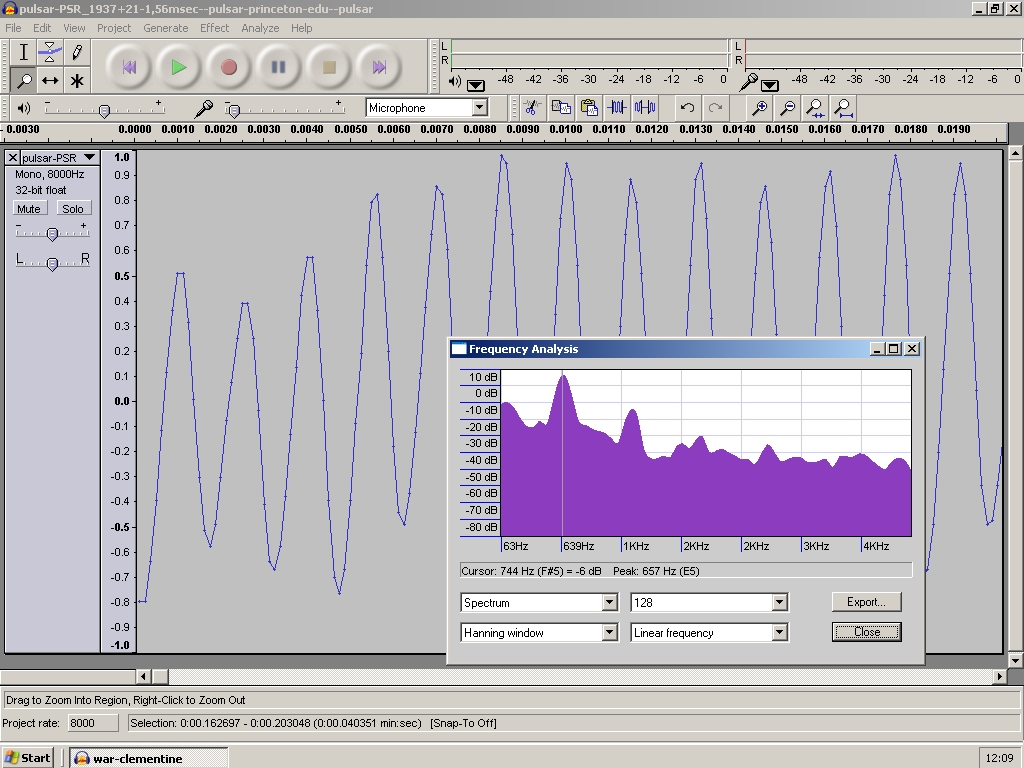
fastest millisecond pulsar, PSR 1937+21 rotating with a period of 1.56
ms or 641 times a second. The surface of this star is moving at about
1/7 of the velocity of light ! Its FFT
shows the period (~657 Hz). Recorded at Jodrell Bank,
FTT by T.Lombry. |
|
|
843
KB |
16
among the 22 millisecond pulsars discovered in the globular
cluster 47 Tucanae. Their period is ranging between 2 and 8 ms. Recorded at Jodrell Bank |
|
|
843
KB |
A
sequence of the pulsar sounds discovered in 47 Tuc as they
sound due to intensity variation caused by scintillation. Recorded at Jodrell Bank |
|
|
391
KB |
The
pulsar CP0834, rotating with a period of 1.2738 s. Recorded
at Arecibo at 111 MHz. An example of weak signal good for DSP. |
|
|
314
KB |
Pattern
of an individual pulse (in theory 1.56ms or 623 Hz) of PSR 1937+21. Signal
processed with AVS
and Audacity. For more info about this
microstructure see Jodrell
Bank. To not confuse with a false pattern as below. |
|
|
294
KB |
False
pattern identified in an individual pulse (89.3 ms) of PSR
0833-45 recorded at Jodrell
Bank. Signal processed with AVS.
Together, the compressed audio file (.AU format) and this
cheap DSP program introduced some
"artificial" artifacts during processing (similar to
patterns that we can see in a compressed JPG image) that are
not related to the sampling or the quality of the raw data.
This can easily be seen by doing an FFT using Adobe
Audition (ex-Cool Edit Pro) or even
MatLab. |
Back to Radio
Astronomy - Back
to Download
|