|
|
|
The History of Amateur Radio
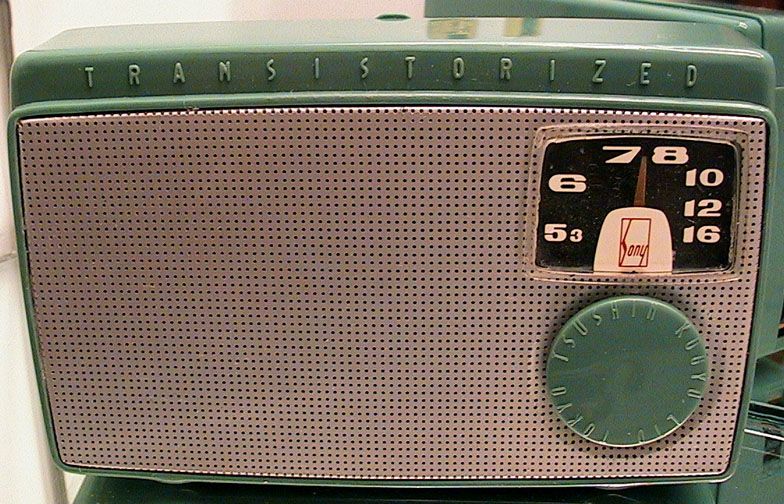
The 1950s : The King Transistor (X) In 1950, the first transistors were developed at Bell Labs and the military were immediately informed of this discovery. Next year, in the same time as the DNA discovery, the junction transistor was developed. Bell offered his licenses to other companies for $25,000, really not much when, in restrospect, we know the extension that had this technology up to date. In 1953, for the first time transistors were use in a commercial product, for hearing aids. In 1954, Texas Instrument USA had bought the Bell license and wanted to create a fun product that pleased to all the nation. In a flash of genius they used the transistors to manufacture the first hand-held radio, forging its nickname of "transistor". The first model was Texas Instrument Regency TR1, the left most model displayed above near other competitors, a portable radio 12 cm high (5") using four germanium transistors. Quickly sold out it was no more manufactured but another japanese company, Tokyo Tsushin Kogyo sold a new model TR-55 that entered the US and European markets in Spring 1955. From a pure marketing point of view, the japanese brand brought a name hard to pronounce and to remember for Occidental people. The company choosed to name his new line of products "Sonus", meaning sound in latin. But after a while M.Ibuka and his partner Akio Morita changed it in "Sony". A young, dynamic and very agressive company was born. You know the rest of the story. For your information, in 2004 revenues (ttm) of Sony Corp., SNE, reached approx. $70 billions for a gross profit of $20 billions, his annual earning growth exceeded 735%, with 16% of his shares held by institutions and insiders. Not only Sony became a major company represented worldwide including to the small dealer located down to your street, but he has extended his know-how in all personal and domestic activities : computing, imaging, audio, video, television, wireless network, robotic, and more. As they say themselves, welcome to the world of Sony ! Today more than 50 years after its invention, more than half of the world population has a transistor, so about 3 billions people.
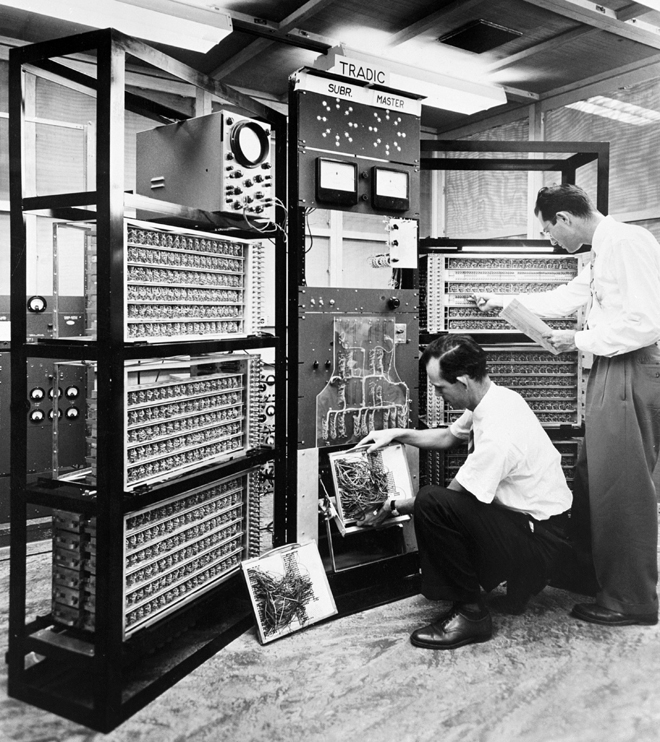
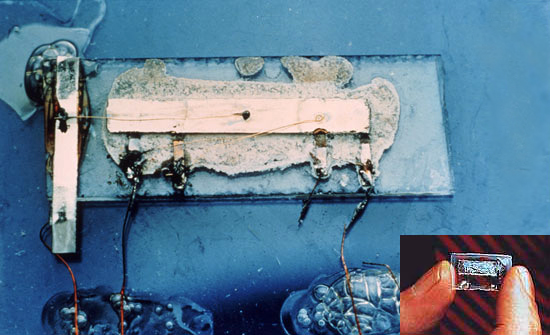
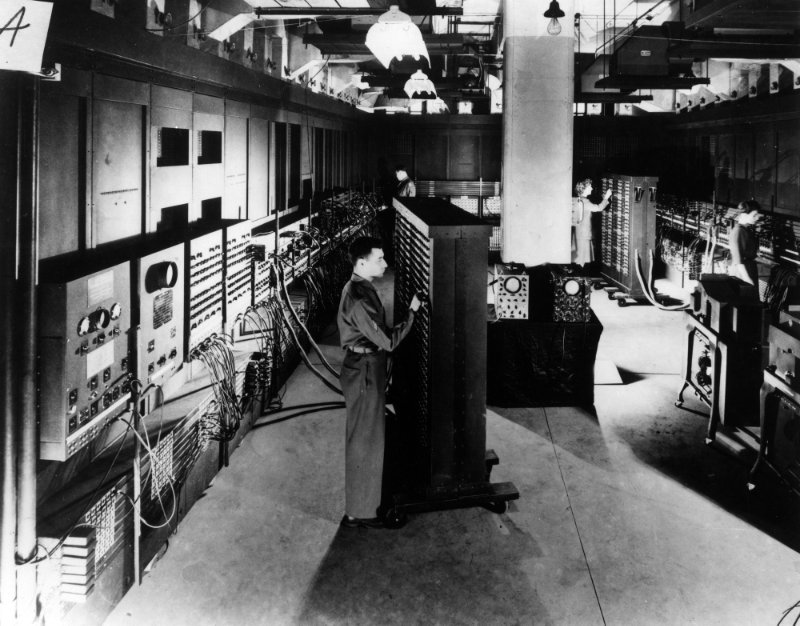
In January 1954, supported by military, the prolific engineers at Bell Labs built the first computer using no vacuum tubes, the TRADIC (standing for TRAnsistorized DIgital Computer). For the public this electronic machine looked like a magic box of about a cubic meter (27 cubic feet), more than 300 times smaller than the famous vaccuum tube computer ENIAC ! TRADIC contained approximatively 800 point-contact transistors and 10,000 germanium crystal rectifiers where ENIAC used 18000 vaccuum tubes ! TRADIC could perform a million operations per second, quasi as fast as the vacuum tube computer to date, and last but not least it operated on less than 100 watts of power. Only drawback a transistor was 20 more expensive than a tube, $20 vs. $1. But in respect to the Moore Law saying that the price of electronic components decreases by half each 18 months if not faster, it was sure that the price of the next computer should decrease, it was only a question of time. In all cases the micro-computing was in sight. Above H.Felker (kneeled down) give instructions to the TRADIC by means of a plug-in unit while J. R. Harris places data into the computer by flipping simple switches. The first integrated circuit In 1957, a new startup company set up, Fairchild Semiconductor. As its name stated it specialized in building semiconductors, and wanted to build what they called "unitary circuits", the future chips. In 1958, Jack Kilby from Texas Intruments invented the first monolithic integrated circuit. A semiconductor device was mounted in a hermetically sealed unit together with resistors and capacitors constituting an electronic circuit. The connections between the various components were made by soldering leads to tiny wires internally as shown on the picture displayed at right. J.Kilby won the Nobel price of Physics in 2000. The next year, R.Noyce from Fairchild Semiconductor had another idea and starting from the individual components arrived to insert a whole circuit in a single chip too.The patent office awarded Noyce invention while historians recognized the paternity of the discovery to both inventors as they individually conceived of the IC idea.
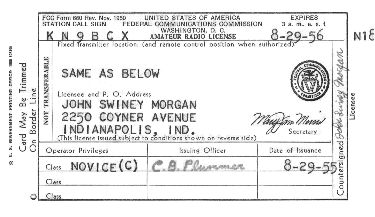
In 1961, Fairchild Semiconductor built the first integrated-circuit transistor. They received the first patent for a commercially available silicon IC on 25th of April 1961. About Novice license in the USA and Canada In 1951, FCC instituted a new licence structure organized in three classes : the Novice, Technician and Extra, along with name changes of the old class A, B, C licenses to Advanced, General and Conditional, respectively.
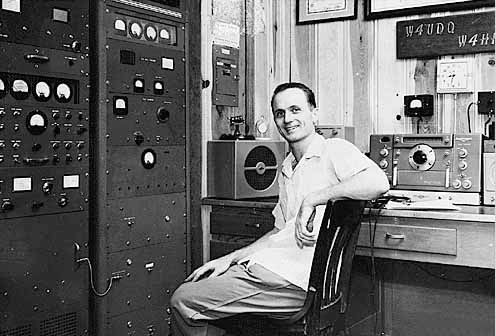
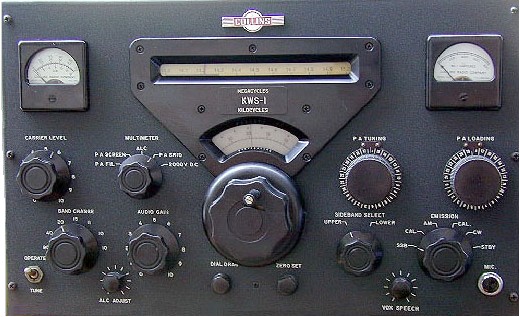
Next year, FCC changed again the rules. No new Advanced licenses will be issued and the special phone privilege on HF attributed to Advanced and Extra licenses were withdrawn, the other privilege remaining unchanged. In 1953, unlike in other countries, FCC allowed to Novices to transmit in CW in a segment of two HF bands as well as in a segment on 2 meters. The radioelectricity examination was a simple test quite easy to succeed. Hopefully on all VHF bands and up the code speed was reduced from 13 to 5 WPM at the great relief of Novices. ARRL released the first "Novice Licence Manual" to help Novice candidates to get prepared to the examination. Technicians received privileges on 6 meters in 1955 and on 2 meters in 1959. But all V/UHF licenses were associated the mandatory Morse code, even if this time it was reduced at 5 WPM. And with time US hams were used to see their regulation changed every ten years or so by FCC. It was scarely negative and even often in favor of a better protection of hams. The Canada didn't follow these changes immediately and they didn't introduce a Novice license yet. Licensed were first delivered by the Ministery of Transport, who became the Ministery of Communications-Canada then Industrie-Canada in the '90s. In the 50's full privilege canadian amateurs could work in CW at 15 WPM on all bands and in phone from 50 MHz and up. After a 6-month delay and the proof of CW contacts (thanks to his log book and QSLs) amateurs could ask the endorsement of their license on the 10-meter band too. These requirements were then remove. In Europe, at that time there was often two types of licenses, telephony and telegraphy, this latter requiring to reach not less than 15 WPM, whatever the band used. The good time... Today, when we speak with Old Timers who were active after WW II, it looks like if we do not belong to the same world... During the "transistor" years and the ones of Rock'n Roll most amateurs continued to work with gears equipped with vacuum tubes, oscillating detectors, and AM transceivers. SSB and the first transistored transceivers (1952) were rising at the horizon but were not in fashion yet. Till then the best way to modulate a carrier in amplitude was in modulating the plate with a class B modulator. Today only the OT still understand this language, Hi ! At that time amateurs didn't use to work on all bands from 160 to 2m as nowadays neither. The most used bands were the 75-80 meters, and thus often limited to regional QSOs. The OM exploring the 40, 20 and 10 meters were often considered as genius. Amateurs working on the 2-meter band look like plumbers, as their resonating circuits were most of the time made of parallel lines built from copper tubing used by plumbers ! The ham shack of these OM was constituted of bulky receiver, transmitter, power supply, wattmeter, preamplifier, and other amplifier often set up on cumbersome racks like Paul Wilson's impressive installation displayed below.
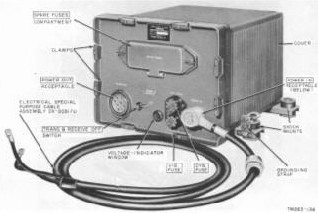
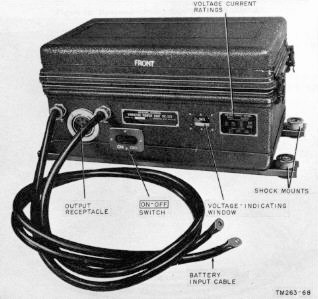
It was also a good time to become a high speed CWer or a skilled radio-teletype operator (RTTY). The '50s see the first transmissions in slow-scan television (SSTV) and facsimile (APT) using a thermal paper that gave off a strong smell of burning. This last device was still in use in some remote military airbase in the '80s to receive weather maps, I know something about it ! Mobile stations worked already well since the first test of Marconi. Of course amateurs worked only on HF and mainly on the 80-meter band. It was the time of "dynamotors" and "vibrators" power supplies that delivered the require high voltage to mobile stations as well as to some base stations. And high was the voltage ! The HV was ranging between 100 volts and a few thousands volts, depending on the output power ! Like fifty years earlier amateurs had to use these infernal power systems with a great caution at the risk to rejoin quickly the Silent keys family... and some OT experimented severe accidents (HV discharges) in their flesh. To wonder how they are still alive ! There is only one explanation : if they respected some security rules, they were especially lucky ! New licenses in Japan Before 1951 (before the War), there were about 300 licensed radio amateurs in Japan. They had to visit the Regional Bureau of Telecommunications to take exam individually. In 1951 the first amateur band allocation went into effect and the first national exam to license radio amateurs was implemented. There was two types of licenses : Grade I (full privileges) and Grade II (phone only, 100 W maximum). Today, Japanese call these licenses the "Old Classes". In July 1952, JARL resumed his activities and 30 Japan amateur radio stations were granted provisional licenses. But we had to wait until 1959 to see the implementation of the first national exams for radio amateurs and the introduction of two "New classes" : Phone and CW with a maximum output power of 10 W. This event spurred a rapid increase in the number of amateur radio enthusiasts, and within a mere two years the number of Japan amateur stations reached 2,000, the growth rate exceeding 6 times what it was before the war ! Meanwhile, on September 8, 1951 was signed the San Francisco Peace Treaty between Allied Powers and Japan that entered into force on April 28, 1952. But many Asian countries refused to participate for a simple reason : the Allied Powers waived all reparations claims for war damages, although it is one of the rights that are commonly recognized under international law against an aggressor state... The Japan might not become a new Power. But it is another debate. Since that time, within two generations Japan became in spite of everything one of the major Powers in the world. We will see how far it has progressed in the '90s. Captain, Old Man on the bridge !
In 1953, during a severe tempest that blew over the North Sea, the radio-lighthouse of the coastal Humber Radio station, on the western coast of Great Britain was suddently silent as it was relaying the urgent message sent by a boat; it was cut off the world by the hurricane as well as by radio. An English amateur listening by noticed that something went wrong and, after some moment of hesitation, tuned his transmitter on the distress frequency and began to relay the message. In the middle of the tempest that drove away the lighthouse-ships, he ensured the link with all boats calling desperately the Humber Radio, advising the companies on the status of their ships, and saved several streamers and other boats. This last several days. This event occured in the country the most confident in its maritime and communication networks. Some months earlier, the "Radio Amateur's Emergency Network" (today the "Old Womens Institute") had offered his participation to aid organisations. "This cannot happen here", one answered him. Today the RSGB's RAYNET (Radio Amateurs Emergency Network) works in co-operation with civilian authorities as do the French authorities which "Plan ORSEC" is managed in co-operation with the REF amateur union or like in Belgium where the Red Cross works in co-operation with the belgian IARU society, UBA.
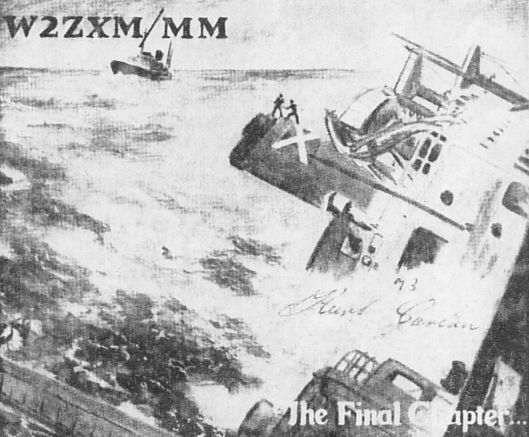
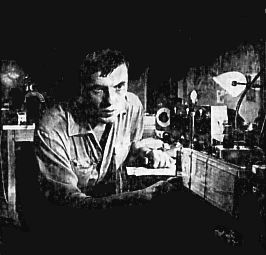
Unfortunately such rescue stories count by hundreds. Recall simply the story of the "Saint Didier" airplane, F-ALH, that crashed in Hoggar desert in 1928 during a long-distance trek. Thanks to the onboard amateur station belonged to F8KW, a French amateur heard his message and relayed it to the Air ministry. All ended well thanks to the collaboration of Algerian amateurs among them FM8IH. Another time, during Christmas 1939, a French radio amateur heard an emergency call from ZS9F requesting assistance to save two hunters wounded by a leopard in the Jungle of North Rhodesia (Kenya). The message was relayed by an American amateur from Fairhaven, Mass., who heard better the Kenyan operator. After have been rescued, as thanks the hunter sent the skin of the leopard to the French amateur, closing his message with this words "Vive la France". Late 1951 at last, US Captain Carlsens, W2ZXM/MM, from the "Flying Enterprise" ship was took in a tempest in the Atlantic ocean, and tried to save his freight of zirconium, a scarce metal used in US atomic submarines. This "Captain Courage" asked all his crew to give up the ship, and he stayed alone onboard during fourteen days, then the wreck sank. Carlsen was rescued. Si tous les gars du monde... In 1956, the French director Christian Jaque and Henri Georges Clouzot released a drama film entitled "Si tous les gars du monde" (If all guys of the world). This film last 1h50m and told the story of the commander of a trawler in trouble at sea whose crew was saved by radio amateurs. It was played by the French actors André Valmy, Jean Gaven, Marc Cassot and Georges Poujouly. Although this film included no plot, no crime and no stars but only young actors, it became a success of the box office because of the directing work of Christian Jaque. Desiring to made an authentic and moving film, he made use of the modest but real ham shack of the French F8YT; the amateur transceiver of the "Lutèce", the tuna boat of Concarneau, Britain, was the transceiver used by another tuna boat from the same harbor; dialogues, technical expressions, and all details were as per the everyday reality. To watch : Si tous les gars du monde (Fr)
This is surely this concern of the truth that brought an inimitable accent to this production which contributed to make know to the public the activities of radio amateurs, always ready to help, with the means at their disposal, other people in peril of their life or in distress. First Transatlantic Telephone cable On September 25, 1956, TAT-1, the first Transatlantic Telephone cable went into operation. It was inaugurated with a conversation between the head of AT&T and the British Postmaster General. In all, seven transatlantic coax systems were laid before the switch was made to fiber optics. Next chapter Echoes from Moonbounce to Sputnik
|
||||||||||||||||||||||||||||||||||||||