|
|
|
The radio propagation
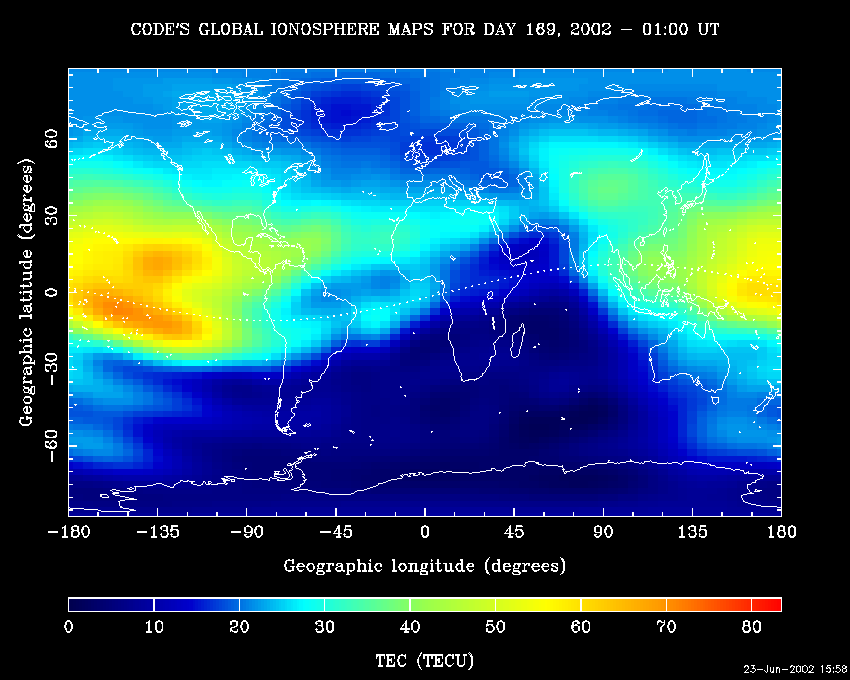
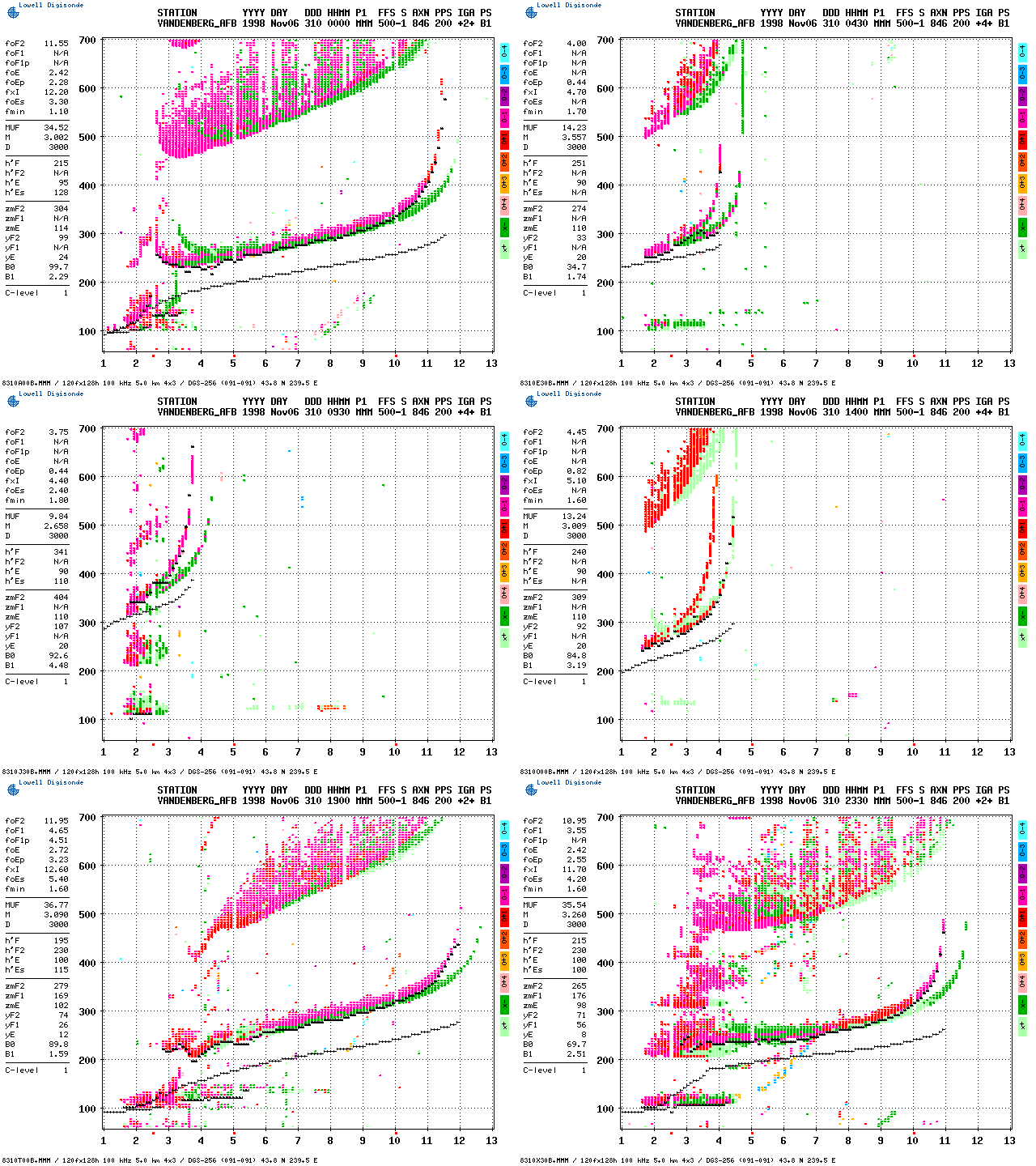
Traffic via ionospheric layers (III) Electromagnetic properties of the ionosphere are amazing. Thanks to Marconi invention, using shortwaves between 1.8 and 30 MHz we can communicate as easily or almost with an amateur located at one hundred km away than with another one located ten thousands km away ! And all this using only electromagnetic waves, a few watts of power, a good antenna and goodwilling of dame Nature ! Many thanks, Madame ! But what is the structure of this ionosphere that interest us so much for more than a century ? Components of the solar emissions described previously tend to be deposited at different altitude and therefore create an horizontally stratified medium where each layer has a peak density and, to some degree, a definable width, or profile. The density of these layers increases roughly parabolically with altitude, with densities starting at essentially zero at stratospheric altitudes (~70 km aloft) and rising to a peak at about 300 km aloft. The shape of the ionized layer is often referred to as a "Chapman function" which shape is somewhat elongated on the top side as displayed on the sounding at right. These layers are identified by letters D, E, F1 and F2, (F at night) in order of their altitude above ground. Contrarily to a metallic surface that shows an uniform electron density and reflects totally of not at all waves, the ionosphere shows a refractive index that affects the wave velocity according the altitude until the critical frequency of the layer (the plasma resonance frequency) is reached. Of course if the working frequency is above the critical frequency (the cut-off frequency) the wave is never reflected and can penetrate the ionosphere and escape into space. Otherwhise, below and at the critical frequency of the concerned ionospheric layer, the incident energy is re-radiated by electrons, permitting to establish radio communications. Due to their importance for shortwave transmissions, since the years '60s the status of ionospheric layers are monitored in real-time between 0.1-30 MHz by souding techniques and satellites and were recently available to the ham community and other concerned groups through the web (e.g. at SEC/NOAA). Radio amateurs take advantage of these ionospheric layers and other properties of the low atmosphere to establish communications with remote stations. I have listed below 18 types of traffic. Let's describe each of them. Traffic via the F-layer The F-layer, located near 300 km aloft, is subdivided at daytime in F1 and F2. These two layers are responsible for most long distance contacts (DX).
A few hours after the sunset, F1 and F2-layers merge into the F-layer. If it nominal height is close to 300 km, its maximum height over the equatorcan reach 700 km of altitude. The propagation via the F-layer is limited to wavelengths up to around 15 m, occasionally 12 m due to the decreasing of the cut-off frequency. At daytime the F1-layer is able to reflect radio waves up to wavelengths of about 30 m, but not shorter. Its F2 counterpart is the most ionized around 1 hour after the sunrise and remains so until sunset. It shows however a great variability due to its sensitivity to the solar activity and becomes a "daytime band" during the minima of the sun activity. The F2-layer is the most used during winter months where radio waves up to wavelengths of 12 m or even 4 m can be used during periods of solar maximum activity to reach DX countries. It is the most used by the 15 m band and is regularly accessible in the 20 m band offering some exciting DX. When ionization decreases long distance transmissions are also possible in the 40 m band. Skip, hop and mode Say some words about the skip distance that we will review again when we will speak about DX activities for an SWL. When working at short distance around any radio transmitter station there is a "blind zone", silent, called the "skip zone". Its name comes after the fact that this zone is skipped over by waves. It cannot normally be worked by either ground waves or sky waves. A QSO is possible between two stations at the condition that the working frequency is less or equal to the Maximum Usable Frequency (the MUF) for the 3000-km circuit, over which waves escape into space instead of being reflected to the ground. The MUF also depends on the obliquity factor Q which must be greater than or equal to the quotient Working frequency/Critical frequency. For example, using sky waves, for a one-hop propagation via the F-layer on 14 MHz, if Q = 2 for a path greater or equal to 1000 km, that means that the critical frequency is only 7 MHz. You might work or hear stations located 1000 km away and more on 20m, but you might not work stations located closer than 1000 km. The 1000 km zone around your station is called the skip zone. This situation is normal because the ionosphere is supposed to reflect all radio waves at frequencies less than the critical frequency when their incidence angle is vertical on the ionosphere. This is for this reason that oblique propagation (under low takeoff angle) enhances the ability of the ionosphere to reflect radio waves with a given frequency, and thus sometimes at working frequencies higher than the critical frequency. As this skip zone increases with the height of the ionospheric layer and that higher frequencies bend less that lower, this zone increases with the frequency. Depending on the frequency used and the wave incidence angle over the horizon, this zone can exceed 1500 km of radius. Consequently, to work with friends located at very short distances, say between a few tens to some hundreds of km away, it is recommended to use VHF bands or optionally HF frequencies above 27 MHz or, conversely, much longer waves like the 75, 80 or 160 m band that doesn't show a skip zone. In-between your correspondent will be very weak or straight out inaudible. This skip zone can only be reached by intermittence using backscatter propagation (see later), a phenomenon linked to the waves reflection by the F2-layer at various angles and specially backward, toward a region just surrounding the transmitter station. Backscatter signals sound usually like "hollow" or "barrel" sound originating from the silent zone. To read : Radar Systems on Shortwave (OTH radar), IARU, 2013
There is also another way to exceed the maximum distance allowed by the F2-layer : the multi-hop propagation. When conditions are in favor of DX, bands open down to QRP stations, instead of working a near station in doing only one jump or a single "hop" via the F2-layer, we can reach far DX stations in doing several hops and break the skip distance wall of 1500 km on the higher frequencies. In using a very low incidence angle, if the first signal reflects well to the upper layers of the ionosphere and then impacts the ground far from your home, hop after hop this multihop propagation allows communications with stations located on the other side of the Earth. It is of course subject to fading and attenuation each time that the radio wave is reflected or partially refracted, but signals can also be stable with few attenuation if the ionospheric absorption is very weak. The famous "DX bands" between 20 and 15m are the best for this type of traffic. In these bands, even equipped with a wire antenna or a vertical and 100W PEP out, you can work stations located over 10000 km away, and, from Europe, work stations in the middle of the Pacific ocean if conditions are met. At last, as we just speak about the ionospheric F-layer and hop, it is great time to introduce the concept of propagation mode, to not confuse with the modulation mode like CW or SSB. A propagation mode is the path that radio wave takes when travelling between a transmitter and a receiver. These paths are many and various, via the E-layer, Es-layer, F-layer, even mixed, etc. Then each mode is associated to a certain number of hop to establish the contact : one hop via the F1-layer is listed as 1F, two hops via the F2-layer is listed 2F2, etc. Remember also the higher the order of the mode (or the more hops it has, 3F, 4F,...), the lower its signal strength. Indeed each reflection of a radio wave at either the ground or ionosphere results in loss of energy. One considers that a typical ground reflection losses for DX hops (long distance and low elevation angles) are 3 dB for a poorly conducting ground and 0.5 dB for reflection from the sea, without to mention that the E-layer is a much poorer reflector than the F-layer for example. When we know that a loss of 3 dB represents a decreasing of half (50%) of the signal strength, you quickly understand all the interest of working near the sea and using an antenna offering a very low takeoff angle... We will come back on these concepts on other pages dealing with antenna properties and performances. Traffic via the E-layer
This layer located near 110 km of altitude sees its density follow strictly the sunspots cycle. It is also a sporadic layer which plasma clouds move up tot 400 km/h, disturbing telecommunications over a wide area of the earth. This layer tends to disappear at night as the next animation shows very well but it can remain almost as dense as the D-layer at daytime. The E-layer is mainly accessible between the 40 and 15 m bands. On the highest frequencies (VHF) this layer authorizes local or regional QSOs in very good conditions up to 2000 km. Traffic via the D-layer This layer should be better name "D-Region" as it extends over 50 km of altitude. Located near 90 km aloft, it shows a mean density 100 times less than the F-layer. It remains however a major obstacle after chromospheric solar eruptions and coronal mass ejections (CME), a subject that we will discuss in another page dealing with ionospheric perturbations. The D-layer is know to absorb radio waves at daytime in the 160-40 m bands, and thus to reduce the propagation while the sun is above the horizon. Only regional QSOs are possible at daytime but with much noise. Conversely, it is interesting to note that during a total eclipse of sun, stations working on low bands and located around the line of centrality see their signal strength amplified over 30 dB on 160 meters and up to 15 dB on 80 meters for a period that can exceed 1 hour. The D-layer absorption does not strictly follows the solar activity, or at least not its surface activity known through its sunspots. We can easily simulate what happens using a propagation analysis program like PropLab Pro. At daytime, on 160m, along a single-hop path of about 1000 km, the absorption starts at about 60 dB when the solar activity is the quietest (no sunspot, smoothed sunspot number SSN<10) and it doesn't change to about a SSN of 50. This constant absorption level is the main source of the quiet daytime D-region. Then the absorption climbs to 100 dB for a SSN of 150. In fact, above a SSN of 50, hard solar X-rays start contributing to the absorption as the Sun becomes more active. In such conditions, do even not imagine to work DX stations at daytime. The D-layer does not intervene in DX, excepting at night where it opens and disappears allowing radio waves to reach the F-layer around 250 km aloft. The 40 m band is practically open 24h a day as all upper bands from 30 m allowing very confortable QSOs up distances to about 2000 km. Next chapter Propagation conditions on bands
|
|||||||||||||||||||||||||