|
|
|
The Kenwood TS-570D(G) transceiver Communication aids (III) Beside the RIT/XIT useful to work in split mode, the TS-570D equalizer works also very well, both in emission and reception. The TX equalizer is customizable via the Menu #14 with 5 different receive profiles, emphasing higher or lower frequencies. When set correctly your correspondent can copy in better conditions some high sounding signals. The effect is however not important.
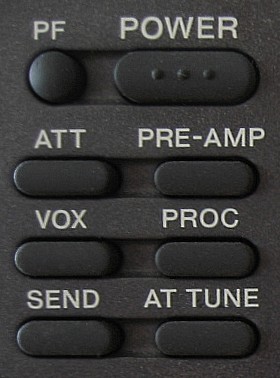
Emission side, another communication aid is the speech processor (Menu #15). It is able to level the average transmit output power in raising low power together with the voice compression adjustment in order your correspondent hear you easier without impression of fading. Of course this compressor does not increase your emitting power... (check your SWR-meter if you doubt). The default value is 10 over 25 and offers an excellent modulation. At last, when emitting the VOX button helps you in suppressing the need of manually switching to the transmit mode (SEND or PTT button) each time you want to communicate. Some users like this feature, other don't, all depending on how fast it is set. However the VOX delay, like the CW key delay, are fixed and cannot be changed separately. By default the current setting is 50 ms but you can increase it to 3000 ms. It should be nice to separate the two settings as the voice drops more rapidely off than the CW that switches back to RX in between characters if you are not fast enough. The only other solution is to switch on the SEND button an using your standard PTT... The VOX gain is also adjustable between 0-9, set at 4 by default as well as the microphone gain for FM mode than can be set to Low or High. Settings and memories What this transceiver cannot do ? It is clever, it speaks, displays messages on screen and listen to you. There is not many things it cannot do. It can't set different modes, changing from CW to SSB as you moved from one part of the band to another. But it stores this information when changing of band which is the most useful As we told earlier, all settings are stored in memory, you have acces to 100 "channels" to store specific frequencies, all mode settings per band and a second VFO stored in memory and quickly accessible. All these data can be recall and displayed on the large LCD screen using the Menu button together with the multifunctional MULTI CH button. To be familiar with the channel memories you have however to read and re-read the concerned section in the manual a few times. At first readings the procedure seems quite complex, and it is, a bit like the first time you have to set your VCR; you have to learn playing with several push-buttons but after a while that becomes a reflex. To set up the TS-570D memory channels : Memori A software by OH2KXO A software by PP1ETL Three memories are also able to handle phone or CW messages. The first accepts a 30-second message that you can then transfer on the air by pushing a button while the CW memories, as we have seen, accept only a short 50 characters. But what a help during pile-ups instead of loosing you voice after an hour of unsuccessful calls !...
Antenna tuner
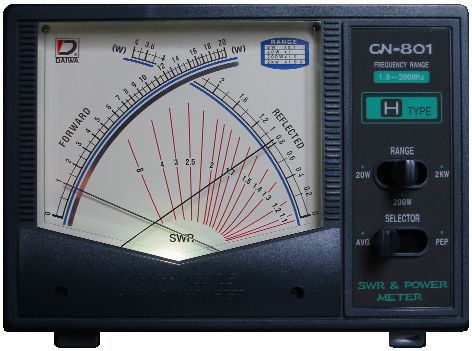
Among the other useful tools, the automatic Antenna Tuner (AT TUNE) is a great option. It emits less that 1 W to the antenna in CW mode, a so weak and intermittent signal that it cannot damage any device, even a receive antenna. Some amateurs complain that they could not tune with some linear amplifiers. In fact Kenwood engineers insist on the fact their transceiver requests at least 13.8 V to work properly and get 100 W out. For other values, and specially using the Tuner in, you could loss 1 dB in output, some 20 W or more if you cannot match to the load. So if you cannot accommodate with this voltage, you can loss a couple-hundred watts or so for the antenna... The built-in Antenna tuner does a very good job. Pressing the AT TUNE button during about 1 second it enters in a tuning mode and you hear clics. This is not a malfunction as I believed the first time I heard them ! The sound of the system means it is trying to find the optimal position for its capacitors. During these few seconds it tries to match to the load. If it can't match below SWR 2.5:1 after about 20 seconds its warns you with morse code S-W-R and gives up where other high-end transceivers resume. You can however retry tuning. If you work in such conditions, the TS-570D protection circuit will activate. But as wrote Kenwood "do not rely on this protection to compensate for a poorly functioning antenna system". It is preferable to not using an untuned aerial offering a SWR above 3:1 or so instead of generating high current and sometimes interferences with consumer products or even with your own transceiver, or burning the cabling system or maybe worse. NB. This is not because your built-in SWR-meter shows an excellent SWR of 1:1 that your transmitter or your linear sends all its power to your antenna. Check the forward and reflected power on an external SWR-meter to avoid bad surprises. Other advantage of the built-in antenna tuner, TS-570D keeps in memory all its settings per band, including the matching for 2 antennas. This is very useful if like me you have two QTH and portable installations or if you use two kinds of antennas, one for low bands, another one for 20m and above. Settings for 18 sub-bands can in this way be stored in memory. FYI, the antenna tuner does not match outside the official amateur bands. But of course, as usual if your national regulation allows you to work in emission in bands locked by Kenwood, you can use a screwdrive and a soldering iron to suppress these limitations, at your risks. Diagrams and explanations are available on the Internet. External antenna tuner To tune automatically your antenna, optimize your emitting power and get the lowest VSWR, you would be well-advised to use an external antenna tuner like the famous Kenwood AT-100. Such devices are even recommended to use some multi-band antennas. Output power At last, the emitting power level is adjustable from the front panel (POWER + DOWN/UP buttons) by step of 5 W between 5 W QRP to the nominal 100 W PEP in SSB or 25 W maximum in AM, but you cannot set the power level for each band. This rating is the power going out of your transceiver PA stage, not yet the power radiated by your antenna ! So contrarily to other older transceivers I worked with, the true emitting power of the TS-570D is far to reach the 100 W PEP, even using a dipole perfectly cut, a Cushcraft R7 vertical or a Fritzel tri-bander beam. Reading my external Daiwa CN-801H SWR-meter, the peak power reaches with difficulties 80 W PEP in CW and about 60 W at best using a beam, in average reading in SSB. I asked Kenwood to check the transceiver in their repair desk. They concluded, worksheet as proof, that all worked correctly; in their office connected to a dummy load the TS-570D sustains well its power of 5, 25, 50 or 100 W ±15% PEP. However, I can tell them, and other friends using this rig can confirm, that in the field this transceiver radiates up to 40% less power compared to other 100 W RTX from Kenwood. The best proof is that working on the air, during the minimum of the solar activity, I had sometimes difficulties to reach the eastern coast of the USA or even near countries whereas using an older RTX I worked these OM without problem, or almost. Some of my friends have thus decided to use a small linear amplifier 200-300 W PEP out to balance its lack of power. In the meantime I also bought a linear. The difference is light but enough to work or not work a station. However, I have to moderate this observation. In fact I observed currently the same behaviour using some recent high-end transceivers from Yaesu. Therefore I can conclude now that if indeed the TS-570D serie meets its specifications on a testing ground, in the field the previous generation of transceivers available until 2004 offered a stronger output signal. To read : Check your transmitter power TS-570D Power measurement (21 KB XLS file) Oscillator For digital mode a drift of the transceiver is noticable due to a heat build up during the first hour or two of operation. Indeed as all electronic devices in operation, this transceiver becomes quite warm after say 30 minutes of QSO, and the standard crystal oscillator gives a 50 Hz drift on 28 MHz over a 90 minute period of receive, at room temperature. All manufacturers using similar products, this drift is probably not worse than other similar transceivers. But good news, this problem can be solved in installing the optional temperature compensated crystal oscillator SO-2, that reduces this drift to as little as 2 Hz.
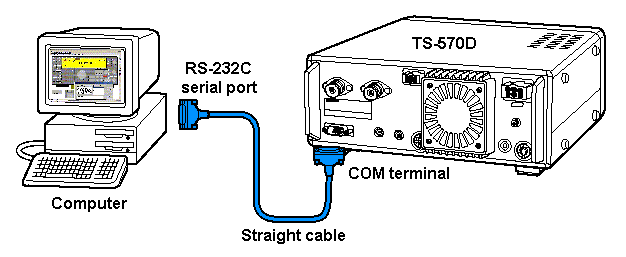
CAT and peripherals At last, like all digital gears, the Kenwood TS-570D serie is able to communicate with another transceiver, a computer or even a dumb terminal by using an RS-232 serial cable terminated with a female 9-pin connector.
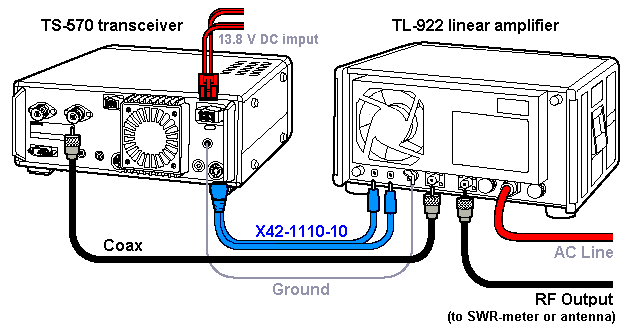
But here several solutions are available. If you want to transfer data to another Kenwood transceiver (e.g. to another TS-570D) you must use a cross-wired serial cable. If you insert an interface unit (e.g.. IF-232C) in the circuit, to connect for example to a TS-450S, 690S, 850S or 950SDX, you need an optional straight cable between the interface and the second transceiver. To connect your tranceiver to a computer you need a straight DB9 female/female cable. Only 3 lines of the serial port are required theoretically to control the transceiver via the computer : transmit data (pin-2), receive data (pin-3) and the ground (pin-5). But for practical reasons, specially to control data transfer, RTS-receive enable (pin-7) and CTS-transmit enable (pin-8) are also used. All this information is documented in the TS-570D/S Instruction Manual (p60, p70). For time to time Kenwood provides free on its ftp or http website a CAT program called "RCP2" to control the transceiver remotely. I provide you a copy of this program as its availability to Kenwood is not ensured. This is a 2 MB zip file mainly used to set filters and less accessible options. The software runs on most Windows 32-bit OS, including XP, and is supported by various logging and communications programs like CommCat, DX4Win, Logger, SwissLog, or WIN/Log EQF to name a few. At left, the RCP2 software from Kenwood running on my computer. This serial link works the same way on all Kenwood base stations (TS-570 series, TS-870S, TS-2000). Remember well that you must use a "direct" cable, not crossed, to address the VFO and memory channels with these programs. Linear Amplifier If you want to use an external linear amplifier with this transceiver, most of them, including the Kenwood TL-922 request to connect the ACL EXT and RL CONT cinch terminals to their outputs on the RTX. Note that without this link the amplifier will never switch in emission, a secure way to prevent overdriving tubes. But this mid-range transceiver has not such cinch terminals. Instead of using dedicated ACL and RL terminals, the TS-570D serie provides on its rear side a REMOTE plug (a 7-pin DIN connector) for that purpose. It must be used in conjunction with a modification of Menu #39 (Linear Amplifier Control Realy On/Off, providing a fast or slow AGC Time constant if your work in CW). The required cable is referenced X42-1110-10 and is available to any Kenwood dealer.
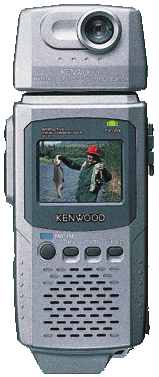
SSTV interface With Slow Scan TV (SSTV), you can transmit and receive still images by shortwaves. This mode is sensitive to fading and noise but used in good conditions your pictures can be free of QRM. The Kenwood TS-570 series have no mean to convert images in SSTV signals and vice versa but it can of course take advantage of external controller boards through their COM or data I/O port. For receiving SSTV signals you only need a SSTV software like MM-SSTV or ChromaPix and link your speaker output to the soundcard of your computer (in-line or mic input). To avoid any saturation of the sound board don't forget to check the level of audio of your PC and to decrease it a bit if necessary. In emission, as your transmitter does not include either a video interface nor an SSTV signal converter, you need to buy or build yourself the scan-converter (e.g. Kenwood Visual Communicator VC-H1, discontinued today, was sold $320). For a permanent installation, I suggest you to build yourself the interface; you will spare a lot of money. Otherwhise you can buy a multi-purposes interface like the RIGblaster for SSTV ($250), the Tigertronics SignaLink ($75) or even the small RASCAL GLX interface ($40), and optionally a digital camera (digicam or video camera) to create still digital images. The transceiver provides the COM and data ports suited to exchange data with the interface. By way of conclusion After have used this transceiver over one year, I can tell you that if you are not satisfied with the built-in DSP of TS-570D or even D(G), do not expect a miracle in selecting another mid-range competitor. This is probably the best of them at that time. But to be complete and objective, globally the TS-570D receiver module is not the best that Kenwood engineers have designed up to now, and other models, including to its competitors, equipped with more performing DSP filtering will give better results in receive. Thanks to a DSP working on the IF stage these transceivers largely exceed the TS-570D performances, what ARRL test labs confirmed too. However, on the air, you will recognize that the DSP features offered with this TS-570D cannot be bypassed as they provide a much better audio comfort than any other analog transceiver and many modern solid-states competitors. Complementary, the fact to be able to tailor all signals going in or going out the transceiver and even hear your own transmission if you want to is not a luxury. Saying that, this small transceiver is probably also as powerful as many expensive challengers, at least in emission, generating a very clear modulation. For its price, the Kenwood TS-570D transceiver is a winner, a world class transceiver that I warmly recommend to all users, young and older, mainly casual who does not every day work in conditions of heavy QRM, pile-ups or when bands as as crowded as the 40 meter on weekends... In all other circumstances this TS-570D transceiver is made for you ! Of course, as time goes by, new competitors appear even to Kenwood, to name e.g. TS-590SG released in 2014. Small is beautiful ! The "pluses" of the TS-570D(G) are: Perform in emission like any high-end model from Icom, Kenwood or Yaesu Size appropriated for portable or desktop operation Great look, excellent cosmetic, quality material, qualified servicing Predominance of digital processing, settings, scrolling messages, Vu-meter All settings are stored in memory and easy to recall Settings are easy to remember as there are displayed on the LCD with scrolling text messages TX functions complete, power adjustable, IF filters, SPLIT, RIT, F.LOCK Good performance of the dynamic microphone (stand or hand-held) Quality audio RX, built-in speaker pleasant to listen The audio DSP functions are efficient The RX provides an excellent and strong signal handling Additional filters are easy to install PL connectors for 2 aerials Built-in software supported by most loggers CAT program capabilities The "minuses" of the TS-570D(G) are : The emitting power does not meet expectations with a drop that can exceed 40% The emission power is very sensitive to voltage, 13.8V are mandatory or you lost up to 20% of power The battery change is long : it requests to remove 2 panels plus the front one, and to unscrew 20 screws although Kenwood could have placed it under the bottom cover as they do to modify filters. Hopefully one does not change the battery every day. Vu-meter includes several ratings but some are exclusives like the reading of Power/SWR or ALC/Compression The sensitivity and accuracy of the transmitter module can be improved by a 20-factor (hence the release on new models) DSP circuit placed on the AF stage what affects its performances (selectivity) Very few DSP filtering options (choice of bandpass filters limited, no Collins filters, etc) No Notch or IP button to reduce tunes or near QRM Several useful items are only accessible from the Menu and request to play with a few buttons The antenna tuner works only if SWR is 2.5:1 or lower (in most cases hopefully if your antenna is well cut for each band) There is a drift in digital mode due to head buil-up using the standard oscillator. The problem can be solved in installing the temperature compensated crystal oscillator
Maintenance The unique problem I ever had with the Kenwood TS-570D was a failure of a surge absorber (110 euros) and its attached capacitor and varistor that prevented me to work in emission (at 100 Watts PEP the signal dropped to S1 instead of S9+60 dB), a technical problem probably due to a static electricity discharge or while emitting in FM on upper bands. In the same time my antenna balun failed to work too. The second one is not a problem, but after 4 years of use, after a long power off (over 24 hr) the memory began to loose its settings and frequencies resetted to the begin of each band (e.g. 14.000.00 instead of standing where it was left). The small 3V battery located behind the front panel had to be replaced. TS-570D Specifications
For more information How to select a HF transceiver (on this site) Kenwood TS-570D/S Operating Manual (2.4 MB PDF) Kenwood TS-590S (see also eHam) that replaced TS-570D in 2010 Kenwood TS-590SG (see also eHam) that completed the TS-590S serie in 2014 (and till more performing) Memori (by OH2KXO) KSM by PP1ETL QST May 1999, ARRL QST January 1997, ARRL Mods, Tricks and other comments about Kenwood transceivers (include a special submenu for TS-570 series) A summary of this review was published on eHam.net on July 26, 2002 and immediately received a warm appreciation from american users that I thank warmly. Readers rate this model 4.6/5 while other transceivers get a higher score. Is there a better transceiver ? Of course, but all depends on your needs.
|
|||||||||||||||||||||||||||||||||||||||||||||||||||||||||||||||||||||||||||||||||||||||||||||||||||||||||||||||||||||||||||||||||||||||||||||||||||||||||||||||||||||||||||||||||||||||||||||||||||||||||||||||||||||||||||||||||||||||||||||||||||||||||||||||||||||||||||||||||||||||||||||||||||||||||||||||||||||||||||||||||||||||||||||||||||||